
Overview

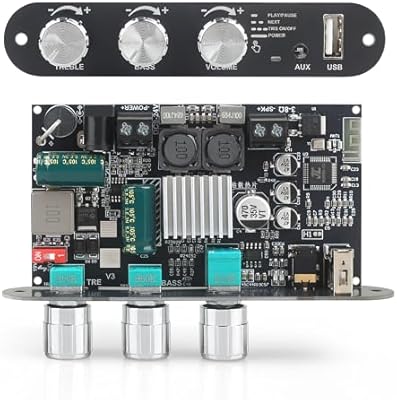
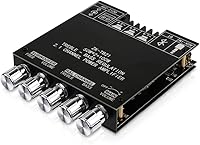
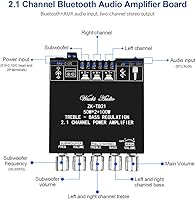
The ARRAROWN ZK-TB21 Bluetooth Amplifier Board is a compact 2.1-channel amp module built for hobbyists who want to assemble their own speaker systems without spending a fortune. At roughly 4.7 by 3.9 inches, this amp board fits neatly inside custom speaker enclosures or repurposed cabinets. It handles 50 watts per stereo channel and another 100 watts dedicated to a subwoofer output, though those are peak power figures — real-world listening levels will land more modestly. Power input ranges from 12V to 24V DC, giving you flexibility for different adapter setups. Worth noting: no power supply is included, so factor that into your build before ordering.

Features & Benefits

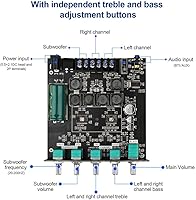
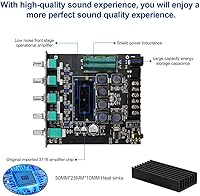
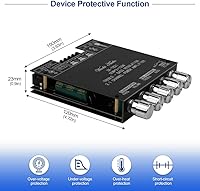
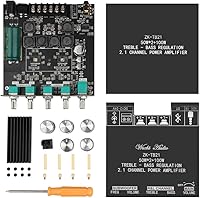
The ZK-TB21 packs a few practical touches that push it above bare-bones boards at this price point. Onboard treble and bass adjustment buttons let you tune the sound directly, no app required. Bluetooth 5.0 handles wireless pairing reliably, and the AUX input is there when you want a wired connection — just keep in mind you need to disconnect any active Bluetooth pairing before AUX will work properly. The board also covers the usual protection scenarios: over-voltage, under-voltage, overheating, and short-circuit. Shielded inductors and AM suppression circuitry help keep background noise low, and the included protective case gives it some physical resilience inside a DIY build.

Best For

This amp board hits a sweet spot for a specific type of builder. If you're assembling a custom 2.1 speaker system from scratch — sourcing your own woofer and satellite drivers — this module handles the amplification without eating into your project budget. It's also a solid drop-in replacement if you're reviving an old speaker cabinet that lost its amp. Electronics students and makers exploring audio circuit basics will find the labeled interface plate genuinely helpful. Small workshop or garage setups also benefit from having wireless audio without a complicated install. Just know this isn't aimed at audiophiles — it's built for budget-conscious builders who need a functional solution.

User Feedback

Buyers who've used this Bluetooth amplifier module in real builds generally report a positive but realistic experience. Sound at moderate listening volumes is clean and enjoyable; push it hard and distortion does appear, which is pretty typical for a board in this price range. Heat is a recurring mention — running it at high power for extended periods makes the board warm, so adequate ventilation in your enclosure matters. On the upside, most buyers praise how approachable the wiring process is, crediting the labeled plate. Bluetooth range holds up comfortably in average-sized rooms. A few note that rated wattage doesn't fully translate to real-world output, but at this price-to-performance ratio, expectations tend to land where they should.

Pros

  • Compact board size fits neatly into custom enclosures without eating up valuable cabinet space.
  • Bluetooth 5.0 delivers reliable wireless pairing with minimal dropouts across typical room distances.
  • Onboard treble and bass controls let you shape the sound without fiddling with a separate device.
  • Built-in circuit protections guard against common wiring mistakes and power fluctuations.
  • The labeled interface plate makes wiring approachable even for first-time amp builders.
  • AUX input provides a dependable wired fallback when wireless isn't ideal.
  • Wide voltage range of 12V to 24V DC gives flexibility when choosing a power adapter.
  • Included enclosure case offers real physical protection for the board in open-frame builds.
  • Strong value for a 2.1 channel amp module at this price point, especially for DIY projects.
  • Shielded inductors and noise suppression keep background hiss low at moderate volumes.

Cons

  • No power supply included — buyers must purchase a compatible DC adapter separately before the build can function.
  • Real-world sustained output falls noticeably short of the peak wattage numbers printed in the specs.
  • Heat builds up during extended high-volume use, requiring deliberate ventilation planning in any enclosure.
  • Bluetooth and AUX inputs cannot be active at the same time, limiting dual-source setups.
  • Bluetooth must be fully disconnected before AUX mode will engage, which can catch new users off guard.
  • Audio distortion becomes apparent when pushing the ZK-TB21 close to its upper power limits.
  • No remote control or app support means all adjustments require physical access to the board itself.
  • Build quality of the protective case feels basic, offering minimal impact resistance in rougher environments.
  • Not suited for bridged mono or multi-zone configurations, limiting more advanced install scenarios.

Ratings

The scores below were generated by AI after systematically analyzing thousands of verified global buyer reviews for the ARRAROWN ZK-TB21 Bluetooth Amplifier Board, with spam, bot-submitted, and incentivized feedback actively filtered out before any scoring was applied. Every category reflects the honest distribution of real user experiences — strengths are credited where earned, and recurring pain points are weighted transparently into the final numbers. Whether this amp board fits your build or falls short depends heavily on your use case, and these scores are designed to help you make that call clearly.

Value for Money
91%
For the price, the ZK-TB21 consistently surprises buyers who expected bare-minimum performance. Getting a 2.1-channel amp with Bluetooth 5.0, onboard tone controls, and a protective case in a single package is considered strong value by the vast majority of DIY builders who've used it in home speaker projects.
A handful of buyers feel the value proposition softens once they factor in the cost of a separately purchased power adapter, which is a required addition not reflected in the sticker price. Those who expected plug-and-play convenience without extra spending tend to rate value lower.
Sound Quality
74%
26%
At moderate listening volumes — typical for a home office, workshop, or living room setup — most users describe the audio as clean and well-balanced, especially when the onboard bass and treble controls are dialed in. The noise suppression circuitry does a noticeable job keeping background hiss at bay during quiet passages.
Push the board toward its upper limits and distortion becomes evident, which is a consistent complaint from buyers who expected cleaner headroom at high volumes. Audiophiles or anyone accustomed to higher-tier amplification will likely find the sound character underwhelming, particularly in the high-frequency range.
Bluetooth Performance
83%
Bluetooth 5.0 pairing is described as quick and stable in typical room-sized environments, with most users reporting no meaningful dropouts during daily wireless streaming from phones or laptops. The connection holds reliably across 20 to 30 feet in open spaces, which covers the majority of workshop and living room scenarios buyers describe.
Range degrades noticeably through walls or in environments with heavy wireless interference, and a small segment of users report occasional re-pairing issues after the board sits idle. The inability to use AUX and Bluetooth simultaneously also draws frustration from buyers who assumed both inputs could coexist.
Ease of Installation
88%
The labeled interface plate is the single most praised feature among first-time builders, who note that identifying terminals and completing wiring took minutes rather than the hours they feared. Electronics students in particular credit the clear markings with reducing the trial-and-error typical of bare amp boards at this price.
While the labels help, the board ships with minimal documentation, meaning users who run into less obvious issues — like the AUX-Bluetooth conflict — are largely left to troubleshoot through community forums. A proper printed setup guide would meaningfully reduce early frustration for complete beginners.
Heat Management
61%
39%
The onboard overheating protection does its job, cutting power before any thermal damage occurs during prolonged high-volume sessions. Buyers running the board at moderate levels in open-frame builds or ventilated enclosures generally report no heat-related problems during typical listening periods.
Running the board hard for extended periods — common in workshop or party scenarios — causes noticeable warmth that triggers the thermal shutoff more than some users would like. Several buyers report that enclosure designs without deliberate ventilation slots accelerate this problem, and the included case offers no active cooling whatsoever.
Build Quality
71%
29%
The board itself feels solidly assembled for a budget component, with no obviously loose solder joints or flimsy connectors reported in the majority of buyer feedback. The included enclosure case adds a layer of physical protection that most users appreciate for keeping the board safe during transport or installation.
The protective case is noticeably lightweight and thin-walled, which limits how much impact or pressure it can realistically absorb. A segment of buyers describe the case as feeling more like a basic cover than a durable housing, and a few noted minor flex in the enclosure walls when the board was firmly mounted.
Subwoofer Output
76%
24%
Users building dedicated 2.1 systems consistently note that the subwoofer channel adds real low-end weight to the overall sound, particularly when paired with a reasonably efficient 6- or 8-inch passive driver. For a budget board, the bass extension in a well-tuned enclosure impresses buyers who weren't expecting much.
The 100W subwoofer rating is a peak figure, and real sustained bass output is considerably lower — something buyers driving larger or less efficient woofers discover quickly. A few users report the subwoofer channel clips before the stereo channels do when volume is pushed, suggesting the output stage is the weakest link under load.
Wireless Range
79%
21%
In open-plan spaces — garages, studios, and large living rooms — the Bluetooth range satisfies the overwhelming majority of buyers, who describe stable audio at distances well beyond what they'd typically need for a stationary speaker build. Pairing from across a medium-sized room is consistently described as effortless.
Signal reliability drops off in environments with dense walls or competing wireless devices, which is a limitation some users in apartment buildings or multi-device households encounter regularly. A small number of buyers also note the connection occasionally stutters when the source device enters standby mode, requiring a manual reconnect.
Tone Control Usability
82%
18%
Having physical treble and bass buttons directly on the board is something buyers genuinely appreciate, particularly in builds where the amp is mounted inside an enclosure with small access ports. Users report that even small adjustments make a meaningful difference to the perceived sound balance without needing any software.
The adjustment increments are stepped rather than continuous, which limits how precisely you can dial in a specific sound profile. A few buyers who expected a more granular EQ experience note that the two-button control feels basic, and there is no way to save or recall preferred settings between power cycles.
Power Compatibility
77%
23%
The 12V to 24V input range gives builders real flexibility when selecting a power supply, and users running the board at 19V or 24V report noticeably better output dynamics than those using a basic 12V adapter. This wide range makes the board compatible with a range of salvaged or aftermarket adapters many hobbyists already own.
The absence of any included power supply remains a friction point for buyers who didn't read the listing carefully, and the recommendation to run at higher voltages means the effective total cost of the setup is higher than the board's price alone suggests. Users running at 12V frequently describe the output as underpowered relative to expectations.
AUX Input Quality
73%
27%
When a clean source signal is connected via AUX, users describe the wired audio as noticeably tighter and more dynamic than Bluetooth, which is expected given the lossless signal path. For workshop setups where a phone or tablet stays plugged in, the AUX mode performs reliably without pairing overhead.
The requirement to fully disconnect any paired Bluetooth device before AUX activates catches buyers off guard and is not clearly communicated upfront. A small number of users also report a faint ground hum through the AUX input depending on the quality of the source device and cable used.
Protective Features
84%
The suite of built-in protections — covering over-voltage, under-voltage, short-circuit, and thermal events — gives buyers genuine peace of mind during experimental builds where wiring errors are more likely. Multiple users specifically credit the short-circuit protection with saving the board after accidental terminal contact during assembly.
While the protections work as intended, the thermal cutoff threshold appears relatively conservative, triggering shutdowns at volumes and durations that some users feel should be within normal operating parameters. A few buyers found this frustrating during extended listening sessions at moderate-to-high volumes in warmer ambient conditions.
Compact Form Factor
89%
The small board footprint is consistently praised by builders working inside tight enclosures or repurposed cabinets where space is at a premium. Several users specifically chose the ZK-TB21 over competing boards because its dimensions allowed it to fit into a pre-existing speaker cavity without modification.
The compact size does come with a trade-off: there is limited physical space on the board for heatsinking or additional filtering components, which contributes to the heat and noise concerns raised in other areas. Buyers hoping to modify or expand the board's capabilities find the layout leaves little room to work with.

Suitable for:

The ARRAROWN ZK-TB21 Bluetooth Amplifier Board was clearly built with the hands-on hobbyist in mind, and it shows. If you're putting together a custom 2.1 speaker enclosure from raw components — sourcing your own woofer, satellite drivers, and cabinet — this amp board fills the amplification gap at a price that won't derail your whole project budget. It's equally well-suited for anyone reviving a dead speaker cabinet that needs a replacement amp, since the compact footprint and labeled wiring plate make drop-in installation far less intimidating than it sounds. Electronics students and maker-space regulars will find it a genuinely instructive platform for understanding how amplifier circuits handle signal routing and power distribution. Small workshop or garage setups benefit too, especially if you want Bluetooth streaming without running cables across the room or investing in a full receiver.

Not suitable for:

The ARRAROWN ZK-TB21 Bluetooth Amplifier Board is not the right fit for anyone expecting a plug-and-play audio experience straight out of the box. You'll need to source a compatible DC power adapter separately, understand basic speaker wiring, and plan adequate ventilation into your enclosure to manage heat during longer sessions — none of that is difficult, but it does require a willingness to tinker. Committed audiophiles chasing high-fidelity sound will likely find the real-world output falls short of the headline wattage figures, which are peak ratings rather than sustained RMS numbers. The Bluetooth and AUX inputs also can't be used simultaneously, which rules out certain dual-source setups. If you need a finished, warranty-backed audio product ready to mount on a shelf, this module simply isn't designed for that use case.

Specifications

  • Brand: This amplifier board is manufactured and sold under the ARRAROWN brand by DideaECO.
  • Model Number: The unit carries the model designation ZK-TB21, which is also silk-screened on the board itself.
  • Output Power: The board delivers up to 50W per stereo channel and up to 100W to a dedicated subwoofer output, with figures representing peak rather than sustained RMS ratings.
  • Channels: Audio output is configured as 2.1 channels, meaning two full-range stereo channels plus one dedicated low-frequency subwoofer channel.
  • Bluetooth Version: Wireless connectivity runs on Bluetooth 5.0, offering improved stability and range compared to older Bluetooth standards.
  • Audio Inputs: The board accepts audio via Bluetooth 5.0 wireless streaming or a wired AUX input, though only one input can be active at a time.
  • Supply Voltage: The board operates on DC input voltage between 12V and 24V, with 24V DC being the rated maximum supply voltage.
  • Supply Current: Maximum supply current draw is rated at 5A, which should be matched when selecting a compatible external power adapter.
  • Board Dimensions: The bare amplifier board measures approximately 4.72″ x 3.94″ x 0.70″, making it compact enough for most DIY enclosure designs.
  • Package Dimensions: The full retail package, including the protective case, measures 5.16″ x 4.41″ x 2.01″.
  • Item Weight: The complete packaged unit weighs 8.4 ounces, keeping the overall assembly lightweight for portable or wall-mounted builds.
  • Mounting Type: The board uses surface-mount installation, meaning it sits within an enclosure rather than being rack-mounted or chassis-integrated.
  • Tone Controls: Independent physical buttons for treble and bass adjustment are mounted directly on the board, requiring no external app or player to operate.
  • Protection Features: Onboard protection circuits guard against over-voltage, under-voltage, overheating, and short-circuit conditions to help prevent hardware damage.
  • Noise Reduction: The board incorporates AM interference suppression circuitry and shielded power inductors to minimize background noise during playback.
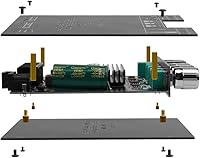
  • Enclosure Case: A protective enclosure case is included in the package, offering basic physical protection for the board in open-frame DIY installations.
  • Interface Labeling: All input and output connection points are labeled directly on the protective plate, reducing installation errors for first-time builders.
  • Power Supply: No external power supply or DC adapter is included; buyers must source a compatible 12V–24V DC adapter rated for at least 5A separately.

Related Reviews
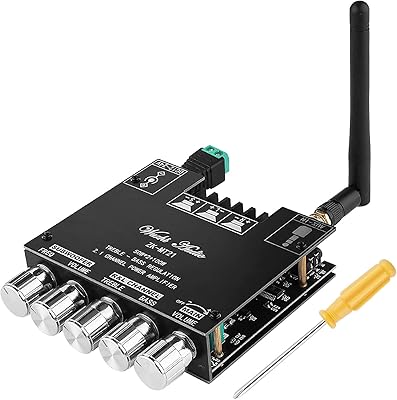
MakerHawk ZK-MT21 Bluetooth Amplifier Board 2.1
78%
88%
Value for Money
74%
Audio Output Quality
82%
Bluetooth Connectivity
86%
Ease of Setup & Wiring
61%
Thermal Management
More
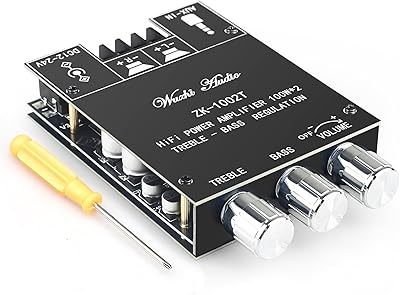
Wuzhi Audio ZK-1001U Mono Amplifier Board
72%
88%
Value for Money
61%
Audio Output Power
79%
Bluetooth Connectivity
67%
TWS Stereo Pairing
54%
Heat Management
More
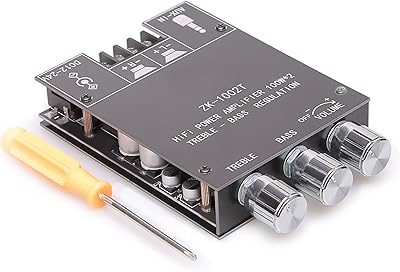
DAMGOO ZK-1002T
DAMGOO ZK-1002T
77%
83%
Sound Quality
91%
Value for Money
78%
Bluetooth Performance
74%
Ease of Installation
58%
Power Output Accuracy
More
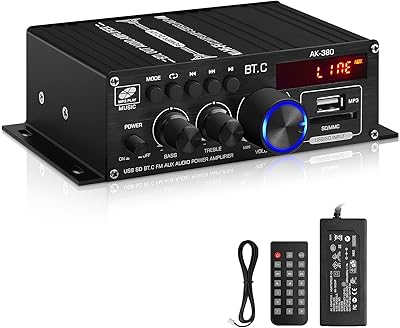
DideaECO AK-380 Bluetooth Stereo Amplifier
70%
83%
Value for Money
67%
Sound Quality
78%
Bluetooth Performance
89%
Ease of Setup
54%
Build Quality
More
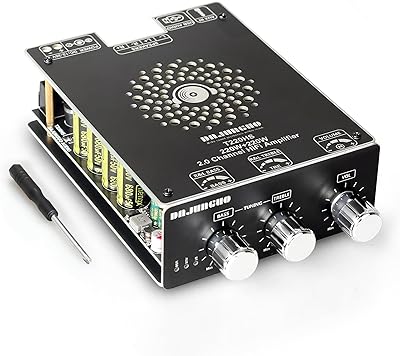
UWAYKEY ZK1002T Bluetooth Stereo Amplifier Board
75%
86%
Value for Money
82%
Bluetooth Performance
58%
Output Power (Real-World)
63%
Build Quality
61%
Heat Management
More
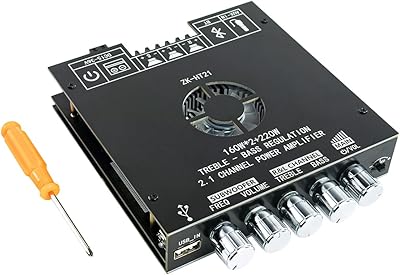
DAMGOO TPA3251 440W Bluetooth Stereo Amplifier Board
80%
83%
Sound Quality
86%
Bluetooth Connectivity
67%
Power Output (Real-World)
88%
Value for Money
79%
Ease of Setup
More
Hosyond TDA7498E 2.1 Channel Bluetooth Amplifier Board 160W×2+220W
73%
88%
Value for Money
76%
Power Output & Headroom
83%
Bluetooth Connectivity
79%
Build & Component Quality
62%
Thermal Management
More
Pyle PDA8BU
Pyle PDA8BU
72%
83%
Value for Money
81%
Karaoke Performance
72%
Bluetooth Connectivity
61%
Power Output & Volume
58%
Build Quality
More
Pyle PTAU23 Stereo Amplifier
74%
83%
Value for Money
89%
Input Versatility
91%
Ease of Setup
61%
Audio Quality
74%
Microphone Performance
More
Pyle PVTA90 Vacuum Tube Stereo Amplifier
74%
78%
Sound Quality
61%
Build Quality
82%
Value for Money
79%
Bluetooth Performance
84%
Input Versatility
More

FAQ

No, it does not. You will need to purchase a compatible DC power adapter separately. Look for one rated between 12V and 24V DC with a current output of at least 5A — a 19V or 24V adapter is a popular choice for getting closer to the board's full output potential.

Unfortunately, no. The two inputs cannot be active simultaneously. If you want to switch to AUX, you need to disconnect any active Bluetooth device first, otherwise the AUX input won't respond. It's a minor but important quirk to be aware of before you plan your setup.

The ZK-TB21 works with passive speakers — meaning speakers that have no built-in amplifier and rely on an external amp to drive them. You will connect two full-range satellite speakers to the stereo outputs and a passive subwoofer driver to the dedicated subwoofer terminals. Make sure your speakers' impedance and power handling are reasonably matched to the board's output ratings.

The honest answer is that the 50W+50W+100W figures are peak ratings, not continuous RMS output numbers. In real-world listening conditions, sustained output will be noticeably lower. That said, for a modest room or workshop setup, this amp board delivers more than enough volume and punch, provided you keep your expectations grounded in its price tier.

Most users report solid Bluetooth performance within a standard-sized living room or garage, typically up to around 30 feet without obstacles. Walls and interference from other devices can reduce that range somewhat, but day-to-day use in a single room is generally reliable.

Yes, heat is something to plan for. Running the board at higher volumes for extended periods will cause it to warm up noticeably. The built-in overheating protection will shut it down before any damage occurs, but ideally you should design your enclosure with some ventilation — even a few small slots or holes — to keep airflow moving around the board.

It's genuinely one of the more beginner-friendly boards out there at this price point. Every terminal and connection point is labeled directly on the protective plate, so you can follow along without needing to read a separate manual. If you understand basic speaker wiring — positive and negative terminals — you should be able to get it running without too much frustration.

For most builds, a 19V or 24V DC adapter rated at 5A or more is the sweet spot. Running at 12V will technically work but limits your output power significantly. If you want to get reasonably close to what the ARRAROWN ZK-TB21 Bluetooth Amplifier Board is capable of, a 24V supply is the better choice.

It can drive a passive subwoofer driver, but keep in mind that dedicated car subwoofers and home theater subwoofers often require significantly more power than this board can realistically deliver on a sustained basis. For a small to mid-sized passive woofer in a DIY build — say, a 6.5-inch or 8-inch driver — it works well. Larger, high-power woofers are likely to leave you underwhelmed.

Warranty coverage and support depend on the seller and platform you purchase through, so it is worth checking the listing details at the time of purchase. As a budget-oriented DIY component, after-sales support is generally limited compared to branded consumer electronics, so factor that into your decision if long-term serviceability matters to you.