Overview

The DideaECO AK-380 Bluetooth Stereo Amplifier is a compact, affordable unit sitting at an interesting crossroads between home audio and car audio — small enough to toss in a bag, capable enough to drive a decent pair of passive speakers in a workshop or small room. What you actually get is 40W per channel of rated power; the 400W figure on the box refers to peak output under ideal conditions, so set your expectations accordingly. That said, the included 12V 5A power supply is a thoughtful addition that saves you an extra purchase. This is entry-level HiFi — practical and honest about what it is, if you let it be.
Features & Benefits

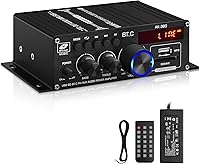
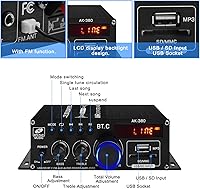
This compact amplifier packs a surprisingly long list of inputs into its modest chassis: Bluetooth 5.0, AUX, USB, SD card, and FM radio all live on one unit. In practice, Bluetooth pairing is quick and notably free of the annoying pop or hiss that plagues cheaper amps. The FM tuner with its included antenna can store over 20 preset stations, which is genuinely handy if you run it in a bar or kitchen where switching sources is frequent. Separate treble and bass knobs, alongside a backlit LCD, let you tune the sound without diving into menus. The remote control is a small but welcome touch for anyone sitting across the room.

Best For

This mini stereo amp fits a specific kind of buyer really well. If you have a pair of old passive speakers sitting unused and want to breathe life into them without spending much, this is a practical solution. It performs best in small spaces — a garage, a workshop, a bedroom, or a modest home bar setup. Car audio users who want a plug-and-play install without complex wiring will find it convenient too. It is not the right pick if you are chasing room-filling volume or running speakers in a larger space. Pair it with speakers rated around 40W and you will be in solid shape.

User Feedback

The AK-380 carries a 3.8-star average, which tells you there is real variation in buyer experiences. People who are happy with it share a common profile: they paired it with modest speakers in a small room and kept expectations realistic, praising the easy setup, reliable wireless connection, and the value delivered at this price point. The frustrations are just as predictable — buyers who expected the full 400W to translate to powerful output were disappointed, and a few noted that FM reception can be inconsistent depending on location. Build quality also gets a mention; the chassis feels light. Not a dealbreaker here, but worth knowing before you buy.

Pros

  • Bluetooth 5.0 connects quickly and reliably with no audible pop or hiss on pairing.
  • Five input options — Bluetooth, USB, SD card, AUX, and FM — cover nearly every source a casual listener uses.
  • The included 12V 5A power supply saves you a separate purchase for home use.
  • Separate treble and bass knobs let you tune sound to your room without any app or menu navigation.
  • The built-in FM tuner stores over 20 presets, handy for kitchens, bars, or workshops.
  • The remote control works well for adjusting volume from across a small room.
  • Compact size makes it easy to relocate between a home setup and a car or outdoor event.
  • Compatible with a wide range of passive speakers from 4 to 16 ohms.
  • At its price point, the feature-to-cost ratio is genuinely difficult to beat for casual listeners.

Cons

  • Rated power is just 40W per channel — the 400W peak figure on the packaging is misleading.
  • The plastic chassis feels noticeably lightweight and less durable than even mid-range competitors.
  • FM reception can be inconsistent, particularly in areas with weaker broadcast signals.
  • Not suitable for driving larger or higher-impedance speaker setups in bigger rooms.
  • The LCD display, while functional, is small and can be hard to read at a distance.
  • No optical or digital audio input limits compatibility with modern TVs and soundbars.
  • Bass output at higher volumes can sound thin when paired with larger passive speakers.
  • The remote control feels cheap and has limited range compared to dedicated AV receivers.
  • Mixed user ratings suggest quality consistency may vary between units.

Ratings

The scores below reflect our AI-powered analysis of verified global buyer reviews for the DideaECO AK-380 Bluetooth Stereo Amplifier, with spam, bot-generated, and incentivized feedback actively filtered out before scoring. Each category captures what real owners consistently praised or criticized across hundreds of purchase experiences worldwide. Both the strengths and the frustrations are represented as accurately as the data allows — nothing is glossed over.

Value for Money
83%
For buyers who understood what they were getting — a modest 40W-per-channel amp with a broad feature set — the price-to-functionality ratio landed well. Having Bluetooth, FM, USB, SD, and AUX inputs bundled with a power supply at this price point is genuinely competitive in the budget audio segment.
Buyers who fixated on the 400W peak claim felt burned once they heard the actual output, which significantly dragged down perceived value for that group. If your expectations are calibrated correctly, the value is real; if they are not, it feels like a poor deal.
Sound Quality
67%
33%
Paired with appropriately sized passive speakers in a small room, garage, or kitchen, the AK-380 produces clean, listenable audio at moderate volumes. The separate treble and bass knobs give enough control to compensate for speaker characteristics without needing an external equalizer.
At higher volumes, clarity degrades noticeably — bass thins out and the overall sound loses definition. Users with any prior experience using mid-range amplifiers consistently found the sonic output underwhelming, particularly when driving speakers with greater dynamic range.
Bluetooth Performance
78%
22%
Bluetooth 5.0 pairing is fast and the connection holds reliably within a normal room. A frequently noted detail is the absence of the loud pop or static burst on connection — something cheaper Bluetooth amps routinely produce and that users found refreshingly absent here.
Range drops off when walls or significant obstructions are involved, which is expected but still limits placement flexibility. A small number of users reported occasional stuttering during streaming, particularly when the source device was at the edge of its Bluetooth range.
Ease of Setup
89%
This is consistently one of the most praised aspects — users with no prior amplifier experience had music playing within minutes of opening the box. Speaker terminals are straightforward, the power adapter is included, and input switching is handled directly from the front panel with no software required.
The included documentation is thin and not particularly clear for complete beginners, which caused some confusion around speaker wiring polarity and FM antenna placement. A better quick-start guide would eliminate most of the setup frustration reported by first-time buyers.
Build Quality
54%
46%
The unit is compact and reasonably well-assembled at first glance, with a clean front panel layout and knobs that turn smoothly. For casual desktop or shelf use in a low-traffic environment, the construction holds up adequately over normal use.
The plastic chassis feels noticeably lightweight — closer to a toy than a piece of audio equipment — and the overall finish lacks the rigidity buyers expect even at a budget price. Several users noted creaking or flexing when moving the unit, raising legitimate durability concerns for car or portable use.
Power Output Accuracy
41%
59%
The rated 40W per channel is a legitimate figure that performs as expected when driving matched speakers in a small space. Users who understood this specification from the start had no complaints about the actual output delivered during normal listening sessions.
The 400W peak marketing claim is the single biggest source of negative reviews for this product. Buyers expecting high-volume output capable of filling a large room or driving demanding speakers were consistently and significantly disappointed, and many felt the listing was actively deceptive.
FM Radio Functionality
69%
31%
In locations with strong FM broadcast signals, the tuner works well and the 20-plus station memory is a practical feature for users who keep the amp in a fixed location like a kitchen or bar. Auto-scanning for stations is quick and accurate in good reception areas.
Reception quality is highly location-dependent, and the included wire antenna is rudimentary at best. Users in urban apartments or areas with weaker broadcast coverage reported persistent static and dropped stations, with limited ability to improve things beyond repositioning the antenna wire.
Input Versatility
82%
18%
Having five distinct input options — Bluetooth, AUX, USB, SD card, and FM — on a unit this compact and affordable is a genuine differentiator. Users running it as a multi-source hub in a bar or workshop particularly appreciated switching between a phone stream and a USB drive without any reconfiguration.
There is no optical or digital audio input, which limits direct integration with modern smart TVs that lack analog outputs. Switching between inputs requires cycling through them in sequence rather than jumping directly, which some users found mildly tedious.
Remote Control
61%
39%
The remote covers the basics — volume and input switching — which is exactly what you want when the amp is on a shelf across the room. Users running it in a living room or bar setting found it useful enough for day-to-day convenience without getting up every time.
The remote feels cheap and has limited effective range, requiring a clear line of sight to function reliably. Several users reported the remote becoming unresponsive within a few months of use, suggesting the build quality of this accessory does not match even the modest standard of the main unit.
USB & SD Playback
74%
26%
Playing audio directly from a USB stick or SD card works reliably with standard MP3 files, which covers the majority of casual users who store music locally. It is a genuinely useful feature for events or locations where streaming is not practical or reliable.
Format support is limited to the most common audio types, and there is no folder navigation or display of track metadata beyond basic playback controls. Users with large music libraries or varied file formats found the experience frustrating due to its lack of organizational flexibility.
Thermal Management
66%
34%
For typical listening sessions at moderate volume in open air, the unit manages heat adequately and stays within a normal operating range. Users who run it intermittently — background music during a party or workshop session — report no heat-related issues.
Extended high-volume use causes the chassis to become noticeably warm, and the lack of ventilation slots on the plastic body gives no real path for heat to escape. Placing it in an enclosed cabinet or driving it hard for long periods risks performance degradation over time.
Portability
77%
23%
At under two pounds and compact enough to fit in a backpack, the AK-380 genuinely travels well between a home setup and a vehicle or outdoor event. Users who used it across multiple locations appreciated not having to invest in separate units for each environment.
The lightweight plastic build that aids portability also makes it feel fragile in transit without a protective case. The power adapter adds bulk when traveling, and there is no carrying case or protective sleeve included in the package.
Speaker Compatibility
72%
28%
The 4 to 16 ohm impedance range covers the vast majority of common passive speakers, making it easy to pair with whatever speakers a buyer already owns. Users who matched it with bookshelf speakers in the 20W to 40W range reported a consistently good pairing experience.
Users who connected high-efficiency or larger floor-standing speakers expecting room-filling volume hit a hard ceiling quickly. The amp has no protection circuitry feedback that warns when it is being pushed beyond its real-world limits, which caused a few users to experience distortion-related issues.

Suitable for:

The DideaECO AK-380 Bluetooth Stereo Amplifier is a solid pick for anyone who wants a no-fuss way to get music playing through passive speakers without spending much. It fits naturally into small, casual listening environments — a garage workshop, a home bar corner, a bedroom, or a modest outdoor patio setup where filling the space with background music matters more than audiophile accuracy. If you already own a pair of passive speakers rated around 40W and just need something to drive them, this compact amplifier checks that box efficiently. People who frequently switch between sources — streaming from a phone via Bluetooth, playing files from a USB stick, or tuning into local FM radio — will appreciate having all of that handled by one affordable unit. First-time amp buyers who want a gentle introduction without a complicated setup will also find it approachable.

Not suitable for:

The DideaECO AK-380 Bluetooth Stereo Amplifier is not the right tool if you are trying to power a larger room or run high-demand speakers. The rated output is 40W per channel, and while that is workable in a small space, buyers expecting the peak 400W figure to reflect real-world performance will be disappointed — that number is a marketing ceiling, not a practical baseline. Dedicated audiophiles or home theater enthusiasts who care about low distortion, channel separation, and dynamic headroom should look at purpose-built amplifiers at a higher price point. The build quality also reflects the price; the chassis is lightweight plastic, which may feel flimsy to users accustomed to more substantial hardware. If FM reception in your area is already weak, the built-in tuner is unlikely to improve that experience significantly.
Specifications

  • Rated Power: Delivers 40W per channel (2 channels) of continuous rated output under normal operating conditions.
  • Peak Power: Advertised peak power reaches 400W per channel, reflecting maximum short-burst capacity rather than sustained output.
  • Channels: Operates as a 2.0 stereo amplifier with two independent output channels and no dedicated subwoofer channel.
  • Bluetooth: Built-in Bluetooth 5.0 supports stable wireless audio streaming with low-noise, pop-free connection behavior.
  • Audio Inputs: Accepts audio from five sources: Bluetooth, AUX, USB flash drive, SD card, and FM radio antenna.
  • Speaker Impedance: Compatible with passive speakers rated between 4 and 16 ohms for safe and stable amplifier operation.
  • Speaker Power: Recommended for use with passive speakers rated at or below 40W to avoid distortion or damage.
  • Audio Chip: Powered by a YD7377 audio amplifier chip, which handles signal processing and output control.
  • FM Tuner: Integrated FM tuner supports local radio reception and stores up to 20 user-programmed station presets in memory.
  • Display: Features a backlit LCD screen that shows input source, volume level, and FM frequency information at a glance.
  • Controls: Three dedicated physical knobs manage overall volume, treble frequency, and bass frequency independently.
  • Remote Control: Includes an infrared remote control for adjusting volume and switching inputs from a distance.
  • Power Supply: Ships with a 12V 5A DC power adapter included in the box, ready for home use without additional purchases.
  • Input Voltage: Operates on a supply voltage between 12V DC and 24V DC, making it adaptable for both home and vehicle use.
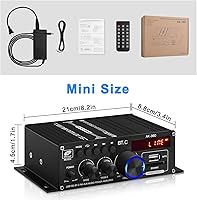
  • Dimensions: Measures 9.49 x 7.6 x 2.79 inches, giving it a compact desktop footprint suitable for tight shelf or dash spaces.
  • Weight: Weighs 1.72 pounds, making it light enough to transport between a home setup and a vehicle or outdoor venue.
  • Manufacturer: Designed and sold by DideaECO, a consumer electronics brand focused on budget-friendly audio accessories.
  • Model Number: Officially designated as model AK-380 by the manufacturer for identification and support purposes.

Related Reviews

Pyle PDA5BU Bluetooth Stereo Amplifier
82%
88%
Audio Performance
82%
Bluetooth Connectivity
71%
Build Quality
85%
Ease of Setup
90%
Input Versatility
More
Pyle PDA69BU Stereo Amplifier Receiver
75%
83%
Bluetooth Connectivity
74%
Sound Quality
79%
Build Quality
86%
Value for Money
88%
Input Versatility
More
AIYIMA T9
AIYIMA T9
77%
83%
Sound Quality
88%
Value for Money
91%
Connectivity & Input Variety
67%
Bluetooth Performance
74%
Build Quality & Materials
More
Moukey MK0153 Karaoke Amplifier
73%
88%
Value for Money
91%
Ease of Setup
72%
Microphone Performance
78%
Bluetooth Connectivity
58%
Audio Output Power
More
Saiyin PA300H Stereo Bluetooth Power Amplifier
74%
76%
Sound Quality
79%
Bluetooth Performance
58%
Build Quality
83%
Value for Money
91%
Ease of Setup
More
Fosi Audio BT20A
Fosi Audio BT20A
80%
93%
Value for Money
84%
Sound Quality
81%
Build Quality
96%
Ease of Setup
72%
Bluetooth Performance
More
NEOHIPO AK45 Bluetooth Stereo Receiver Amplifier
73%
83%
Value for Money
91%
Ease of Setup
71%
Sound Quality
88%
Input Versatility
67%
Bluetooth Stability
More
Pyle PCAU46BA Bluetooth Stereo Amplifier
73%
83%
Value for Money
67%
Sound Quality
91%
Ease of Setup
68%
Bluetooth Performance
54%
Build Quality
More
Fosi Audio BL20A
Fosi Audio BL20A
80%
86%
Sound Quality
91%
Value for Money
67%
Bluetooth Performance
78%
Build Quality
89%
Input Versatility
More
Romicta 4-Channel Bluetooth 5.0 Stereo Amplifier
76%
88%
Value for Money
91%
Ease of Setup
83%
Bluetooth Connectivity
71%
Sound Quality
54%
Power Output Accuracy
More

FAQ

Passive speakers rated at 40W or below with an impedance of 4 to 16 ohms are the sweet spot. Bookshelf speakers in the 20W to 40W range, used in a small room, tend to produce the best results. Avoid pairing it with large floor-standing speakers or anything that needs significantly more power, as the amp will run out of headroom quickly.

Not in any practical sense. The 400W figure is a peak rating — meaning the theoretical maximum the unit can momentarily handle under ideal lab conditions. What you actually get day-to-day is 40W per channel of rated power. That is enough for a small room with appropriately matched speakers, but buyers expecting concert-level volume will be let down. It is a common marketing convention in budget audio, and worth knowing before you buy.

Yes, with one caveat. The AK-380 runs on 12V DC, which matches standard automotive electrical systems. You can tap into your car's power supply or use a compatible adapter, but the included power supply is a home wall-plug unit. For a vehicle install, you will need to connect it directly to your car's 12V source, which most people handle with basic wiring or an adapter harness. It is genuinely straightforward compared to traditional car amps.

For a budget unit, it holds up well. Bluetooth 5.0 pairs quickly and tends to stay connected without frequent drops in normal use. One thing users consistently note is the absence of a loud pop or buzz when you connect — a small detail that cheaper amps often get wrong. Range is solid within a typical room, though walls and interference can reduce it, as with any Bluetooth device.

It depends heavily on your location and how well you position the included antenna. In areas with strong FM signals, it works reliably and the 20-preset memory is handy. In weaker signal areas or densely built environments, reception can be patchy. The antenna is a simple wire type, so positioning it near a window often makes a noticeable difference.

Yes. The DideaECO AK-380 Bluetooth Stereo Amplifier reads audio files from USB flash drives and SD cards directly, with no phone or computer required. It handles common formats like MP3. Just plug in your drive, switch to the USB or SD input, and it plays through. It is a handy option when you want background music at an event without streaming.

It is basic but functional. The remote covers volume adjustment and input switching, which are the two things you actually want to change from across the room. The build quality is minimal — it feels like a standard IR remote — and range is limited to line-of-sight within a few meters. It is not a gimmick, but it is not a premium experience either.

The unit does get warm during prolonged playback, which is normal for a Class AB amplifier design. Running it at moderate volume levels in open air keeps things manageable. Avoid enclosing it in a cabinet with no airflow, especially during longer listening sessions, as heat buildup can affect performance and longevity.

Not directly via a dedicated subwoofer output — this is a 2.0 stereo amp with no built-in sub channel or line-level subwoofer output. If your subwoofer is a passive unit within the 4 to 16 ohm range, you could wire it as one of the speaker outputs, but you would lose stereo separation. A powered subwoofer with its own amplifier would not have an appropriate line-level input to connect to here.

Honestly, yes — with the right expectations. The setup is about as simple as it gets: connect your speakers to the terminals, plug in the power supply, and you are running. There are no complicated configuration menus or driver installations. The multiple inputs mean you can experiment with different sources easily. If you are new to amplifiers and just want something that works without a learning curve, this compact amplifier is a reasonable starting point.

Where to Buy