Overview

The Wuzhi Audio ZK-1001U Mono Amplifier Board is a compact Class D module built around the TPA3116 chip, targeting DIY audio builders and car audio hobbyists who want real amplification power without a steep price tag. At roughly the size of a deck of cards, this amplifier board punches into territory that used to require bulkier, pricier hardware. It accepts a wide 9–24V input, making it equally at home on a 12V vehicle battery or a benchtop power supply. What separates it from the sea of similar TPA3116 boards is its TWS pairing support and three-input flexibility — features rarely bundled together at this price point.
Features & Benefits

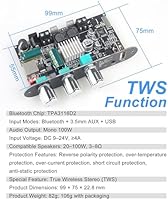
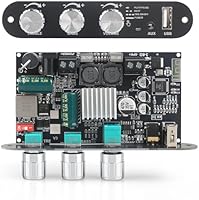
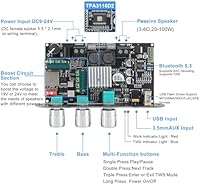
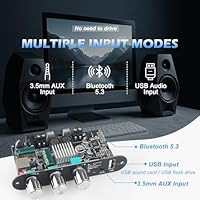
The ZK-1001U packs a surprising amount of functionality into a small footprint. The onboard boost circuit is genuinely useful — it steps up lower supply voltages to a stable 19V or 24V, so audio output stays consistent even when battery voltage sags. Connectivity covers Bluetooth 5.0, USB playback, and a 3.5mm AUX input, which means you rarely need an external receiver module. The three-knob EQ layout — volume, bass, treble — is straightforward, and the volume knob doubles as a multifunction button for playback control and power toggling. The TWS dual-board pairing is the real standout: link two units and you get true left/right channel separation from what is otherwise a mono board.

Best For

This mono amp module suits anyone building a powered speaker cabinet who doesn't want to wire in a separate Bluetooth receiver. Car audio hobbyists running a single subwoofer or full-range driver from a 12V system will find the voltage range practical and the install fairly clean. It also pulls duty in workshop or garage setups powered by a repurposed laptop adapter. Keep in mind that stereo requires two boards linked via TWS — that's an added cost to factor in. Audiophiles expecting hi-fi fidelity or anyone needing stereo output from a single unit should look elsewhere; this is a mono-first design through and through.

User Feedback

Buyers generally appreciate the ZK-1001U's input flexibility and the TWS concept, but a few recurring concerns are worth weighing. The 100W rating is a peak figure under ideal conditions — at 12V, real sustained output is considerably lower, which is standard for TPA3116 boards across the category. Heat is a practical concern; running at high volumes without a heatsink attached risks thermal throttling over time. The multifunction knob draws mixed reactions — some find the press patterns intuitive, others call them fiddly. Bluetooth range is adequate for short-distance use, and USB format support reportedly varies between units. Buyers who go in with realistic expectations tend to be satisfied; those expecting audiophile performance are less so.

Pros

  • Bluetooth 5.0, USB, and AUX inputs bundled together eliminate the need for a separate receiver module in most builds.
  • The onboard boost circuit stabilizes audio output even when supply voltage dips, a practical advantage in 12V vehicle installs.
  • TWS dual-board pairing enables true stereo channel separation — a feature rarely found at this price tier.
  • Three physical EQ knobs let you tune bass and treble on the fly without touching a phone app.
  • Tiny footprint and light weight make this mono amp module easy to fit into tight enclosures and dashboard panels.
  • Wide 9–24V input range means most hobbyists can run it from supplies they already own.
  • Setup is fast for anyone with basic wiring experience — power in, speaker out, and you are playing audio within minutes.
  • USB flash drive playback works reliably with standard MP3 files, useful for hands-free workshop listening.
  • The multifunction volume knob consolidates several controls into one, keeping panel cutouts minimal in custom builds.
  • Competitive price point makes it easy to buy a second unit for TWS stereo without a significant budget hit.

Cons

  • Rated 100W output is a misleading peak figure — usable sustained power at 12V is far lower in real-world conditions.
  • No heatsink is included, and running at high volumes without one risks thermal shutdown during long sessions.
  • TWS pairing can drop mid-session and sometimes requires manual re-pairing after a power cycle.
  • FLAC and WAV playback via USB is inconsistent across units, with some boards refusing these formats entirely.
  • The multifunction knob press sequences are easy to misfire, especially when trying to skip tracks quickly.
  • No mounting holes on the board mean buyers must engineer their own bracket or adhesive solution for permanent installs.
  • A meaningful number of units arrive dead or fail within the first few weeks, so early QC issues are a known risk.
  • Faint switching noise from the boost circuit is audible through sensitive tweeters in quiet listening environments.
  • Bluetooth does not always auto-reconnect to the last paired device on power-up, requiring occasional manual re-pairing.
  • No wiring diagram is included in the packaging, which can slow down first-time builders unfamiliar with the terminal layout.

Ratings

Our scores for the Wuzhi Audio ZK-1001U Mono Amplifier Board were generated by AI after systematically analyzing verified buyer reviews from multiple global markets, with spam, bot activity, and incentivized feedback actively filtered out. The result is a balanced breakdown that honestly reflects where this budget amp module earns its praise and where real users have run into frustration. Both strengths and recurring pain points are represented transparently across every category below.
Value for Money
88%
Most buyers are genuinely surprised by how much functionality this mono amp module delivers at its price point. Bluetooth 5.0, USB playback, AUX input, an onboard EQ, and TWS pairing capability bundled together would cost significantly more if sourced separately, making this a standout deal for hobbyists on a tight build budget.
The value equation depends heavily on expectations. Buyers who later discover they need a second board for stereo output feel the effective cost doubles, which can sting when it was not clearly anticipated upfront.
Audio Output Power
61%
39%
For low-sensitivity speakers in a small cabinet or a single subwoofer in a compact car install, the ZK-1001U provides enough headroom to get genuinely loud without audible clipping at moderate listening levels. The boost circuit helps maintain drive even when supply voltage dips slightly.
The rated 100W figure is a peak ceiling under ideal lab conditions, not a realistic sustained output at 12V — real-world usable power is closer to 30–50W in typical builds. Buyers expecting chest-thumping volume from a single 12V battery source often walk away underwhelmed.
Bluetooth Connectivity
79%
21%
Bluetooth 5.0 pairs quickly and holds a stable connection for everyday workshop streaming within a normal room distance. Most users report clean audio with no noticeable dropout when the source device stays within roughly 8–10 meters and there are no major obstructions.
Range drops noticeably through walls or in environments with heavy wireless interference. A handful of buyers also noted that the board does not always auto-reconnect to the last paired device on power-up, requiring a manual re-pair occasionally.
TWS Stereo Pairing
67%
33%
The concept works and genuinely impresses when it functions correctly — syncing two boards for left/right channel separation gives a proper stereo stage for a DIY cabinet pair, which is rare at this tier. Users who built matched speaker enclosures and ran TWS reported satisfying results.
Pairing stability is inconsistent for some buyers. Occasional sync dropouts mid-session and the need to re-trigger pairing after power cycles are commonly reported. The feature is promising but not polished enough to be considered fully reliable in a permanent install.
Heat Management
54%
46%
Under moderate listening levels and with adequate airflow, the ZK-1001U stays within acceptable temperature ranges for reasonable session lengths. The Class D topology is inherently more efficient than Class AB, which helps keep baseline heat generation lower than older amplifier designs.
Running the board at high volume for extended periods without an attached heatsink causes noticeable heat buildup, and some users have reported thermal protection triggering a shutdown. For any permanent install, adding a heatsink is essentially non-optional rather than an optional upgrade.
Build & Component Quality
72%
28%
Solder joints and PCB traces appear clean on most units, and the TPA3116 chip is reported by experienced makers as appearing genuine rather than a remarked clone. The board feels appropriately solid for the price and handles routine DIY handling without visible flex or component shift.
The plastic knob caps feel lightweight and cheap, and a few buyers reported one arriving loose or slightly off-axis from the factory. It is a budget-grade finish, and anyone building a polished enclosure for public display may find the aesthetic underwhelming.
Multifunction Knob Usability
66%
34%
Consolidating volume control, playback control, TWS toggle, and power functions into a single knob is a genuinely clever space-saving idea for tight enclosure builds where panel real estate is limited. Users who took time to learn the press patterns generally found day-to-day operation comfortable.
The learning curve for the multi-press sequences is real. Single, double, triple press, and long-press actions are easy to misfire in practice, and a few users reported accidentally toggling TWS mode or cutting power when they just wanted to skip a track.
USB Playback Compatibility
63%
37%
USB flash drive playback works reliably with standard MP3 files, and buyers who load up a drive with a playlist for garage or workshop use report trouble-free operation for hours. It is a convenient offline option that eliminates phone dependency entirely.
FLAC and WAV support is inconsistent across units — some buyers report success, others get no playback with the same file types. The board also appears to lack folder navigation, meaning large or disorganized drives can make track management frustrating.
EQ & Tone Control
74%
26%
Having physical bass and treble knobs rather than relying entirely on a source app EQ is a genuine practical advantage, especially for car installs where reaching for a phone mid-drive is inconvenient. The range of adjustment covers enough ground to meaningfully shape sound for different speaker types.
The EQ sweep is not labeled with frequency reference points, so dialing in a specific response requires trial and error. Audiophile users note the tone controls interact in ways that can introduce coloration at extreme settings, though at this price level that is an expected tradeoff.
Installation & Setup Ease
81%
19%
Wiring up the ZK-1001U is straightforward for anyone with basic electronics experience — power in, speaker out, and a source connection is all it takes to get audio playing within minutes. The wide voltage tolerance means most hobbyists can grab a supply they already own and start testing immediately.
There is no printed wiring diagram included in the package, and the labeling on terminal pads is small and can be hard to read under workshop lighting. First-time builders occasionally wire polarity incorrectly on the first attempt, though no permanent damage typically results.
AUX Input Performance
77%
23%
The 3.5mm AUX input is clean and low-noise at moderate gain settings, making it a reliable fallback for wired sources like a laptop or older media player. For workbench use where a computer is the audio source, the AUX path is consistently praised as the most stable input option.
At higher volume settings some users detect a faint background hiss through the AUX path, which becomes more noticeable with high-sensitivity speakers. Shielding the input cable helps but does not fully eliminate the issue in electrically noisy vehicle environments.
Form Factor & Portability
86%
At just 3.56 ounces and slightly larger than a credit card in footprint, this mono amp module fits into enclosures, dashboards, and project boxes where larger boards simply cannot go. The compact size is consistently one of the most praised practical attributes across buyer reviews.
The surface-mount design means mounting hardware is not included and buyers must plan their own bracket or adhesive solution. There are no pre-drilled mounting holes on the board itself, which adds a small engineering step for anyone building a permanent installation.
Long-Term Reliability
58%
42%
Many buyers report weeks to months of regular use without issues when the board is kept cool and within its voltage spec. Units operated within their design envelope — reasonable volume, adequate airflow, stable supply — tend to hold up well through regular hobbyist use.
A meaningful minority of reviews mention early failures, including units that arrived dead or stopped functioning within the first few weeks. This failure rate is not unusual for import amplifier boards but is worth factoring in, particularly for any mission-critical or permanent audio install.
Boost Circuit Performance
76%
24%
The onboard voltage booster genuinely helps when running from a 9V or 12V source by stepping up to a more optimal operating voltage, keeping audio output levels consistent even as supply voltage fluctuates slightly. Builders using laptop-style 19V adapters report especially clean, stable performance.
The boost circuit adds a layer of switching noise that some users detect as a faint high-frequency whine through efficient tweeters. It is a minor issue for most builds but worth knowing if you plan to drive very sensitive drivers in a quiet listening environment.

Suitable for:

The Wuzhi Audio ZK-1001U Mono Amplifier Board is a natural fit for makers, tinkerers, and hobbyists who want capable amplification without building a complex, expensive system from scratch. If you are constructing a powered speaker cabinet for your workshop, wiring up a single subwoofer in a hatchback, or prototyping an enclosure on a workbench, the wide voltage range and three input options make this board genuinely practical across all those scenarios. DIY builders who already own a 12V supply or a repurposed laptop adapter will find setup straightforward and the learning curve manageable with some basic electronics confidence. The TWS feature is particularly compelling for anyone planning a matched stereo cabinet pair — syncing two boards wirelessly for proper left and right channel output is a clever solution that saves the cost and complexity of a dedicated stereo amplifier. Anyone who prioritizes flexibility over audiophile-grade precision, and values having Bluetooth, USB, and AUX connectivity in one compact footprint, will get real, tangible value here.

Not suitable for:

The Wuzhi Audio ZK-1001U Mono Amplifier Board is not the right call for anyone expecting hi-fi fidelity or genuinely clean, sustained high-power output at 12V — the 100W rating is a peak ceiling under ideal conditions, and real-world sustained output at typical supply voltages lands considerably lower. If you need true stereo from a single board without purchasing a second unit, this design will disappoint you since it is fundamentally a mono amplifier. Listeners who are sensitive to background noise should also be aware that the AUX input and boost circuit can both introduce faint hiss or switching noise, particularly with high-sensitivity speakers. Permanent installations in vehicles or built-in cabinetry demand a heatsink to manage thermal load at high volumes — without one, long listening sessions at loud levels risk triggering thermal shutdown. Finally, buyers who need rock-solid reliability for a critical or public-facing audio install should factor in the failure rate that is not unusual for budget import boards in this category, and perhaps budget for a spare unit just in case.
Specifications

  • Amplifier Chip: Built around the TPA3116 Class D amplifier IC, a widely used and well-regarded chip in the DIY audio community for its efficiency and output capability.
  • Output Power: Rated up to 100W mono peak output; real-world sustained power at 12V DC is considerably lower, typically in the 30–50W range depending on load and supply.
  • Input Voltage: Accepts a wide DC input range of 9V to 24V, making it compatible with standard 12V vehicle batteries, 19V laptop adapters, and regulated bench power supplies.
  • Boost Circuit: Onboard auto-boost circuit steps up 9V or 15V supply inputs to either 19V or 24V internally, with 24V set as the factory default for maximum output headroom.
  • Bluetooth: Bluetooth 5.0 for wireless audio streaming, offering improved connection stability and range compared to older Bluetooth 4.x implementations.
  • Additional Inputs: Includes a USB Type-A port for flash drive playback and a 3.5mm AUX jack for wired analog sources such as phones, laptops, or media players.
  • TWS Support: Supports True Wireless Stereo pairing, allowing two identical boards to be linked wirelessly so one handles the left channel and the other handles the right channel.
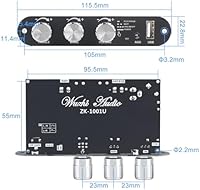
  • EQ Controls: Three dedicated physical knobs provide independent control over master volume, bass level, and treble level without requiring any external device or app.
  • Multifunction Knob: The volume knob doubles as a multifunction button supporting single press for play/pause, double press for next track, triple press to toggle TWS, and long press for power on/off.
  • Mounting Type: Surface-mount board design intended for integration into enclosures, panels, or chassis; no pre-drilled mounting holes are present on the PCB itself.
  • Dimensions: Package measures 5.04 x 3.19 x 1.81 inches, with the bare board occupying a footprint comparable to a standard playing card for easy enclosure integration.
  • Weight: Complete packaged unit weighs 3.56 ounces, making it one of the lighter amplifier modules in its output class.
  • Color: Finished in black PCB with black knob caps, giving it a neutral appearance that suits most DIY enclosure aesthetics.
  • USB Playback: USB port supports direct playback from flash drives formatted with compatible file systems; MP3 is universally supported while FLAC and WAV compatibility varies by firmware version.
  • Manufacturer: Designed and produced by Wuzhi Audio, a Chinese electronics manufacturer specializing in budget-tier amplifier boards and audio modules for the DIY market.
  • Model Number: Official model designation is ZK-1001U, which differentiates this USB and Bluetooth-equipped variant from other boards in the Wuzhi Audio ZK series.
  • Thermal Management: No heatsink is included in the package; attaching an aftermarket heatsink to the TPA3116 chip is strongly recommended for sustained high-volume operation.
  • Supply Voltage DC: Operates exclusively on DC power; a regulated DC supply with adequate current capacity (minimum 3–5A recommended at 12V) is required for stable full-output performance.

Related Reviews
ARRAROWN ZK-TB21 Bluetooth Audio Amplifier Board
84%
85%
Sound Quality
88%
Ease of Installation
90%
Connectivity (Bluetooth)
80%
Durability and Build Quality
87%
Bass and Treble Control
More
YaeCCC 1000W Car Audio Amplifier Board
85%
91%
Power Output
88%
Bass Performance
80%
Heat Dissipation
85%
Ease of Installation
84%
Build Quality
More
DAMGOO ZK-1002T
DAMGOO ZK-1002T
77%
83%
Sound Quality
91%
Value for Money
78%
Bluetooth Performance
74%
Ease of Installation
58%
Power Output Accuracy
More
MakerHawk ZK-MT21 Bluetooth Amplifier Board 2.1
78%
88%
Value for Money
74%
Audio Output Quality
82%
Bluetooth Connectivity
86%
Ease of Setup & Wiring
61%
Thermal Management
More
OSD Audio SMP500 800W Mono-Channel Subwoofer Amplifier
86%
88%
Performance
90%
Bass Enhancement
81%
Ease of Installation
93%
Heat Management
85%
Power Output
More
Harmony Audio HA-A1500.1 3000W Mono Amplifier
85%
91%
Performance
94%
Bass Quality
85%
Ease of Installation
92%
Power Output
67%
Size & Weight
More
Harmony Audio HA-A400.1 800W Mono Subwoofer Amplifier
86%
91%
Bass Performance
88%
Ease of Use
84%
Build Quality
87%
Reliability
92%
Power Handling
More
MB Quart FA1-1500.1 Mono Channel Car Audio Amplifier
84%
91%
Sound Quality
88%
Power Delivery
87%
Durability & Build Quality
85%
Ease of Setup & Installation
65%
Thermals (Heat Management)
More
MB Quart FA1-1000.1 Mono Channel Car Audio Amplifier
87%
91%
Sound Quality
94%
Power Output
85%
Installation Ease
89%
Durability
83%
Connectivity/Compatibility
More
UWAYKEY 200W Bluetooth 5.0 Stereo Power Audio Amplifier Board
83%
88%
Sound Quality
74%
Bluetooth Connectivity
92%
Value for Money
78%
Ease of Use
80%
Build Quality
More

FAQ

It is largely a marketing peak figure. The TPA3116 chip is capable of high output under ideal lab conditions — think 24V supply, low-impedance load, and very brief transients. In a typical 12V car or workshop setup, you are realistically looking at around 30–50W of sustained usable power. That is still plenty for most DIY builds, but go in with realistic expectations rather than expecting chest-thumping bass from a single 12V battery.

For casual low-volume listening, you can get away without one for a while, but it is genuinely not a good idea long-term. At moderate to high volume levels the TPA3116 chip gets hot, and without a heatsink attached you risk triggering the board's thermal protection, which cuts audio output until it cools down. A small aluminum heatsink costs almost nothing and is worth adding before you even wire it into your project.

Yes, TWS pairing requires two identical ZK-1001U boards — you cannot mix it with a different model. To pair them, you triple-press the multifunction knob on one board while both are powered on and in Bluetooth mode, and they sync wirelessly to split left and right audio channels. In practice it works, though the connection is not always rock-solid and may occasionally need to be re-triggered after a power cycle.

A repurposed laptop adapter in the 19V range is a popular and effective choice for bench or workshop builds since it hits close to the board's optimal boosted voltage. A regulated 12V supply rated at 5A or higher also works well. Just make sure whatever supply you use can deliver consistent current at your target volume level — underpowered supplies cause audio clipping and instability before you hit the board's actual limits.

It depends on the unit. Some buyers report successful FLAC playback, while others find the board simply skips or ignores those files. MP3 is universally supported and the safest bet. If lossless playback matters to you, convert your files to high-bitrate MP3 before loading the drive, and you will avoid compatibility headaches entirely.

It is beginner-accessible as long as you are comfortable with basic DC wiring — connecting positive and negative terminals, and identifying speaker polarity. The main catch is that no wiring diagram is included in the box, so you will want to find the terminal label markings on the board under good lighting or look up the pinout online before you start. Getting it backwards on the speaker terminals will not damage anything, but it is worth doing right the first time.

In an open room with no obstacles, most users get a solid 8–10 meters before the connection starts to feel unreliable. Through walls or in environments with a lot of competing wireless signals — like a busy workshop with routers and other Bluetooth devices nearby — expect that range to drop noticeably. For typical garage or workshop use where your phone is within the same room, it is perfectly adequate.

Not always reliably. A good number of users have noted that the board does not consistently auto-reconnect to the last paired device after a full power cycle. In practice you may need to go into your phone's Bluetooth menu and manually select it again. It is a minor nuisance rather than a dealbreaker, but worth knowing if you plan to use it daily and want hands-free startup.

Yes, and it is actually one of the more practical use cases for this mono amp module. Running a single subwoofer or a full-range driver from the 12V vehicle supply is straightforward, and the onboard bass knob lets you tune the low-end response without extra hardware. Just keep the enclosure ventilated and attach a heatsink if the board will be running at high volume for extended highway drives.

It can work in a living room build if you are budget-focused and not an audio perfectionist. The sound quality from the TPA3116 is genuinely respectable for casual listening. However, sensitive ears in a quiet room may pick up a faint background hiss, particularly through the AUX input or with high-sensitivity speakers. If you are building a speaker to impress guests or replace a proper hi-fi system, you might eventually wish you had spent more on a cleaner amplifier platform.