Overview

The Hosyond TDA7498E 2.1 Channel Bluetooth Amplifier Board 160W×2+220W is a compact, capable amp solution aimed squarely at DIY audio builders who want real output headroom without spending a fortune. Running dual TDA7498E chips, it has enough power on tap to drive a meaningful 2.1 setup — stereo channels plus a dedicated subwoofer output. Competing with a crowded field of budget amp boards, it sits at a price point that feels reasonable given the chip quality. Three input options — Bluetooth, AUX, and USB — make it flexible for different room setups. One critical thing to know upfront: this is a bare board, meaning you will need to source your own DC power supply and enclosure before any sound comes out.

Features & Benefits

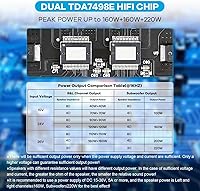
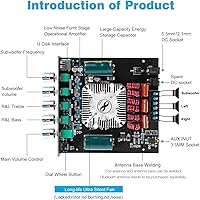
The TDA7498E module packs a lot onto a single board. The rated 160W per stereo channel and 220W subwoofer figures are peak wattage values — real continuous output will be lower depending on your PSU and load, so set expectations accordingly. That said, the power headroom is genuine, and the board runs the dedicated subwoofer channel independently from the stereo pair, which is exactly how a proper 2.1 system should work. On-board treble and bass knobs handle basic tone shaping, saving you from needing a separate EQ. The wide DC input range — 15 to 36 volts — gives you flexibility when choosing a power supply; a quality 24V unit tends to be the sweet spot for most builds.

Best For

This Hosyond 2.1 board is built for DIY speaker builders — people assembling a stereo-plus-sub system from scratch who already have a suitable DC power supply on hand. It also works well as a drop-in replacement if you are pulling out a tired, underpowered amp from an existing enclosure. Workshop and garage setups benefit from the Bluetooth input; being able to stream from a phone without running cables is a genuine convenience in those environments. If you want to run a passive subwoofer alongside bookshelf speakers, the independent sub output makes that straightforward. What it is not well suited for is critical listening or audiophile-grade accuracy — this is a functional, practical board, not a reference-class component.

User Feedback

With over 700 ratings averaging 4.4 stars, the reception for this amp board is broadly positive. Buyers consistently highlight the bass output quality and how easily Bluetooth pairs with phones and computers — no fussy setup required. Build quality earns praise too, with most finding it solid for the price tier. The recurring frustrations are worth knowing about: the power supply is not included, and several beginners were caught off guard by that. USB playback is limited in terms of supported file formats, so do not count on it as your primary input. A handful of users flag that the board runs warm at sustained high volumes, so adequate ventilation inside your enclosure is worth planning for.

Pros

  • Dual TDA7498E chips provide genuine power headroom that most boards in this price range cannot match.
  • Independent subwoofer output channel produces tight, room-filling bass that integrated stereo boards simply cannot replicate.
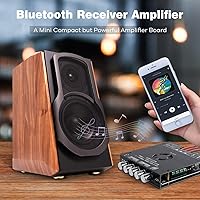
  • Bluetooth 5.0 pairs quickly and holds a stable connection for everyday wireless streaming.
  • Wide DC input range from 15 to 36 volts gives builders real flexibility when sourcing a power supply.
  • Onboard treble and bass controls handle basic tone shaping without requiring a separate equalizer.
  • Comprehensive protection features — including reverse polarity and short circuit safeguards — add meaningful peace of mind in a DIY build.
  • Compatible with a broad range of 4 to 8 ohm speakers rated 30 to 200W, covering most common DIY configurations.
  • Compact PCB footprint integrates easily into custom enclosures of almost any size.
  • At the asking price, the chip quality and feature set represent strong value for experienced hobbyists.
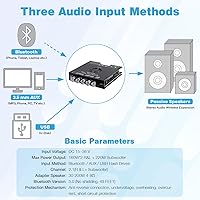
  • Three input options — Bluetooth, AUX, and USB — make it genuinely versatile across different source setups.

Cons

  • No power supply is included, and the listing does not make this limitation clear enough for first-time buyers.
  • Peak wattage figures are heavily inflated relative to real continuous output, which misleads buyers on actual loudroom performance.
  • Thin documentation leaves beginners without guidance on PSU selection, ventilation, or speaker pairing.
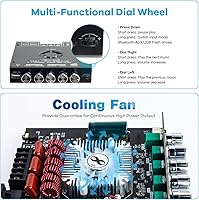
  • The board runs hot at sustained high volumes, and thermal shutdowns are a real risk without planned enclosure airflow.
  • USB audio input has limited file format support, making it unreliable as a primary source.
  • The input selector dial feels flimsy and has shown inconsistency issues in longer-term use reports.
  • Subwoofer output level cannot be independently adjusted via a dedicated gain knob on the board itself.
  • No display or indicator shows which input is currently active, which is awkward in low-light environments.
  • Long-term reliability shows a visible tail of complaints around channel imbalance and connection degradation after 12 to 18 months.
  • Customer support from Hosyond is minimal, leaving troubleshooting largely dependent on community forums.

Ratings

The scores below were generated by AI after analyzing verified buyer reviews for the Hosyond TDA7498E 2.1 Channel Bluetooth Amplifier Board 160W×2+220W from multiple global sources, with spam, bot-submitted, and incentivized feedback actively filtered out. Drawing from hundreds of real-world DIY builds, workshop installs, and home audio projects, the ratings reflect an honest cross-section of where this amp board genuinely delivers and where it falls short. Both consistent praise and recurring frustrations are represented transparently.
Value for Money
88%
For a dual-chip TDA7498E board at this price tier, most buyers feel they are getting significantly more amplifier than the cost suggests. Hobbyists building their first 2.1 system frequently cite it as the most cost-effective path to real subwoofer output without upgrading to a full receiver.
The value calculus shifts once you factor in the cost of a quality DC power supply, which is a required purchase most beginners do not anticipate. When that additional spend is included, the total outlay starts to approach entry-level packaged solutions.
Power Output & Headroom
76%
24%
In real builds with a 24V power supply and 6-ohm speakers, users report genuinely satisfying volume levels that fill medium-sized rooms without straining. The independent subwoofer channel delivers punchy, authoritative bass that punches well above what integrated stereo boards typically manage.
The advertised peak wattage figures are misleading in practice — continuous RMS output is considerably lower, and buyers expecting cinema-level power in a large room will be disappointed. The board also demands a quality PSU to approach its upper performance range; cheap supplies visibly limit headroom.
Bluetooth Connectivity
83%
Bluetooth 5.0 pairing is consistently described as quick and stable across phones, tablets, and laptops. Workshop users especially appreciate being able to stream from across the room without fussing with cables, and re-pairing after power cycles is smooth for most devices.
A small but notable number of users report occasional dropout at distances beyond about 8 meters, particularly through walls. The board does not display a connected device name, so in shared spaces it can pair with unintended devices if left discoverable.
Build & Component Quality
79%
21%
The PCB layout is tidy for the price point, with solid solder joints and clearly labeled terminals that make wiring a first build much less intimidating. The onboard protection circuitry — covering reverse polarity, short circuit, and overheating — adds a layer of confidence that cheaper boards often lack entirely.
The physical input dial and tone control knobs feel plasticky and do not inspire confidence under repeated use. A few long-term users have reported the dial switch becoming inconsistent after several months of daily switching between input modes.
Thermal Management
62%
38%
At moderate listening volumes the board handles heat adequately without any active cooling, which keeps builds simpler and quieter. The onboard overtemperature protection does its job — the board throttles rather than failing outright, which has saved more than a few builds from damage.
Running at high volume for extended periods, particularly driving lower-impedance speakers, the board gets noticeably hot. Builders who did not plan ventilation into their enclosure have reported thermal shutdowns within 20 to 30 minutes of sustained loud playback, making airflow planning non-optional for serious use.
Ease of Setup for Beginners
57%
43%
Terminals are clearly labeled and the board logic is straightforward for anyone with basic electronics knowledge. Experienced hobbyists consistently describe setup as a 30-minute task with the right power supply and speaker wire on hand.
For true beginners, the lack of an included power supply — combined with thin documentation — creates a steep learning curve. Several one-star reviews come specifically from buyers who did not realize they needed an external DC supply, which suggests the product listing sets insufficient expectations upfront.
Input Versatility
81%
19%
Having three input modes — Bluetooth, AUX, and USB — on a single board is genuinely useful for mixed-use setups. A garage build, for example, can easily switch between a phone playlist over Bluetooth and a PC audio feed via AUX with a single dial click.
USB audio support is limited in terms of file format compatibility, which frustrates users who rely on it as a primary input. The input switching dial also lacks any visual indicator or display, so in low-light environments it is easy to cycle past the intended source.
Tone Control Effectiveness
71%
29%
The onboard treble and bass knobs provide genuine tonal adjustment that makes a perceptible difference, saving builders from needing a separate equalizer for casual listening. Users tuning for bass-heavy music find the bass knob particularly responsive in the low end.
The control range is fairly coarse — there is no midrange adjustment, and at extreme positions the sound can become unbalanced rather than simply colored. Audiophile-minded builders will find these controls too blunt for precise tuning.
Speaker Compatibility
84%
The 4 to 8 ohm impedance range and 30 to 200W power handling cover a wide variety of common DIY speaker configurations, from salvaged bookshelf drivers to purpose-built mid-size cabinets. Users report reliable, stable operation across this impedance range without unexpected clipping or instability.
The board is not suited for high-impedance drivers or anything outside the 4 to 8 ohm window, which rules out some vintage speaker projects. Pairing it with speakers at the lower end of the wattage range requires careful volume management to avoid overdrive.
Power Supply Flexibility
74%
26%
The wide DC input range from 15 to 36 volts means builders are not locked into a single PSU type, and the undervoltage protection at 9V prevents damage from marginal supplies. Running at 24V is widely regarded as the practical sweet spot for performance and thermal balance.
No power supply is included, which is a recurring source of frustration and one-star reviews from buyers who missed that detail. The documentation does not clearly recommend a specific voltage or wattage for the PSU, leaving beginners to research that separately.
Subwoofer Channel Performance
78%
22%
The dedicated subwoofer output is one of the strongest selling points here — it drives a passive sub independently from the stereo channels, producing tight, room-filling low end that integrated stereo amp boards simply cannot replicate. Users building ported bass cabinets are particularly satisfied.
The sub output level cannot be adjusted independently from a dedicated gain control on the board, so balancing the sub against the main channels requires either post-processing or a separate inline solution. At very high sub volumes, some crosstalk into the stereo channels has been reported.
Documentation & Support
44%
56%
The core wiring terminals are labeled clearly enough on the board itself that experienced builders rarely need to consult any paperwork. Community forums and YouTube build guides have partially filled the documentation gap for common configurations.
The included documentation is thin and unhelpful for beginners, with no guidance on PSU selection, recommended speaker pairings, or enclosure ventilation requirements. Hosyond offers minimal direct customer support, and troubleshooting is largely left to the buyer and online communities.
Physical Footprint & Mounting
73%
27%
The compact board dimensions make it easy to integrate into custom enclosures of almost any size, and the surface-mount format gives builders flexibility in how and where it is positioned. The package weight is light enough that mounting hardware requirements are minimal.
The board does not ship with any mounting hardware or standoffs, so builders need to source their own isolation mounts to avoid shorting the PCB against a metal enclosure. The control knobs and dial protrude enough that rear-panel integration requires careful measurement.
Long-Term Reliability
67%
33%
A meaningful share of buyers report trouble-free operation over a year or more of regular use, particularly in builds where ventilation was properly considered. The onboard protection features appear to genuinely extend longevity by preventing stress events that would kill unprotected boards.
There is a visible tail of reliability complaints in the longer-dated reviews, with some units developing channel imbalance or connection issues after 12 to 18 months. It is difficult to separate poor enclosure design from actual component degradation, but long-term durability is not a strong suit.

Suitable for:

The Hosyond TDA7498E 2.1 Channel Bluetooth Amplifier Board 160W×2+220W is built for DIY audio hobbyists who know what they are getting into and are excited by the project. If you are assembling a custom 2.1 speaker system from scratch — pairing a pair of bookshelf or mid-size drivers with a passive subwoofer cabinet — this board gives you a capable, purpose-built foundation without forcing you into an expensive full receiver. It also makes strong sense for makers upgrading an existing enclosure where the original amplifier has become too weak or has failed; the board drops into a custom build with minimal complexity for anyone comfortable with basic wiring. Workshop and garage setups benefit particularly well here, since Bluetooth streaming from a phone or tablet means no cables to trip over and no separate source component to manage. Builders who already own a suitable 24V DC power supply will find the total cost of the project extremely reasonable for the output capability on offer.
Not suitable for:

If you are expecting a ready-to-use audio product that you can plug into a wall and connect to speakers out of the box, the Hosyond TDA7498E 2.1 Channel Bluetooth Amplifier Board 160W×2+220W is not that — a separate DC power supply and a purpose-built or DIY enclosure are both required before you hear a single note. Complete beginners with no electronics experience may find themselves frustrated by the sparse documentation and the need to independently research PSU wattage and voltage requirements. Anyone chasing the headline wattage figures for a high-output party or venue application should temper expectations; continuous RMS output is meaningfully lower than the peak figures suggest, and sustained loud playback requires careful ventilation planning to avoid thermal shutdowns. Audiophiles prioritizing low distortion and measured accuracy will find the on-board tone controls too blunt and the overall tuning too colored for critical listening. If your speakers fall outside the 4 to 8 ohm range, or if you are working with vintage high-impedance drivers, this board is also not a safe fit.
Specifications

  • Manufacturer: This board is made by Hosyond and carries the model designation H019.
  • Amplifier Chip: The board uses two TDA7498E Class-D amplifier chips operating in tandem to drive the 2.1 channel output configuration.
  • Channel Config: Supports a 2.1 channel layout with dedicated left, right, and subwoofer output terminals, each driven independently.
  • Stereo Output: Each of the two main stereo channels is rated at a peak of 160W, with real continuous output depending on supply voltage and load impedance.
  • Subwoofer Output: The dedicated subwoofer channel reaches a maximum peak output of 220W, driven independently from the stereo pair.
  • Input Options: Three audio inputs are available: Bluetooth 5.0 wireless, a 3.5mm AUX line input, and a USB port for digital audio playback.
  • Input Switching: A physical rotary dial on the board handles input selection and basic track navigation without requiring any external controller.
  • Tone Controls: Dedicated treble and bass control knobs are built onto the board, allowing basic frequency shaping without an external equalizer.
  • Operating Voltage: The board accepts a DC supply voltage between 15V and 36V, with 24V widely regarded as the optimal operating point for balanced performance and thermal load.
  • Undervoltage Protection: An onboard undervoltage protection circuit activates when supply voltage drops below 9V to prevent damage to the board and connected speakers.
  • Speaker Impedance: Compatible with passive speakers rated at 4 to 8 ohms impedance; operation outside this range is not supported.
  • Speaker Power Range: Designed to drive speakers with a power handling rating between 30W and 200W for safe and stable operation.
  • Protection Features: Onboard protection covers five failure modes: reverse polarity connection, undervoltage, overheating, overcurrent, and short circuit conditions.
  • Mounting Type: The board uses a surface-mount format and ships without mounting hardware, requiring the builder to source appropriate standoffs or isolation mounts.
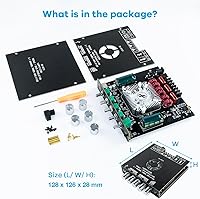
  • Package Dimensions: The retail package measures 6.38 × 5.63 × 2.05 inches, giving a sense of the board's compact footprint for enclosure planning.
  • Package Weight: The total packaged weight is 13.4 ounces, reflecting the bare board and minimal included accessories.
  • Power Supply: No power supply is included; buyers must source a compatible external DC power supply rated within the 15V to 36V input range separately.
  • Bluetooth Version: Wireless audio streaming uses Bluetooth 5.0, offering improved connection stability and range compared to older 4.x implementations.

Related Reviews

DAJUNGUO S600X
DAJUNGUO S600X
75%
78%
Power Output
74%
Audio Quality
83%
Bluetooth Connectivity
88%
Input Versatility
86%
Value for Money
More
MakerHawk ZK-MT21 Bluetooth Amplifier Board 2.1
78%
88%
Value for Money
74%
Audio Output Quality
82%
Bluetooth Connectivity
86%
Ease of Setup & Wiring
61%
Thermal Management
More
Pyle PTA1000BT 2-Channel Bluetooth Power Amplifier
73%
82%
Value for Money
51%
Power Output Accuracy
58%
Build Quality
89%
Ease of Setup
71%
Bluetooth Performance
More
Pyle PTA24BT 2-Channel Karaoke Amplifier
73%
88%
Ease of Setup
83%
Bluetooth Reliability
74%
Microphone Performance
67%
Echo Effect Quality
54%
Actual Power Output
More
Rockville RVT-1 2-Channel Car Amplifier
85%
88%
Sound Quality
85%
Performance
75%
Ease of Installation
90%
Build Quality
83%
Bass Control
More
Fosi Audio MC351
Fosi Audio MC351
81%
83%
Sound Quality
91%
Build Quality
88%
VU Meter
86%
Connectivity & Inputs
71%
Bluetooth Performance
More
Dual Electronics DBTMA100 Micro 2 Channel Bluetooth Amplifier
88%
95%
Bluetooth Connectivity
91%
Audio Clarity
87%
Build Quality
94%
Ease of Setup
78%
Power Output
More
Douk Audio OK013 Mini 2.1 Channel HiFi Stereo Amplifier
75%
83%
Value for Money
71%
Sound Output & Power
77%
Build Quality
88%
Ease of Installation
58%
Thermal Management
More
Pyle PT796BT 7.1-Channel AV Receiver
64%
67%
Value for Money
58%
Audio Performance
83%
Connectivity & Inputs
74%
Bluetooth Performance
52%
Build Quality
More
beFree Sound BFS-A102 2.1 Channel Bluetooth Speaker System
82%
85%
Sound Quality
88%
Bass Performance
80%
LED Lighting Effects
92%
Connectivity Options
75%
Build Quality
More

FAQ

No, it does not. The Hosyond TDA7498E 2.1 Channel Bluetooth Amplifier Board 160W×2+220W ships as a bare board only, and sourcing a compatible DC power supply is entirely the buyer's responsibility. A quality 24V supply with sufficient wattage headroom is the most commonly recommended pairing among experienced builders.
A 24V DC switching power supply rated at least 10 to 15 amps is a solid starting point for most builds. Running at 24V gives you a good balance between output power and heat generation. Avoid cheap unregulated supplies — voltage ripple from low-quality PSUs will show up as audible noise, particularly through the subwoofer.

Technically the subwoofer output terminal is designed to drive a passive sub directly — it sends a speaker-level signal, not a line-level preout. Connecting it to an active subwoofer with a built-in amplifier would likely damage the sub's input stage. Stick to passive subwoofer cabinets for that channel.

At moderate volume levels it stays warm but manageable. Push it hard for extended periods — especially with lower-impedance speakers — and it gets quite hot. If you are mounting it inside a closed wooden enclosure, you will want to plan for ventilation slots or a small cooling fan, otherwise thermal shutdowns become a real possibility during long listening sessions.

The listing specifies Bluetooth 5.0 but does not confirm support for aptX, aptX HD, or LDAC. Based on available information, standard SBC codec support is likely, which is adequate for casual listening but not ideal if audio fidelity is a high priority for you.

USB audio playback is limited in format support and is one of the more common complaints from buyers. MP3 files generally work reliably, but less common formats like FLAC or WMA have been reported as hit-or-miss. If USB is going to be your primary source, test your specific file types early rather than assuming broad compatibility.

Not directly on the board itself — there is no dedicated subwoofer gain knob. Balancing the sub level relative to the stereo channels usually requires either adjusting the speaker crossover passively or using an inline volume control on the subwoofer speaker wire. It is a notable omission for a 2.1-specific board.

It can be done, but it is not the most beginner-friendly starting point. The documentation is thin, and you will need to research PSU selection, wiring terminals, and enclosure ventilation independently. If you are comfortable watching build tutorials and reading forum threads, the learning curve is manageable. If you are expecting a plug-and-play kit with step-by-step instructions, this will likely frustrate you.

The minimum recommended operating voltage is 15V, and the board's undervoltage protection kicks in below 9V. Running it at 12V puts you below the specified range and will result in noticeably reduced output power — the stereo channels will sound weak and the subwoofer output will be significantly compromised. It is worth investing in a proper 24V supply to get the performance you are paying for.

Yes, and this is actually one of the stronger use cases for the TDA7498E module. As long as your existing cabinet's speakers fall within the 4 to 8 ohm, 30 to 200W compatibility range, it slots in cleanly. The main considerations are ensuring the board has adequate ventilation inside the cabinet and routing a DC power supply cable in from outside.