Overview

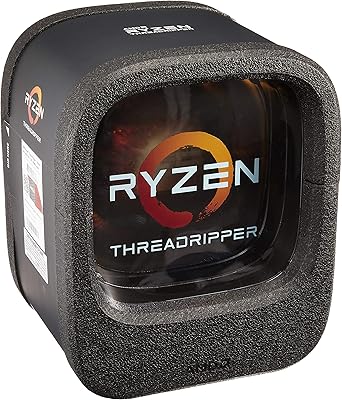
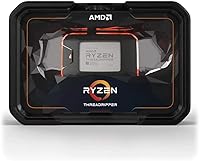
The AMD Ryzen Threadripper 2970WX Desktop Processor sits firmly in the high-end desktop workstation space, built for professionals who genuinely exhaust mainstream CPUs. Released in late 2018 as part of AMD's second-generation Threadripper lineup, it pushed the platform further with more cores and refined boost behavior than its predecessor. But committing to this chip means committing to the whole TR4 ecosystem — X399 motherboards aren't cheap, and the 250W TDP demands a serious cooling solution. This isn't a processor you drop into a budget build. The target audience is narrow by design: 3D artists, engineers, video editors, and anyone whose livelihood depends on multi-threaded throughput.
Features & Benefits

With 24 physical cores and 48 threads, the 2970WX doesn't just look impressive on paper — in CPU-intensive workflows like 3D rendering or heavy video timelines, that core count translates into real, measurable time savings. The Precision Boost Overdrive feature acts as an intelligent boost assist rather than a simple fixed overclock; it reads thermal and power headroom in real time and nudges clocks higher when conditions allow, though results vary by cooler quality. A massive 76MB combined cache keeps latency down in compute-heavy tasks, while quad-channel DDR4 and 64 PCIe lanes ensure bandwidth never becomes the bottleneck — whether you're running dual GPUs, multiple NVMe drives, or professional capture cards at once.

Best For

This 24-core processor earns its place in workstations where thread count directly determines productivity. It's a strong match for 3D rendering pipelines, animation work, multi-stream 4K or 8K video editing, and simulation tasks that scale cleanly across many cores. Content creators who render and stream simultaneously will appreciate having the headroom to do both without compromise. The 64 PCIe lanes also make it attractive for builds with complex storage and GPU configurations. That said, be honest with yourself: gaming-only builds or workloads that rely heavily on single-threaded speed won't get their money's worth here. This chip rewards those who actually need the parallelism, not those chasing the largest spec sheet.

User Feedback

Across a solid base of reviews, the 2970WX holds a 4.3-star rating, and the satisfaction among professional users reads as genuine. People consistently praise its sustained multi-threaded stability, noting it holds up under hours of heavy rendering without throttling when cooled properly. The friction points are predictable: platform costs surprise buyers who underestimated TR4 motherboard and cooler expenses, and taming 250W of heat isn't trivial. Some found PBO's real-world boost gains modest compared to expectations. A recurring theme is the 2990WX comparison — many concluded this chip is actually the more practical of the two. Worth acknowledging: it's several years old now, and newer Threadripper generations have since raised the bar considerably.

Pros

  • 24 cores and 48 threads deliver real, measurable time savings in rendering and simulation workloads.
  • Sustained stability under hours-long all-core loads earns consistent praise from professional users.
  • 64 PCIe lanes allow fully loaded workstation configurations without bandwidth compromises.
  • Quad-channel DDR4 support keeps memory-hungry creative and compute workflows well-fed.
  • Precision Boost Overdrive intelligently pushes clocks higher when thermal and power headroom permit.
  • The unlocked multiplier and Ryzen Master utility make manual tuning approachable without deep BIOS expertise.
  • A massive 76MB combined cache noticeably reduces latency in compute-intensive professional applications.
  • The 2970WX hits a practical sweet spot between the 2990WX and lower-tier Threadripper SKUs for most studio workloads.
  • Years of community knowledge, build guides, and BIOS maturity make platform troubleshooting far less daunting.
  • For professionals billing by the project, the throughput gains translate into a tangible return on investment.

Cons

  • No cooler is included, and the 250W TDP demands a premium TR4-compatible solution that adds meaningful cost.
  • Total platform cost — motherboard, cooling, and quad-channel RAM — far exceeds the CPU price alone.
  • Single-threaded performance lags behind contemporary high-clocking mainstream processors by a noticeable margin.
  • PBO boost gains vary considerably depending on cooler quality and motherboard power delivery implementation.
  • NUMA topology can limit performance in software not specifically optimized for multi-die processor configurations.
  • Some applications fail to distribute work efficiently across all 24 cores, leaving performance unrealized.
  • Fan noise under sustained full-load is a genuine concern in quieter home office or open-plan environments.
  • The platform is aging, and newer Threadripper generations have raised the bar considerably for fresh builds.
  • TR4 cooler and case compatibility requires careful upfront research due to the socket's large physical footprint.
  • Secondhand pricing inconsistency makes value assessment harder than it would be for a current-generation product.

Ratings

The AMD Ryzen Threadripper 2970WX Desktop Processor earns a strong overall reception from the professional and prosumer community, and the scores below reflect what real buyers experienced after putting it to work in demanding environments. These ratings were generated by AI after analyzing verified purchaser reviews worldwide, with spam, bot-submitted, and incentivized feedback actively filtered out. Both the genuine strengths and the recurring frustrations are reflected here without softening either side.
Multi-Threaded Performance
93%
In CPU-bound workloads like Blender rendering, Cinebench multi-core runs, or heavy video exports, this chip consistently impresses users who switched from mainstream 8- or 12-core platforms. The jump in throughput is tangible — render jobs that previously took hours are trimmed significantly. Professionals in 3D animation and VFX workflows cite it as the most meaningful hardware upgrade they made.
The performance advantage is almost entirely confined to workloads that actually scale across many threads. Users who occasionally dabble in rendering but primarily work in single-threaded tools find the real-world gains underwhelming relative to the platform investment required.
Single-Threaded Speed
61%
39%
The 4.2 GHz max boost is respectable for its generation, and Precision Boost Overdrive does push clocks upward intelligently in lightly threaded scenarios. Users doing quick UI-heavy tasks alongside heavier background jobs found the responsiveness acceptable in day-to-day desktop use.
Single-threaded performance is the 2970WX's most notable weakness relative to its price tier. Gamers and users running latency-sensitive applications like certain audio production tools found it trailing contemporary high-clocking mainstream chips by a noticeable margin.
Thermal Management
58%
42%
With a proper 360mm AIO or a high-end TR4-compatible air cooler, the chip runs stably even under sustained all-core loads. Users who invested in adequate cooling reported rock-solid temperatures and no throttling during hours-long rendering sessions.
At 250W TDP, thermal management is a genuine challenge that caught several buyers off guard. Budget or mid-range cooling solutions simply cannot keep pace, and poorly cooled setups see boost clocks collapse under sustained load. The CPU ships without a cooler, which adds meaningful cost and research burden.
Platform & Ecosystem Cost
52%
48%
The TR4 platform is feature-rich — X399 boards offer extensive connectivity, robust VRM designs, and wide memory support that enthusiast builders appreciate. Those who researched the full build cost upfront were satisfied with what the platform delivered for the money.
This is one of the most consistent complaints across reviews: the CPU price is just the starting point. TR4 motherboards, capable cooling, and quad-channel RAM kits push the total platform cost well beyond what many buyers initially budgeted, making the overall investment feel steep.
Memory Bandwidth
89%
Quad-channel DDR4 support gives the 2970WX a real edge in memory-hungry workflows. Video editors working with high-resolution RAW footage and engineers running large simulation datasets both noted how smoothly data moves when the memory subsystem is no longer the constraint.
Filling all four channels requires four matched DIMMs, which adds cost and complicates upgrades. Some users also noted that memory latency is higher compared to mainstream Ryzen platforms due to the chiplet architecture, which can subtly impact latency-sensitive tasks.
PCIe Lane Availability
91%
64 PCIe lanes is a genuine differentiator for users building complex workstations. Running dual professional GPUs alongside multiple NVMe drives and a 10GbE card simultaneously — without any lanes going into sharing or bifurcation compromises — is something mainstream platforms simply cannot do.
Most users will never come close to saturating all 64 lanes, which means this feature delivers less practical value for anyone not running a densely configured multi-GPU or storage-heavy workstation. It is a strength that only a specific subset of buyers will fully use.
Overclocking & Tuning Flexibility
74%
26%
The unlocked multiplier and AMD Ryzen Master utility give experienced builders an accessible path to tuning without diving deep into BIOS menus. Users who paired this chip with high-quality motherboards and cooling found meaningful headroom for modest manual overclocks on top of PBO.
Precision Boost Overdrive's real-world gains disappointed some buyers expecting significant uplift. The automatic boost is conservative by design — it respects thermal and power limits — so users with budget cooling saw little benefit, and PBO behavior can vary noticeably across different motherboard implementations.
Stability & Reliability
88%
Long-term stability under sustained workloads is one of the most praised aspects of this chip. Studio users running overnight render farms and engineers leaving simulations running for days reported no crashes, no instability, and consistent behavior across months of heavy professional use.
A small number of users reported early teething issues with specific X399 board and BIOS combinations at launch. Most of these were resolved through firmware updates, but buyers pairing this chip with older or budget X399 boards occasionally reported intermittent issues that required troubleshooting.
Value for Money
67%
33%
For professional users whose time has measurable dollar value — animators billing by the project, video editors on client deadlines — the core count justifies the cost relatively quickly. In that context, the 2970WX has delivered genuine return on investment for a solid base of verified buyers.
For anyone outside that professional context, the value equation is hard to defend. The combination of CPU cost, platform overhead, and the chip's age — with newer Threadripper generations now available — makes it a difficult recommendation unless found at a significantly reduced price.
Software & Driver Compatibility
82%
18%
AMD's platform maturity improved considerably with the second-generation Threadripper launch. Ryzen Master is polished and practical, BIOS support across major X399 boards is stable, and the chip works reliably with professional applications including industry-standard 3D, rendering, and simulation software.
A handful of users noted that some applications do not efficiently distribute work across all 24 cores, effectively leaving performance on the table. NUMA topology on this chip can also affect performance in software not specifically optimized for multi-die processor configurations.
Build & Installation Experience
79%
21%
The TR4 socket installation process is well-documented and uses a torque screwdriver mechanism that gives builders confidence they are seating the chip correctly. The physical package is substantial, and most users found the installation straightforward when following AMD's official guidance.
The sheer size of the TR4 package means cooler compatibility is a real concern — not all large-format coolers fit cleanly, and case clearance needs careful checking. First-time TR4 builders occasionally underestimated the physical space requirements during the planning stage.
Longevity & Future-Proofing
63%
37%
For users already on an X399 platform, the 2970WX has offered a multi-year productive lifespan. The platform's support for large memory configurations and high PCIe lane counts has kept it relevant in professional workflows longer than many expected when it launched.
The honest reality is that this chip is now several years old, and AMD's newer Threadripper generations have substantially raised the bar. Buyers considering a fresh build today face a tougher justification — the platform is mature but no longer current, and secondhand pricing matters considerably.
Noise Levels Under Load
55%
45%
Users who invested in high-quality, large-radiator AIOs found they could keep the chip cool with fans running at moderate speeds and tolerable noise levels during sustained all-core workloads. Dedicated workstation enclosures with acoustic dampening also helped some users manage fan noise acceptably.
At full load, keeping a 250W processor cool requires fans to spin hard, and several users flagged noise as a genuine annoyance in open-plan or home office environments. Cheaper cooling solutions that struggle thermally also tend to ramp fans aggressively, compounding the problem.
Documentation & Community Support
83%
The 2970WX benefits from a well-established user community accumulated over several years. Detailed build guides, overclock profiles, and platform-specific troubleshooting threads are widely available, making it easier for new buyers to navigate the TR4 ecosystem with confidence.
Because the platform is aging, some community resources reference outdated BIOS versions or software tools that have since been superseded. Newer builders occasionally encounter conflicting advice across forum threads written at different points in the chip's lifespan.

Suitable for:

The AMD Ryzen Threadripper 2970WX Desktop Processor was built for professionals whose workflows genuinely punish anything with fewer cores. If you spend your working hours in Blender, Cinema 4D, or a comparable 3D rendering environment, the 24-core architecture directly compresses the time you spend waiting — and that time has real dollar value. Video editors cutting 4K or 8K timelines with heavy effects stacks will find the thread headroom liberating, particularly when proxies are not an option and real-time performance matters. Scientists and engineers running multi-threaded simulations or large data analysis pipelines benefit enormously from the combination of high core count, quad-channel memory bandwidth, and 64 PCIe lanes that keep every subsystem fed. Content creators who render in the background while continuing to work — streaming, editing, compositing simultaneously — will also feel right at home here. Enthusiast workstation builders who need to run multiple NVMe drives, professional GPUs, and high-bandwidth peripherals without lane-sharing compromises will find no desktop platform more accommodating.
Not suitable for:

The AMD Ryzen Threadripper 2970WX Desktop Processor is straightforwardly the wrong tool for a large portion of buyers who might consider it. Gamers chasing high frame rates will find that most titles barely tickle a handful of cores, meaning single-threaded-focused mainstream CPUs will outperform this chip in the scenarios that matter to them — often at a fraction of the total platform cost. The TR4 ecosystem is not a budget endeavor: a capable X399 motherboard, a cooling solution rated for 250W of continuous heat, and four matched DDR4 DIMMs for quad-channel operation add substantially to the final bill, and that reality catches many buyers unprepared. Users whose workloads are primarily single-threaded — certain audio production environments, many legacy creative tools, and most everyday productivity software — will see little tangible benefit from 48 threads they cannot use. It is also worth being direct about the chip's age: newer Threadripper generations have since arrived with meaningfully improved architectures, and anyone starting a fresh build today should weigh secondhand pricing carefully against what current-generation alternatives offer before committing to this platform.
Specifications

  • Core Count: The processor features 24 physical cores built on AMD's second-generation Zen architecture, enabling true parallel execution across demanding professional workloads.
  • Thread Count: With 48 simultaneous processing threads via SMT, the chip can handle highly parallelized tasks such as multi-pass rendering and large-scale simulations without queuing bottlenecks.
  • Base Clock: The processor operates at a 3.0 GHz base frequency across all cores under sustained full-load conditions.
  • Boost Clock: Peak single-core boost frequency reaches 4.2 GHz via Precision Boost Overdrive, subject to available thermal and power headroom.
  • Total Cache: A combined 76MB of L2 and L3 cache sits on-die, reducing memory fetch latency for compute-intensive and data-heavy professional applications.
  • TDP: Thermal design power is rated at 250W, requiring a high-capacity TR4-compatible cooler — none is included in the box.
  • CPU Socket: This processor uses AMD's Socket TR4, which is physically incompatible with standard AM4 motherboards and requires a dedicated TR4 or X399-platform board.
  • Chipset Platform: The chip is designed for AMD's X399 chipset, found on high-end desktop motherboards from manufacturers including ASUS, MSI, Gigabyte, and ASRock.
  • Memory Support: Quad-channel DDR4 SDRAM is supported, providing up to four times the memory bandwidth of single-channel configurations when all four slots are populated with matched DIMMs.
  • PCIe Lanes: 64 PCIe lanes are available directly from the CPU, allowing simultaneous full-bandwidth operation of multiple GPUs, NVMe arrays, and high-throughput expansion cards without lane sharing.
  • Overclocking: The multiplier is fully unlocked and the chip supports Precision Boost Overdrive for automated intelligent boosting, as well as manual tuning via the AMD Ryzen Master utility.
  • Architecture: Built on AMD's Zen microarchitecture at 12nm FinFET process node, representing the second-generation Threadripper design with refinements over the original 14nm first-gen platform.
  • Memory Type: DDR4 SDRAM is the supported memory standard; DDR5 and ECC unbuffered memory are not officially supported on the X399 consumer platform.
  • Package Dimensions: The physical CPU package measures 3.1 x 2.2 x 0.3 inches, consistent with the large TR4 socket footprint that requires compatible cooler mounting hardware.
  • Weight: The processor package weighs 4.8 ounces, reflecting the large multi-chip module (MCM) die configuration used across the Threadripper product line.
  • Launch Date: This processor was first made available in October 2018 as part of AMD's second-generation Threadripper lineup alongside the flagship 32-core 2990WX.
  • Cooler Included: No CPU cooler is included in the retail package; buyers must separately source a TR4-socket-compatible cooler rated to handle a sustained 250W thermal load.
  • Supported Technologies: The chip supports AMD SenseMI Technology, AMD Ryzen Master Utility, Precision Boost Overdrive, and the AMD Zen core architecture's advanced branch prediction and prefetch features.

Related Reviews
AMD Ryzen Threadripper 3990X Desktop Processor
73%
97%
Multi-Threaded Rendering Performance
96%
Core Count and Thread Scalability
41%
Platform and Total Build Cost
53%
Thermal Management
93%
I/O and Bandwidth
More
AMD Ryzen Threadripper 3970X Desktop Processor
75%
97%
Multi-Threaded Performance
74%
Single-Threaded Responsiveness
58%
Platform Value & Total Cost
62%
Thermal Management
94%
PCIe Lane Density & Expandability
More
AMD Ryzen Threadripper 1920X 12-Core Processor
82%
94%
Multi-Core Performance
90%
Processing Speed
91%
Video Rendering Performance
58%
Power Consumption
60%
Heat Management
More
AMD Ryzen Threadripper 3960X 24-Core Processor
83%
94%
Overall Performance
98%
Multi-Threaded Performance
89%
Overclocking Potential
93%
Core & Thread Count
61%
Thermal Management
More
AMD Ryzen 5 5500 B550M K Bundle
78%
88%
Value for Money
79%
Gaming Performance at 1080p
91%
Ease of Installation
83%
Motherboard Feature Set
74%
CPU Thermal Performance
More
AMD Ryzen 5 1400 Processor
82%
92%
Value for Money
85%
Gaming Performance
88%
Overclocking Potential
80%
Thermal Management
90%
Setup and Installation
More
AMD Ryzen 5 PRO 4650G Processor
87%
85%
Gaming Performance
92%
Value for Money
87%
Overclocking Potential
89%
Multitasking Efficiency
88%
Integrated Graphics Quality
More
AMD Ryzen 9 7950X
AMD Ryzen 9 7950X
77%
97%
Multi-Core Performance
93%
Single-Core Speed
58%
Thermal Management
71%
Value for Money
88%
Platform Longevity (AM5)
More
AMD Ryzen Threadripper 1950X Desktop Processor
80%
94%
Multi-Threaded Performance
61%
Single-Core & Gaming Performance
96%
PCIe Lane Availability
63%
Platform & Motherboard Ecosystem
67%
Thermal Management & Cooling Requirements
More
AMD Ryzen 5 8500G
AMD Ryzen 5 8500G
77%
83%
CPU Performance
71%
Integrated Graphics
78%
Value for Money
67%
Gaming Capability
88%
Platform Longevity
More

FAQ

No, it does not. The box contains the processor and mounting hardware, but no cooler. Given the 250W TDP, you will need to separately purchase a TR4-compatible cooler — ideally a 280mm or 360mm AIO liquid cooler, or a high-end air cooler with a TR4 bracket. Do not underestimate this cost or the research involved in finding something that physically fits your case.

You need an AMD X399 platform motherboard with a Socket TR4 slot. Major options came from ASUS (ROG Zenith Extreme), MSI (MEG X399 Creation), Gigabyte (X399 Aorus Xtreme), and ASRock (X399 Taichi). These boards are not cheap, but they are purpose-built for this platform. Double-check that the board's BIOS supports second-generation Threadripper if buying older stock.

No. The TR4 socket is significantly larger than AM4, and standard AM4 cooler mounting brackets will not attach correctly. You need a cooler that either natively supports TR4 or one that comes with a compatible TR4 mounting kit. Most major cooler manufacturers offered TR4 brackets, sometimes sold separately, so check before buying.

Honestly, not particularly — at least not relative to its cost. Most games rely heavily on single-threaded performance and do not effectively use more than 8 to 12 cores. This chip's single-threaded speed is decent but not class-leading, and the platform cost far exceeds what a gaming-focused build would justify. If gaming is your primary use case, a mainstream Ryzen or Intel Core processor will serve you better and cost considerably less overall.

PBO is best understood as an intelligent boost assist rather than a traditional manual overclock. It monitors real-time thermal and power conditions and pushes clock speeds above standard boost limits when headroom exists. The results vary depending on your cooler quality, motherboard power delivery, and ambient temperature. Do not expect massive gains — users typically see modest improvements, and heavily budget-cooled setups may see minimal benefit at all.

The TR4 platform supports up to 128GB of DDR4 RAM across four channels. For best performance, populate all four channels with matched DIMMs — so sets of four sticks rather than two. DDR4-3200 is a solid target for most workloads, though the platform's memory controller is known to be somewhat sensitive to overclocked memory kits, so sticking to validated QVL memory from your motherboard manufacturer is wise.

For most professional users, the 2970WX is actually the more practical choice. The 2990WX's additional 8 cores come with a more complex NUMA configuration that creates performance bottlenecks in software not specifically optimized for multi-die workloads. The 2970WX tends to deliver more consistent performance across a wider range of applications. Unless your specific software scales cleanly to 32 cores and you have verified benchmarks showing a meaningful advantage, the 24-core chip is typically the smarter buy.

That depends heavily on what you are paying. At a deeply discounted secondhand price, the 2970WX can still be a capable workstation chip for the right workloads. At close to original retail pricing, it becomes a harder case to make — newer Threadripper generations have significantly improved architecture, efficiency, and single-threaded performance. If you are building a cost-sensitive professional workstation and can find this chip at a steep discount with a compatible X399 board, it can still earn its keep. At full price, evaluate current alternatives seriously first.

Plan for at least an 850W power supply for a single-GPU workstation build, and 1000W or higher if you intend to run dual professional GPUs. The CPU alone pulls up to 250W under sustained all-core load, and that headroom adds up quickly once you factor in your GPU, storage, and other components. A high-quality 80+ Gold or Platinum rated PSU from a reputable manufacturer is strongly recommended — this is not the place to cut costs.

The X399 consumer platform does not officially support ECC (Error-Correcting Code) memory in the way that AMD's EPYC server platform does. While some users have reported limited ECC functionality depending on the motherboard, it is not a guaranteed or officially validated feature on this platform. If ECC memory support is a hard requirement for your workflow — common in scientific computing or financial modeling — you should look at AMD's EPYC platform rather than consumer Threadripper.

Where to Buy