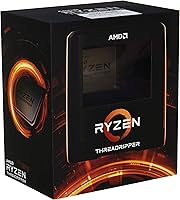
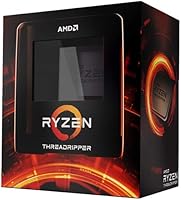
AMD Ryzen Threadripper 3970X Desktop Processor

Overview
The AMD Ryzen Threadripper 3970X Desktop Processor arrived in late 2019 as one of the most capable high-end desktop chips AMD had built to that point, targeting serious workstation builders rather than casual users. Sitting in the middle of the Threadripper 3000 family — above the 3960X and below the 3990X — the 3970X hits a practical sweet spot for professionals who need extreme parallel performance without paying top-tier prices. That said, this is not a plug-and-play upgrade. It demands a TRX40 motherboard, a substantial power supply, and a capable aftermarket cooler, given its 280W TDP. Budget accordingly before pulling the trigger.
Features & Benefits
At the heart of this Threadripper chip is a 32-core, 64-thread design built on AMD's 7nm Zen 2 architecture, which means workloads that spread across many cores — rendering, simulation, heavy compilation — get to use every ounce of that capacity simultaneously. A 4.5 GHz max boost keeps single-threaded tasks responsive, while the massive 144MB combined cache reduces how often the CPU has to reach out to slower memory. The 3970X also brings 88 PCIe 4.0 lanes to the table, letting builders run multiple NVMe drives, expansion cards, and GPUs without starving any of them for bandwidth. Quad-channel DDR4 support rounds out a platform built for data-intensive professional work.
Best For
This workstation processor genuinely shines in environments where core count and throughput matter most. Blender, Cinema 4D, and V-Ray users will notice render times dropping substantially — sometimes dramatically — compared to mainstream desktop chips. Video professionals cutting 4K or 8K timelines, running noise reduction, and encoding simultaneously will appreciate not having to wait on the CPU. Scientific and engineering teams processing large datasets also have real reasons to consider this platform. It handles heavy multi-application workflows — streaming, virtual machines, and creative tools running side by side without meaningful slowdown. If you need maximum PCIe lane density for a complex multi-device rig, few chips at this tier offer more flexibility.
User Feedback
Across roughly 255 ratings, the 3970X holds a 4.4 out of 5, and the pattern in buyer comments is fairly consistent. Professional users — studio artists, video editors, engineers — tend to be enthusiastic about real-world rendering gains and the processor's stability under prolonged heavy loads. Complaints cluster around the platform, not the chip itself: the cost of a TRX40 board, the absence of a bundled cooler, and a thermal envelope that demands serious airflow planning. A few buyers noted that for gaming or lightly-threaded tasks, a mainstream Ryzen 5000 chip may actually edge it out. First-time HEDT builders flagged a steeper learning curve around platform setup, though experienced builders found the process manageable.
Pros
- 32 cores and 64 threads deliver transformative render time reductions in Blender, V-Ray, and Cinema 4D.
- Sustained all-core performance remains stable over long overnight renders and batch processing jobs.
- 88 PCIe 4.0 lanes allow multi-GPU setups, NVMe RAID arrays, and professional I/O cards to coexist without bandwidth limits.
- Quad-channel DDR4 support meaningfully accelerates data-intensive workloads like simulation and large dataset processing.
- The 3970X handles multiple demanding applications running simultaneously without noticeable slowdown.
- Unlocked multiplier gives experienced builders straightforward access to manual overclocking or automatic boost tuning.
- Strong long-term platform stability — professional users report reliable daily operation across months of heavy use.
- Broad OS support covers Windows 10, RHEL, and Ubuntu, making it practical for cross-platform studio and research environments.
- Core count and throughput remain competitive for professional creative software even years after the original launch.
Cons
- No cooler is included — a capable TR4-compatible aftermarket solution adds meaningful cost and installation complexity.
- The 280W TDP demands serious case airflow planning; mid-tier cooling choices can lead to thermal throttling under sustained load.
- Total platform cost — motherboard, RAM, PSU, and cooler — is substantially higher than the chip price alone suggests.
- Single-core gaming performance trails behind modern mainstream desktop chips in CPU-limited titles.
- Not all professional software scales efficiently beyond 16 cores, leaving some buyers with underutilized hardware.
- High-speed RAM kits can require BIOS tuning to stabilize, which adds unexpected setup friction.
- The TRX40 platform offers no upgrade path beyond the Threadripper 3000 series, limiting long-term flexibility.
- Power consumption under full load requires a 1000W or higher PSU in most configurations, raising ongoing electricity costs.
- First-time HEDT builders frequently report a steeper learning curve around component compatibility and initial configuration.
- Some older professional applications need patches or manual thread affinity adjustments to properly utilize all 32 cores.
Ratings
The AMD Ryzen Threadripper 3970X Desktop Processor earns a strong overall standing across verified buyer feedback, and the scores below reflect an AI-driven analysis of real-world user reviews sourced globally, with spam, incentivized posts, and bot activity actively filtered out. Professional workstation builders, 3D artists, and video editors dominate the reviewer pool, which shapes where this chip excels and where it falls short. Both the genuine strengths and the frustrations buyers actually encountered are reflected here without sugarcoating.
Multi-Threaded Performance
Single-Threaded Responsiveness
Platform Value & Total Cost
Thermal Management
PCIe Lane Density & Expandability
Memory Bandwidth & Cache
Overclocking Headroom
Long-Term Stability & Reliability
Gaming Performance
Platform Setup Complexity
Software & OS Compatibility
Power Consumption
Workstation Build Suitability
Packaging & Out-of-Box Experience
Longevity & Future-Proofing
Suitable for:
The AMD Ryzen Threadripper 3970X Desktop Processor is purpose-built for professionals whose daily work is genuinely bottlenecked by CPU throughput — not just people who want a fast computer. If you spend hours waiting on Blender renders, V-Ray scene exports, or Cinema 4D simulations, this chip can cut those wait times in ways that have a direct impact on your output and deadlines. Video editors working with 4K or 8K footage who need to run noise reduction, color grading, and background encoding simultaneously will find the 32-core architecture handles concurrent tasks without forcing compromises. Engineers and scientists processing large datasets, running fluid dynamics simulations, or working in CAE software will benefit from both the core count and the quad-channel memory bandwidth. Content creators who live with multiple virtual machines, streaming software, and creative tools open at the same time will notice real headroom that mainstream chips simply cannot provide. If you also need to connect multiple NVMe drives, professional capture cards, and a high-end GPU without bandwidth contention, the 88 PCIe 4.0 lanes make this platform uniquely capable.
Not suitable for:
The AMD Ryzen Threadripper 3970X Desktop Processor is a poor fit for anyone who primarily games, does casual computing, or is building a general-purpose desktop — the cost and complexity of the TRX40 platform make it overkill by a wide margin for those use cases. Gamers in particular should look elsewhere: mainstream Ryzen 5000 chips deliver better frame rates in CPU-limited titles at a fraction of the total platform investment. Budget-conscious builders also need to understand that the chip is only the starting point — a compatible TRX40 motherboard, quad-channel RAM kit, high-wattage power supply, and a capable aftermarket cooler are all mandatory expenses, and none come cheap. First-time PC builders or those unfamiliar with HEDT platforms should be cautious; the setup process is more involved than a standard desktop build, and troubleshooting compatibility issues requires patience and research. Anyone whose professional software does not scale well across many cores — certain DAWs, older CAD tools, or single-threaded compilers — will not extract meaningful value from the added core count and will likely feel the platform cost is hard to justify.
Specifications
- Architecture: Built on AMD's 7nm Zen 2 microarchitecture, delivering improved instructions-per-clock efficiency and power characteristics over the previous generation.
- Core Count: Features 32 physical cores capable of handling massively parallel workloads that mainstream desktop processors cannot approach.
- Thread Count: Simultaneous multi-threading across 64 threads allows compatible software to distribute work across the full logical core count.
- Boost Frequency: Reaches up to 4.5 GHz on boosted cores via Precision Boost Overdrive, maintaining single-threaded responsiveness alongside heavy multi-threaded workloads.
- Total Cache: 144MB of combined L2 and L3 cache substantially reduces memory latency in data-intensive applications like simulation and large-scene rendering.
- PCIe Lanes: Provides 88 PCIe 4.0 lanes, enabling simultaneous high-bandwidth operation of multiple GPUs, NVMe drives, and professional expansion cards without contention.
- Memory Support: Supports quad-channel DDR4 memory, delivering the wide memory bandwidth required by video editing, scientific computing, and large dataset workloads.
- CPU Socket: Uses Socket TR4, requiring a compatible TRX40 platform motherboard — it is not compatible with mainstream AM4 or older TRX40 predecessor boards.
- TDP: Rated at 280W thermal design power, necessitating a capable aftermarket cooler rated for the TR4 socket and a robust system power supply.
- Cooler Included: No cooling solution is included in the box; buyers must source a compatible high-capacity TR4 air cooler or AIO liquid cooler separately.
- Overclocking: The unlocked multiplier supports manual overclocking via AMD Ryzen Master software, which also offers an automatic performance tuning mode for less experienced builders.
- OS Support: Officially supports Windows 10 64-bit, Red Hat Enterprise Linux x86 64-bit, and Ubuntu x86 64-bit operating systems.
- Dimensions: The processor measures 3.07 x 2.2 x 0.3 inches, consistent with the large TR4 socket footprint standard across the Threadripper platform.
- Weight: The chip weighs 1.7 pounds, reflecting the substantial integrated heat spreader surface area required for effective thermal transfer at this power level.
- Platform: Requires a TRX40 chipset motherboard; the platform supports high-end workstation features including multi-channel memory and full PCIe 4.0 lane distribution.
- Launch Date: First made available on November 25, 2019, as part of AMD's third-generation Threadripper high-end desktop processor family.
- Manufacturer: Designed and manufactured by AMD, with the processor carrying AMD's standard warranty terms for desktop processor products.
- Amazon Rating: Holds a 4.4 out of 5 rating based on 255 verified buyer ratings on Amazon, with strong satisfaction concentrated among professional workstation users.
Related Reviews
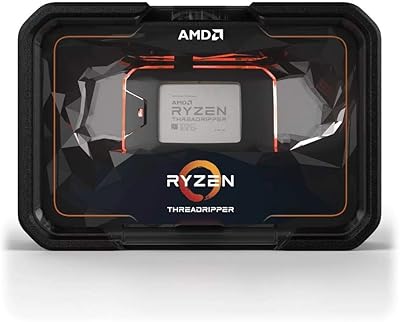
AMD Ryzen Threadripper 2970WX Desktop Processor
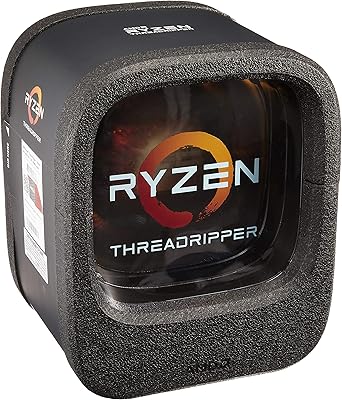
AMD Ryzen Threadripper 1920X Desktop Processor
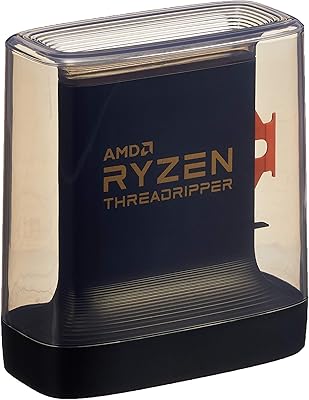
AMD Ryzen Threadripper 3960X 24-Core Processor
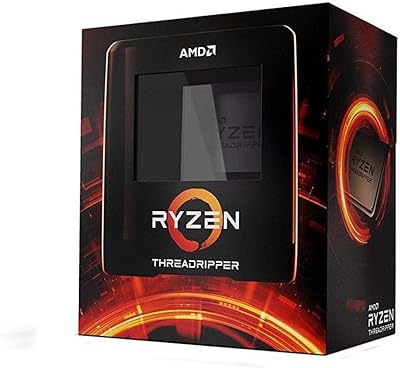
AMD Ryzen Threadripper 3990X Desktop Processor
AMD Ryzen 5 5500 B550M K Bundle
AMD Ryzen 5 1400 Processor
AMD Ryzen 5 PRO 4650G Desktop Processor
AMD Ryzen 9 7950X
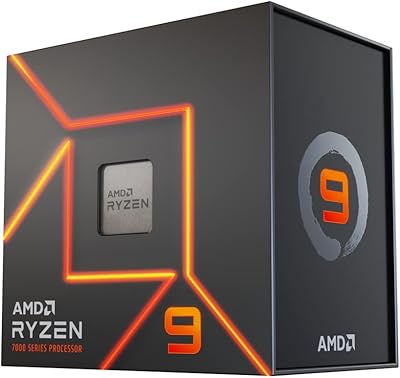
AMD Ryzen 9 7900X