
Overview

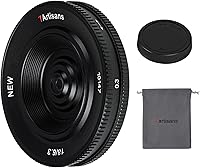
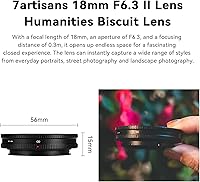
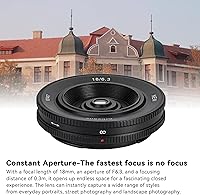
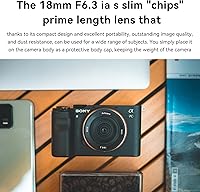
The 7artisans 18mm F6.3 Mark II MFT Lens is about as close to a pancake lens as Micro 4/3 shooters can get without spending serious money. Arriving in late 2020 as a refined iteration, it translates to roughly a 27mm equivalent on MFT bodies — a versatile angle that sits comfortably between true wide and standard perspectives. At just over three ounces and barely over half an inch thick, this compact prime practically disappears on slim bodies like the Panasonic GF9 or GF7. It won't replace a fast zoom, but as an affordable, carry-everywhere lens, it earns its place in a travel bag.

Features & Benefits

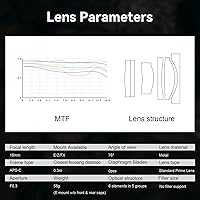
The optical construction uses a 6-element, 4-group formula that prioritizes center sharpness while keeping the overall package impressively small. Manual focus is the only mode on offer — no electronic contacts, no autofocus — which sounds limiting until you realize it suits deliberate, slow-paced shooting rather well. The focus ring moves smoothly enough for careful adjustments, and a minimum focus distance of 0.35m means you can work reasonably close to your subject. That said, the f/6.3 maximum aperture demands honest attention: it is slow by any measure and will frustrate anyone shooting indoors or after dark. In good natural light, though, it produces clean, usable results.

Best For

This manual wide-angle has a clear target audience: street and travel photographers who want a slim, lightweight kit that won't draw attention or weigh down a bag. It pairs especially well with compact Panasonic bodies — the GF7, GF8, GF9, even the GH5 — where the size pairing creates a genuinely pocketable combination. Beginners exploring manual focus will find the 27mm-equivalent angle forgiving enough to build technique without constantly chasing focus. If you shoot mostly outdoors in decent light and value portability over optical speed, this compact prime fits the brief well. Autofocus-dependent shooters or anyone working regularly in low light should look elsewhere.

User Feedback

Across roughly 258 ratings, the 18mm pancake lens sits at 3.9 out of 5 — a score that reflects a niche but appreciative audience. Size and balance are the most consistently praised qualities; buyers note how naturally it sits on smaller bodies without any front-heaviness. The complaints, however, are hard to ignore: edge vignetting and barrel distortion both appear in real-world shots and require post-processing to correct. A handful of reviewers also found the focus ring imprecise for work on moving subjects. On the brighter side, value for money comes up repeatedly, especially from first-time manual lens buyers who feel the overall experience justifies what they paid.

Pros

  • Incredibly slim and light — barely noticeable on small MFT bodies like the GF9 or GH5.
  • The ~27mm equivalent is a versatile, natural-feeling focal length for everyday wide-angle shooting.
  • Manual focus operation gives deliberate shooters full tactile control with no electronic dependencies.
  • Broad compatibility covers most Olympus and Panasonic Micro 4/3 cameras without adapters.
  • Center sharpness in good natural light is genuinely respectable for this price tier.
  • Minimum focus distance of 0.35m allows reasonably close work for detail and near-subject shots.
  • First-time manual lens buyers consistently report strong satisfaction with the overall value.
  • The Mark II refinement brings improved optical consistency over the original version.
  • Its discreet size makes it ideal for candid street shooting without drawing attention.

Cons

  • The f/6.3 aperture struggles badly in low light — indoor shooting without flash is genuinely difficult.
  • Visible barrel distortion at the edges means post-processing correction is almost always necessary.
  • The focus ring, while smooth, lacks the precision needed for tracking any kind of moving subject.
  • No electronic contacts means no EXIF lens data, focus confirmation, or in-body stabilization communication.
  • Vignetting in corners is noticeable and can be distracting if left uncorrected in post.
  • Build quality reflects the budget price point — it feels light in a plastic rather than a premium way.
  • The slow aperture limits creative depth-of-field control, making subject separation nearly impossible.
  • Not a practical option for video work where smooth, accurate manual focus pulls are required.

Ratings

Our AI rating system analyzed verified global buyer reviews for the 7artisans 18mm F6.3 Mark II MFT Lens, actively filtering out incentivized, duplicate, and bot-generated feedback to surface what real photographers actually experienced. The scores below reflect an honest composite of both genuine praise and recurring frustrations, weighted by how frequently each issue was raised across international markets. Nothing has been softened — where this compact prime earns it, the scores show it; where it falls short, those gaps are reflected too.

Portability
94%
This is where the lens genuinely excels above almost everything else in its class. Street and travel photographers repeatedly describe it as the lens they forget is on their camera — it adds so little bulk that shooting with a slim GF9 or GF7 feels like carrying almost nothing at all.
A handful of users note that the lightweight plastic construction, while great for portability, makes the lens feel slightly insubstantial compared to even modestly priced competitors. There is a fine line between impressively light and feeling like it might not survive a hard knock.
Value for Money
88%
Among first-time manual lens buyers especially, the price-to-experience ratio comes up as a strong positive in reviews. Most buyers feel they received a genuinely usable wide-angle lens at a cost that removes any real financial risk, making it an easy recommendation for anyone curious about manual glass.
Those who expected performance closer to pricier pancake options from Panasonic or Olympus came away disappointed, particularly around optical correction and aperture range. Value perception drops noticeably among more experienced photographers who have a clearer benchmark for comparison.
Optical Sharpness
71%
29%
Center sharpness in good daylight conditions is solid enough to produce clean, detailed images that hold up well at normal viewing sizes. Landscape and architectural shots taken outdoors in flat or overcast light tend to look crisp and usable straight from the camera.
Edge and corner performance is a consistent weak point — vignetting and barrel distortion are visible enough to require post-processing correction on most shots. Photographers shooting for print or pixel-peeping for professional work will find the rendering noticeably soft toward the frame borders.
Low-Light Performance
31%
69%
In very bright outdoor conditions — midday sun, open shade, or well-lit urban environments — the fixed f/6.3 aperture is manageable enough to produce noise-free exposures at low ISO settings. A few users shooting in strong natural light report being perfectly satisfied with the results in those specific conditions.
Indoors, after dusk, or in any environment that requires pushing past ISO 800, this manual wide-angle struggles badly. The aperture limitation is a fundamental constraint that no amount of camera-side adjustment fully overcomes, and it renders the lens impractical for a wide category of common shooting situations.
Build Quality
58%
42%
The lens feels solid enough for regular travel and casual daily use, and there are no reports of common mechanical failures like a wobbly focus ring or loose mount. For the price tier, the assembly is consistent and the mount alignment appears accurate across most units.
The external materials feel noticeably plasticky and lightweight in a way that does not inspire long-term confidence, particularly compared to all-metal alternatives. There is no weather sealing of any kind, which limits usefulness in light rain or dusty environments where many travel photographers actually find themselves.
Focus Ring Feel
63%
37%
For slow, deliberate shooting on static subjects like architecture, landscapes, or posed portraits, the focus ring is smooth enough to allow careful, precise adjustments without fighting the mechanism. Beginners learning to manual focus often describe it as easy to operate and accessible.
The ring lacks sufficient resistance for reliable focus pulls on moving subjects — it is too loose and imprecise to consistently nail focus before a subject shifts position. Video users in particular find it frustrating, as smooth cinematic focus transitions are nearly impossible with the current damping level.
Compatibility
91%
The MFT mount covers an impressively wide range of Olympus and Panasonic bodies, and users rarely report any physical fit or mount recognition issues. Photographers with multiple MFT bodies across different generations appreciate that one lens serves their entire camera collection.
The complete absence of electronic contacts means no automatic profile correction, no EXIF lens data, and no stabilization cooperation with IBIS-equipped bodies — all of which reduces practical compatibility despite the physical mount being universally accepted.
Image Distortion
54%
46%
In post-processing software like Lightroom or Capture One, the barrel distortion corrects predictably and without significant image cropping, making it manageable for photographers comfortable working with RAW files. Once corrected, the geometry across the frame looks reasonably natural.
Straight lines near the edges of the frame curve noticeably in uncorrected images, which is particularly visible in architectural and interior photography. JPEG shooters who skip post-processing will regularly encounter warped geometry that is hard to overlook at normal viewing distances.
Vignetting Control
49%
51%
Some photographers deliberately embrace the natural light falloff toward corners for a film-like aesthetic in street and portrait work, and for those users the vignetting actually adds character rather than detracting from it.
For most use cases, the corner darkening is pronounced enough to look like a technical flaw rather than a stylistic choice. It requires deliberate correction in post on nearly every shot, adding extra steps to an editing workflow that many buyers did not anticipate needing.
Manual Focus Usability
67%
33%
For beginners learning manual focus fundamentals, the 27mm-equivalent angle is forgiving enough that small focus errors rarely destroy an otherwise good composition. Pairing the lens with focus peaking on bodies like the GH5 or GH4 significantly improves the hit rate on static subjects.
There is no hard focus stop, infinity mark accuracy is reported as approximate rather than precise, and the focus ring travel is short enough that fine adjustments can easily overshoot the target. Experienced manual focus shooters used to higher-end glass tend to find the feel unsatisfying.
Focal Length Versatility
76%
24%
The ~27mm equivalent sits in a genuinely useful range for street photography, travel documentation, and environmental scenes — wide enough to capture context without the distortion of an ultra-wide lens. Many users report using this as their default walk-around lens when size is the priority.
As a fixed prime, it offers no flexibility for tighter compositions, and the f/6.3 ceiling prevents using the focal length creatively for subject isolation or low-light mood shots the way faster 25mm or 20mm primes can. Versatility is limited to the focal length itself, not to shooting conditions.
Size-to-Body Pairing
89%
The physical balance on compact Panasonic GF-series bodies is one of the most praised aspects across all reviews — it turns an already small camera into a genuinely pocketable system. Photographers who travel light and want a camera that attracts minimal attention consistently single this pairing out as a genuine strength.
On larger MFT bodies with deeper grips, like the GH5 or G85, the tiny lens can feel slightly mismatched proportionally, making the combination front-light in a way that is not quite as elegant. It is a minor ergonomic point, but worth noting for users of deeper-bodied cameras.
Weather Resistance
18%
82%
For controlled outdoor shooting in dry, clear conditions, the lack of sealing is a non-issue and most buyers in fair-weather climates have not encountered any durability problems during normal use.
There is absolutely no weather sealing on this lens, which is a real limitation for travel photographers who shoot in changing outdoor conditions. Even light drizzle or dusty environments pose a genuine risk, and the budget build materials offer little reassurance against incidental moisture exposure.

Suitable for:

The 7artisans 18mm F6.3 Mark II MFT Lens is a natural fit for photographers who shoot primarily outdoors in good light and care more about portability than raw optical performance. Street photographers will appreciate how little it adds to a bag — or a coat pocket — especially when paired with slim Panasonic bodies like the GF7, GF8, or GF9. Travel shooters who want a dedicated wide-angle option without lugging extra weight will find the ~27mm equivalent a practical everyday focal length for landscapes, architecture, and environmental shots. It also works well for beginners wanting to learn manual focus discipline; the wide angle is forgiving enough that slight focus misses rarely ruin a shot. Casual documentarians and hobbyists who shoot at their own pace, value a minimal kit, and are comfortable doing light post-processing corrections will get solid, enjoyable results from this compact prime.

Not suitable for:

The 7artisans 18mm F6.3 Mark II MFT Lens is a genuinely poor choice for anyone who shoots frequently in low light or indoors without supplemental lighting. The f/6.3 maximum aperture is slow enough that available-light photography — think indoor events, evening street scenes, or dim cafes — will consistently produce noisy or underexposed images even on capable MFT bodies. Photographers who rely on autofocus for moving subjects, kids, pets, or any fast-paced situation should avoid this lens entirely; the manual-only design simply cannot keep up. Users expecting edge-to-edge sharpness straight out of camera will also be disappointed, as vignetting and barrel distortion at the edges are real enough to require Lightroom or similar corrections. Anyone shooting video who needs smooth, reliable focus pulls may find the ring too imprecise for professional or even semi-professional work.

Specifications

  • Brand: Manufactured by 7artisans, a Chinese optical brand known for producing affordable manual lenses for mirrorless systems.
  • Focal Length: Fixed 18mm focal length, equivalent to approximately 27mm on a Micro Four Thirds sensor due to the 2x crop factor.
  • Max Aperture: Maximum aperture of f/6.3, which is relatively slow and best suited to well-lit outdoor shooting conditions.
  • Optical Formula: The lens uses 6 elements arranged in 4 groups to balance center sharpness with a compact physical profile.
  • Focus Type: Fully manual focus only, with no autofocus motor, electronic contacts, or focus confirmation communication with the camera body.
  • Min Focus Distance: Minimum focusing distance of 0.35m (approximately 13.8 inches), allowing reasonably close approach to nearby subjects.
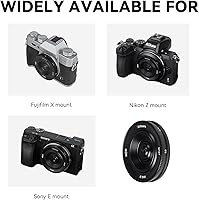
  • Mount: Micro Four Thirds (MFT) mount, compatible with Olympus and Panasonic mirrorless camera systems without any adapter.
  • Dimensions: Measures 0.6 x 2.2 x 2.2 inches, making it one of the slimmest prime lenses available for the MFT system.
  • Weight: Weighs just 3.17 ounces (approximately 90 grams), adding minimal bulk to any compatible mirrorless body.
  • Generation: This is the Mark II version, released in October 2020 as a refined iteration of the original 18mm f/6.3 design.
  • Filter Thread: Standard 46mm front filter thread, compatible with commonly available ND, UV, and polarizing filters of that size.
  • Aperture Blades: The lens features a fixed aperture design at f/6.3 with no adjustable aperture ring or diaphragm blades.
  • Compatibility: Confirmed compatible bodies include the Panasonic GF1 through GF9 series, G1 through G85, GH1, GH4, GH5, and most Olympus MFT cameras.
  • ASIN: Amazon Standard Identification Number for this product is B08LPS3YLD.
  • Seller Rating: Currently rated 3.9 out of 5 stars across 258 customer ratings on Amazon.
  • BSR Ranking: Holds a Best Sellers Rank of #163 in the Mirrorless Camera Lenses category on Amazon.
  • Warranty: 7artisans offers an 18-month limited warranty on this lens covering manufacturing defects under normal use conditions.
  • Availability: The lens is not discontinued and remains actively available as of its Amazon listing status.

Related Reviews
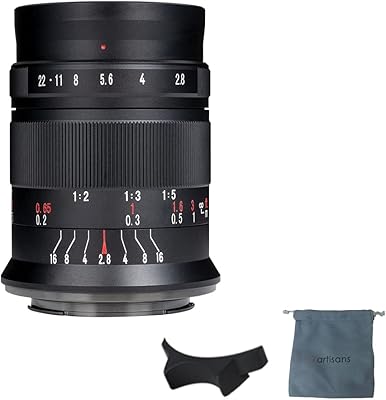
7artisans 60mm F2.8 Mark II Macro Lens
77%
84%
Optical Sharpness
88%
Bokeh Quality
81%
Build Quality
91%
Value for Money
79%
Focus Ring Feel
More
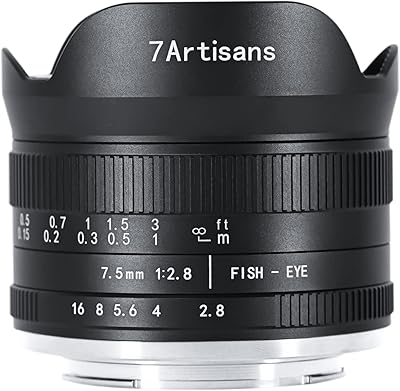
7artisans 7.5mm f2.8 Mark II Fisheye Lens
78%
74%
Optical Sharpness
77%
Chromatic Aberration Control
83%
Build Quality
91%
Value for Money
58%
Manual Focus Usability
More
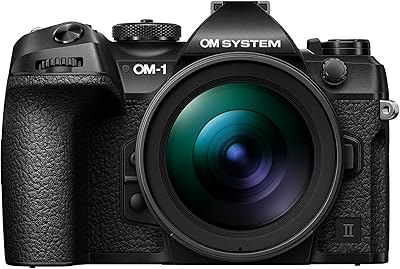
OM System OM-1 Mark II with M.Zuiko 12-40mm f/2.8 PRO II
81%
93%
Autofocus Performance
91%
Weather Sealing & Durability
84%
Image Quality
71%
Autofocus in Low Light
92%
Lens Quality (M.Zuiko 12-40mm f/2.8 PRO II)
More
Viltrox AF 85mm F1.8 Mark II Lens
81%
86%
Autofocus Speed
91%
Autofocus Noise
88%
Center Sharpness
63%
Edge & Corner Sharpness
79%
Bokeh Quality
More
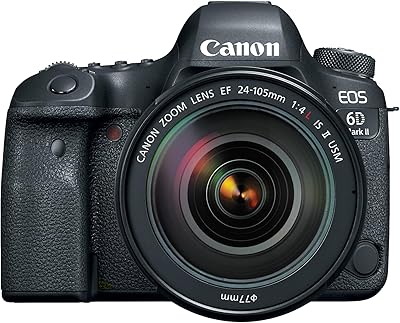
Canon EOS 6D Mark II with EF 24-105mm f/4L IS II USM
81%
93%
Image Quality
79%
Autofocus Performance
57%
Video Capabilities
91%
Bundled Lens Quality
88%
Battery Life
More
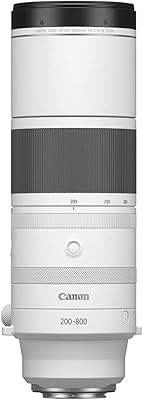
Canon RF200-800mm F6.3-9 IS USM Zoom Lens
82%
96%
Zoom Range Versatility
91%
Image Stabilization
83%
Autofocus Performance
89%
Portability & Weight
58%
Aperture Range
More
Canon RF-S10-18mm F4.5-6.3 IS STM Zoom Lens
83%
91%
Image Sharpness
84%
Autofocus Performance
88%
Image Stabilization
76%
Build Quality & Handling
93%
Vlogging Usability
More
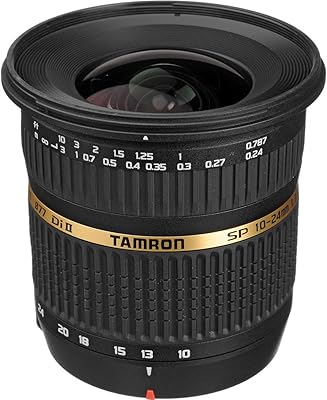
Tamron 10-24mm f/3.5-4.5 SP Di II LD Aspherical (IF) Lens for Nikon
85%
87%
Image Quality
82%
Autofocus Speed
80%
Build Quality
91%
Portability
70%
Low-Light Performance
More
Tamron 18-300mm F/3.5-6.3 Zoom Lens
81%
91%
Autofocus Speed & Accuracy
96%
Zoom Range Versatility
74%
Image Sharpness
88%
Optical Image Stabilization
61%
Low-Light Performance
More
JOYALENS JL246PS 3-Lens Digital Microscope
77%
83%
Image & Screen Clarity
74%
Magnification Range
86%
Lighting System
57%
Build Quality
79%
Ease of Use
More

FAQ

Yes, any camera with a Micro Four Thirds mount will accept this lens, which covers the full Olympus OM-D and PEN lineup alongside Panasonic GF, G, and GH series bodies. No adapter is needed — it mounts directly.

No, there are no electronic contacts on this lens at all. That means no EXIF lens data recorded in your photos, no focus peaking assistance triggered automatically, and no stabilization communication with bodies that use lens data for IBIS calculations. You can still enable focus peaking manually in your camera settings, which helps a lot.

It is noticeable, especially in the corners at the widest settings. Most shooters correct it quickly in Lightroom or similar software using the manual lens correction tools. If you shoot JPEG and dislike post-processing, it may bother you more than it would a RAW shooter.

Technically yes, it mounts fine on the GH5, but practically it is a tough lens for video work. Manual focus pulls are hard to execute smoothly, and there is no focus ring dampening designed for cinematic use. For casual vlog-style footage in good light it is workable, but for anything requiring precise focus it will frustrate you.

Honestly, not really. The f/6.3 aperture means you need a lot of light to get clean exposures without pushing ISO high. Indoor shooting — at home, in cafes, at events — will almost always result in either motion blur or noisy images unless you have bright window light or supplemental lighting on hand.

On any MFT body, the 2x crop factor brings the 18mm focal length to a roughly 27mm full-frame equivalent. That gives you a moderately wide, natural-looking angle — wider than a standard 35mm equivalent but not dramatically wide like a 24mm or below. It works well for street scenes, interiors with good light, and environmental portraits.

Most users describe it as smooth but fairly loose, which makes precise focus adjustments a bit tricky. For static subjects like architecture or landscapes it is fine. For anything that moves — people walking, kids, animals — the imprecision becomes a real problem quickly.

The front filter thread is 46mm, which is a common and affordable size. Standard UV protection filters, circular polarizers, and ND filters in that size are easy to find and inexpensive.

It is durable enough for regular travel use, but do not expect the kind of reassuring solidity you get from higher-end glass. The body feels light — some would say plasticky — and there is no weather sealing. A small lens pouch or protective case is a smart investment if you plan to throw it in a bag frequently.

This compact prime trades the convenience of a zoom range for a dramatically smaller footprint and the discipline of a fixed focal length. Optically they are in a similar tier, though the kit lens will almost certainly have a faster maximum aperture and autofocus. The main reason to choose this over a kit lens is size — if you want the smallest possible wide-angle option for your MFT body, it is genuinely hard to beat.

Where to Buy