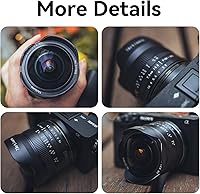
Overview

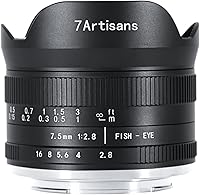
The 7artisans 7.5mm f2.8 Mark II Fisheye Lens is 7artisans' second crack at an already capable budget fisheye, and the refinements are noticeable. Built for APS-C mirrorless cameras on the Canon RF mount, it produces an effective field of view closer to 11mm — full-frame users should be aware upfront that significant vignetting will appear across the frame. The 190-degree field of view is the real draw here, enabling that signature warped, spherical look. Worth noting right away: this is a fully manual lens with zero electronic connection to the camera, which means no autofocus, no EXIF metadata, and no in-body stabilization communication.
Features & Benefits

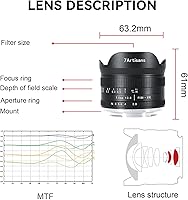
Optically, the 7.5mm Mark II runs a 9-group, 11-element design with two ED glass elements — a meaningful addition that tackles the chromatic aberration that plagued budget fisheyes for years. 7artisans sourced Hoya glass for this version, and the difference shows in edge color rendering, especially compared to earlier iterations. At f2.8, this wide-angle manual lens handles low-light environments well enough for star trail and aurora work, where pulling in extra light matters more than pixel-perfect sharpness. Physically, it weighs just 1.23 lbs and fits comfortably in a jacket pocket, making it easy to bring along without adding bulk to a travel or adventure kit. A one-year warranty rounds out the package.

Best For

This fisheye lens punches well above its price class for a specific kind of shooter. Landscape and travel photographers looking for creative wide-angle compositions on a Canon RF APS-C body will get a lot of mileage here. Content creators building VR or 360-style videos will appreciate just how much the 190-degree coverage captures in a single frame. Astrophotographers after an affordable option for star trails will find the f2.8 aperture genuinely useful under dark skies. Action and lifestyle photographers — think skateparks, surfing, or street scenes — love the dramatic distortion this style of lens produces. For beginners curious about creative lenses, it lowers the barrier to experimentation without a major commitment.

User Feedback

Across around 100 reviews, this wide-angle manual lens holds a 4.4-star average, which is solid for a manual-only specialty lens. Buyers consistently praise the center sharpness, the compact build, and the overall construction quality relative to what they paid. Real-world uses cited include travel vlogging, night sky photography, and skateboard footage. On the critical side, edge softness at f2.8 is a recurring note — it tightens up considerably by f5.6, but wide-open corners are soft, as is typical for this lens category. The manual focus learning curve also catches some buyers off guard, particularly those coming from autofocus systems. A few full-frame users noted unexpected vignetting, reinforcing that this lens is built for APS-C shooting.

Pros

  • The 190-degree field of view produces a uniquely immersive look that is impossible to achieve with standard wide-angle lenses.
  • Two ED glass elements visibly reduce chromatic aberration compared to the original version, especially noticeable at the frame edges.
  • Center sharpness is genuinely impressive for the price, holding up well in landscape and travel shots.
  • At under 1.3 lbs, this fisheye lens is light enough to carry every day without adding meaningful weight to a kit.
  • The f2.8 aperture performs well enough for astrophotography and low-light wide-angle work on APS-C bodies.
  • Hoya-sourced glass gives the optics a quality feel that punches above the typical budget lens tier.
  • Build quality consistently earns praise from buyers who expected something flimsier at this price point.
  • A one-year warranty with a stated 24-hour support response adds a reasonable safety net for the investment.
  • At #41 in Mirrorless Camera Lenses on Amazon, real-world buyer interest confirms this is not a fringe product.
  • The compact footprint makes it practical for travel vlogging, adventure shooting, and situations where pack size matters.

Cons

  • Fully manual operation with zero electronic communication means no autofocus, no EXIF data, and no stabilization link to the body.
  • Edge softness at f2.8 is real and noticeable — stopping down to f5.6 or beyond is needed for cleaner corners.
  • Full-frame Canon RF users will encounter heavy vignetting that makes the lens essentially impractical without heavy cropping.
  • No aperture blade count is officially confirmed, which makes it harder to predict sunstar rendering for creative shooting.
  • Manual focus on a super-wide fisheye can be tricky to nail in fast-moving or unpredictable shooting situations.
  • The lack of EXIF metadata means your editing software will not automatically apply lens correction profiles.
  • Chromatic aberration, while improved over the Mark I, can still appear under high-contrast conditions near the frame edges.
  • New shooters transitioning from autofocus lenses may face a frustrating learning curve before getting consistently sharp results.
  • No weather sealing is mentioned, which limits confidence when shooting in rain, mist, or dusty outdoor environments.
  • Customer support quality can vary significantly depending on region and timing, despite the advertised response commitment.

Ratings

The scores below reflect an AI-driven analysis of verified global buyer reviews for the 7artisans 7.5mm f2.8 Mark II Fisheye Lens, with spam, incentivized, and bot-generated feedback actively filtered out before scoring. Each category is rated independently based on patterns found across real-world usage reports, meaning both genuine strengths and recurring frustrations are transparently baked into every number. Nothing is rounded up to look good — if buyers struggled with something, the score reflects it.

Optical Sharpness
74%
26%
Center sharpness earns consistent praise from buyers shooting landscapes, travel scenes, and night skies — many report clean, detailed results in the middle of the frame even at f2.8. For a specialty lens at this price point, the center resolution genuinely surprises people who expected less.
Edge and corner sharpness wide open is a recurring complaint, and it is a real issue rather than nitpicking. Stopping down to f5.6 helps significantly, but for any scene where corner detail matters — architecture interiors, star fields at the frame edge — wide-open shots require realistic expectations.
Chromatic Aberration Control
77%
23%
The two ED glass elements introduced in the Mark II make a measurable difference compared to the original, and buyers who owned both versions specifically call this out. High-contrast edges near the frame perimeter show far less color fringing than the previous generation did under similar shooting conditions.
Chromatic aberration is not fully eliminated, particularly toward the extreme edges of the 190-degree frame under bright, high-contrast lighting. Some buyers note that corrections still need to be applied in post-processing for technically clean results in challenging outdoor scenes.
Build Quality
83%
Given the price positioning, the physical construction consistently surprises buyers in a positive way. The barrel feels solid without any rattling, the focus ring has a smooth, damped resistance, and nothing about the lens feels like it was assembled cheaply — a common concern with budget third-party glass.
No weather sealing is present, which starts to show as a real limitation when buyers take this fisheye lens on adventure or travel shoots in unpredictable conditions. A few users also report that the focus ring, while smooth, offers limited tactile feedback for fine adjustments at close focus distances.
Value for Money
91%
Across the review pool, value is the single most cited positive attribute. Buyers repeatedly express that the image quality, glass sourcing, and build they received far exceeded what they expected at this price. For photographers exploring fisheye work for the first time, the cost-to-capability ratio is hard to argue with.
The value equation does weaken slightly for buyers who discover after purchase that they need to frequently stop down to get acceptable corner sharpness, effectively limiting wide-open shooting. At a higher price this compromise would be harder to accept, but in context most buyers still consider it fair.
Manual Focus Usability
58%
42%
For static subjects — landscapes, architecture, nightscapes — manual focus on a super-wide lens is genuinely workable, and many buyers settle into a comfortable zone focus technique within a few sessions. The deep depth of field at this focal length means that small focus errors are often invisible in practice.
For action shooting — skateparks, moving subjects, street scenes — the manual-only operation creates real frustration, and this is the most common source of negative reviews from buyers who did not fully register the lack of autofocus before purchasing. Missing focus on a fast-moving subject with no AF fallback is a painful experience.
Low-Light Performance
79%
21%
At f2.8 with a wide 190-degree frame, this wide-angle manual lens pulls in enough light to produce usable star trail and aurora images on APS-C bodies when paired with higher ISO settings. Astrophotographers in particular report satisfying results on clear, dark-sky nights without needing to push ISO to extremes.
Without any electronic communication to the camera, in-body image stabilization does not activate, which hurts handheld low-light performance in non-astro situations like indoor events or dimly lit travel scenes. Users shooting handheld in low light need to keep shutter speeds high enough to compensate on their own.
Distortion & Fisheye Character
88%
The 190-degree fisheye rendering is exactly what action, lifestyle, and VR content creators are after, and buyers in these groups are almost universally satisfied with the look this lens produces. The distortion is dramatic and consistent across the frame, making it feel intentional and creative rather than accidental.
The pronounced barrel distortion is, by definition, not correctable into a rectilinear image without heavily cropping and warping the frame, which limits versatility. Buyers who expected a correctable ultra-wide-angle perspective rather than a true fisheye aesthetic tend to feel misled, even though the product description is clear.
Compatibility & Mount Fit
86%
The Canon RF mount connection is reported as snug and precise across user reviews, with no wobble or play once the lens is seated. Buyers using it on Canon APS-C RF bodies like the R7 and R10 report that it mounts cleanly and feels secure during handheld and stabilized shooting.
The complete absence of electronic contacts means no automatic lens correction, no EXIF focal length data, and no aperture recording — all of which create minor but persistent workflow friction. Full-frame RF body owners who did not read the APS-C targeting closely enough frequently report disappointment at the vignetting.
Portability
93%
At 1.23 lbs and just over 2.4 inches in length, this fisheye lens is compact enough to drop into a jacket pocket or a small sling bag alongside a spare battery. Travel photographers and vloggers specifically mention that its size makes it easy to bring on trips where every ounce and cubic inch matters.
The bulbous front element, standard for fisheye designs, makes the lens slightly awkward to pack flat against other gear without a dedicated pouch or case. Front element scratches are also a realistic risk since no conventional protective filter can be attached to the exposed curved glass.
Astrophotography Suitability
78%
22%
Buyers using this lens for Milky Way arches and aurora photography report that the combination of f2.8 and the extreme field of view captures wide sky scenes in single exposures that would otherwise require stitched panoramas. The manual focus limitation is less of a disadvantage here since focus is typically set once and left alone.
Coma and edge star distortion are present wide open, which is common but still mentioned by more technically demanding astrophotographers who expect tighter star rendering toward the corners. Stopping down reduces coma but increases exposure time, creating the usual trade-off familiar to any night sky shooter.
Ease of Setup
72%
28%
Mounting the lens, setting a zone focus, and starting to shoot takes only a few minutes even for users new to manual glass. The learning curve for static shooting scenarios is shallow enough that most buyers feel comfortable within their first outing, especially with some guidance from online communities.
Users coming from fully electronic, autofocus lens systems often underestimate how much workflow adjustment is required. The absence of any in-camera lens data also means that setting up proper lens profiles in Lightroom or Capture One requires manual configuration, which adds time to the editing process.
Vignetting Control
63%
37%
On APS-C bodies — the intended sensor format — natural vignetting is moderate and many fisheye users find it aesthetically acceptable or even desirable for the creative look it adds to the circular, warped frame. At smaller apertures it largely disappears without any correction needed.
On full-frame Canon RF bodies, vignetting is severe enough to make the lens practically unusable for standard photography without heavy cropping. Even on APS-C bodies, wide-open vignetting at the corners is noticeable in evenly lit scenes like overcast skies and requires correction in post if a clean edge-to-edge exposure is needed.
After-Sales Support
67%
33%
7artisans includes a one-year warranty and advertises a 24-hour response window, which gives buyers a reasonable baseline of confidence for a third-party lens purchase. Users who have successfully contacted support report that replacements and responses are handled without excessive friction.
Support quality appears inconsistent depending on region and how the purchase was fulfilled, with some international buyers reporting slower resolution times than the advertised window. The warranty does not appear to cover accidental damage, which limits its practical value for outdoor and adventure shooters.

Suitable for:

The 7artisans 7.5mm f2.8 Mark II Fisheye Lens is a strong pick for Canon RF APS-C shooters who want to experiment with extreme wide-angle and fisheye photography without spending a lot. Travel photographers will appreciate how little space it takes up in a bag, while the 190-degree field of view opens up genuinely creative compositional possibilities that a standard wide-angle simply cannot replicate. Astrophotographers working on a tighter budget will find the f2.8 aperture capable enough for star trails and dark-sky sessions where pulling in ambient light is the priority. Content creators producing immersive or VR-style video will benefit from how much the frame captures in a single shot. Action sports photographers — skateboarding, surfing, mountain biking — who want that dramatic, distorted perspective will also get real value here, as will beginners who are simply curious about what a fisheye can do without committing to a high-end optic.

Not suitable for:

Shooters who rely on autofocus should stop here — the 7artisans 7.5mm f2.8 Mark II Fisheye Lens is entirely manual, with no electronic coupling to the camera body whatsoever, and that catches a lot of buyers off guard. There is no EXIF data written to files, no focus confirmation assistance, and no in-body image stabilization communication, which makes it a slower, more deliberate tool than most modern mirrorless users are accustomed to. Full-frame Canon RF users should also know upfront that this lens is engineered specifically for APS-C sensors — mounting it on an R5 or R6 will produce heavy vignetting that makes the images largely unusable without significant cropping. Photographers who prioritize corner-to-corner sharpness wide open will likely be frustrated, as edge performance at f2.8 is noticeably soft, which is common for fisheye designs at this price tier but still worth flagging. If you need a workhorse lens for client work, event shooting, or any scenario demanding speed and reliability, this wide-angle manual lens is not the right tool for the job.
Specifications

  • Focal Length: The lens has a fixed focal length of 7.5mm, equivalent to approximately 11mm on an APS-C sensor camera body.
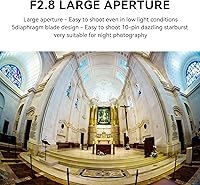
  • Maximum Aperture: The maximum aperture is f2.8, allowing meaningful light intake for low-light and night sky photography.
  • Field of View: The lens covers a 190-degree field of view, producing the full spherical fisheye effect characteristic of this lens category.
  • Optical Design: Internal construction uses 9 groups and 11 elements, including two ED (Extra-low Dispersion) glass elements to reduce chromatic aberration.
  • Lens Glass: Optical elements are sourced from Hoya, a recognized glass manufacturer, representing a quality step up from the original version.
  • Focus System: Focus is entirely manual with no autofocus motor, no electronic contacts, and no communication with the camera body.
  • Compatible Mount: This lens is designed exclusively for the Canon RF mount, compatible with Canon APS-C mirrorless bodies such as the R, RP, R5, and R6.
  • Sensor Format: Optimized for APS-C sensor cameras; full-frame Canon RF bodies will experience significant vignetting across the image frame.
  • Weight: The lens weighs 1.23 lbs, keeping the overall travel and handheld shooting kit lightweight and manageable.
  • Dimensions: Physical dimensions measure 2.4 x 2.49 x 2.49 inches, making it a compact option for a specialty wide-angle lens.
  • Lens Type: This is a fisheye lens designed to produce intentional barrel distortion and an ultra-wide immersive perspective.
  • Aperture Blades: The exact number of aperture blades has not been officially specified by the manufacturer in available product documentation.
  • Warranty: 7artisans includes a one-year limited warranty with a stated customer support response time of within 24 hours.
  • Availability: The lens became available in October 2024, making it a relatively recent release within the 7artisans product lineup.
  • Market Rank: At time of review, this lens held a Best Sellers Rank of #41 in the Mirrorless Camera Lenses category on Amazon.

Related Reviews

7artisans 60mm F2.8 Mark II Macro Lens
77%
84%
Optical Sharpness
88%
Bokeh Quality
81%
Build Quality
91%
Value for Money
79%
Focus Ring Feel
More
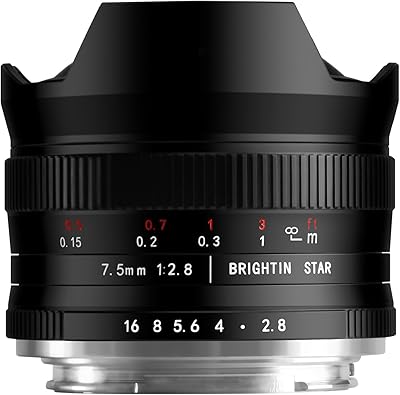
Brightin Star 7.5mm F2.8 III Fisheye Lens
75%
78%
Image Sharpness
88%
Value for Money
71%
Low-Light & Astrophotography Performance
82%
Build Quality & Construction
61%
Manual Focus Usability
More
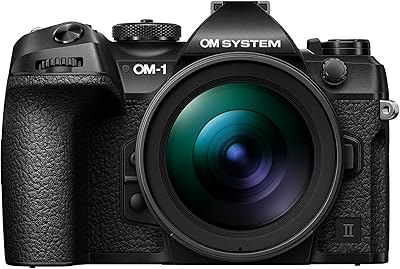
OM System OM-1 Mark II with M.Zuiko 12-40mm f/2.8 PRO II
81%
93%
Autofocus Performance
91%
Weather Sealing & Durability
84%
Image Quality
71%
Autofocus in Low Light
92%
Lens Quality (M.Zuiko 12-40mm f/2.8 PRO II)
More
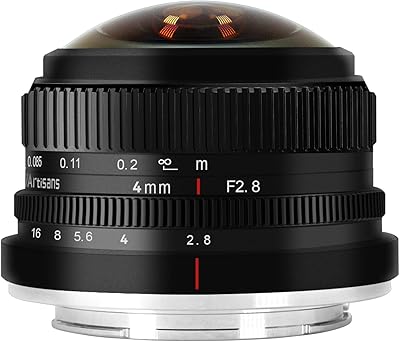
7Artisans 4mm F2.8 Fisheye Lens
75%
88%
Value for Money
83%
Build Quality
71%
Image Sharpness
58%
Ease of Use
86%
Circular Fisheye Effect
More
7Artisans 4mm F2.8 Fisheye Lens
77%
86%
Build Quality
91%
Value for Money
71%
Image Sharpness
63%
Optical Aberrations
58%
Ease of Use
More
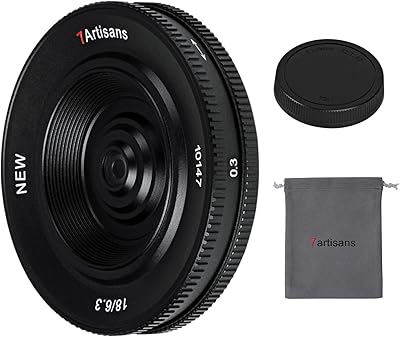
7artisans 18mm F6.3 Mark II MFT Lens
65%
94%
Portability
88%
Value for Money
71%
Optical Sharpness
31%
Low-Light Performance
58%
Build Quality
More
Viltrox AF 85mm F1.8 Mark II Lens
81%
86%
Autofocus Speed
91%
Autofocus Noise
88%
Center Sharpness
63%
Edge & Corner Sharpness
79%
Bokeh Quality
More
Sigma 24-70mm F2.8 DG DN II Lens
82%
93%
Optical Sharpness
84%
Autofocus Performance
88%
Build Quality
86%
Weather Sealing
71%
Value for Money
More
Panasonic Leica DG 8-18mm Wide-Angle Zoom Lens
82%
91%
Image Sharpness
93%
Build Quality
89%
Video Performance
67%
Low-Light Performance
69%
Value for Money
More
Fujifilm X-S20 XF16-50mm Mirrorless Camera Kit
80%
91%
Image Quality
94%
Film Simulations & Color Science
88%
In-Body Image Stabilization
86%
Video Capability
67%
Autofocus Performance
More

FAQ

No, the 7artisans 7.5mm f2.8 Mark II Fisheye Lens is a fully manual lens with no autofocus capability and no electronic contacts on the mount. You will need to focus manually using the focus ring, and the camera will not provide any focus confirmation assistance. If you rely on autofocus for most of your shooting, this will require a significant adjustment.
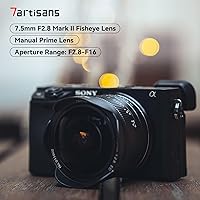
Yes, noticeably. This wide-angle manual lens is engineered specifically for APS-C sensors, and mounting it on a full-frame body like the R5 or original R will produce heavy, dark vignetting around the frame edges. You can partially compensate by shooting in APS-C crop mode, but you will lose a significant portion of the resolution your camera is capable of.

The main upgrades in the Mark II are the two added ED glass elements and the switch to Hoya-sourced glass. In practical terms, this means noticeably improved control over chromatic aberration, especially at the frame edges where color fringing was a common complaint with the original version. Build quality has also received positive comments from users who owned both.

Center sharpness is genuinely good for this price tier and holds up well in landscape, travel, and astro shots. Edge sharpness is softer, especially at f2.8, which is typical for fisheye lenses across all price points. Stopping down to around f5.6 improves the corners considerably. For client-facing professional work where pixel-perfect edge sharpness matters, expectations should be set accordingly.

Yes, and this is one of its stronger practical use cases. The f2.8 aperture lets in a useful amount of light, and the 190-degree field of view captures a massive sweep of sky in a single frame. Manual focus is actually less of a disadvantage in astrophotography since you will typically set focus to near-infinity and leave it there.

No. There are no electronic contacts on this lens, so the camera receives zero information from it. Your EXIF data will not record focal length or aperture values, and the camera cannot apply any automatic lens corrections. You will need to input lens information manually in your editing software if you want correction profiles applied.

No weather sealing is mentioned in any official product documentation for this lens. Using it in rain, heavy mist, or dusty conditions carries the same risk as any unprotected optic. If you regularly shoot in wet or harsh outdoor environments, treat it with appropriate caution.

Due to the extreme bulbous front element that is standard on fisheye lenses of this design, conventional screw-on front filters cannot be attached. Some photographers use rear gel filter holders if available, or specialized fisheye filter systems, but standard 77mm or similar thread filters will not physically fit.

It depends on what you are shooting. For landscapes, architecture, and astro work where subjects are static, manual focus on a super-wide lens is fairly forgiving since depth of field at this focal length is deep. For fast-moving subjects like skateboarders or pets, it takes real practice to nail focus consistently. New manual lens users should expect some trial and error in the first few sessions.

This fisheye lens is quite compact, measuring about 2.4 inches in length and weighing just over a pound. It fits easily in a jacket pocket or the front pocket of a camera bag, which makes it practical to carry alongside other lenses rather than as a dedicated-bag item. For travel photographers in particular, the small footprint is a genuine practical advantage.

Where to Buy