Overview

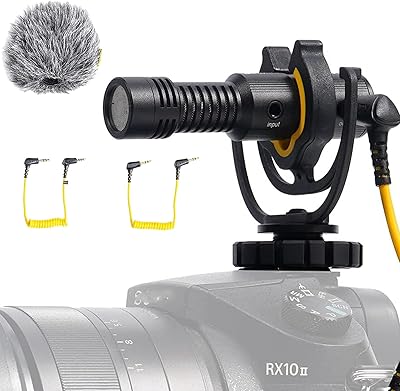
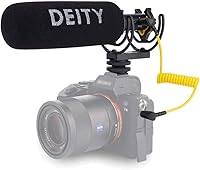
The Deity D4 Duo Dual-Capsule Shotgun Microphone is a compact, camera-mountable mic built for creators who need more than a single forward-facing audio source. Unlike most on-camera shotguns, this dual-capsule mic captures audio from both the front and rear simultaneously — all in a lightweight aluminum body weighing just 40 grams. It draws power directly from your camera via plug-in power, so there are no batteries to manage or forget. Ranked #284 in Professional Video Microphones on Amazon with a 4.3-star average from nearly 500 ratings, the D4 Duo has earned a solid reputation among solo videographers, vloggers, and run-and-gun interview shooters.
Features & Benefits

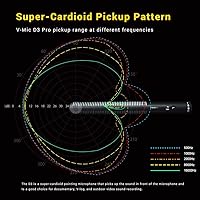
The standout feature of the D4 Duo is its two-capsule setup: a front cardioid capsule aimed at your subject, and a rear capsule pointing back toward the camera operator. A top-mounted switch lets you choose between stereo mode — using only the front capsule — and dual mono, which splits output so front audio goes left and rear audio goes right. That rear capsule can also be bypassed entirely via the 3.5mm AUX input, which accepts a lavalier or wireless receiver instead — worth clarifying upfront, since some buyers assume it is a headphone monitoring jack. With a maximum SPL of 120dB, this camera-mount shotgun handles loud environments without distorting.

Best For

This dual-capsule mic is most useful for solo interview situations — think a journalist or YouTuber filming a subject while also needing their own questions captured clearly. Run-and-gun videographers, particularly those working with mirrorless or DSLR cameras, will appreciate how little bulk it adds to their setup. At just 40 grams, it barely registers on a lightweight rig. Content creators routing a wireless lav system through the AUX input get clean subject audio plus ambient or interviewer audio on a separate channel. It is also a solid first upgrade from built-in camera audio for anyone getting serious about video without investing in a full audio kit.

User Feedback

Buyers consistently highlight the convenience of capturing two audio sources without a separate recorder or mixer, and many are genuinely surprised that the Rycote Lyre shockmount — a premium accessory on its own — is included in the box rather than sold separately. That said, the rear capsule's lower sensitivity is a real limitation; rear audio typically needs noticeable gain adjustment in post compared to the front. A number of users also report that certain smartphones require a TRRS-to-TRS adapter for full functionality, which is worth knowing before your first shoot. Overall reception is positive, but anyone buying specifically for rear-capsule audio should set realistic expectations.

Pros

  • Captures front and rear audio simultaneously — no second recorder or mixer needed.
  • Plug-in power means zero battery management; just plug in and shoot.
  • The Rycote Lyre shockmount is included in the box, not sold separately — a genuine bonus.
  • AUX input lets you feed in a wireless lav receiver for even cleaner subject audio.
  • At 40 grams, this dual-capsule mic adds almost no weight to a camera rig.
  • The top-mounted mono/stereo switch makes channel routing quick to change on the fly.
  • A 120dB maximum SPL means the front capsule handles loud environments without distorting.
  • Broad compatibility with DSLRs, mirrorless cameras, smartphones, and tablets.
  • Compact aluminum body feels durable without adding unnecessary size to your kit.
  • A strong BSR ranking and 4.3-star average from nearly 500 buyers back up its real-world reliability.

Cons

  • Rear capsule sensitivity is 9dB lower than the front, resulting in quieter rear-channel audio that needs post-production correction.
  • No headphone monitoring — the AUX port is input only, which surprises buyers expecting playback.
  • Smartphone users may need a TRRS-to-TRS adapter, which is not included and easy to forget.
  • The D4 Duo relies entirely on camera plug-in power; it will not work with devices that do not supply bias voltage through their 3.5mm jack.
  • Rear capsule audio quality degrades noticeably in louder environments where gain compensation introduces more noise.
  • No built-in high-pass filter or pad, limiting fine-tuned control over the signal before it hits your camera.
  • The stereo spread from the front capsule alone is limited — it is a single small-diaphragm cardioid, not a true stereo pair.
  • Cable and adapter compatibility can vary across camera brands, occasionally requiring trial and error before a clean signal is confirmed.

Ratings

Our AI scoring system analyzed verified global purchases of the Deity D4 Duo Dual-Capsule Shotgun Microphone, filtering out incentivized reviews and bot activity to surface what real buyers actually experienced. The scores below reflect both where this camera-mount shotgun genuinely delivers and where it falls short — no sugarcoating. Strengths in portability and dual-channel convenience are balanced against honest assessments of rear capsule limitations and compatibility quirks.

Audio Quality (Front)
83%
The front capsule consistently earns praise from solo filmmakers and vloggers who notice an immediate, meaningful improvement over built-in camera audio. In controlled indoor environments — sit-down interviews, desk setups, indoor b-roll — the front cardioid delivers clean, detailed sound with a natural character that holds up well in post.
In windier outdoor conditions or noisier venues, the front capsule picks up more ambient bleed than some users expect from a directional shotgun design. Buyers coming from higher-end dedicated shotguns may find the front capsule competent but not class-leading at this price tier.
Audio Quality (Rear)
54%
46%
For casual use — capturing an interviewer's questions or logging ambient reference audio — the rear capsule does its job adequately. Users who need a rough guide track rather than broadcast-grade audio from behind the camera report it as functional and genuinely useful for syncing and editing workflows.
The 9dB sensitivity gap between front and rear capsules is the D4 Duo's most consistently cited pain point. Rear audio often arrives noticeably quieter, and boosting it in post introduces background noise, particularly in outdoor or ambient-heavy environments where the gain penalty becomes difficult to manage cleanly.
Build Quality
81%
19%
The aluminum housing feels solid and purposeful in hand — noticeably more premium than the plastic shells found on competing mics in this category. Users report that after months of regular shooting, including travel and event work, the body shows minimal wear and the switch mechanism stays crisp.
A small number of buyers noted that the output cable, while functional, does not feel as robustly constructed as the mic body itself. Those who frequently pack and unpack their kit flagged the cable connection point as an area worth treating carefully over time.
Ease of Use
88%
Mount it, plug in the 3.5mm cable, flip the switch to your preferred mode, and you are recording — there is genuinely almost nothing to configure. Beginners making the jump from built-in camera audio consistently describe setup as the easiest part of adding the D4 Duo to their workflow.
The mono/stereo switch labeling trips up some users initially, and the AUX input function is frequently misunderstood as a headphone monitoring port. These are minor friction points, but a clearer quick-start guide in the box would eliminate most of the early confusion buyers report.
Portability & Size
93%
At 40 grams and under 94mm tall, this dual-capsule mic adds almost nothing to a compact mirrorless or DSLR setup. Travel filmmakers and street shooters specifically call out how unobtrusive it is — it mounts flush, does not overbalance small rigs, and fits easily into any camera bag pocket.
The very compact dimensions mean the top-mounted switch is closely spaced to the capsule body, making it slightly fiddly to flip with gloves on or during a fast-paced shoot. It is a minor ergonomic trade-off for the size, but worth noting for cold-weather or run-and-gun shooters.
Value for Money
78%
22%
The bundled Rycote Lyre shockmount alone represents meaningful added value — it is an accessory buyers of competing mics often have to purchase separately. For creators who need dual-channel audio on a budget without investing in a separate field recorder or audio mixer, the D4 Duo offers a genuinely practical solution at its price point.
Buyers who primarily need high-quality rear audio may find the value proposition weaker, since the rear capsule limitation means they often end up routing a wireless lav through the AUX input anyway — a workaround that requires additional gear investment. In that scenario, a single high-quality front-only shotgun paired with a dedicated lav system could serve them better for similar money.
Shockmount Performance
86%
The Rycote Lyre mount is a well-regarded piece of isolation hardware, and buyers consistently report that zoom ring vibrations, footsteps, and minor bumps to the camera body are effectively absorbed before reaching the capsules. For handheld run-and-gun work, this makes a real, audible difference compared to a rigid mount.
Like all lyre-style mounts, it offers limited protection against very sharp, sudden impacts directly to the camera body. A small number of users also noted that the shoe mount fit is slightly loose on certain third-party cold shoe adapters, which can introduce a faint rattle if not checked before shooting.
Device Compatibility
67%
33%
With DSLRs and mirrorless cameras that supply plug-in power through a dedicated mic input, the D4 Duo works reliably across brands — Canon, Sony, Nikon, Fujifilm users all report consistent performance with no meaningful setup friction.
Smartphone compatibility is where the experience gets inconsistent. Many Android and iOS devices require a TRRS-to-TRS adapter that is not included, and some users report the plug-in power supply from certain phone models is insufficient to drive both capsules cleanly. It is a workable situation, but one that requires research and potentially extra accessories before shooting.
AUX Input Versatility
74%
26%
For users who connect a wireless lav receiver through the AUX input, the functionality is a genuine workaround for the rear capsule sensitivity gap — clean subject audio on one channel, wireless receiver on the other, all captured in-camera without a mixer. Travel journalists and solo interview shooters find this configuration especially practical.
The AUX input's true purpose is poorly communicated in the product listing, leading a meaningful proportion of buyers to misunderstand it as a monitoring output. Those expecting to plug in headphones for real-time audio check will be disappointed, and the lack of any monitoring option at all is a genuine gap for critical fieldwork.
Wind & Noise Rejection
61%
39%
In calm indoor environments, the cardioid polar pattern does a reasonable job of keeping off-axis noise from entering the mix. The Rycote shockmount handles mechanical vibration competently, and for controlled settings, most users find wind and handling noise to be a non-issue.
Without a foam windscreen or dead cat — neither of which are included — outdoor use in anything above a light breeze produces noticeable wind rumble on both capsules. There is also no built-in high-pass filter to roll off low-frequency noise in post, which means outdoor shooters need to handle this either with accessories or in editing.
Switch & Control Design
71%
29%
Having a physical toggle switch directly on the mic body for mode selection is practical and quick — no menus, no app, no guesswork mid-shoot. Videographers who switch between solo shooting and interview setups throughout a day appreciate being able to change modes without touching the camera.
The switch has a short travel and minimal tactile feedback, making it easy to accidentally shift modes when adjusting the mic or removing it from the shoe mount. A few users have reported arriving at a shoot only to discover the switch had been nudged during transport, resulting in an unexpected recording mode.
In-Box Accessories
82%
18%
Including a genuine Rycote Lyre shockmount rather than a generic plastic clip sets the D4 Duo apart from most competitors at this tier. Buyers frequently highlight this as one of the most pleasant surprises when unboxing, since comparable Rycote mounts retail independently for a significant portion of the total mic cost.
The output cable included in the box is basic, and no windscreen is provided despite outdoor use being an obvious and frequently mentioned use case. A TRRS adapter for smartphone use would also be a practical inclusion given how many buyers pair this mic with mobile devices.

Suitable for:

The Deity D4 Duo Dual-Capsule Shotgun Microphone is purpose-built for solo creators who need to capture two audio sources at once without carrying extra gear. If you regularly shoot interviews by yourself — where you need clean subject audio upfront and your own voice recorded from behind the camera — this dual-capsule mic solves that problem in a single, lightweight package. Run-and-gun videographers working with DSLRs or mirrorless cameras will find it a natural fit; it mounts directly to the hot shoe, draws power from the camera, and adds virtually no bulk to a compact rig. Travel filmmakers and event videographers who cannot afford to miss audio from either direction will also get real value here, especially those routing a wireless lav system through the AUX input for even cleaner subject audio. It is equally well-suited to beginners making their first serious audio upgrade, since there are no batteries, no external recorders, and no complicated setup to navigate.
Not suitable for:

The Deity D4 Duo Dual-Capsule Shotgun Microphone is not the right tool for situations where rear-channel audio quality needs to match the front. The rear capsule operates at a noticeably lower sensitivity than the front, meaning audio captured from behind the camera will require meaningful gain adjustments in post — and in noisier environments, that gap becomes harder to manage cleanly. Audio professionals or advanced filmmakers who demand broadcast-quality capture from both directions will find this camera-mount shotgun falls short of that standard. It is also not a monitoring solution; the AUX input is for feeding in an external mic or receiver, not for plugging in headphones, which trips up buyers expecting in-ear playback. Smartphone users should be aware that certain devices require a TRRS-to-TRS adapter to work correctly, which is an extra step that is easy to overlook until you are already on location.
Specifications

  • Capsule Config: Dual cardioid capsule arrangement with one front-facing and one rear-facing electret condenser element for simultaneous two-direction audio capture.
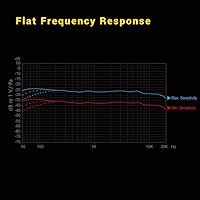
  • Frequency Response: Captures audio across a range of 50Hz to 20kHz, covering everything from low vocal warmth to the upper edge of human hearing.
  • Front Sensitivity: Front capsule sensitivity is rated at -42±3dB re 1V/Pa at 1kHz, delivering a strong, clean signal from subjects positioned in front of the camera.
  • Rear Sensitivity: Rear capsule sensitivity is rated at -51±3dB re 1V/Pa at 1kHz, which is 9dB lower than the front and typically requires gain compensation in post-production.
  • Maximum SPL: Handles up to 120dB SPL at 1kHz before distortion reaches 1% THD, making it suitable for moderately loud environments such as outdoor events or street interviews.
  • Signal-to-Noise: Signal-to-noise ratio of 84dB ensures a relatively quiet noise floor for a camera-mounted mic in this form factor.
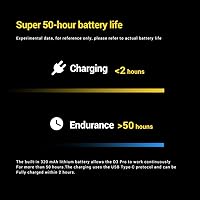
  • Power Source: Operates entirely on plug-in power supplied through the camera's 3.5mm jack, requiring no batteries or external power supply.
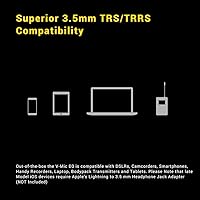
  • AUX Input: TRS 3.5mm AUX input accepts an external signal between 2–5VDC, allowing a lavalier microphone or wireless receiver to feed directly into the right channel.
  • Output Connector: Single TRS 3.5mm output connects directly to a camera, smartphone, or laptop audio input for straightforward plug-and-record operation.
  • Output Modes: A physical switch on the top of the body toggles between stereo mode (front capsule only, full stereo track) and dual mono mode (front on left channel, rear on right channel).
  • Body Material: Housing is constructed from aluminum, providing a balance of durability and low weight suited to compact camera rigs.
  • Weight: Weighs 40g (1.41oz), adding minimal load to a camera hot shoe or cold shoe mount.
  • Dimensions: Measures 21mm in diameter and 93.5mm in height, making it one of the more compact camera-mount shotgun options available.
  • Shockmount: Includes a Rycote Lyre shockmount with integrated camera shoe mount, which mechanically isolates the capsules from vibration and handling noise.
  • Compatible Devices: Works with DSLRs, mirrorless cameras, smartphones, tablets, and laptops — any device that supplies plug-in power through a 3.5mm audio input.

Related Reviews

Sennheiser ME66 Short Shotgun Microphone Capsule
79%
88%
Directional Performance
84%
Noise Floor
61%
Value for Money
53%
Module Dependency
71%
Reach & Coverage
More
Deity V-Mic D4 Mini Video Microphone
86%
88%
Sound Quality
95%
Portability & Size
90%
Ease of Use
72%
Wind Protection
92%
Value for Money
More
Deity S-Mic 2 Shotgun Condenser Microphone
78%
88%
Audio Clarity
84%
Off-Axis Rejection
67%
Build Quality
86%
Value for Money
83%
Included Accessories
More
Deity V-Mic D3 Shotgun Microphone
81%
83%
Audio Clarity
46%
Wind Rejection
86%
Build Quality
91%
Value for Money
89%
Ease of Setup
More
Nady DKW-DUO-HT-PR Dual Wireless Microphone System
77%
91%
Ease of Setup
83%
Wireless Range
66%
Audio Clarity
88%
Battery Life
58%
Build Quality
More
Pixel M80 Shotgun Microphone
74%
74%
Audio Clarity
71%
Noise Rejection
38%
Wind Resistance
67%
Build Quality
83%
Value for Money
More
Comica VM40
Comica VM40
83%
88%
Audio Quality
93%
32-Bit Float Recording
82%
Wireless Performance
91%
Onboard Backup Recording
89%
Build Quality
More
Rode VideoMic with Rycote Lyre
83%
92%
Vocal Clarity
94%
Vibration Isolation
89%
Build Durability
91%
Ease of Use
58%
Power Management
More
Comica VM20
Comica VM20
81%
83%
Audio Clarity
78%
Noise Rejection
88%
Build Quality
81%
Low-Cut Filter Performance
76%
Gain Control
More
Saramonic VMICMINI Mini Shotgun Microphone
76%
72%
Audio Quality
94%
Ease of Use
83%
Build Quality
88%
Value for Money
86%
Device Compatibility
More

FAQ

No — the D4 Duo runs entirely on plug-in power drawn from your camera's 3.5mm audio input. As long as your camera supplies bias voltage through that jack (most DSLRs and mirrorless cameras do), you are ready to record with nothing extra required.

Yes, that is the core idea behind this dual-capsule mic. In dual mono mode, the front capsule feeds the left channel and the rear capsule feeds the right channel, giving you two separate audio sources on a single stereo track. You split and balance them in post.

The AUX input is not a headphone output — it is an audio input. You plug a lavalier microphone or a wireless receiver into it, and that signal replaces the rear capsule on the right channel. Many buyers assume it is for monitoring, so it is worth clarifying before you hit record for the first time.

It can, but smartphones are where compatibility gets tricky. Most phones use a TRRS connector that combines audio and microphone signals on one jack, while the Deity D4 Duo Dual-Capsule Shotgun Microphone uses a TRS connector. You will likely need a TRRS-to-TRS adapter, which is not included in the box.
It is real and worth understanding before you buy. The rear capsule is 9dB less sensitive than the front, so rear-channel audio comes in quieter and may need gain adjustments in editing. In a quiet indoor setting that is manageable; in a noisy environment, boosting that gain can introduce more background noise. The AUX input with an external lav mic is the cleaner workaround if rear audio matters to your project.

It genuinely helps. Rycote Lyre mounts use a flexible polymer suspension to absorb vibration before it reaches the capsule, so footsteps, zoom ring adjustments, and camera body taps are much less likely to show up in your audio. Getting a Rycote mount bundled in rather than purchased separately is a meaningful bonus.

In stereo mode, only the front capsule is active and its signal fills both left and right channels as a standard stereo track. In dual mono mode, the front capsule goes to the left channel and the rear capsule (or AUX input) goes to the right channel, giving you two independently adjustable audio sources in post-production.

The included Rycote Lyre mount uses a standard cold shoe design, which fits the hot shoe on virtually all DSLR and mirrorless cameras. It does not use any electrical contacts from the hot shoe itself, so it works as a purely mechanical mount regardless of camera brand.

For most people, yes. The setup is simple — mount it, plug in the cable, switch it on, and you are recording. The front capsule alone is a substantial step up from any built-in camera mic, and the dual-channel capability gives you room to grow into more complex shooting scenarios without buying more gear right away.

No — plugging something into the AUX input bypasses the rear capsule entirely. The AUX signal takes over the right channel in place of the rear capsule, not in addition to it. So you get front capsule audio on the left and your wireless receiver on the right, which for most interview setups is the more useful arrangement anyway.

Where to Buy