Overview
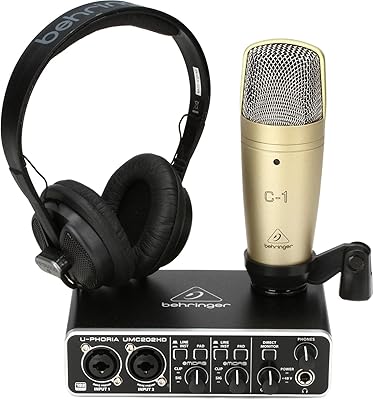
The Behringer UMC1820 provides a surprisingly accessible entry point for musicians who need a high-quality 1U rack interface without breaking the bank. It is designed to sit comfortably in a professional studio rack or travel in a mobile rig, offering a clean, standard layout that veteran engineers will find immediately familiar. By placing two combo jacks on the front panel, the designers ensured that quick instrument or vocal patches are easy to manage even in a dark room. This multi-channel unit is essentially a high-value alternative for those looking to expand their home studio inputs without sacrificing build quality. The sturdy metal chassis has a reassuring weight of nearly four pounds, suggesting it can handle the rigors of frequent transport. It positions itself as a practical workhorse for multi-track recording sessions.
Features & Benefits
What sets this multi-channel unit apart is the inclusion of eight Midas-designed preamps, which deliver remarkably transparent and low-noise gain for the price. This clarity is essential when you are tracking delicate acoustic instruments or stacking multiple vocal layers. Beyond the physical inputs, the unit offers impressive digital expandability through ADAT, allowing for up to 16 total mic inputs if you connect an external preamp. You also get zero-latency monitoring, which is a lifesaver for performers who need to hear themselves without distracting delays. The dual headphone outputs are another thoughtful touch, featuring independent source selection so two people can monitor different mixes. Even integration with external gear is handled easily by the dedicated MIDI I/O. Everything is processed at 24-bit/96 kHz resolution to ensure your recordings maintain professional standards.
Best For
Finding a way to record a full drum kit effectively is a common hurdle for home producers, but this 1U rack interface simplifies the process by providing enough preamps for overheads, shells, and room mics. It is equally appealing to podcasters who need to manage four or more microphones for roundtable discussions or interview formats. Bands looking to capture live rehearsal sessions in high definition will find the setup straightforward and reliable. Additionally, for studio owners who already have a favorite interface but need more channels, the UMC1820 serves as a cost-effective expansion through its ADAT connectivity. Whether you are building your first serious recording rig or just need a dependable way to increase your channel count, this hardware offers the flexibility to grow with your production needs.
User Feedback
Real-world users consistently highlight the professional-grade features found here, often noting that the tactile feel of the gain knobs rivals equipment twice its price. The build quality of this multi-channel unit earns high marks, as the metal frame feels durable and road-ready. However, it is important to be aware of potential driver hurdles that some users encounter on older Windows systems; while Mac users enjoy a plug-and-play experience, PC owners may need to spend a little extra time on the initial setup. Despite these software quirks, the consensus points toward impressive preamp transparency that handles everything from loud drums to quiet narration without adding unwanted color. It is rare to find this much connectivity at this price point, making it a favorite for those who value performance over brand prestige.
Pros
- Provides eight clean Midas-designed preamps that offer professional-grade transparency for critical tracking.
- The ADAT input allows you to easily double your microphone count by connecting an external expansion unit.
- Features dual headphone outputs with independent volume controls for flexible monitoring during joint sessions.
- Built with a rugged all-metal chassis that feels substantial and secure in a studio rack.
- Zero-latency direct monitoring ensures performers can hear themselves without distracting software delays.
- Includes dedicated MIDI I/O, saving you the cost and desk space of a separate MIDI interface.
- Front-panel combo jacks make it quick and easy to plug in instruments without reaching behind your gear.
- Offers an incredible ratio of inputs to price, making multitrack recording accessible to budget-conscious creators.
Cons
- Driver installation on Windows can be finicky and may require manual troubleshooting for stable performance.
- The internal headphone amplifiers lack the output power to drive high-impedance studio headphones at high volumes.
- Phantom power is switched in blocks rather than for individual channels, which limits connectivity flexibility.
- The external power brick is somewhat bulky and adds cable clutter to your recording setup.
- Gain knobs can feel a bit crowded on the front panel, making precise adjustments slightly difficult during a session.
- There are no front-panel visual meters for MIDI activity, complicating the troubleshooting of external hardware connections.
- The Behringer UMC1820 gain range is not perfectly linear, with most of the usable boost concentrated at the end of the dial.
Ratings
Our analysis of the Behringer UMC1820 synthesizes global feedback from verified owners while stripping away incentivized reviews and promotional noise. These scores represent a transparent look at how this 1U rack interface performs in real-world studio environments, highlighting both its professional-grade strengths and common technical pain points.
Value for Money
Preamplifier Clarity
Build Quality
Input/Output Versatility
Driver Stability (Windows)
Ease of Use (Mac/iOS)
Headphone Monitoring
MIDI Connectivity
Monitoring Latency
Portability & Size
Suitable for:
The Behringer UMC1820 is an ideal solution for home studio owners and independent bands who need to capture high-quality multitrack recordings, such as full drum kits, without a massive financial investment. Its inclusion of eight transparent preamps and ADAT expandability makes it a practical cornerstone for a growing studio rig. Podcasters running roundtable discussions will find the multiple independent inputs and dual headphone monitoring particularly useful for managing several guests at once. Even professional engineers can benefit from keeping this 1U rack interface as a cost-effective backup or mobile recording solution for field work.
Not suitable for:
This hardware may not be the right fit for users who prioritize premium software bundles or boutique aesthetic over raw connectivity. While the Behringer UMC1820 is technically capable, those working on older Windows systems might find the driver installation process more frustrating than the plug-and-play experience offered by high-end competitors. Audiophiles seeking specific vintage "coloration" or high-impedance headphone power may find the internal amplifiers slightly lacking for their specialized needs. If your recording workflow is strictly limited to one or two channels, the bulky rackmount form factor and external power brick might feel like unnecessary clutter compared to a compact desktop interface.
Specifications
- Form Factor: The unit follows a standard 1U rackmount design for easy integration into professional studio racks.
- Total I/O: It features 18 total inputs and 20 outputs including both analog and digital connections.
- Analog Inputs: The front and back panels house 8 XLR/TRS combo inputs for microphones or instruments.
- Preamplifiers: It utilizes 8 MIDAS-designed mic preamplifiers with switchable +48V phantom power.
- Digital Connectivity: Digital expansion is handled via ADAT and S/PDIF optical or coaxial ports.
- Audio Resolution: The interface supports high-fidelity 24-bit/96 kHz analog-to-digital conversion.
- Headphone Outputs: Two 1/4″ headphone jacks are included with independent volume controls and source selection.
- MIDI Interface: A dedicated 5-pin MIDI In and Out is located on the rear panel for hardware synchronization.
- Computer Link: The device connects to Mac or PC systems via a high-speed USB 2.0 interface.
- Dimensions: The physical footprint measures 19.02 x 5.12 x 1.81 inches.
- Weight: The entire metal chassis weighs approximately 3.97 pounds.
- Phantom Power: Switchable power is organized into two groups covering channels 1 through 4 and 5 through 8.
- Direct Monitoring: A hardware switch provides zero-latency monitoring for performers during recording.
- Main Outputs: Two 1/4″ TRS main outputs are provided for studio monitors alongside 8 additional line outs.
- Chassis Material: The enclosure is constructed from a heavy-duty metal for maximum durability.
Related Reviews
Behringer Podcastudio USB
Behringer XM8500 Wired Microphone
Behringer XENYX X1204USB Mixer
Behringer UMC22 Audio Interface
Behringer XENYX X1222USB
Behringer Xenyx X2222USB
Behringer XENYX X2442USB

Behringer B-2 PRO Microphone