Overview

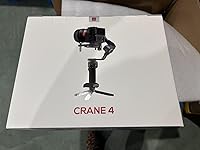
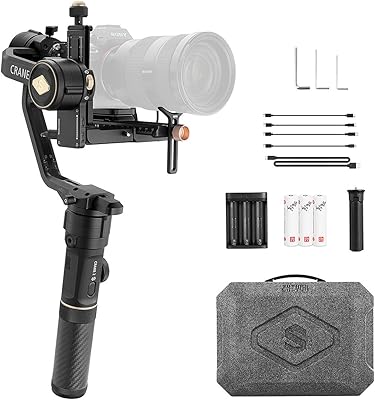
The ZHIYUN Crane 4 Combo 3-Axis Gimbal Stabilizer sits at the top of ZHIYUN's Crane lineup, and the Combo package bundles accessories that make a real operational difference rather than just padding the box. Where the standard model covers the basics, the Combo adds tools aimed at solo operators who can't afford to stop and swap gear mid-shoot. This is a premium-tier rig built for hybrid shooters and cinematographers running full-frame cameras or compact cinema setups. Pick it up and the build quality immediately signals serious intent — it's dense, purposeful, and clearly engineered for professionals who need hardware that doesn't flinch under a heavy load.
Features & Benefits

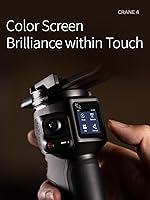
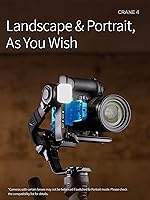
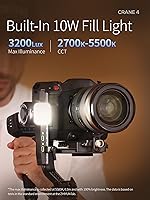
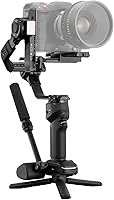
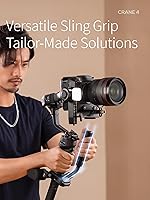
The motors on this gimbal stabilizer have been noticeably upgraded — handling the extra mass of a Sony A7S III or Canon EOS R5 with a fast prime attached without protest. The quick-release module lets you flip between landscape and portrait in seconds, genuinely useful when cutting between widescreen and vertical social content. The built-in fill light delivers 3200 Lux with a CRI above 95 and color temperature adjustable from 2700K to 5500K — not a substitute for a proper LED panel, but a real asset in run-and-gun situations. The sling grip with wrist rest and the 1.22-inch touchscreen add further control, letting you adjust ISO, aperture, and focus without ever touching the camera body.

Best For

This ZHIYUN rig is genuinely suited to professionals rather than beginners experimenting with their first gimbal. If you're shooting with a BMPCC 6K, a Sony FX3, or any full-frame mirrorless with a heavier lens combination, it has the muscle to keep footage steady. Documentary and event videographers who frequently switch between orientations will appreciate how fast that transition happens. Solo creators working without a lighting assistant will find the fill light saves meaningful setup time on location. It also makes strong sense for long-day shooters — weddings, corporate events — where the ergonomic sling grip reduces arm fatigue over hours. Those who want direct camera control from the handle, without reaching back to the body, will find this rig particularly capable.

User Feedback

Buyers consistently highlight motor strength and build, noting the Crane 4 Combo handles heavier rigs far more confidently than similarly priced alternatives. The fill light draws frequent appreciation from solo shooters who weren't expecting to actually rely on it in the field. That said, balancing a heavy full-frame body with a large zoom is not quick or intuitive — several users report spending 20 to 30 minutes dialing things in before achieving smooth results. The unit's own weight, over four pounds before mounting a camera, is a recurring concern for all-day use. The touchscreen interface splits opinion: some find it logical after a short adjustment period, while others would prefer a simpler menu structure. Bluetooth pairing reliability has also drawn mixed notes from recent buyers.

Pros

  • Motor strength handles full-frame bodies and heavy glass without struggling or overheating under normal professional loads.
  • The built-in fill light is a genuine field asset for solo shooters, not just a spec-sheet talking point.
  • Switching between landscape and portrait orientation takes seconds, making multi-format shoots far less disruptive.
  • Build quality feels premium and rattle-free even under heavy camera loads across long shooting days.
  • Direct control of ISO, aperture, and focus from the handle reduces the need to touch the camera body mid-shot.
  • The adjustable sling grip and wrist rest make a real difference during extended event or documentary shoots.
  • PD fast charging lets you recover meaningful battery capacity during short breaks between shooting blocks.
  • Broad camera compatibility covers Sony, Canon, Nikon, Fujifilm, and Panasonic bodies via Bluetooth shutter control.
  • The color touchscreen gives access to timelapse and custom control mapping without needing a companion app open.

Cons

  • Balancing a heavy full-frame rig from scratch regularly takes 20 to 30 minutes for users without prior gimbal experience.
  • At over four pounds before mounting a camera, all-day single-hand operation becomes physically taxing.
  • The touchscreen menu structure has a steep learning curve and can trigger accidental inputs mid-shoot.
  • Bluetooth pairing is inconsistent with certain Sony and Canon firmware versions, causing on-location frustration.
  • Battery runtime drops noticeably when the fill light and motors are running simultaneously at higher loads.
  • Cinema rigs at the heavy end of the payload range push motors close to their limits, causing warmth during long sessions.
  • Frequent lens-swappers face repeated rebalancing, which adds friction to hybrid photo-video workflows.
  • Firmware updates have occasionally introduced new connectivity issues before subsequent patches resolved them.
  • The price is hard to justify for shooters using crop-sensor cameras who do not need the advanced feature set.

Ratings

The scores below reflect AI-powered analysis of verified global user reviews for the ZHIYUN Crane 4 Combo 3-Axis Gimbal Stabilizer, with spam, bot activity, and incentivized feedback actively filtered out to ensure reliability. Each category distills patterns from real-world shooting experiences across documentary, event, and solo creator workflows. Both the standout strengths and the genuine frustrations buyers have reported are reflected honestly in the numbers.

Stabilization Performance
91%
Users consistently report smooth, locked-down footage even when running with a full-frame body and a heavy zoom attached. Wedding and event videographers specifically note that transitions between walking shots and static setups hold up without the jitter spikes common in lighter-duty rigs.
A small but vocal group of users shooting with particularly front-heavy cinema lenses report occasional micro-oscillations during abrupt directional changes. These are largely resolved through motor calibration, but it adds setup time before a shoot.
Motor Strength & Payload Handling
88%
The upgraded motors handle the weight of cameras like the Sony A7S III or Canon EOS R5 paired with standard primes without any noticeable struggle. Users who previously fought torque limits on earlier ZHIYUN models describe this as a meaningful step forward in confidence under load.
With the heaviest cinema rigs — think a BMPCC 6K with a speed booster and a compact zoom — a few users report the motors running warm after extended periods. It handles the load, but it is clearly operating near its ceiling in those configurations.
Build Quality & Materials
93%
The construction feels genuinely premium. Users across multiple reviews describe the chassis as solid and rattle-free, with no flex in the arm joints even when the rig is loaded. The finish holds up well to field use, and the overall impression is that this is built to survive professional work schedules.
A handful of users flag that some of the smaller plastic adjustment knobs feel slightly inconsistent with the rest of the build quality. Nothing functionally problematic, but noticeable for buyers expecting every component to match the main body's rigidity.
Balancing Ease
61%
39%
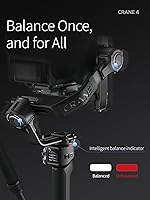
Once dialed in, the balance holds reliably across long sessions, and experienced gimbal operators familiar with ZHIYUN's previous systems will find the process intuitive enough. The extended quick-release plate does give useful fore-and-aft range for positioning heavier bodies.
New users and those switching from lighter consumer gimbals frequently report that balancing a full-frame setup takes 20 to 30 minutes the first several times. The process demands patience and a methodical approach, and without it, stabilization quality drops significantly — a real concern for shooters working on tight schedules.
Built-in Fill Light
84%
For a feature that could easily have been a marketing checkbox, the fill light earns genuine praise. Solo run-and-gun shooters covering interviews or b-roll in dim indoor environments report it pulling real duty as a supplemental source, with the color temperature range from 2700K to 5500K covering warm interior to neutral daylight matching.
Users expecting this to replace a dedicated LED panel will be disappointed — it is a supplement, not a solution for demanding lighting setups. At maximum output it can also affect battery runtime in ways that catch users off guard during longer shooting blocks.
Ergonomics & Shooting Comfort
78%
22%
The adjustable sling grip and wrist rest receive consistent praise from event videographers logging four-plus-hour shoots. Users note that the ability to fine-tune the grip angle makes a tangible difference in arm fatigue compared to fixed-handle rigs at a similar price point.
At just over four pounds before a camera is mounted, this ZHIYUN rig crosses a threshold where extended single-hand operation becomes genuinely tiring. Users doing solo documentary work over full days frequently mention switching to two-handed mode or taking rest breaks more often than expected.
Landscape-to-Portrait Switching
86%
Content creators managing both widescreen video and vertical social formats in the same shoot describe the quick-release orientation system as one of the Crane 4 Combo's most practically useful features. The mechanical lock feels secure in both positions, and the transition itself takes only a few seconds once you know the motion.
Initial use of the quick-release module requires some practice — a few users report accidentally releasing at the wrong stage in the sequence during fast-paced shoots before the muscle memory develops. The mechanism is reliable, but it is not entirely self-explanatory without reading the manual first.
Touchscreen Interface
69%
31%
Users who invest time learning the menu structure generally appreciate having access to timelapse settings, mode switching, and customizable controls directly on the gimbal. The color display is bright enough to read outdoors, and the customizable trigger and front dial are consistently praised for reducing the need to reach back to the camera body.
The learning curve on the touchscreen is steep for users coming from simpler gimbals. Several reviewers describe the menu hierarchy as unintuitive on first use, and some report accidentally triggering functions mid-shot while adjusting grip. A more streamlined UI would likely improve the experience for a significant portion of buyers.
Bluetooth Connectivity & Camera Control
72%
28%
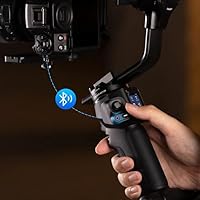
When pairing works cleanly, Bluetooth shutter and recording control adds real convenience — particularly for solo operators who need to trigger the camera without a second hand. Compatibility with Sony, Canon, Nikon, Fujifilm, and Panasonic bodies covers most professional mirrorless users effectively.
Pairing reliability is a recurring topic in user feedback. Some buyers report occasional drops or initial difficulty establishing a connection, particularly with certain Sony and Canon firmware versions. Most issues are resolvable, but the inconsistency is frustrating for users who need wireless control to just work without troubleshooting on location.
Overall Weight & Portability
63%
37%
For a rig capable of handling full-frame and cinema cameras, the weight is physically justified and most experienced videographers accept the trade-off knowingly. Users doing car-mounted or static rig work rarely raise this as an issue at all.
Photographers transitioning into video who expected something closer to consumer gimbal weights are consistently caught off guard. Combined with a mounted camera, the total carry weight makes this gimbal stabilizer a deliberate tool for planned shoots rather than something you casually pull out of a bag between stills sessions.
PD Fast Charging & Battery Life
77%
23%
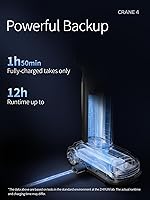
PD fast charge support means topping up between shoot blocks is genuinely fast, and users running corporate or event work appreciate being able to recover battery capacity during lunch breaks or transition periods without carrying multiple spare batteries.
With the fill light running at higher output alongside active motor use, battery life falls shorter than some users expect from a flagship-tier gimbal. A few reviewers note that the rated runtime feels optimistic under real-world combined loads, particularly in cold outdoor environments.
Value for Money
74%
26%
For professional videographers who regularly work with full-frame or cinema cameras, the combination of motor strength, the fill light, and the orientation-switching system justifies the price as a consolidated tool. Users who replaced multiple separate accessories with this single rig tend to view the cost positively.
Casual shooters or those primarily using crop-sensor cameras find it harder to justify the premium. Several reviews note that buyers who needed only basic stabilization — without the fill light or advanced controls — would be better served by a significantly less expensive option elsewhere in ZHIYUN's own catalog.
Setup Speed in the Field
66%
34%
Once a specific camera-and-lens combination has been balanced and saved to a profile, returning to that same setup is reasonably quick. Users with dedicated camera bodies who do not frequently swap lenses report that daily deployment becomes muscle memory after a short adaptation period.
For shooters who rotate through multiple lens configurations — a common situation in hybrid photo-video work — re-balancing each time adds meaningful friction. The setup time required before reliable stabilization is achieved is one of the most frequently cited frustrations across buyer feedback for this gimbal stabilizer.
Firmware & Software Support
71%
29%
ZHIYUN's app and firmware update process is familiar to existing users of the brand's ecosystem, and users who kept firmware current through the ZY Cami app generally report a more stable experience with Bluetooth and motor calibration. The customization available via firmware updates is a genuine long-term asset.
Several users report that firmware updates introduced or temporarily worsened specific connectivity behaviors before being patched in subsequent releases. For a rig at this price point, the expectation of rock-solid out-of-box firmware stability is reasonable, and the inconsistency between software versions has drawn criticism in recent buyer feedback.

Suitable for:

The ZHIYUN Crane 4 Combo 3-Axis Gimbal Stabilizer is built for working videographers who regularly shoot with full-frame mirrorless bodies — Sony A7 series, Canon EOS R5, Nikon Z6 II — or compact cinema cameras like the BMPCC 6K, and who need a rig that can keep up with a professional pace without constant compromise. Documentary and event videographers who frequently toggle between landscape and portrait orientations mid-shoot will find the quick-release switching system genuinely useful rather than gimmicky. Solo creators working without a dedicated lighting assistant will also get real mileage from the built-in fill light, which adds usable illumination in dim interiors without requiring a light stand, an extra cable, or a second pair of hands. Filmmakers logging multi-hour days — weddings, corporate productions, reality shoots — benefit from the ergonomic sling grip and wrist rest, which meaningfully reduce the physical toll of extended handheld operation. If you want direct control over ISO, aperture, shutter, and focus from the gimbal handle itself rather than reaching back to the camera body constantly, this ZHIYUN rig is one of the more capable options at this tier.
Not suitable for:

The ZHIYUN Crane 4 Combo 3-Axis Gimbal Stabilizer is not the right choice for photographers making their first foray into video who expect to pick it up and start shooting within minutes. Balancing a heavy full-frame body with a large lens requires patience, a methodical approach, and a willingness to spend meaningful time before the first clean take — casual shooters will find that frustrating. Users primarily working with lighter crop-sensor cameras or compact mirrorless bodies will also be overpaying for motor capacity and structural engineering they do not need, and ZHIYUN's own lineup offers more appropriately sized options at lower prices. If portability is a top priority — street work, travel documentary, anything requiring a light bag — the combined weight of this gimbal stabilizer and a mounted camera crosses a threshold that many shooters find uncomfortable for spontaneous use. Budget-conscious buyers who only need basic stabilization without the fill light, touchscreen controls, or orientation switching should look elsewhere; the premium here is tied directly to those added capabilities, and if you do not need them, you are paying for features that will sit unused.
Specifications

  • Brand: Manufactured by ZHIYUN, a specialist in professional camera stabilization systems.
  • Model: Crane 4 Combo, the top-tier configuration in the Crane 4 product line.
  • Stabilization: 3-axis motorized stabilization covering pan, tilt, and roll axes for smooth handheld footage.
  • Compatible Cameras: Supports full-frame DSLRs, mirrorless cameras, and compact cinema cameras including the BMPCC 6K.
  • Dimensions: Unit measures 2.76″ deep by 11.02″ wide by 13.39″ tall when assembled.
  • Weight: The gimbal unit itself weighs 2000 grams (4.41 pounds) before any camera is mounted.
  • Fill Light Output: Built-in 10W fill light delivers a maximum illuminance of 3200 Lux with a CRI rating above 95.
  • Color Temperature: Fill light is adjustable across a range of 2700K to 5500K to match warm interior or neutral daylight conditions.
  • Display: Features a 1.22-inch color touchscreen for accessing shooting modes, timelapse settings, and control customization.
  • Connectivity: Bluetooth shutter control supports major camera brands including Sony, Nikon, Canon, Fujifilm, and Panasonic.
  • Shooting Modes: Integrated quick-release module enables switching between native landscape and portrait orientations without tools.
  • Grip Design: Adjustable sling grip includes a wrist rest with fine-tunable angle adjustment to reduce fatigue during extended shoots.
  • Grip Modes: The extendable sling grip can be repositioned to the gimbal's central axis, allowing switching between sling and two-handed operating modes.
  • Power Input: Supports PD (Power Delivery) fast charging for reduced downtime between shooting sessions.
  • Control Inputs: Trigger button and front dial are fully customizable to map to ISO, shutter speed, aperture, focus motor, or gimbal mode selection.
  • Batteries Required: Requires one AAA battery (included in the package) for certain accessory functions.
  • Market Rank: Holds a Best Sellers Rank of number 210 in the Professional Video Stabilizers category on Amazon.
  • Release Date: First made available for purchase on June 5, 2023.
  • Manufacturer: Designed and produced by ZHIYUN, model number A-CR122C-EU.
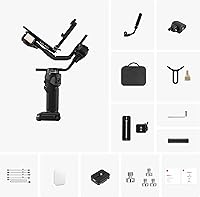
  • Combo Package: The Combo variant includes accessories beyond the standard model, supporting more complete solo production workflows out of the box.

Related Reviews

DJI RS 4 Gimbal Stabilizer
81%
93%
Stabilization Performance
88%
Balancing Experience
91%
Native Vertical Shooting
89%
Build Quality & Materials
86%
Battery Life
More
Zhiyun Weebill S
Zhiyun Weebill S
76%
83%
Stabilization Performance
91%
Battery Life
78%
Build Quality & Durability
86%
Ergonomics & Comfort
88%
Camera Compatibility
More
DJI RS 2 3-Axis Gimbal Stabilizer
81%
93%
Build Quality
91%
Stabilization Performance
89%
Payload Capacity
84%
Touchscreen Usability
81%
Balancing & Setup
More
DJI RSC 2 Pro Combo 3-Axis Gimbal Stabilizer
86%
95%
Stabilization Performance
89%
Portability & Design
90%
Ease of Use
85%
Battery Life
88%
Build Quality
More
Zhiyun Crane M2S Camera Gimbal Stabilizer
74%
83%
Stabilization Performance
91%
Portability & Size
78%
Build Quality
86%
Fill Light Quality
88%
Quick Release System
More
ZHIYUN Crane 4E Camera Gimbal Stabilizer
78%
91%
Stabilization Performance
88%
Build Quality
86%
Ergonomics & Fatigue
89%
Battery Life
58%
Ease of Setup & Balancing
More
Zhiyun Weebill 3S Combo
80%
91%
Stabilization Performance
88%
Orientation Switch Speed
79%
Built-In Fill Light
93%
Battery Life
84%
Build Quality & Materials
More
DJI RS 4 Pro Combo
DJI RS 4 Pro Combo
79%
93%
Motor Strength & Payload Handling
81%
LiDAR Autofocus Accuracy
88%
Native Vertical Shooting
86%
Combo Bundle Value
78%
Battery Life
More
Zhiyun Crane 2S 3-Axis Gimbal Stabilizer
74%
91%
Stabilization Performance
88%
Build Quality
58%
Setup & Balancing
54%
Ease of Use & Learning Curve
89%
Motor Power & Payload Handling
More
Zhiyun Crane M3 3-Axis Gimbal Stabilizer
78%
83%
Stabilization Performance
91%
Portability & Form Factor
82%
Build Quality
79%
Ease of Setup
74%
Touchscreen & Interface
More

FAQ

Yes, the Crane 4 Combo is specifically engineered for full-frame mirrorless bodies like the Sony A7S III. The upgraded motors and extended arm length accommodate heavier rigs, though you will want to take time balancing carefully — a front-heavy zoom will need proper fore-and-aft plate positioning before the motors can stabilize effectively.

Realistically, expect 20 to 30 minutes the first few times you balance a full-frame camera setup. It is not a quick snap-and-go process at this payload level. Once you have dialed in a specific camera-and-lens combination, returning to that same configuration gets faster, but new setups always require starting the process over from scratch.

It is genuinely useful as a supplemental light source, particularly for indoor interviews, b-roll in dim environments, or quick fill when you have no lighting kit handy. That said, it is not a replacement for a proper LED panel — for controlled lighting setups or anything requiring broad coverage, you will still need dedicated lighting gear. Think of it as a smart convenience feature rather than a primary light.

The quick-release module makes the switch take only a few seconds once you have practiced the motion a couple of times. The lock is mechanically secure in both orientations, so there is no wobble or play once it clicks into place. Just be aware there is a brief learning curve on the release sequence — read through the steps before your first shoot so you are not fumbling with it mid-production.

Yes, the BMPCC 6K is one of the compact cinema cameras this rig was explicitly designed to support. The extended arm and stronger motors handle its weight without difficulty. As with any heavier setup, proper balancing is essential before relying on the stabilization, so budget extra setup time before your first shoot with it.

Bluetooth control works well for most users once pairing is established, but it is not entirely without friction. Some buyers using certain Sony and Canon firmware versions have reported occasional drops or initial pairing difficulty. Keeping both the gimbal firmware and your camera firmware current resolves most issues, but it is worth doing a test pairing before any critical shoot rather than assuming it will connect instantly on location.

It depends on your fitness level and whether you use the sling grip effectively. Many wedding videographers use this gimbal without major issues, but single-hand operation over a full eight-hour day does become tiring. Using the two-handed mode and the wrist rest where possible, and taking deliberate rest breaks, makes a real difference. If you are already fatigued from a previous shoot, the total carry weight will be noticeable.

The Combo package bundles accessories that extend the rig's capabilities for solo and run-and-gun production workflows — most notably the sling grip with wrist rest and related mounting hardware. The exact contents can vary slightly by region, so it is worth confirming the specific accessory list at the point of purchase, but the Combo is specifically aimed at operators who need more flexibility and comfort than the base model provides.

Yes, the front dial on the handle can be mapped to focus motor control, which works with compatible lenses and camera systems. You can also assign it to ISO, aperture, or shutter speed depending on what your shooting workflow demands. The customization is handled through the touchscreen menu, which takes a bit of time to learn but gives you a lot of flexibility once you are familiar with it.

PD fast charging means you can use a compatible USB-C power adapter to charge the gimbal significantly faster than standard charging allows. In practical terms, this lets you recover a meaningful amount of battery during a lunch break or between shooting blocks rather than waiting for a full overnight charge. Actual charge times vary based on your adapter's wattage, so using a higher-output PD charger will give you the best results.

Where to Buy