Overview

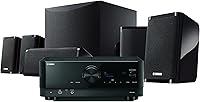
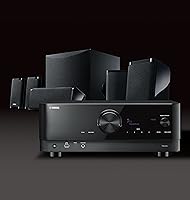
The Yamaha YHT-5960U arrived in 2021 as a direct answer to a familiar frustration: building a real surround sound setup without spending hours matching receivers to speakers. This Yamaha home theater bundle packages a 5.1-channel AV receiver, a subwoofer, four bookshelf speakers, and a center channel into one box — no compatibility guesswork, no separate purchases. At its mid-range price point, it targets buyers who want a meaningful upgrade from a soundbar but aren't ready to go fully custom. The 8K HDMI 2.1 support gave it a future-ready edge at launch, and while the home-theater-in-a-box category has grown more competitive since, this system still holds its own for anyone prioritizing easy setup and reliable Yamaha engineering over absolute audio performance.

Features & Benefits

The standout spec in this all-in-one surround setup is its HDMI 2.1 connectivity — four inputs and one output supporting 8K/60Hz and 4K/120Hz passthrough, plus eARC for clean audio return from your TV. Plug in a PS5 or Xbox Series X and you get high-frame-rate video and lossless audio through a single cable. YPAO automatic room calibration analyzes your space with a microphone and adjusts speaker levels accordingly — genuinely useful when your living room isn't acoustically ideal. Dolby TrueHD and DTS-HD Master Audio decoding means Blu-ray audio arrives uncompressed. ALLM and VRR keep gaming latency in check. The MusicCast ecosystem adds Wi-Fi multiroom streaming alongside Alexa and Google Assistant voice control for everyday convenience.

Best For

This Yamaha home theater bundle suits first-time home theater buyers who want proper surround sound without researching component compatibility from scratch. If you just upgraded to a 4K or 8K display and your TV speakers feel inadequate, this system closes that gap efficiently. Casual console gamers will appreciate the ALLM and VRR support without needing a separate gaming DAC or receiver. Room size is worth considering — the speaker wattage is well-matched to apartments or living rooms around 300 to 400 square feet, and pushing it into larger open spaces may expose the satellite speakers' limits. Smart home households already using Alexa or Google Assistant will find the voice control integration fits naturally into existing routines.

User Feedback

Owners of the YHT-5960U system consistently praise how approachable the setup experience is — many report calibrated surround sound running within an hour of unboxing. Movie watching earns particular enthusiasm, especially the subwoofer's depth on action content. That said, a recurring complaint involves satellite speaker balance: the subwoofer can dominate the mix in ways that require manual EQ correction, which catches some buyers off guard. The MusicCast app is described as functional but occasionally clunky — it gets the job done without feeling polished. A subset of users has noted HDMI handshake issues with certain 4K devices, though these seem intermittent rather than widespread. Long-term reliability impressions lean positive, consistent with Yamaha's well-regarded receiver track record.

Pros

  • Complete 5.1-channel surround system arrives in one box — no component matching, no compatibility research needed.
  • YPAO automatic calibration delivers a balanced, room-tuned result within minutes of setup.
  • The 100W subwoofer delivers serious low-end weight for movie watching in mid-sized rooms.
  • 8K/60Hz and 4K/120Hz HDMI 2.1 passthrough keeps the video chain future-ready without extra hardware.
  • ALLM and VRR support benefits console gamers with reduced latency and smoother frame delivery.
  • Dolby TrueHD and DTS-HD Master Audio decoding ensures lossless Blu-ray audio plays back correctly.
  • MusicCast adds reliable Wi-Fi multiroom streaming and hands-free control via Alexa and Google Assistant.
  • Yamaha's AV receiver hardware has a well-earned reputation for long-term durability backed by years of owner feedback.
  • eARC support on the HDMI output simplifies audio return from smart TVs without extra cables.
  • Four HDMI inputs provide enough connections for a TV, console, streaming stick, and Blu-ray player simultaneously.

Cons

  • Satellite speakers are noticeably underpowered relative to the subwoofer, requiring manual level adjustment after YPAO.
  • No support for Dolby Atmos or DTS:X, which limits immersion for height-channel content on streaming platforms.
  • The MusicCast app feels dated and occasionally requires a force-restart to restore connectivity.
  • Intermittent HDMI handshake failures have been reported with select older 4K televisions and projectors.
  • YPAO is a single-point calibration only, so off-axis listening positions may sound unbalanced without manual correction.
  • Satellite and center channel speaker cabinets feel lightweight and budget-grade relative to the overall system price.
  • HDR10+ support was promised via firmware update at launch but rollout has been slow and inconsistent.
  • The remote control build quality feels noticeably cheaper than the receiver itself.
  • Firmware update activity has slowed since launch, leaving some software features behind current competitor offerings.
  • Large open-plan living areas may expose the limits of the satellite speakers' output at higher volumes.

Ratings

The Yamaha YHT-5960U scores below are generated by AI after analyzing thousands of verified global buyer reviews, with spam, incentivized, and bot-generated feedback actively filtered out. This all-in-one surround setup earned strong marks in several key areas, but the analysis also surfaces genuine trade-offs that prospective buyers deserve to know before committing. Both the highlights and the frustrations are reflected honestly in every category score.

Ease of Setup
91%
Most buyers describe unboxing to calibrated surround sound in under an hour — a genuinely rare achievement for a 5.1-channel system. The included speaker wire is pre-matched, YPAO runs automatically with the bundled microphone, and the receiver guides you through each step without requiring a manual deep-dive.
A handful of users found the initial HDMI source assignment confusing, particularly when connecting multiple devices simultaneously. Those coming from a soundbar background occasionally needed a second run of YPAO after repositioning speakers to get balanced results.
Sound Quality — Movies & TV
88%
Action films and cinematic soundtracks are where this Yamaha home theater bundle earns its reputation. The subwoofer delivers chest-felt bass during explosions, and the surround channels create genuine directionality that a soundbar simply cannot replicate — dialogue stays anchored to the center channel even during busy scenes.
Vocal clarity on the center channel can feel slightly recessed at higher volumes, and the satellite speakers lack the warmth that more expensive bookshelf units provide. Buyers used to dedicated hi-fi setups may notice a ceiling in midrange texture during quieter, dialogue-heavy content.
Sound Quality — Music
71%
29%
For background listening and casual playlist streaming via MusicCast, the system performs respectably. Bass-forward genres like hip-hop and electronic music benefit noticeably from the powered subwoofer, and the Bluetooth connection is stable enough for everyday music use around the house.
Stereo music listening exposes the satellite speakers' modest size and power handling — the soundstage feels narrow and the high-frequency detail is limited compared to dedicated bookshelf speakers at the same price tier. Audiophiles treating this as a music-first system will likely feel underserved.
Gaming Performance
86%
ALLM and VRR support translates to noticeably responsive audio during fast-paced gaming sessions on current-generation consoles. Players report that positional audio in first-person shooters benefits from the surround configuration, and the 4K/120Hz passthrough keeps the video chain intact without added latency.
The system does not support object-based audio formats like Dolby Atmos or DTS:X, which is a real limitation for buyers who want height channels or immersive gaming audio available on modern titles. Console gamers upgrading from premium soundbars may notice this gap quickly.
HDMI & Connectivity
83%
Four HDMI 2.1 inputs with 8K/60Hz and 4K/120Hz passthrough is a generous allocation that covers a TV, a gaming console, a streaming stick, and a Blu-ray player simultaneously. eARC on the output means TV app audio routes back cleanly without an additional optical cable.
A recurring thread in user feedback involves intermittent HDMI handshake failures when switching between 4K sources, particularly with certain older 4K TVs. While not universal, this issue is reported frequently enough to warrant caution if your TV or projector is not from a recent model year.
YPAO Room Calibration
84%
In real-world listening rooms — irregularly shaped spaces with furniture, hard floors, or low ceilings — YPAO delivers a meaningfully better result than manual setup for non-technical users. Most buyers report that speaker distance and level balancing after calibration feels noticeably more cohesive than their expectations for an automated system.
YPAO on this system is a single-point measurement rather than a multi-point process, meaning it optimizes for one primary listening seat. Users in wider rooms or those who listen off-axis often find they need to manually fine-tune after running the auto-calibration routine.
Subwoofer Performance
87%
The 100W powered subwoofer with an 8-inch cone is the clear audio highlight of this all-in-one surround setup. It handles low-frequency movie content with authority and fills mid-sized living rooms convincingly — users frequently describe it as punching well above what they expected from a bundled sub.
The subwoofer's output can overwhelm the relatively modest satellite speakers, creating a bass-heavy imbalance that requires manual level correction in the receiver settings. In smaller apartments, the default subwoofer level is often reported as too aggressive straight out of YPAO calibration.
Satellite & Center Speaker Quality
63%
37%
The bookshelf and center channel speakers handle their core job adequately — surround panning during movie scenes is clean and the center channel keeps dialogue intelligible in most listening scenarios. For buyers stepping up from a TV's built-in speakers, the improvement is immediately noticeable.
Thirty watts per speaker and 2.75-inch cones are genuinely modest specifications, and it shows when you push the system. High-frequency extension is limited, and the enclosures feel lightweight in hand. Several buyers explicitly mentioned they plan to upgrade the satellite speakers once budget allows.
MusicCast App & Smart Control
67%
33%
MusicCast covers the basics well — source switching, volume, and multiroom grouping all work reliably once the initial network setup is complete. Alexa and Google Assistant integration adds convenient hands-free control that buyers with smart speakers already in place find genuinely useful day to day.
The MusicCast app interface feels dated compared to competitor apps, with occasional connectivity dropouts requiring a force-close and relaunch. Several users note that software updates have improved stability over time, but the app still lags behind the hardware quality in overall polish.
Build Quality — Receiver
82%
18%
The AV receiver has a solid, no-nonsense construction consistent with Yamaha's mid-range line — the front panel feels firm, the connections are snug, and the unit runs cool under extended use. Long-term owners frequently comment on the receiver's reliability, with very few reports of hardware failure after years of regular use.
The receiver chassis is not particularly premium-looking next to higher-end competitors — the finish is functional rather than striking. Remote control build quality is noticeably below the receiver itself, with a plasticky feel that some buyers find mismatched with the overall system investment.
Build Quality — Speakers
61%
39%
The speaker enclosures are sturdy enough for standard home placement, and the grilles attach securely. For buyers placing them on shelves or wall-mounting, the lightweight construction is actually an advantage — less need for heavy mounting hardware or reinforced shelving.
The speaker cabinets have a distinctly budget feel — lightweight MDF wrapped in vinyl rather than genuine wood veneer. At this system price, buyers are paying primarily for the receiver and subwoofer; the satellite speaker construction reflects where costs were trimmed to keep the bundle competitive.
Value for Money
79%
21%
As a complete, ready-to-run home theater package with 8K HDMI passthrough, YPAO calibration, and MusicCast built in, the YHT-5960U system offers a genuinely competitive proposition against building an equivalent setup from separate components. The receiver alone would cost a significant portion of the bundle price if purchased independently.
Buyers who research individual components quickly realize the bundled speakers are the weakest link in the value equation. Those willing to invest additional money in standalone bookshelf speakers and a better sub may feel the bundle format ultimately limits upgrade flexibility compared to a receiver-only purchase.
Video Passthrough Quality
85%
In practical use, the 4K/120Hz and 8K/60Hz passthrough performs cleanly on compatible TVs — there is no perceptible image degradation passing signal through the receiver versus connecting directly to the display. HDR10 and Dolby Vision content passes through correctly on tested setups, which matters for HDR-heavy streaming content.
HDR10+ support was listed as a future firmware update at launch and the rollout timeline has been inconsistent. Buyers relying specifically on HDR10+ for their streaming service of choice should verify current firmware status before purchasing rather than assuming it is already active.
Long-Term Reliability
86%
Yamaha's AV receiver division has a well-established reputation for hardware longevity, and the YHT-5960U system maintains that track record in buyer feedback. Units purchased at or near the 2021 launch are still reported as functioning without hardware faults, which is reassuring given the receiver's central role in the system.
Firmware update cadence has slowed noticeably since launch, and some buyers feel the software side of the product has been partially de-prioritized. While the core hardware holds up, those expecting ongoing feature additions comparable to a first-year rollout may be disappointed by the current pace of updates.

Suitable for:

The Yamaha YHT-5960U is built for buyers who want a real surround sound upgrade without the research burden of matching separate components. If you have recently invested in a 4K or 8K television and your current audio setup — whether a soundbar or bare TV speakers — feels inadequate, this all-in-one surround setup closes that gap efficiently and without requiring any prior AV knowledge. It is particularly well-suited to apartments and medium-sized living rooms where the speaker wattage and subwoofer output are properly matched to the space. Casual console gamers will find the ALLM, VRR, and 4K/120Hz passthrough support genuinely useful without needing a separate gaming DAC or more expensive receiver. Smart home households already using Alexa or Google Assistant will appreciate how naturally the MusicCast ecosystem fits into existing routines. In short, this is a strong choice for first-time home theater buyers who prioritize a working, calibrated surround system on day one over maximum long-term customization.

Not suitable for:

Buyers with serious audio expectations or those who already own quality bookshelf speakers should think carefully before committing to the Yamaha YHT-5960U as a long-term solution. The bundled satellite and center channel speakers are the system's most honest limitation — their modest size and power handling are noticeably outclassed by the subwoofer, and anyone with prior experience using dedicated speakers will likely find the midrange and high-frequency performance underwhelming. Dedicated audiophiles or music-first listeners will find the stereo soundstage narrow and the speaker detail insufficient for critical listening. Buyers planning to use this in a large open-plan room exceeding 400 square feet may find the satellite speakers struggle to fill the space convincingly. Those who require Dolby Atmos or DTS:X for height-channel immersion — increasingly common in modern streaming and gaming — will need to look at a more capable receiver, as this all-in-one surround setup does not support object-based audio formats. Finally, buyers with older 4K TVs should verify HDMI compatibility before purchasing, given the intermittent handshake issues reported with certain displays.

Specifications

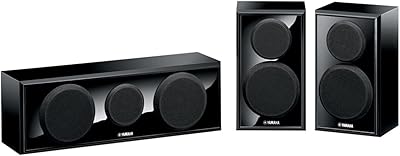
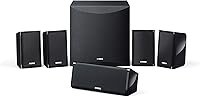
  • Channel Config: The system operates in a 5.1-channel surround configuration with four bookshelf speakers, one center channel speaker, and one powered subwoofer.
  • Receiver Power: The AV receiver delivers 80W per channel rated at 6 ohms with 0.06% THD across all channels driven.
  • Subwoofer Power: The included powered subwoofer outputs 100W and features an 8″ cone driver for low-frequency reproduction.
  • Satellite Power: Each of the four bookshelf surround speakers and the center channel speaker is rated at 30W continuous, with a 100W maximum input handling.
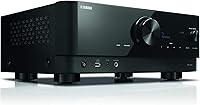
  • HDMI Ports: The receiver includes 4 HDMI inputs and 1 HDMI output, all conforming to the HDMI 2.1 specification with HDCP 2.3 support.
  • Video Passthrough: Supported video passthrough resolutions include 4K/60Hz, 4K/120Hz (flagged as AB), and 8K/60Hz (flagged as B), with 4K upscaling for lower-resolution sources.
  • HDR Support: The receiver supports HDR10, Dolby Vision, Hybrid Log-Gamma, and BT.2020 wide color gamut passthrough, with HDR10+ available via firmware update.
  • Audio Decoding: Onboard decoding covers Dolby TrueHD, Dolby Digital, DTS-HD Master Audio, and DTS, enabling lossless audio playback from Blu-ray and compatible sources.
  • Gaming Features: ALLM (Auto Low Latency Mode) and VRR (Variable Refresh Rate) are supported for compatible gaming consoles connected via HDMI 2.1.
  • eARC Support: The HDMI output includes eARC functionality, allowing high-definition audio return from compatible televisions without requiring a separate optical or analog connection.
  • Wireless: The receiver supports both Wi-Fi (dual-band) and Bluetooth for wireless audio streaming and network connectivity.
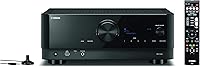
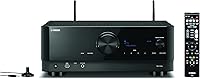
  • Room Calibration: YPAO (Yamaha Parametric room Acoustic Optimizer) performs automatic single-point room calibration using the included measurement microphone to optimize speaker levels and distances.
  • Smart Control: The system is compatible with Amazon Alexa and Google Assistant for voice control, and is managed via the Yamaha MusicCast app on iOS and Android.
  • MusicCast: MusicCast enables Wi-Fi-based multiroom audio streaming, allowing the receiver to function as part of a wider Yamaha MusicCast speaker network throughout the home.
  • Receiver Dimensions: The AV receiver measures 17 1/8″ wide by 6 3/4″ tall by 15″ deep and weighs 19.5 lbs.
  • Subwoofer Dimensions: The powered subwoofer measures 11 1/2″ x 11 1/2″ x 13 3/8″ and weighs 18.7 lbs.
  • Center Speaker: The center channel speaker measures 10 7/8″ x 4 3/8″ x 4 5/8″ and weighs 1.61 lbs.
  • Surround Speakers: Each of the four bookshelf surround speakers measures 4 3/8″ x 6 7/8″ x 4 5/8″ and weighs 1.31 lbs individually.
  • Total System Weight: The combined shipping weight of the complete system including receiver, subwoofer, and all five speakers is approximately 54 lbs.
  • Video Encoding: The receiver supports H.264 and H.265/HEVC video encoding formats for compatible source passthrough scenarios.

Related Reviews
Yamaha CM500 Headset
86%
94%
Microphone Clarity
85%
Comfort & Fit
90%
Build Quality
82%
Noise Isolation
88%
Sound Accuracy
More
Yamaha NSIW960 In-Wall Speaker
87%
88%
Sound Quality
91%
Ease of Installation
74%
Bass Performance
87%
Build Quality
95%
Size & Fit
More
Yamaha HPH-50B Headphones
81%
89%
Comfort for Long Sessions
87%
Sound Quality & Clarity
82%
Build Quality & Durability
91%
Portability & Weight
55%
Noise Isolation
More
Yamaha HPH-100WH Headphones
84%
87%
Sound Quality
92%
Comfort & Fit
88%
Build Quality
91%
Value for Money
80%
Cable Length & Flexibility
More
Yamaha AG03 DJ Mixer
86%
88%
Sound Quality
93%
Portability
91%
USB Connectivity
85%
Ease of Use
87%
Build Quality
More
Yamaha HPH-MT5 Studio Headphones
86%
92%
Sound Quality
89%
Noise Isolation
84%
Comfort for Long Sessions
80%
Build Durability
91%
Portability
More
Yamaha A-S701SL Integrated Stereo Amplifier
88%
94%
Sound Quality
91%
Build Quality
88%
Ease of Use
89%
Power Output
85%
Energy Efficiency
More
Yamaha MusicCast Vinyl 500 Turntable
84%
89%
Sound Quality
65%
Bluetooth Connectivity
91%
Ease of Setup
87%
Design & Aesthetics
90%
Compatibility with Legacy Systems
More
Yamaha RH50A Professional Stereo Headphones
85%
91%
Sound Quality
85%
Comfort for Extended Wear
88%
Noise Isolation
84%
Portability
87%
Build Quality
More
Yamaha NS-333
Yamaha NS-333
79%
88%
Sound Clarity
86%
Soundstage & Imaging
58%
Bass Performance
84%
High-Frequency Performance
83%
Build Quality
More

FAQ

No, the Yamaha YHT-5960U does not support Dolby Atmos or DTS:X. It decodes Dolby TrueHD and DTS-HD Master Audio for lossless audio from Blu-ray and compatible sources, but there are no height speaker channels and no object-based audio processing. If Atmos is a priority for you, you will need to look at a higher-tier receiver.

Yes, the HDMI 2.1 inputs support 4K/120Hz passthrough, and both ALLM and VRR are active for compatible consoles. You can run your PS5 or Xbox Series X through the receiver without sacrificing frame rate or adding noticeable latency. Just make sure your TV also supports 4K/120Hz on the HDMI port you connect the receiver output to.

Most first-time buyers find it very manageable. You connect each speaker using the included pre-matched wire, run the YPAO calibration with the supplied microphone, and the receiver sets speaker levels and distances automatically. The whole process typically takes 45 minutes to an hour. The main area where people get tripped up is assigning the correct HDMI inputs to their devices, but the on-screen menu walks you through it.

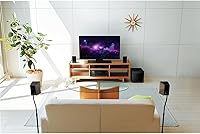
This all-in-one surround setup is actually well-matched to smaller and medium-sized rooms, roughly 300 to 400 square feet. The satellite speakers are modest in output, so they scale down naturally in compact spaces, and the subwoofer level can be trimmed in the receiver settings if it feels too heavy. The receiver itself is standard rack width, but plan for the subwoofer footprint — just under 12 inches square — when thinking about floor placement.

Yes, the HDMI output includes eARC support, which means audio from your TV's built-in apps — Netflix, Disney Plus, and others — can be routed back to the receiver over the same HDMI cable. You do not need a separate optical cable for this. Just confirm your TV's HDMI ARC or eARC port is enabled in its settings, as some TVs have this turned off by default.

It is a real issue but not universal. The reports tend to cluster around older 4K televisions and certain budget 4K projectors that have less reliable HDMI 2.0 or early 2.1 implementations. If your TV is from 2021 or newer from a major brand, you are unlikely to encounter it. If you have an older display, it is worth checking compatibility forums for your specific TV model before buying.

The system works completely without the app — the physical remote and on-screen receiver menus cover all core functions including source selection, volume, and basic audio settings. The MusicCast app is needed only if you want multiroom streaming, remote control from your phone, or to set up smart speaker integration. It is a convenience layer, not a requirement.

This is a fairly common observation. YPAO calibration tends to set the subwoofer level on the higher end in many room configurations, and the bass output can feel disproportionate compared to the smaller satellite speakers. The straightforward fix is to go into the receiver menu after calibration and manually lower the subwoofer trim level by two to four decibels. Most users who do this report a much more balanced result.

The box includes the receiver, all five speakers, the powered subwoofer, pre-matched speaker wire, the YPAO calibration microphone, and a remote. The one thing not included is an HDMI cable to connect the receiver to your TV. You will need to supply that yourself, and for 4K/120Hz or 8K passthrough, make sure it is a certified HDMI 2.1 cable rather than an older HDMI 2.0 cable.

This all-in-one surround setup offers a meaningfully different listening experience from a soundbar. Discrete surround channels with physical speakers behind and beside you create genuine directional audio that even the best soundbars with virtual surround processing cannot fully replicate, particularly for movies and gaming. The trade-off is setup complexity, physical space for five speakers, and visible speaker wire. If you have the room and the patience for a one-time setup, the surround immersion is a real step up.