Overview

The XFX Swift RX 9070 XT 16GB Graphics Card landed in March 2025 as AMD's most capable RDNA 4 consumer release, and it quickly earned a top-four ranking among graphics cards on Amazon — which tells you something about the reception it got. At this price tier, it competes directly with Nvidia's upper-mid offerings, and the Swift variant's triple-fan cooler is one of the first things that separates it from a basic reference design. This isn't a card aimed at casual or budget builders. It's squarely for enthusiasts and competitive gamers who want strong sustained performance without stepping up to flagship pricing.
Features & Benefits

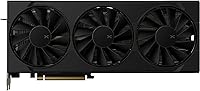
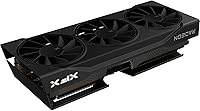
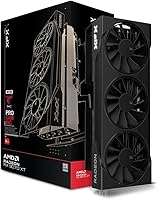
RDNA 4 brings real architectural gains over RDNA 3 — better instruction throughput and improved power efficiency translate into more frames delivered more consistently, not just in benchmarks but in actual gaming sessions. The 16GB GDDR6 running at 20 Gbps gives this RDNA 4 GPU enough memory bandwidth to handle high-resolution textures at 1440p and 4K without asset streaming becoming a bottleneck. A boost clock that reaches 2970 MHz means the card can sustain those clocks under extended load, not just hit them briefly. Four display outputs — one HDMI plus three DisplayPort — support up to 8K. Worth noting: the card runs nearly 13 inches long, so verify case clearance before ordering.

Best For

This RDNA 4 GPU is genuinely well-suited for 1440p high-refresh gaming — that's where RDNA 4's rasterization efficiency really pays off. It can handle 4K at solid settings too, making it a reasonable step toward UHD without a full flagship investment. Content creators working in GPU-accelerated video encoding or 3D rendering will find the 16GB VRAM particularly useful when scene complexity starts pushing memory limits. Builders upgrading from RDNA 2 or an aging mid-range Nvidia card will notice the jump right away. The four display outputs round things out nicely for anyone building a multi-monitor setup, whether for gaming or productivity work.

User Feedback

With over 9,000 ratings averaging 4.5 stars, the broader response to this XFX Swift card is clearly positive. Buyers consistently mention the cooling solution's performance — quiet under load even during extended sessions — and praise the card's solid construction out of the box. The most common criticism involves physical size: at nearly 13 inches, it doesn't fit every mid-tower case, and several buyers flagged this only after purchase. Driver maturity was a minor concern early on, though AMD addressed most issues through subsequent updates. A small number of reviews mention DOA units or shipping damage, which seems to be a logistics issue rather than a manufacturing one. Overall, most buyers consider the performance-per-dollar compelling.

Pros

  • RDNA 4 architecture delivers real efficiency gains, keeping power draw in check while improving performance over the previous generation.
  • The triple-fan cooler keeps thermals well-managed even under sustained gaming loads, and noise levels stay reasonable.
  • 16GB of GDDR6 VRAM provides comfortable headroom for high-resolution textures, modded games, and GPU-heavy creative work.
  • Four display outputs — including three DisplayPort — make this RDNA 4 GPU genuinely versatile for multi-monitor setups.
  • A boost clock approaching 3000 MHz means strong sustained performance, not just brief peak numbers in synthetic tests.
  • Buyers consistently praise the build quality out of the box, with a solid feel that reflects the card's premium tier.
  • The RX 9070 XT lands competitively against same-priced rivals, offering strong rasterization performance at 1440p and capable 4K output.
  • Over 9,000 ratings averaging 4.5 stars reflects broad, sustained satisfaction rather than a short honeymoon period.
  • AMD addressed most early driver concerns through updates, making the software experience much more stable for buyers today.

Cons

  • At nearly 13 inches long, this XFX Swift card will not fit in smaller mid-tower or compact cases without careful pre-purchase measurement.
  • Some early buyers encountered DOA units or shipping damage, suggesting packaging and logistics handling has been inconsistent.
  • AMD's software ecosystem still lags behind Nvidia in a few areas, particularly for users who depend on DLSS or Reflex equivalents.
  • Driver maturity was a genuine issue at launch, and buyers who purchased in the first weeks faced more troubleshooting than they expected.
  • The card weighs over 4 pounds, which may require a GPU support bracket to avoid sag in builds without vertical mounting.
  • Ray tracing performance, while improved over RDNA 3, still trails Nvidia cards at a comparable price point in heavily RT-dependent titles.
  • Availability and pricing have been inconsistent since launch, making it harder to catch this GPU at its best value window.

Ratings

The scores below were generated by our AI review engine after analyzing thousands of verified global purchases of the XFX Swift RX 9070 XT 16GB Graphics Card, with spam, bot activity, and incentivized reviews actively filtered out before any scoring was applied. Both the strengths that earned this RDNA 4 GPU its loyal following and the friction points that frustrated a meaningful minority of buyers are transparently reflected in each category. Nothing here is rounded up to make the card look better than the real-world experience supports.

Gaming Performance at 1440p
93%
At 1440p, the RX 9070 XT is genuinely impressive — buyers running high-refresh monitors consistently report smooth, stable frame delivery even in demanding open-world titles. The RDNA 4 architecture's rasterization improvements over the previous generation show up in real session performance, not just benchmark sheets.
A small number of users noted occasional frame pacing inconsistencies in certain DX11 titles, which AMD has been addressing through driver updates. It doesn't affect most modern games, but it's worth knowing if your library skews toward older engines.
4K Gaming Capability
78%
22%
The RX 9070 XT handles 4K gaming at high settings in many popular titles, and buyers who made the jump from 1080p or 1440p report being genuinely satisfied with the visual upgrade. For mainstream AAA titles and esports games at 4K, it performs well above expectations for its tier.
Pushing ultra settings in the most demanding 4K titles — like Cyberpunk 2077 with full ray tracing — exposes the card's limits, often requiring setting compromises to maintain comfortable frame rates. It's a capable 4K card, not an unconstrained one.
Thermal Performance
91%
The SWFT triple-fan cooler is one of the most praised aspects of this card across verified buyer feedback. Even during hours-long gaming sessions, users report temperatures that stay well-controlled, with the card sustaining its boost clock reliably rather than throttling under heat pressure.
A handful of buyers in warmer climates or poorly ventilated cases found the fans ramping up more aggressively than expected under sustained load. Adequate case airflow makes a noticeable difference — the cooler rewards a well-ventilated build and punishes a cramped one.
Noise Levels
82%
18%
Under typical gaming conditions, most buyers describe the fan noise as background-level — audible if you're in a quiet room without headphones, but not intrusive. The triple-fan design spreads the thermal load across a wider surface area, which lets each fan spin at a lower, quieter RPM.
At full load, particularly during GPU-intensive benchmark runs or heavy rendering tasks, the fans become notably louder. It's not an unusually loud card, but it's not a quiet one under sustained 100% load either.
Build Quality
89%
Buyers consistently describe the card as feeling solid and well-finished out of the box. The cooler shroud has a premium weight to it and the backplate adds structural rigidity, which contributes to the overall impression of a product built to last rather than a cut-cost design.
At over 4 lbs, the weight creates real sag risk in horizontal builds without a support bracket, and a few buyers reported slight cosmetic imperfections in the shroud finish upon arrival — nothing functional, but noticeable up close.
Value for Money
84%
Compared to competing Nvidia options at a similar price point, the RX 9070 XT delivers competitive rasterization performance that most buyers feel justifies the spend. Buyers upgrading from RDNA 2 or older Nvidia mid-range cards find the generational leap large enough to make the investment feel well-placed.
A segment of buyers feel that AMD's software ecosystem and ray tracing performance don't quite match Nvidia at equivalent pricing, making the value proposition less compelling for those who prioritize those specific capabilities. Availability fluctuations have also pushed prices above MSRP at times.
Driver Stability
67%
33%
Driver stability has improved considerably since launch, and buyers who purchased this RDNA 4 GPU in mid-2025 or later report a much smoother out-of-box software experience than early adopters did. AMD's update cadence has been responsive to the issues that surfaced post-launch.
Early adopters encountered genuine driver headaches — crashes in specific titles, display output instability in multi-monitor configurations, and occasional black screens that required rollbacks. While largely resolved now, it was a frustrating launch window for those who bought on day one.
Case Compatibility
59%
41%
Buyers with full-tower or larger mid-tower cases report zero installation issues, and many note that the length feels proportional to the cooler's thermal ambition — a necessary trade-off for what the SWFT design delivers thermally.
At nearly 13 inches long, this is one of the most frequently cited pain points in negative reviews — buyers who didn't check clearance specs found the card simply didn't fit their cases. It's a real and avoidable problem, but it catches enough buyers off-guard to warrant a significant score penalty here.
Ray Tracing Performance
63%
37%
RDNA 4 brings meaningful ray tracing improvements over RDNA 3, and in titles with moderate RT implementations, buyers notice the difference compared to what AMD hardware previously delivered. For casual RT use — ambient occlusion, shadows — the experience is solid.
In titles that lean heavily on full ray tracing pipelines, the RX 9070 XT lags noticeably behind Nvidia's competing offerings. Buyers who specifically want RT-heavy gameplay as a core use case consistently report that this is where the card falls short of expectations.
Software & Ecosystem
71%
29%
AMD's Adrenalin software suite has matured considerably, and buyers generally find the interface usable for monitoring, overclocking, and display tuning. FSR support across a growing game library adds genuine value for 4K and high-refresh gaming without requiring Nvidia-specific hardware.
Compared to Nvidia's GeForce Experience and its tighter integration with DLSS and Reflex, AMD's software stack still feels less polished and less feature-complete to buyers who've used both ecosystems. Some advanced features require more manual configuration than equivalent Nvidia tools.
Multi-Monitor Support
88%
Four video outputs — one HDMI plus three DisplayPort — give this card practical flexibility that buyers running dual or triple-monitor setups genuinely appreciate. Content creators and traders who need multiple screens active simultaneously find the output count hits the right number without needing a hub.
A small number of buyers reported display detection issues in specific multi-monitor configurations at launch, particularly with mixed-resolution setups. Most of these edge cases were addressed in subsequent driver updates, but they added friction for early multi-monitor users.
Packaging & Unboxing
72%
28%
The majority of buyers describe the unboxing experience as appropriate for a premium graphics card — protective foam, clean presentation, and no missing accessories. For most, the card arrived in perfect condition and ready to install without any surprises.
A recurring thread in negative reviews involves shipping damage and DOA units — bent PCIe connectors, cracked cooler shrouds, and non-booting cards. This appears to be a logistics and fulfillment issue rather than a manufacturing defect pattern, but it affects enough buyers to be worth flagging.
Overclocking Headroom
76%
24%
Buyers who enjoy manual tuning report that the RX 9070 XT has reasonable headroom beyond its factory boost clock, and the SWFT cooler's thermal headroom supports modest overclock stability. For casual overclockers, the stock performance combined with a small manual push offers a satisfying ceiling.
The card is already factory-boosted close to the architecture's practical limits, which means serious overclocking returns diminish quickly. Enthusiasts chasing maximum manual clocks find the gains relatively modest compared to what older architectures offered at equivalent effort.
Content Creation Utility
81%
19%
The 16GB VRAM is a legitimate selling point for creators doing GPU-accelerated video encoding, 3D rendering, or AI-assisted workflows — buyers in these fields specifically call out the memory capacity as the reason they chose this card over competing options with less VRAM at similar prices.
AMD's compute ecosystem for professional creative applications — particularly those relying on CUDA-dependent workflows — still requires workarounds or alternative tools. Buyers deep in Adobe or DaVinci Resolve pipelines may find the experience less plug-and-play than it would be on Nvidia hardware.

Suitable for:

The XFX Swift RX 9070 XT 16GB Graphics Card is the right call for enthusiast PC builders who want strong 1440p or entry-level 4K gaming performance without spending flagship money. If you're running a high-refresh 1440p monitor and want frames to stay consistently high in demanding titles, this RDNA 4 GPU is built exactly for that workload. Gamers upgrading from older RDNA 2 cards or mid-tier Nvidia GPUs from a couple generations back will feel a genuine, noticeable improvement in both frame rates and efficiency. Content creators who work in GPU-accelerated applications — video encoding, 3D rendering, or even AI-assisted creative tools — will appreciate having 16GB of VRAM to work with, since that headroom matters when scenes and assets get complex. Anyone building a multi-monitor workstation will also find the four video outputs practical, covering up to 8K if the use case ever calls for it.
Not suitable for:

Buyers with compact or mid-tower cases on the smaller end should measure carefully before committing — at nearly 13 inches long, the XFX Swift RX 9070 XT 16GB Graphics Card simply will not fit in every enclosure, and this is the most common regret mentioned in negative reviews. If you're building in a mini-ITX or small form factor case, this card is a non-starter without serious research into clearance specs first. Gamers who rely heavily on software features like Nvidia's DLSS 3 ecosystem or Reflex-based latency tools may also find AMD's software stack a less complete substitute, even after recent driver improvements. Buyers who want an absolutely plug-and-play experience with zero driver troubleshooting should know that, like most freshly launched architectures, early adopters encountered some software rough edges. Finally, if your gaming is exclusively at 1080p on a standard 60Hz display, the performance on offer here outpaces what that setup can actually use, making it a poor value fit.
Specifications

  • Chipset: The card is powered by AMD's RX 9070 XT GPU, built on the RDNA 4 architecture for improved efficiency and performance over the previous generation.
  • Memory: It carries 16GB of GDDR6 memory running at 20 Gbps, providing ample bandwidth for high-resolution textures and demanding creative workloads.
  • Boost Clock: The GPU can boost up to 2970 MHz under load, sustaining high clock speeds for consistent frame delivery in games and applications.
  • Base Clock: The base GPU clock runs at 1660 MHz, serving as the stable floor from which the card scales up under heavier workloads.
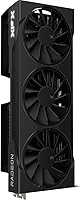
  • Cooling System: XFX equips this card with the SWFT triple-fan cooling solution, designed to keep temperatures controlled and fan noise at a reasonable level during extended sessions.
  • Display Outputs: The card provides one HDMI port and three DisplayPort outputs, supporting up to four simultaneous displays at resolutions reaching 7680x4320 (8K).
  • Max Resolution: Maximum supported output resolution is 7680x4320, making this card technically capable of driving 8K displays when paired with appropriate content and monitors.
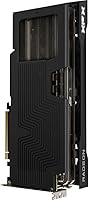
  • Card Length: The PCB measures 12.99 inches (approximately 33 cm) in length, which requires careful clearance verification in mid-tower and compact cases before purchase.
  • Card Width: The card spans 5.91 inches in width, occupying a standard dual or triple-slot footprint depending on the case configuration.
  • Card Weight: At 4.27 lbs (approximately 1.94 kg), the card is on the heavier end for its class and may benefit from a GPU support bracket to prevent sag.
  • Color: The card ships in a black finish consistent with the XFX Swift series aesthetic, suited to most build themes without requiring special accommodation.
  • Model Number: The official XFX model identifier is RX-97TSWF3BA, which should be referenced when looking up firmware updates, warranty claims, or compatibility documentation.
  • Series: This card belongs to XFX's Swift (SWFT) product line, which historically focuses on strong thermal performance using multi-fan cooling configurations.
  • Launch Date: The RX 9070 XT became available in March 2025, placing it among the earliest RDNA 4 cards available to retail consumers.
  • BSR Ranking: Shortly after launch, the card reached a top-four ranking in the Computer Graphics Cards category on Amazon, reflecting strong early sales and buyer interest.
  • Average Rating: Based on 9,232 customer ratings, the card holds a 4.5 out of 5 average score, indicating consistently positive reception across a large buyer pool.
  • Chipset Brand: The GPU is manufactured by AMD, with XFX serving as the add-in board partner responsible for the cooler design, PCB tuning, and factory configuration.
  • Video Outputs: Output interfaces include HDMI and DisplayPort, covering compatibility with virtually all modern gaming monitors, TVs, and professional displays currently on the market.

Related Reviews
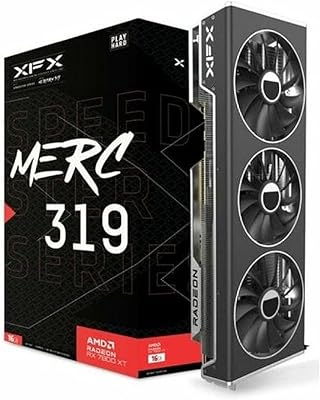
XFX Speedster MERC319 RX 7800 XT 16GB GDDR6 Graphics Card
85%
91%
Overall Performance
94%
Gaming Performance at 4K
88%
Cooling Efficiency
87%
Value for Money
85%
Build Quality
More
Sapphire Nitro+ RX 9070 XT 16GB
82%
92%
Gaming Performance
88%
Thermal Management
91%
Noise Level
93%
VRAM Capacity & Bandwidth
74%
Ray Tracing Performance
More
XFX Speedster MERC319 AMD Radeon RX 6800 XT 16GB GDDR6 Graphics Card
85%
94%
Performance in 4K Gaming
88%
Thermal Management & Cooling
89%
Value for Money
85%
Build Quality & Durability
82%
Installation & Setup
More
XFX RX 9060 XT 8GB Graphics Card
82%
88%
Gaming Performance at 1440p
93%
Gaming Performance at 1080p
67%
VRAM Adequacy
86%
Thermal Performance
89%
Noise Levels
More
AMD Radeon RX 6950 XT Graphics Card
72%
92%
4K Gaming Performance
94%
VRAM Capacity & Bandwidth
51%
Power Consumption
48%
Physical Size & Case Fit
67%
Driver Stability
More
GIGABYTE RX 7600 XT 16GB Graphics Card
80%
88%
Value for Money
84%
1080p Gaming Performance
72%
1440p Gaming Performance
93%
VRAM Capacity
86%
Thermal Performance
More
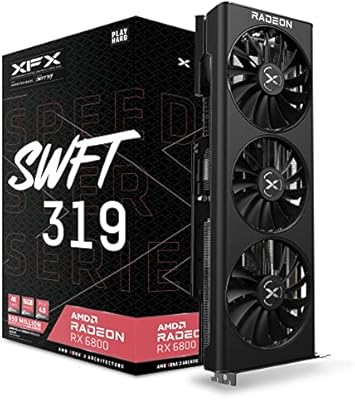
XFX Speedster SWFT319 RX 6800 Graphics Card
76%
88%
Thermal Performance
84%
Noise Levels
94%
VRAM Capacity
86%
1440p Gaming Performance
63%
Ray Tracing Capability
More
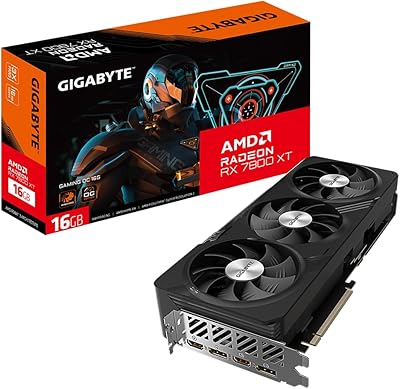
GIGABYTE RX 7800 XT 16GB Graphics Card
78%
91%
1440p Gaming Performance
88%
Thermal Management
93%
VRAM & Future-Proofing
79%
Value for Money
61%
Driver & Software Experience
More
ASUS Prime RX 9070 OC Graphics Card
82%
91%
Gaming Performance at 1440p
88%
Thermal Management
87%
Noise Levels
84%
Build Quality & Feel
67%
Driver Stability & Software
More
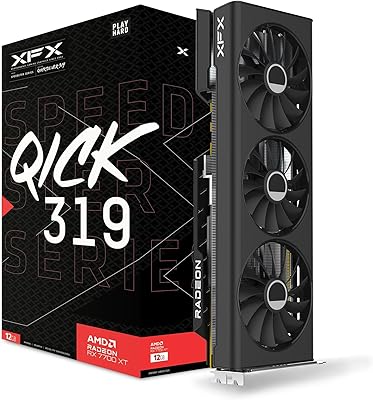
XFX Speedster QICK319 RX 7700 XT 12GB GDDR6 Graphics Card
85%
92%
Gaming Performance
87%
Cooling Efficiency
90%
Price-to-Performance Ratio
62%
Compatibility with Motherboards
88%
Build Quality
More

FAQ

It depends on your specific case. The RX 9070 XT measures nearly 13 inches long, which exceeds the maximum GPU length in many mid-tower and compact enclosures. Before ordering, check your case manufacturer's listed maximum GPU clearance and compare it against 330mm. Full-tower cases generally have no issue, but don't assume — measure first.

Yes, as an RDNA 4 card it supports AMD FidelityFX Super Resolution, including the latest FSR iterations available at the time of launch. FSR works across a wide range of games and doesn't require specific hardware like Nvidia's DLSS does, so you can use it in any compatible title regardless of engine.

Most buyers report that the triple-fan cooler keeps noise levels reasonable even during extended gaming sessions. It's not silent — no triple-fan card is — but the general consensus is that it stays well below the threshold most people would find distracting with headphones on or in a typical room environment.

AMD recommends at least a 700W to 750W PSU for the RX 9070 XT, and pairing it with a quality unit from a reputable brand matters more than just hitting the wattage number. If you're running a high-core-count CPU alongside it, budgeting for 800W or more gives you comfortable headroom.

It handles both, though 1440p is where this RDNA 4 GPU is most comfortable delivering consistently high frame rates. At 4K you'll need to dial settings to high rather than ultra in some demanding titles to stay above 60fps, but for many games it performs well at native 4K. If your primary goal is maxed-out 4K in every game, a higher-tier card would serve you better.

Yes. The card has four video outputs — one HDMI and three DisplayPort — and can drive up to four displays simultaneously. This makes the RX 9070 XT a practical choice for multi-monitor gaming rigs or productivity setups that need multiple screens active at once.

The RX 9070 XT trades blows with Nvidia's upper-mid-range offerings in rasterization performance. Where Nvidia pulls ahead is in ray tracing workloads and in software features like DLSS 3 and Reflex. AMD has its own equivalent tools, but if you rely heavily on Nvidia-specific features, that's worth factoring into the decision.

Early buyers in March 2025 did encounter some driver instability, which is fairly common with any freshly launched GPU architecture. AMD has pushed multiple driver updates since launch and most of those early rough edges have been smoothed out. Buying today puts you in a much more stable position than day-one adopters were in.

At just over 4 pounds, sag is a real consideration — especially in cases where the card is horizontally mounted without support. A GPU support bracket is a low-cost addition that eliminates the issue entirely. Some premium cases include one, but if yours doesn't, it's worth picking one up separately.

The 16GB of GDDR6 VRAM is the main draw here for creative workloads. Video editors working in high-bitrate formats and 3D artists dealing with complex scenes will benefit from having that memory headroom. AMD's software stack for professional applications has matured considerably, though if your workflow is built around CUDA-dependent tools, you'd want to verify compatibility before switching ecosystems.

Where to Buy