Overview

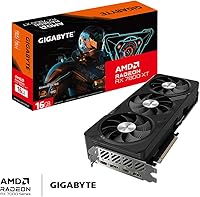
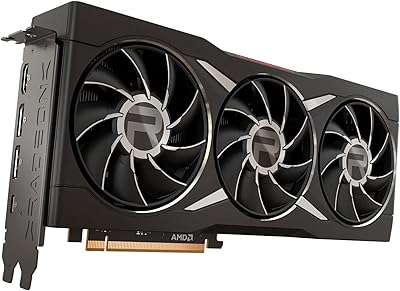
The GIGABYTE RX 7800 XT 16GB Graphics Card occupies an interesting position where the mid-range and high-end GPU market genuinely overlap. Built on AMD's RDNA 3 architecture, it targets 1440p gaming primarily, though 16GB of GDDR6 VRAM gives it more breathing room than most cards at this tier — including some that cost considerably more. GIGABYTE's Gaming OC variant ships with a factory overclock above AMD's reference spec, which translates to a small but real performance cushion straight out of the box. The card launched in late 2023 into a crowded field and has held its ground well. A 3-year warranty rounds things out and gives buyers reasonable long-term peace of mind.
Features & Benefits

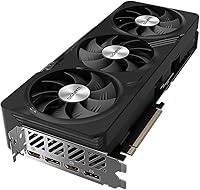
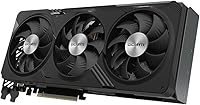
The Windforce cooling system uses three 90mm fans and seven composite copper heat pipes to keep temperatures in check under sustained load — and in practice, it does a solid job. Boost clocks reach 2565 MHz thanks to GIGABYTE's overclock, adding a measurable edge in GPU-intensive scenes without requiring any manual tuning. The 16GB of GDDR6 memory on a 256-bit bus is arguably the card's biggest long-term selling point; modern open-world and texture-heavy titles are already pushing 8GB and 12GB cards to their limits. Connectivity covers two DisplayPort 2.1 and two HDMI 2.1 ports for high-refresh multi-monitor setups. RDNA 3 also brings hardware AV1 encoding, a genuine plus for anyone who streams regularly.

Best For

This Radeon card is an obvious fit for 1440p high-refresh gaming — that's where it consistently performs well, handling demanding AAA titles without visible strain. Streamers and video editors will appreciate AV1 hardware encoding, which offloads compression work from the CPU during capture or export. Anyone upgrading from an RX 5000-series or RTX 20-series GPU will notice a substantial generational jump. Multi-monitor power users benefit from DisplayPort 2.1 outputs, which handle high-resolution and high-refresh displays that older standards struggle with. For buyers thinking a few years ahead, 16GB of VRAM provides a buffer that keeps this card relevant as games grow increasingly memory-hungry over time.

User Feedback

With a 4.5-star average across nearly 700 ratings, the RX 7800 XT earns its reputation among buyers. Thermal performance under sustained load draws consistent praise, with the Windforce cooler keeping GPU temperatures well within comfortable range during long sessions. Value relative to competing cards is another recurring highlight. On the downside, AMD's driver software remains a friction point for some users — not a dealbreaker for most, but worth knowing if you're switching from an Nvidia setup. A handful of buyers noted case compatibility concerns given the card's physical footprint, and PCIe connector placement can feel awkward in tighter builds. These are minor complaints overall, and the consensus skews clearly positive.

Pros

  • 16GB of GDDR6 VRAM is unusually generous at this market tier, helping the card stay relevant as games grow more memory-hungry.
  • The Windforce triple-fan cooler keeps thermals genuinely comfortable during extended gaming sessions without excessive noise.
  • Factory overclocking to 2565 MHz boost means a small but real performance edge with zero manual effort required.
  • Hardware AV1 encoding is a practical bonus for streamers and video editors who want less CPU overhead.
  • Dual DisplayPort 2.1 and dual HDMI 2.1 outputs cover virtually any monitor setup, including high-refresh and high-resolution displays.
  • A 3-year warranty provides meaningful long-term protection that shorter-warranty competitors do not always match.
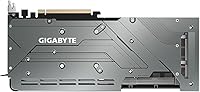
  • The metal backplate adds structural rigidity and helps with passive heat dissipation on a card that runs warm under load.
  • Nearly 700 buyer ratings averaging 4.5 stars reflects a broad consensus of satisfaction, not just early-adopter enthusiasm.
  • Generational performance uplift over RX 5000 and RTX 20-series cards is substantial enough to feel immediately noticeable.
  • DirectX 12 Ultimate and ray tracing support keep this GIGABYTE GPU compatible with current and near-future game features.

Cons

  • AMD's driver software still requires occasional user intervention and can be less polished than Nvidia's equivalent experience.
  • The card's physical footprint may cause clearance or fitment issues in smaller cases and compact builds.
  • PCIe power connector placement has been flagged by some builders as awkward, particularly in tighter cable-management setups.
  • Ray tracing performance, while supported, trails Nvidia's competing cards at a similar price point in heavily RT-dependent titles.
  • A 700W recommended PSU requirement pushes total system power demands higher than some existing builds can accommodate without an upgrade.
  • No equivalent to DLSS 3 frame generation means Nvidia users switching ecosystems will lose a feature they may rely on.
  • 4K gaming is achievable in lighter titles but inconsistent in the most demanding AAA games at maximum settings.
  • Resale value for AMD cards has historically been softer than comparable Nvidia options, which matters for buyers who upgrade frequently.

Ratings

The scores below reflect AI-driven analysis of verified global buyer reviews for the GIGABYTE RX 7800 XT 16GB Graphics Card, with spam, bot activity, and incentivized feedback actively filtered out before scoring. Each category captures what real users experienced across hundreds of reviews — the wins and the frustrations alike. Strengths are credited where earned, and recurring pain points are scored honestly without softening.

1440p Gaming Performance
91%
Buyers consistently report smooth, high-frame-rate experiences in demanding AAA titles at 1440p, with the factory overclock providing a noticeable edge over reference-clocked alternatives. Gamers running titles like Cyberpunk 2077 and Hogwarts Legacy at high settings praise the card's composure under sustained load.
Performance in ray-tracing-heavy scenarios at 1440p drops more sharply than on competing Nvidia cards at a similar price point, requiring settings adjustments to maintain comfortable frame rates in the most graphically intensive scenes.
Thermal Management
88%
The Windforce triple-fan setup earns frequent praise for keeping GPU temperatures well within comfortable ranges during multi-hour gaming sessions. Buyers upgrading from dual-fan cards notice the difference immediately, especially in warmer ambient environments.
Under extended synthetic load or during summer months in poorly ventilated cases, temperatures climb higher than some users expected. A minority of reviewers noted the fans spin up aggressively in those conditions, which can be audible in quieter rooms.
VRAM & Future-Proofing
93%
16GB of GDDR6 VRAM is a genuine differentiator at this tier, and reviewers frequently mention it as the deciding factor over competing 8GB and 12GB cards. Users running texture mods in RPGs or working with high-resolution assets in creative applications report zero memory-related stuttering.
The 256-bit memory bus, while adequate, means raw bandwidth trails wider-bus alternatives in synthetic memory benchmarks. For most real-world gaming scenarios this is imperceptible, but it is a technical ceiling worth understanding.
Value for Money
79%
21%
Buyers who compare specifications per dollar consistently land on this Radeon card favorably, particularly when factoring in the 16GB VRAM buffer that higher-priced competitors often skip. The 3-year warranty adds perceived long-term value that many reviewers explicitly call out.
At its asking price, the card sits in a competitive bracket where Nvidia options offer stronger ray tracing and a more polished software ecosystem. Buyers who ultimately chose this card occasionally mention they wrestled with the decision longer than expected.
Driver & Software Experience
61%
39%
AMD's Adrenalin software suite has matured meaningfully, and most users report stable day-to-day operation once the drivers are properly configured. Features like Radeon Super Resolution and the streaming overlay are genuinely useful additions that reviewers appreciate.
A recurring theme across reviews is the occasional need for clean driver reinstalls after updates, and some users report game-specific instability that required rollbacks to older driver versions. Buyers switching from Nvidia frequently cite the software adjustment period as the steepest part of the transition.
Build Quality
86%
The metal backplate and robust shroud construction leave a strong first impression out of the box, and buyers with previous GPU experience note that the card feels substantially built compared to more budget-oriented alternatives. The structural rigidity holds up well over time according to longer-term owners.
A handful of reviewers reported minor cosmetic inconsistencies in the fan shroud finish, and the card's weight means it can cause slight PCIe slot sag in cases without GPU support brackets, which is worth planning around during installation.
Noise Levels
74%
26%
During normal gaming workloads, the semi-passive fan stop feature keeps things completely silent at idle and near-silent during light use, which owners of open desk setups particularly appreciate. Most users describe the fan noise during gaming as unobtrusive.
When the card hits its thermal limits under stress testing or in hot environments, fan noise increases to a level that some reviewers found distracting. Users in quiet office setups or those sensitive to fan noise mentioned this more frequently than average.
Installation & Fit
72%
28%
The standard PCIe 4.0 interface and straightforward driver installation process make the initial setup approachable for most builders, including those doing their first GPU upgrade. Reviewers generally describe the physical installation as uncomplicated in full-size ATX and mid-tower cases.
The card's triple-slot footprint and length create genuine fitment challenges in smaller mid-tower cases and make it incompatible with many compact builds. PCIe power connector orientation drew specific criticism for being awkward to route in cases with side-entry cable management cutouts.
Ray Tracing Performance
63%
37%
Hardware ray tracing support via RDNA 3 ray accelerators is a meaningful step forward from previous AMD generations, and titles with moderate ray tracing implementations run acceptably at 1440p with some settings adjustment. Buyers using ray tracing selectively rather than universally report satisfactory results.
In titles that lean heavily on ray tracing — particularly path-traced games — the RX 7800 XT trails Nvidia's competing cards by a margin that forces more aggressive quality trade-offs. Buyers who prioritize ray tracing fidelity above all else are likely better served by alternatives.
Connectivity & Display Output
89%
Four video outputs covering two DisplayPort 2.1 and two HDMI 2.1 ports give this GIGABYTE GPU exceptional multi-monitor flexibility, and reviewers running three-display setups consistently praise the configuration options. The DisplayPort 2.1 spec future-proofs the card against upcoming high-bandwidth monitors.
Four ports is plenty for almost any setup, but the lack of a VirtualLink or USB-C output means VR headset users with cable-dependent headsets may need an adapter. This is a niche concern but worth noting for that specific audience.
AV1 Encoding
82%
18%
Streamers and content creators who switched to hardware AV1 encoding report noticeably lower CPU utilization during live broadcasts, freeing up system resources for smoother gameplay in tandem. OBS users integrating AMD's encoder specifically mention improved stream quality at equivalent bitrates.
AV1 encoding support in third-party creative applications remains inconsistent, and users working in Premiere Pro or After Effects note that GPU acceleration still leans heavily on CUDA in many workflows, limiting the practical benefit outside of live streaming.
4K Gaming Capability
58%
42%
In well-optimized or visually lighter titles, the card handles 4K at medium-to-high settings with acceptable frame rates, giving buyers occasional flexibility to game above 1440p when a 4K display is available. The 16GB VRAM buffer at least removes memory as a bottleneck in these scenarios.
In demanding open-world or graphically intensive titles at 4K maximum settings, frame rates drop to levels that frustrate users expecting consistent high-refresh performance. Reviewers who primarily game at 4K express visible disappointment, making clear this card was not designed with that resolution as its target.
RGB & Aesthetics
76%
24%
RGB Fusion 2.0 integration allows lighting customization that syncs with other compatible GIGABYTE components, and reviewers who invested in a cohesive system build appreciate the visual cohesion. The overall black shroud design is widely described as understated and versatile.
RGB customization requires GIGABYTE's Fusion software, which some users find bloated and prefer to leave uninstalled entirely. A minority of reviewers reported lighting effects not syncing correctly with third-party RGB controllers without additional configuration steps.
Warranty & Support
81%
19%
A 3-year manufacturer warranty is notably longer than competitors in this tier and comes up repeatedly in reviews as a meaningful reassurance, particularly for buyers investing a significant sum in a GPU. Reviewers who actually needed warranty service generally describe GIGABYTE's process as functional.
Warranty claim turnaround times draw some criticism, with a subset of reviewers describing the RMA process as slower than ideal. International buyers outside major markets also note that warranty service logistics can be more complicated depending on region.

Suitable for:

The GIGABYTE RX 7800 XT 16GB Graphics Card is built squarely around the 1440p gaming experience, and buyers who game at that resolution — especially on high-refresh monitors — will get the most out of it. If your priority is smooth, consistent frame rates in demanding AAA titles without spending flagship money, this Radeon card hits a practical sweet spot. Content creators who stream or edit video will also find real utility here, since hardware-accelerated AV1 encoding offloads a meaningful chunk of work from the CPU during capture or export sessions. PC builders upgrading from an RX 5000-series or RTX 20-series card will notice a substantial generational jump in both raw performance and feature support. The 16GB GDDR6 VRAM buffer is particularly appealing for anyone thinking two or three years ahead, as modern games are already pushing older 8GB and 12GB cards into uncomfortable territory. Multi-monitor users with DisplayPort 2.1 displays round out the ideal audience.
Not suitable for:

Buyers chasing 4K gaming at high refresh rates across all titles should temper their expectations — the GIGABYTE RX 7800 XT 16GB Graphics Card can handle 4K in many games, but it was not designed to dominate at that resolution the way higher-tier cards are. If you are fully committed to the Nvidia ecosystem — particularly for DLSS 3 frame generation, CUDA-dependent creative workflows, or GeForce Experience features — this card does not offer a direct equivalent and the transition carries real friction. AMD's driver software has improved considerably over the years, but it still occasionally requires more user attention than Nvidia's, which can frustrate buyers who prefer a set-it-and-forget-it experience. The card's physical size also means compact or mini-ITX build owners may face case compatibility issues and tighter power connector routing. Finally, buyers on a strict budget who game primarily at 1080p will likely find more value in a less expensive option, since the RX 7800 XT's strengths are largely wasted at that resolution.
Specifications

  • GPU Architecture: Built on AMD's RDNA 3 architecture, which delivers improved performance-per-watt and enhanced ray tracing capability compared to the previous generation.
  • Boost Clock: The factory overclock pushes the boost clock to 2565 MHz, running above AMD's reference specification without requiring any manual tuning from the user.
  • VRAM: Equipped with 16GB of GDDR6 memory, providing substantial headroom for high-resolution textures and memory-intensive workloads in modern titles.
  • Memory Bus: The 256-bit memory bus supports a memory speed of 19500 MHz, enabling strong bandwidth for demanding 1440p and light 4K workloads.
  • Cooling System: The Windforce triple-fan cooler uses three 90mm blade fans, seven composite copper heat pipes, and a large copper plate that directly contacts the GPU die.
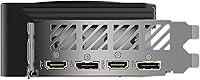
  • Display Outputs: Connectivity includes two DisplayPort 2.1 and two HDMI 2.1 ports, supporting up to 7680x4320 resolution and high-refresh multi-monitor configurations.
  • PCIe Interface: Uses a PCIe 4.0 interface, fully backward compatible with PCIe 3.0 motherboards while delivering full bandwidth on current-generation platforms.
  • Power Requirement: GIGABYTE recommends a minimum 700W power supply unit to ensure stable operation under sustained gaming or rendering loads.
  • DirectX Support: Supports DirectX 12 Ultimate, enabling access to hardware-accelerated ray tracing, variable rate shading, and mesh shaders in compatible titles.
  • AV1 Encoding: Includes a dedicated hardware AV1 encoder, allowing streamers and video editors to offload compression tasks from the CPU during capture or export.
  • Ray Tracing: Ray tracing is supported at the hardware level via dedicated RDNA 3 ray accelerators, offering improved performance over prior AMD generations.
  • Backplate: A full-coverage metal backplate is fitted to the rear of the card, adding structural rigidity and contributing to passive thermal management.
  • Card Weight: The card weighs approximately 3.3 pounds, which is typical for a triple-fan GPU of this size and should be accounted for in case planning.
  • RGB & Lighting: RGB Fusion 2.0 integration allows users to customize lighting effects via GIGABYTE's software, synchronized with other compatible components if desired.
  • Warranty: Covered by a 3-year manufacturer warranty from GIGABYTE, offering longer protection than the standard 1- or 2-year coverage common in this category.

Related Reviews
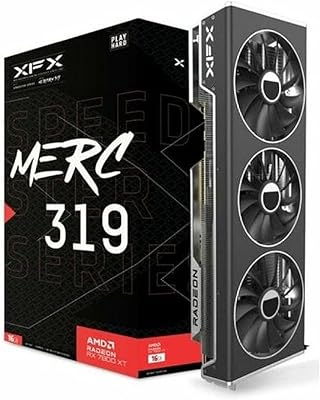
GIGABYTE RX 7600 XT 16GB Graphics Card
80%
88%
Value for Money
84%
1080p Gaming Performance
72%
1440p Gaming Performance
93%
VRAM Capacity
86%
Thermal Performance
More
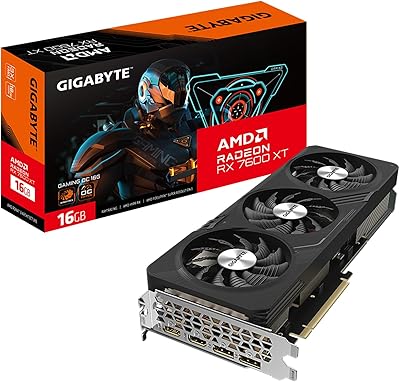
XFX Speedster MERC319 RX 7800 XT 16GB GDDR6 Graphics Card
85%
91%
Overall Performance
94%
Gaming Performance at 4K
88%
Cooling Efficiency
87%
Value for Money
85%
Build Quality
More
AMD Radeon RX 6950 XT Graphics Card
72%
92%
4K Gaming Performance
94%
VRAM Capacity & Bandwidth
51%
Power Consumption
48%
Physical Size & Case Fit
67%
Driver Stability
More
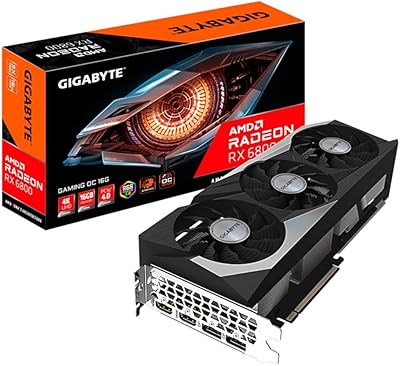
Gigabyte Radeon RX 6800 16GB Graphics Card
77%
88%
Gaming Performance
91%
Thermal Management
87%
Noise Level
93%
VRAM Capacity
89%
Build Quality
More
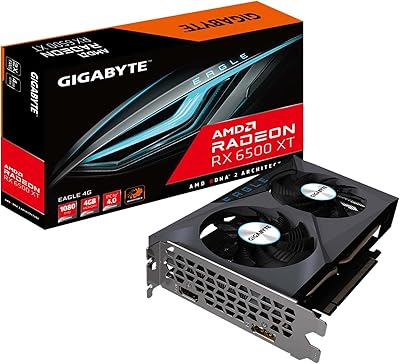
GIGABYTE Radeon RX 6500 XT Eagle 4GB Graphics Card
83%
92%
Value for Money
88%
Gaming Performance (1080p)
90%
Cooling System Efficiency
63%
4K Performance
84%
Build Quality
More
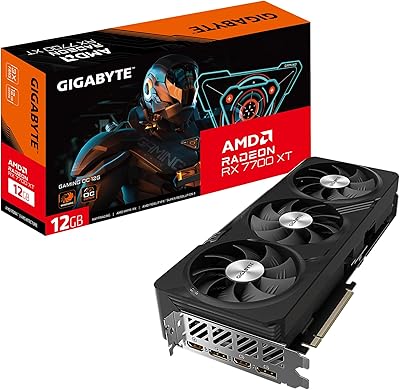
GIGABYTE RX 7700 XT 12GB Graphics Card
83%
88%
1440p Gaming Performance
91%
Thermal Performance
83%
Noise Level
93%
Build Quality
76%
Value for Money
More
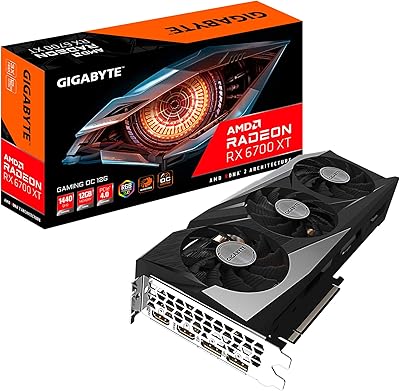
GIGABYTE Radeon RX 6700 XT Gaming OC 12GB Graphics Card
87%
94%
4K Gaming Performance
91%
Cooling System Efficiency
88%
Installation and Setup
86%
Design and Durability
89%
Frame Rates in Demanding Games
More
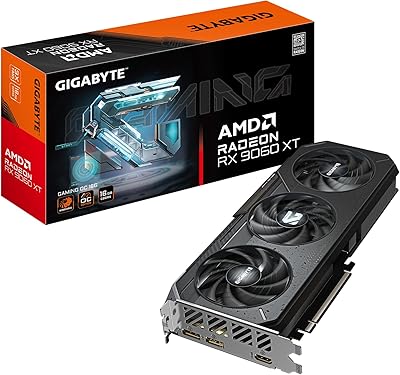
GIGABYTE Radeon RX 9060 XT Gaming OC 16G
83%
93%
1440p Gaming Performance
96%
Memory Capacity (VRAM)
89%
Thermal Management
84%
Acoustic Performance
87%
Build Quality & Materials
More
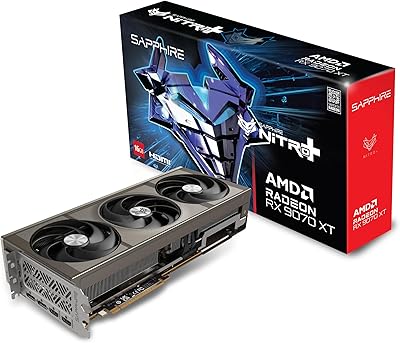
Sapphire Nitro+ RX 9070 XT 16GB
82%
92%
Gaming Performance
88%
Thermal Management
91%
Noise Level
93%
VRAM Capacity & Bandwidth
74%
Ray Tracing Performance
More
XFX Swift RX 9070 XT 16GB Graphics Card
78%
93%
Gaming Performance at 1440p
78%
4K Gaming Capability
91%
Thermal Performance
82%
Noise Levels
89%
Build Quality
More

FAQ

It genuinely is well-suited for 1440p. The RX 7800 XT consistently delivers strong frame rates in demanding AAA titles at that resolution, and the 16GB of VRAM means you rarely run into the memory ceiling that plagues some competing cards. For most 1440p gamers, this is a comfortable match.

It can run games at 4K, and lighter or well-optimized titles will perform acceptably. That said, if 4K at maximum settings is your primary goal, you will likely hit performance limits in the most demanding games. Think of 4K as an occasional option here, not the card's main strength.

Most users report that the Windforce system stays reasonably quiet during normal gaming. Under sustained stress — long benchmark runs or extended high-load sessions — the fans do spin up noticeably, but it is not unusually loud compared to other triple-fan cards in this class. Semi-passive mode keeps things silent during light use.

The 700W recommendation is sensible rather than excessive, especially if your system includes a modern CPU and other components drawing meaningful power. Running the card on a lower-rated PSU is not recommended, as power instability under load can cause crashes or hardware stress. If you are near that threshold, upgrading the PSU is worth considering.

Switching ecosystems is straightforward on the hardware side — you simply swap the card and install AMD's drivers. Where things get nuanced is software: AMD's Adrenalin driver suite has improved considerably, but it is more hands-on than Nvidia's GeForce Experience. You will also lose access to DLSS and any CUDA-dependent tools you rely on, so check your specific software dependencies before committing.

It will fit in most standard mid-tower cases without issue, but you should verify the available GPU length clearance in your specific case before purchasing. The card is also a triple-slot design, so check slot spacing if your motherboard has components close to the PCIe x16 slot.

Yes, ray tracing is supported at the hardware level. Performance with ray tracing enabled varies by title — the RX 7800 XT is competitive but generally trails Nvidia's RTX 4070 in heavily ray-traced scenes. Turning ray tracing to medium settings rather than maximum usually produces a much better balance of visuals and frame rates on this card.

GIGABYTE provides a 3-year limited warranty on this card, which covers manufacturing defects. You would need to contact GIGABYTE's support directly to initiate a claim, and the process requires proof of purchase. Three years is a genuinely useful coverage window for a component expected to last that long in most builds.

It is increasingly useful in practice. Several recent games — particularly at 1440p with high texture settings — already push past 8GB and nudge toward 12GB. Having 16GB means this Radeon card is less likely to hit a memory bottleneck as game requirements grow over the next few years, which is a real advantage if you plan to keep the card for a while.

It works well beyond gaming. The hardware AV1 encoder is a practical asset for streamers using OBS or similar software, reducing CPU load during broadcasts. For video editing, AMD's GPU acceleration is supported in applications like DaVinci Resolve, though the ecosystem support is broader on Nvidia in some professional tools. For most creative hobbyists, it handles the workload comfortably.

Where to Buy