Overview

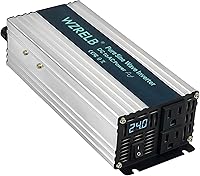
The WZRELB SE80024 800W Pure Sine Wave Inverter sits in an interesting spot in the market — it delivers genuinely clean AC power at a price point that won't give you pause. Built by Yueqing Reliable Electric, a Chinese OEM with a broad inverter catalog, this isn't a boutique product, but it doesn't need to be. What separates it from the cheaper modified sine wave crowd is the quality of its output and a live DC voltage display that lets you keep tabs on your battery without reaching for a multimeter. For off-grid users, campers, and RV owners on a 24V system, this 800W inverter offers a practical entry point into clean power.
Features & Benefits

The most meaningful thing about this pure sine wave unit is what it means for the devices plugged into it. Modified sine wave inverters are inexpensive, but they can cause buzzing in audio equipment, shorten the life of motors, and create real problems for CPAP machines and sensitive medical gear. The WZRELB inverter avoids all of that with clean 60Hz output. The soft-start feature ramps voltage gradually rather than hitting connected devices with a sudden jolt — a small engineering choice that reduces long-term wear. Its 1600W surge rating is real, but brief; treat it as a safety margin for startup spikes, not something to lean on regularly. Two AC outlets allow simultaneous use.

Best For

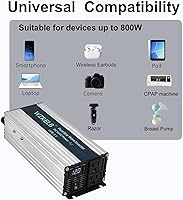
This 800W inverter is a natural fit for anyone running a 24V battery system off the grid — van lifers, RV owners, and overlanders who need reliable AC power for laptops, a flat-screen, or a CPAP machine. Its compact dimensions (just over 10 inches long and under three pounds) make it easy to mount or stow in tight spaces. Truck drivers powering a phone charger and a small TV during overnight stops will find it handles those loads without complaint. It also works well as an emergency home backup, keeping a router, lights, or medical equipment running during an outage. One firm limit: this is not a fridge inverter. A compressor needs roughly ten times its running wattage at startup, which is well beyond what this unit can sustain.

User Feedback

Buyers tend to highlight two things consistently: output quality and the LED voltage display. For CPAP users especially, the clean output makes a real difference — no motor hum, no interference, no disruptions. The display gets mentioned regularly as a genuinely useful feature for keeping tabs on battery state. On the downside, the aluminum housing gets noticeably hot during extended runs, and this is worth taking seriously. The manufacturer flags it clearly, and real-world buyers confirm it — don't store anything flammable nearby and avoid handling the unit while it's operating. A number of users have also flagged fan noise as a factor in quiet environments. Long-term reliability sits in mixed territory, with terminal connections and cable quality cited as common weak points after several months of regular use.

Pros

  • Pure sine wave output protects sensitive devices like CPAP machines, laptops, and TVs that modified sine wave inverters can damage over time.
  • The live LED voltage display is genuinely useful — you can monitor your battery bank state without any extra tools or guesswork.
  • Soft-start technology reduces startup stress on connected appliances, which can meaningfully extend their lifespan.
  • At under three pounds and roughly 10 inches long, this 800W inverter is easy to mount, move, or pack into a vehicle or gear bag.
  • Two AC outlets let you run two devices simultaneously, which is a practical advantage over single-outlet competitors at this price.
  • The all-aluminum housing acts as a passive heat sink, adding a layer of thermal management beyond just the cooling fan.
  • Standby draw is under 10 watts, so leaving it connected without a load won't noticeably drain your battery bank.
  • For the price, the output quality is notably better than budget modified sine wave alternatives — a real, tangible difference for sensitive loads.

Cons

  • The housing gets hot enough during extended use that touching it is a genuine burn risk — installation placement needs careful thought.
  • Fan noise runs continuously during operation, which can be disruptive in quiet sleeping environments like a camper or van bedroom.
  • Terminal connections and cable build quality have been flagged by long-term users as potential weak points after months of regular use.
  • The 1600W surge rating provides only a brief safety buffer — it cannot sustain high-draw startup loads from compressors or motors.
  • Refrigerators, air conditioners, and microwave ovens are all incompatible with this unit due to high motor startup demands.
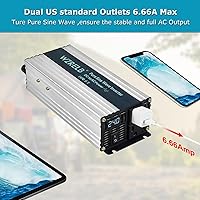
  • There is no USB charging port, so phone charging requires using one of the two AC outlets, which limits simultaneous device options.
  • Long-term reliability data is limited given the product's relatively recent market entry, making multi-year durability hard to assess confidently.
  • Efficiency claims of 91.6% or higher have not been independently verified, and real-world performance may vary depending on load and ambient temperature.

Ratings

The scores below reflect an AI-driven analysis of verified global buyer reviews for the WZRELB SE80024 800W Pure Sine Wave Inverter, with spam, bot activity, and incentivized feedback actively filtered out before scoring. Each category is rated on real-world user experiences — not manufacturer claims — so both the genuine strengths and the recurring frustrations are represented honestly. Whether this 800W inverter is the right call for your setup depends heavily on which of these categories matter most to you.

Output Power Quality
91%
Across verified buyer feedback, the pure sine wave output is the most consistently praised aspect of this unit. CPAP users, in particular, report zero interference or pressure fluctuations — a result they could not get from cheaper modified sine wave alternatives. Laptop and TV users similarly note no buzzing, flickering, or unusual behavior.
A small number of buyers noted minor voltage inconsistencies under loads approaching the 800W ceiling, suggesting the output is cleanest in the low-to-mid wattage range. For highly sensitive audio equipment, a handful of users reported faint background hum that was not present with higher-end inverters.
Value for Money
87%
For buyers who specifically need pure sine wave output on a 24V system, this 800W inverter sits at a price point that is hard to argue with. The combination of clean output, LED display, and aluminum construction at this cost gives it a clear edge over similarly priced modified sine wave units that offer less usable power.
Buyers who have owned more expensive inverter brands tend to note that the build finish and terminal quality do not match that tier, which is expected but still worth acknowledging. A few users felt the value proposition weakened after reliability issues emerged past the six-month mark.
Thermal Management
63%
37%
The all-aluminum housing genuinely helps distribute heat during operation, and buyers running moderate loads — a laptop and phone charger, for instance — report the unit stays within acceptable temperature ranges without issue. The dual cooling approach of passive housing plus an active fan works as intended under normal use.
At sustained or near-peak loads, the housing gets hot enough to be a real concern — multiple reviewers describe it as too hot to touch comfortably after 30 to 60 minutes of heavy use. This is not a flaw per se, since the manufacturer explicitly warns about it, but buyers who did not read the documentation were caught off guard and considered it a safety issue.
Fan Noise
58%
42%
The cooling fan does its job effectively, keeping internal temperatures under control during continuous use. Buyers running this inverter in a truck cab or outdoors report the noise is a non-issue in those contexts, where ambient sound levels already mask a steady fan hum.
In quiet environments — particularly for CPAP users running the inverter overnight in a van or RV — the constant fan noise is a recurring complaint. Unlike some inverters where the fan ramps on demand, this unit runs the fan continuously from the moment it is switched on, which becomes noticeable in any setting where silence matters.
LED Voltage Display
88%
The real-time DC voltage readout is one of the most practically appreciated features in buyer feedback. RV and van-life users especially value being able to glance at battery voltage without reaching for a separate meter — it removes one variable from the anxiety of managing an off-grid power setup.
The display shows only DC input voltage, with no readout for AC output voltage, load wattage, or remaining runtime estimation. More experienced off-grid users noted that while the display is useful, it leaves them wanting a more complete picture of what the inverter is actually doing.
Build Quality
69%
31%
The all-aluminum enclosure feels noticeably more solid than plastic-bodied inverters at a comparable price, and the overall assembly is tight enough that buyers report no rattling or flexing during transport. For a budget-tier unit, the physical construction earns more positive comments than negative ones.
Terminal blocks and cable connection points are where the build quality most often falls short in longer-term reviews. Several users reported signs of oxidation or loosening at the terminals after months of regular use, and the included connection hardware is described as functional but not confidence-inspiring for permanent installations.
Ease of Installation
82%
18%
The compact dimensions and light weight make positioning and mounting straightforward for most vehicle and off-grid setups. Buyers with basic wiring knowledge report a quick and intuitive installation, with the input and output terminals clearly labeled and accessible.
The product documentation is minimal, and buyers who are new to inverters or off-grid systems mention frustration with the lack of guidance on appropriate wire gauge, fuse sizing, or safe mounting orientation. A more detailed instruction set would help this unit reach a broader audience confidently.
Surge Handling
67%
33%
The 1600W surge rating provides enough headroom to handle brief startup spikes from small power tools or audio receivers without tripping the protection circuitry. Buyers who use it for occasional startup loads — rather than sustained motor-heavy appliances — report it handles those moments reliably.
Several buyers discovered the hard way that the surge capacity is momentary, not a sustained buffer. Attempting to run appliances with large motors — even modestly sized ones — resulted in protection shutdowns or, in a few cases, premature unit failures. The marketing around surge capacity tends to create inflated expectations.
Soft-Start Performance
83%
The gradual voltage ramp at startup is something buyers notice indirectly — connected devices power on smoothly without the sharp jolt that can stress sensitive components over time. CPAP users specifically mention that devices connected to this unit seem to experience less wear than with previous inverters they have owned.
For buyers running appliances with large inductive loads, the soft start does not fully compensate for the high inrush current those devices demand at startup. It is a useful feature within the inverter's power envelope, but it does not meaningfully extend what that envelope can accommodate.
Low Voltage Protection
86%
The automatic shutoff when input voltage drops to the low threshold is a well-regarded safety feature among buyers managing AGM battery banks, where over-discharge causes permanent capacity loss. RV owners report the cutoff has protected their batteries on more than one occasion when they forgot to monitor charge levels.
A few users noted the low voltage cutoff threshold is fixed and not adjustable, which can be a limitation for buyers with lithium battery systems that have different safe discharge floors than AGM banks. The inability to customize this parameter is a minor but real drawback for advanced users.
Portability
89%
At under three pounds and roughly the size of a thick hardback book, this pure sine wave unit travels easily between a truck cab, a tent setup, and a cabin without being a burden. Campers who prioritize keeping their kit light consistently mention the weight as a strong point.
Portability is somewhat limited in practice by the need for heavy-gauge cables to connect it to a battery — those cables add bulk and are less convenient to manage than the inverter itself. There is also no carry handle or protective case included, which matters for buyers who move the unit frequently.
Long-Term Reliability
61%
39%
A reasonable number of buyers report the unit running without issue for well over a year under moderate, intermittent use — the kind of use case it is clearly designed for. For seasonal campers or occasional emergency backup users, durability concerns are less likely to surface.
For buyers using this inverter daily or near its rated capacity, reliability concerns emerge more frequently in the three-to-six-month range. Terminal degradation, fan failure, and occasional unexplained shutdowns are the most commonly cited issues in critical longer-term reviews, pointing to limits in component quality at this price point.
Protection Features
78%
22%
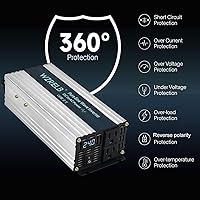
The inverter includes over-voltage, under-voltage, overload, and short-circuit protection, which gives buyers a meaningful safety net during unexpected power events. In practice, buyers report these protections triggering correctly and the unit recovering cleanly after an overload fault is cleared.
The protection system's sensitivity means it occasionally trips under load conditions that feel borderline rather than clearly excessive, leading some buyers to describe the unit as slightly conservative in how it defines its own limits. A reset process that requires fully powering down the unit before restarting can also be inconvenient mid-use.

Suitable for:

The WZRELB SE80024 800W Pure Sine Wave Inverter is a strong pick for anyone living or working off a 24V battery system who needs clean, reliable AC power without spending a lot to get it. RV owners and van-lifers are the obvious sweet spot — particularly those running a CPAP machine, a laptop, or a flat-screen TV from a lithium or AGM battery bank, where output quality genuinely matters. Off-grid cabin users who only need AC power occasionally, rather than continuously, will get solid value here without over-investing in a larger, more expensive unit. Truck drivers who want to power a phone charger and a small TV during overnight rest stops will find it handles those modest loads comfortably. Its compact footprint and sub-three-pound weight also make it a practical choice for campers who want to keep their gear bag light but still have access to standard AC outlets when needed.
Not suitable for:

The WZRELB SE80024 800W Pure Sine Wave Inverter is simply the wrong tool if your power demands exceed what 800 watts can sustain — and that category is broader than many buyers initially realize. Running a refrigerator is a common mistake: a typical fridge compressor can draw ten times its running wattage at startup, which puts it far outside what this unit can safely handle even momentarily. Anyone hoping to run a microwave, a power tool, an air conditioner, or any appliance with a large motor or compressor should look at a significantly higher-capacity inverter. The housing gets genuinely hot during extended operation, which makes it unsuitable for installations in poorly ventilated spaces or anywhere it might be accidentally touched. Buyers who need near-silent operation — particularly light sleepers relying on a CPAP overnight — should be aware that the cooling fan runs continuously and may be disruptive in a quiet environment. Finally, those expecting heavy daily use over years from a budget-tier OEM unit should temper expectations; terminal connections and long-term durability are areas where this price range typically shows its limits.
Specifications

  • Continuous Output: The inverter delivers a steady 800W of continuous AC power, suitable for most small electronics and appliances under that threshold.
  • Surge Output: A brief surge capacity of 1600W helps absorb short startup spikes from certain loads, though this headroom is momentary and not a sustained rating.
  • DC Input Voltage: Accepts a DC input range of 21–30V, making it compatible with standard 24V lithium and AGM battery banks.
  • AC Output Voltage: Produces a stable 120V AC output at 60Hz, matching standard North American household current.
  • Output Waveform: Generates a true pure sine wave signal, which is safe for sensitive electronics including CPAP machines, laptops, and modern flat-screen televisions.
  • Conversion Efficiency: Rated at 91.6% or higher efficiency, meaning minimal energy is lost as heat during the DC-to-AC conversion process under typical load conditions.
  • Standby Draw: Idle power consumption is under 10W, so leaving the unit connected to your battery bank without an active load will not cause significant drain.
  • Low Voltage Shutdown: The unit automatically shuts off when input voltage drops to between 18.5V and 20.5V DC, protecting connected batteries from harmful over-discharge.
  • High Voltage Shutdown: An automatic cutoff at 30.5V DC prevents damage to the inverter if the battery bank voltage rises above safe operating limits.
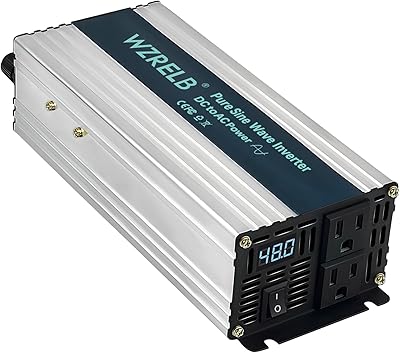
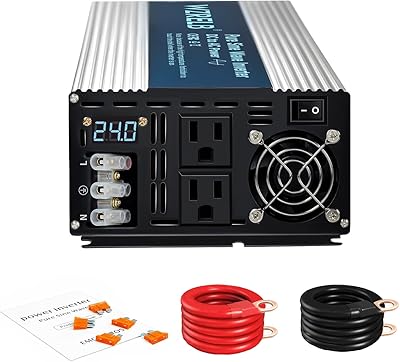
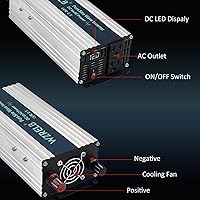
  • AC Outlets: Two standard 120V AC outlets are included, allowing two devices to run simultaneously as long as combined wattage stays within the 800W ceiling.
  • DC Voltage Display: An LED display shows real-time DC input voltage, giving users a straightforward way to monitor battery state during operation.
  • Cooling System: Thermal management combines an active cooling fan with an all-aluminum housing that passively dissipates heat across its entire surface area.
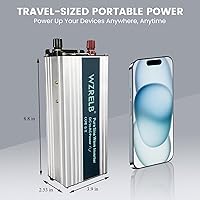
  • Dimensions: The unit measures 10.1 x 3.85 x 2.53 inches, a compact footprint that fits in tight mounting spaces inside an RV, van, or truck cab.
  • Weight: At 2.6 pounds, this pure sine wave unit is light enough to carry in a camping gear bag or reposition easily between vehicles.
  • Operating Temperature: Designed to function reliably in ambient temperatures between 0°C and 40°C (32°F to 104°F), which covers typical outdoor and vehicle use conditions.
  • Model Number: The official model designation is SE80024, manufactured by Yueqing Reliable Electric Co., Ltd. under the WZRELB brand.

Related Reviews

WZRELB SE80048 800W Pure Sine Wave Inverter 48V to 120V
86%
94%
Power Output Stability
91%
Conversion Efficiency
88%
Safety & Protection Features
85%
Portability & Size
90%
Cooling & Heat Management
More
WZRELB 1500W 24V Pure Sine Wave Inverter
73%
88%
Output Power Quality
61%
Reliability & Longevity
84%
Cooling & Noise
82%
Ease of Installation
71%
Remote Control Function
More
WZRELB 1200W Pure Sine Wave Inverter SE120048
83%
88%
Power Stability
85%
Ease of Setup
78%
Cooling System
90%
Display & Monitoring
87%
Portability
More
WZRELB 1000W Pure Sine Wave Inverter SE100048
82%
88%
Power Performance
90%
Ease of Use
75%
Cooling System Efficiency
70%
Surge Power Handling
85%
Portability
More
WZRELB RBP-500024S 5000W 24V Pure Sine Wave Inverter
84%
91%
Power Performance
73%
Ease of Setup
85%
Safety Features
88%
Cooling Efficiency
90%
Build Quality
More
WZRELB 3000W 24V Pure Sine Wave Inverter
76%
91%
Output Power Quality
84%
Build Quality
78%
Thermal Management
61%
Fan Noise
66%
Voltage Display Accuracy
More
TVNIKD 2500W Pure Sine Wave Inverter
85%
88%
Overall Performance
92%
Power Output
80%
Ease of Use
89%
Efficiency
91%
Noise Level
More
ZETAWALE 2500W Pure Sine Wave Inverter
87%
94%
Power Output Performance
91%
Value for Money
89%
Ease of Use
85%
Cooling System Efficiency
87%
Versatility of Ports
More
TVNIKD 3500W Pure Sine Wave Inverter
86%
92%
Power Conversion Performance
89%
Ease of Setup
72%
Portability & Size
90%
Reliability & Durability
91%
Power Output (Wattage)
More
SUNWHEEL 2000W Pure Sine Wave Inverter
80%
86%
Power Output Reliability
91%
Waveform Quality
83%
Build Quality
88%
Noise Level
67%
LCD Display Usefulness
More

FAQ

Yes, and this is actually one of its strongest use cases. CPAP machines require a clean sine wave to run quietly and correctly — a modified sine wave inverter can cause humming, affect pressure delivery, or void the device warranty. This pure sine wave unit outputs the same quality of power your CPAP would get from a wall outlet, so compatibility is not an issue for most models. Just verify your CPAP's wattage is under 800W, which nearly all of them are.

No, and this is important to understand before buying. A refrigerator compressor can draw roughly ten times its running wattage the moment it kicks on — a typical mini fridge might run at 80–150W but spike to 800W or more at startup. This 800W inverter cannot handle that safely or reliably. If you need to run a fridge, you want an inverter rated at several times the fridge's running wattage, not just its continuous draw.

The fan runs whenever the inverter is powered on, not just when it reaches a certain temperature threshold. This is worth knowing if you plan to use it near a sleeping area — it produces a consistent low-level fan noise that some people find disruptive in quiet environments, especially light sleepers using a CPAP overnight.

Yes, and the manufacturer explicitly warns about it. The aluminum body acts as a heat sink, so warmth spreading across the housing is normal and intentional — it is part of the thermal management design. That said, it can get hot enough to cause discomfort or injury if touched during extended operation, so mount it somewhere you won't accidentally brush against it, and keep flammable materials away from it.

For an 800W inverter on a 24V system, you are drawing roughly 33–35 amps at full load, so you generally want at least 6 AWG wire for short cable runs, with 4 AWG being safer if your cables run longer than a few feet. Always fuse the positive cable close to the battery — a fuse rated around 40–60 amps is a common recommendation for this power level. Check local standards and the product documentation before finalizing your wiring.

Yes, the WZRELB SE80024 800W Pure Sine Wave Inverter has two AC outlets, so you can power two devices simultaneously. The key constraint is that their combined wattage must stay under 800W. For example, a laptop at 65W and a TV at 120W together draw well under the ceiling, so that combination is fine. Just add up the wattage of both devices before plugging them in.
No. This specific model is designed exclusively for 24V DC input, with an acceptable input range of 21–30V. Connecting it to a 12V battery bank will not work — it will either fail to turn on or trigger the low voltage protection cutoff. If you have a 12V system, you need a different inverter model rated for 12V input.

The LED display on the front shows your live DC input voltage, which gives you a direct read on your battery bank's state. As the battery discharges, the voltage reading will drop. Most 24V lithium banks are considered low around 23–24V, and AGM banks around 23–24V as well depending on depth of discharge preferences. The inverter will also shut itself off automatically when voltage drops to the low cutoff threshold, protecting your batteries from going too deep.

That depends entirely on your battery capacity and the load you are running. As a rough example, a 100Ah 24V battery bank holds about 2400 watt-hours of energy. Running a 200W load, you would theoretically get around 10–12 hours before hitting safe discharge limits, accounting for inverter efficiency losses. Heavier loads drain the bank proportionally faster. Use your specific battery capacity and device wattage to estimate runtime for your setup.

The standby draw is under 10W, so it won't rapidly drain your battery just sitting idle. That said, any continuous load on a battery that isn't being charged will eventually deplete it, so it's worth being mindful of how long you leave it on without a charging source connected. The built-in low voltage shutdown will protect the battery from over-discharge if you do forget, but it's better not to rely on that as a regular safety net.