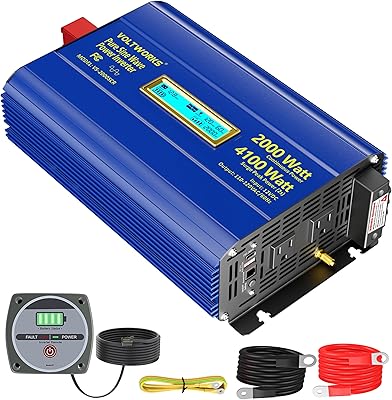
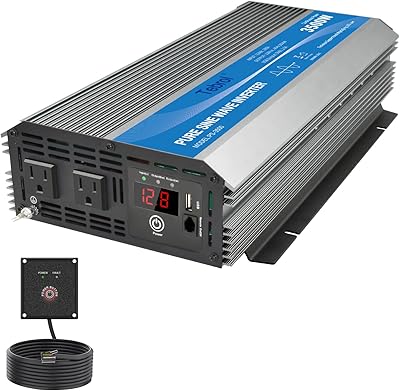
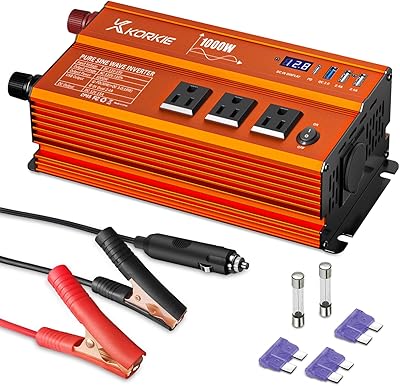
Overview

The SUNWHEEL 2000W Pure Sine Wave Inverter arrived on the market in early 2025, carving out a practical middle ground between barebones budget units and premium-brand options. It converts 12V DC battery power to 120V AC at a claimed efficiency above 92%, which holds up reasonably well in real-world use. What stands out at this price tier is the aluminum alloy housing — most competitors here still ship with plastic shells that flex and crack over time. Two AC outlets and an LCD display round out a feature set that feels genuinely complete rather than stripped down for cost-cutting purposes.
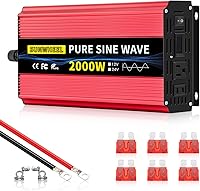
Features & Benefits

The pure sine wave output is the core selling point, and it matters more than many buyers initially realize. Modified sine wave inverters can degrade motor efficiency, cause buzzing in audio equipment, and even damage sensitive gear over time. This sine wave inverter sidesteps all of that, running laptops, CPAP machines, and modern televisions without complaint. The 4000W peak surge capacity means it can start refrigerator compressors and microwave ovens without tripping — a common failure point on undersized units. The smart cooling fan stays quiet during lighter loads, and the built-in GFCI outlet is a thoughtful touch cheaper inverters routinely skip. Sustained draws should stay comfortably below the rated maximum for long-term reliability.

Best For

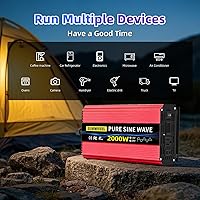
This 2000W inverter is a natural fit for RV campers, van lifers, and overlanders who draw AC power from a 12V lithium or AGM battery bank. Truck drivers wanting to run a compact refrigerator, a coffee maker, or a CPAP overnight will find the wattage headroom reassuring. It also works well in off-grid cabin setups paired with a solar charge controller — a configuration where clean sine wave power is non-negotiable for equipment longevity. It can serve as emergency home backup in a pinch. Anyone upgrading from a modified sine wave unit who is not ready to spend on a premium brand will find this a solid step up without a painful price jump.

User Feedback

Across its 207 ratings, the SUNWHEEL unit holds a 4.0 out of 5, which is respectable but tells a nuanced story. Most positive reviewers single out reliable refrigerator performance and quiet fan behavior during lighter loads — two things that actually matter day-to-day. On the critical side, a number of buyers report that the LCD wattage readout drifts under variable loads, making it less trustworthy as a precision monitor. The included battery cables are also notably short, so budget for longer, properly gauged wire before installation. A small number of units arrived with display defects, pointing to occasional quality inconsistencies. Nothing catastrophic, but worth knowing before you buy.

Pros

  • Pure sine wave output safely powers sensitive electronics like CPAP machines, laptops, and modern TVs without waveform distortion.
  • The 4000W peak surge capacity handles refrigerator and microwave startup loads without tripping.
  • Aluminum alloy housing is a genuine durability upgrade over plastic-bodied competitors in the same price range.
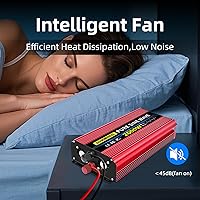
  • The smart cooling fan stays quiet during light use, making it livable in a sleeping or working environment.
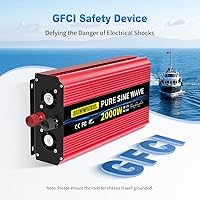
  • Built-in GFCI outlet adds a safety layer that most inverters at this price skip entirely.
  • The LCD display shows voltage and load in real time, giving non-technical users a clear read on system status.
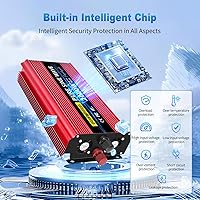
  • Multiple onboard protections — overload, over-temperature, short circuit, and voltage faults — reduce the risk of catastrophic failure.
  • At roughly 6 pounds, this sine wave inverter is light enough to mount flexibly in tight vehicle or cabin spaces.
  • Dual AC outlets let two devices run simultaneously, which is genuinely useful in real daily use.
  • Conversion efficiency above 92% keeps battery drain reasonable during moderate loads.

Cons

  • The included battery cables are too short for most real-world installations — budget for longer, properly gauged wire before you start.
  • LCD wattage readings drift under variable loads, making it unreliable as a precision consumption monitor.
  • A portion of buyer reviews report units arriving with display defects, suggesting inconsistent factory quality control.
  • Sustained draws near the 2000W ceiling will stress the unit and should be avoided for long-term reliability.
  • SUNWHEEL is a newer brand with limited third-party repair support, which matters if the unit fails outside a return window.
  • The fan noise, while quiet at low loads, becomes audible above 1200W — noticeable in a quiet bedroom or cab overnight.
  • No remote on/off switch is included, which can be inconvenient depending on where the unit is mounted.
  • Documentation and setup instructions have been described by some buyers as thin on detail for first-time inverter users.

Ratings

The SUNWHEEL 2000W Pure Sine Wave Inverter earns a measured but genuine endorsement from the broader buyer community — these scores were generated by AI after analyzing verified purchase reviews worldwide, with spam, bot activity, and incentivized feedback actively filtered out. The result is an honest picture that captures both what this sine wave inverter does well and where it leaves room for improvement. Strengths in power quality and build stand out clearly, while a handful of recurring pain points around accessories and display accuracy keep the overall picture balanced.
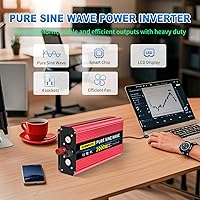
Power Output Reliability
86%
The majority of real-world users report that this 2000W inverter handles refrigerator compressor startups and microwave operation without tripping — the two most common stress tests buyers actually care about. The 4000W surge headroom makes a noticeable difference in everyday RV and truck use.
A small but consistent segment of reviewers note that sustained draws above 1600W produce more heat than expected, suggesting the unit prefers to operate with some headroom below its rated ceiling. Pushing it hard continuously is not where it performs most confidently.
Waveform Quality
91%
Pure sine wave output is the core reason most buyers choose this unit over cheaper alternatives, and it delivers. CPAP users, laptop owners, and those running modern televisions report zero compatibility issues — the kind of clean power that modified sine wave inverters simply cannot match.
There is no independent third-party waveform measurement data available for this specific unit, so buyers with particularly sensitive medical or audio equipment have to take the claimed waveform quality on faith rather than verified lab results.
Build Quality
83%
The aluminum alloy shell is a genuine differentiator at this price point — it feels solid in hand, dissipates heat better than plastic, and gives buyers confidence that it will survive the vibration and temperature swings of a truck cab or RV bay over time.
A minority of buyers received units with pre-existing cosmetic or display defects, pointing to inconsistent final inspection before shipping. For most buyers this is not an issue, but it is enough of a pattern to flag as a real quality-control variable.
Noise Level
88%
During light and moderate loads, the smart fan stays off entirely, making this one of the quieter inverters buyers report using in sleep environments. Several overnight truck drivers and van lifers specifically mention appreciating the silence during low-draw nighttime use.
Once the load climbs above 1200W, the fan activates and becomes clearly audible in a quiet cabin. It is not disruptive during daytime operation, but users sensitive to fan noise in sleeping spaces should be aware of this threshold.
LCD Display Usefulness
67%
33%
Having a live readout of voltage and approximate load wattage is far more useful than nothing, especially for buyers who are newer to off-grid setups and want some visibility into what their system is doing without additional equipment.
Accuracy is where the display loses credibility — multiple reviewers document wattage readings that drift or lag noticeably when loads fluctuate, such as when a compressor cycles. For anyone relying on it as a precision consumption monitor, it is more of a rough indicator than a reliable instrument.
Safety Features
89%
The built-in GFCI outlet is a feature that many competing units at this price point quietly omit, and buyers who understand its value — particularly in damp outdoor or marine-adjacent environments — single it out as a meaningful inclusion. Overload and over-temperature shutoffs have also performed as advertised in reported fault scenarios.
The GFCI and protection systems are reactive rather than preventive, meaning a fault still has to occur before the protection triggers. There is no remote monitoring or app connectivity for users who want proactive system visibility.
Cooling System
81%
19%
The thermally activated fan design keeps the unit running quietly during the light loads that make up most everyday use. Users running small appliances, charging devices, or powering LED systems report the fan rarely or never activates during their typical sessions.
In high-ambient-temperature environments — a parked RV in summer heat, for example — the fan threshold is reached more quickly and the fan runs more frequently than buyers in cooler climates might expect. Adequate airflow around the unit matters more than the product listing implies.
Ease of Installation
74%
26%
The unit itself is straightforward to connect for anyone with basic 12V wiring knowledge — two battery terminals, plug in your devices, and it is operational. The LCD fault indicators help non-technical users diagnose basic issues without needing external tools.
The included battery cables are the single most complained-about accessory in the entire review pool. They are genuinely too short for real vehicle installations, and buyers who do not anticipate this end up making an additional hardware run before they can complete the setup.
Value for Money
82%
18%
For a pure sine wave inverter with aluminum housing, GFCI protection, an LCD display, and a 4000W surge rating, this 2000W inverter lands at a price point that undercuts similarly specified branded alternatives by a meaningful margin — something buyers in the RV and off-grid community notice quickly.
The value calculation weakens slightly when you factor in the cost of proper installation cables, which most buyers need to purchase separately. It is not a dealbreaker, but the out-of-box experience is less complete than the feature list suggests.
Compatibility Range
87%
The pure sine wave output makes this unit broadly compatible with inductive loads like motor compressors, capacitive loads like switching power supplies, and sensitive electronics — a range that covers the vast majority of what RV, truck, and off-grid users actually want to power.
It is a 12V-only unit with North American 120V output, which limits its utility for international users, 24V system owners, or anyone needing 240V output. Those are niche cases, but worth confirming before purchasing.
Fan & Thermal Management
78%
22%
The unit does not run hot during typical operation, and the aluminum housing actively helps conduct heat away from internal components. Users report it remaining touchably warm rather than hot during extended moderate-load sessions, which reflects reasonably well on the thermal design.
Extended high-load operation in an enclosed or poorly ventilated space — such as a cabinet or battery box — pushes temperatures up faster than the cooling system can comfortably manage. Ventilation requirements are not prominently communicated in the setup documentation.
Display Durability
63%
37%
For the majority of buyers, the LCD panel functions correctly from day one and continues to do so through extended daily use. It is legible in typical indoor lighting conditions and updates frequently enough to be genuinely useful during normal operation.
The segment of critical reviews mentioning display failures on arrival is notable enough to flag as a product-specific concern. Whether this reflects a manufacturing batch issue or an ongoing quality variance is unclear, but it is a higher rate of display-related complaints than comparable inverters in this category tend to generate.
Portability & Form Factor
84%
At just over six pounds and with a reasonably compact footprint, this sine wave inverter is one of the more manageable 2000W units available. Buyers who semi-permanently mount it report that the dimensions fit neatly into standard RV utility bays and truck cab storage areas.
The form factor is optimized for fixed mounting rather than grab-and-go use — there is no carry handle, and the terminal connections are not designed for repeated connect-disconnect cycles. It is not the right choice for buyers who need a truly portable setup they can move between vehicles regularly.
Brand Support & Warranty
61%
39%
SUNWHEEL does offer a warranty on this unit, and a portion of buyers who contacted support report receiving replacement units for defective displays without significant friction. The response experience is described as adequate by those who have gone through it.
SUNWHEEL is a newer brand with a limited service footprint outside of the online marketplace channel. Buyers who prefer the reassurance of an established brand with physical service centers, or who are installing this in a remote off-grid location with no easy return option, face more risk here than they would with a legacy inverter brand.

Suitable for:

The SUNWHEEL 2000W Pure Sine Wave Inverter is a strong match for anyone living or working out of a vehicle who depends on AC power from a 12V battery bank. RV campers and van lifers will appreciate the clean sine wave output, which protects sensitive gear — CPAP machines, laptops, and modern televisions — from the kind of waveform distortion that cheaper inverters produce. Truck drivers who need to run a compact refrigerator or brew a pot of coffee during an overnight rest stop will find the wattage headroom comfortable for those tasks. It also fits naturally into off-grid solar setups, where pairing a pure sine wave inverter with a charge controller and battery bank is the practical standard. Anyone upgrading from a modified sine wave unit who wants genuinely better power quality without committing to a high-end brand name will find this 2000W inverter hits a useful middle ground.
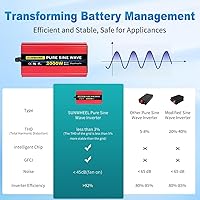
Not suitable for:

The SUNWHEEL 2000W Pure Sine Wave Inverter is not the right tool for buyers who need heavy, sustained power draws close to its rated ceiling — running it near 2000W continuously shortens its lifespan and pushes the cooling system hard. Workshops or job sites requiring simultaneous operation of multiple power-hungry tools should look at higher-capacity or purpose-built industrial inverters instead. The included battery cables are short enough to be a real installation problem in larger rigs or battery setups with some distance between the battery and mounting point, so buyers who are not prepared to source additional wiring will hit a friction point immediately. Anyone who needs a precision power monitor should note that the LCD wattage readout has drawn criticism for drifting under variable loads, making it unreliable for applications where accurate real-time consumption data is critical. And if quality consistency is a hard requirement — such as for medical equipment in a remote setting with no easy return option — the small but noted rate of display defects on arrival is worth factoring into the decision.
Specifications

  • Continuous Output: Delivers a steady 2000W of continuous AC power under normal operating conditions.
  • Peak Surge: Handles up to 4000W of instantaneous surge power to start motor-driven appliances like refrigerators and microwaves.
  • Input Voltage: Accepts 12V DC input from a standard lead-acid, AGM, or lithium battery bank.
  • Output Voltage: Produces 110V to 120V AC output compatible with standard North American household appliances.
  • Waveform Type: Outputs a true pure sine wave, identical in quality to utility grid power and safe for sensitive electronics.
  • Efficiency: Conversion efficiency exceeds 92%, reducing wasted energy during DC-to-AC conversion.
  • AC Outlets: Equipped with two standard AC outlets, allowing two devices to run simultaneously.
  • Display: An LCD panel shows real-time input voltage, output load in watts, and fault condition indicators.
  • Safety Features: Includes GFCI protection, plus automatic shutoff for over-voltage, under-voltage, overload, over-temperature, and short circuit conditions.
  • Cooling System: A smart fan activates automatically when load exceeds 1200W or internal temperature rises above 104°F (40°C).
  • Operating Noise: Fan noise remains under 45 dB during low-load operation, equivalent to a quiet library environment.
  • Housing Material: Constructed from aluminum alloy for improved heat dissipation and greater impact resistance versus plastic enclosures.
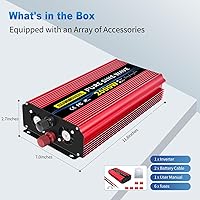
  • Dimensions: Measures 11.8 x 7.09 x 5.91 inches, compact enough for mounting in most RV bays, truck cabs, or utility enclosures.
  • Weight: Weighs 6.14 pounds, making it manageable for a single person to install in most applications.
  • Availability: First made available in January 2025, making it a relatively new entrant in the mid-range inverter category.

Related Reviews
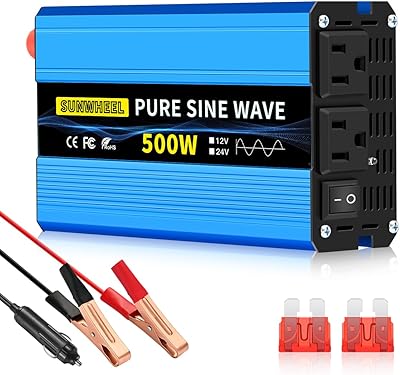
SUNWHEEL 500W Pure Sine Wave Inverter
86%
92%
Power Conversion Efficiency
88%
Noise Level
85%
Build Quality & Durability
80%
Cooling System
83%
Portability
More
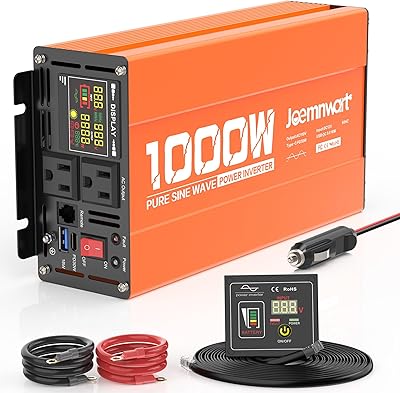
Joemnwart 1000W Pure Sine Wave Power Inverter
79%
88%
Power Output Quality
79%
Build Quality
84%
USB Charging Performance
86%
Safety Protection System
82%
Noise Level
More
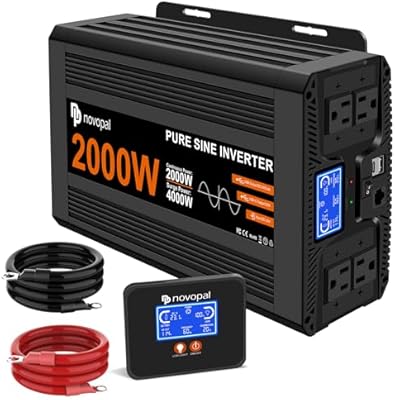
Novopal 2000W 24V Pure Sine Wave Inverter
79%
88%
Power Output Quality
83%
Build Quality
79%
Value for Money
74%
Ease of Installation
81%
Remote Control Functionality
More
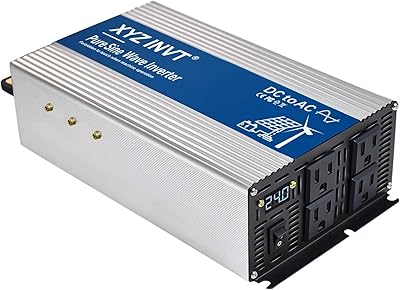
XYZ INVT 2000W Pure Sine Wave Inverter
75%
88%
Power Output Quality
58%
Thermal Management
83%
Surge Handling
91%
Portability & Size
86%
Conversion Efficiency
More
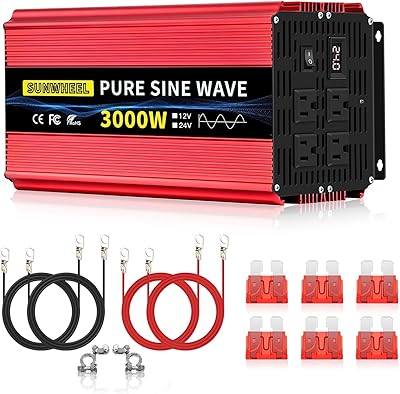
SUNWHEEL 3000W 24V Pure Sine Wave Inverter
78%
88%
Output Power Quality
83%
Value for Money
86%
Ease of Installation
81%
Surge Handling
79%
Noise Level
More
VOLTWORKS VS-2000SCR 2000W Pure Sine Wave Inverter
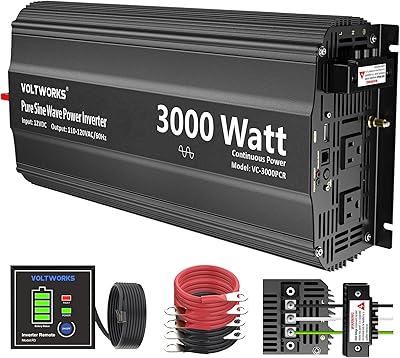
81%
88%
Output Power & Reliability
91%
Sine Wave Quality
83%
Surge Performance
86%
Lithium Battery Compatibility
79%
Build Quality & Housing
More
TVNIKD 2500W Pure Sine Wave Power Inverter
77%
88%
Power Output Quality
81%
Build Quality
63%
Heat Management
86%
Ease of Installation
83%
LCD Display Usability
More
ZETAWALE 2500W Pure Sine Wave Inverter
78%
91%
Pure Sine Wave Quality
87%
Auto Transfer Switch
84%
Value for Money
61%
Long-term Reliability
68%
Cooling & Noise
More
VOLTWORKS VS-3000PCR 3000W Pure Sine Wave Inverter
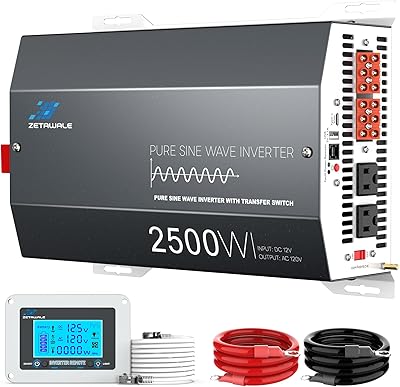
79%
83%
Output Power Accuracy
91%
Output Signal Quality
88%
Cooling & Noise Level
79%
Build Quality & Housing
86%
Installation Ease
More
Novopal 1500W Pure Sine Wave Inverter
76%
83%
Power Output Accuracy
88%
Power Quality
74%
Build Quality
86%
Ease of Installation
89%
Remote Control Usability
More

FAQ

Yes, pure sine wave output is exactly what CPAP machines require — modified sine wave inverters can cause CPAP motors to run hotter and wear faster. As long as your battery bank has sufficient capacity for a full night, this sine wave inverter will power a CPAP without issue.

In most cases, yes. Refrigerator compressors draw a large surge of current at startup — often two to three times their running wattage — and the 4000W peak capacity on this unit is designed to absorb that spike. Once the compressor is running, the continuous draw drops well within the 2000W rating.

That depends entirely on your battery bank size and what you are powering, not the inverter itself. A rough calculation: divide your battery bank capacity in watt-hours by the wattage of your connected load to estimate runtime. The inverter's 92% efficiency means very little energy is lost in conversion, which helps.

The multiple protection systems — including over-temperature shutoff and GFCI — do provide a reasonable safety net. That said, it is good practice with any inverter to ensure adequate ventilation around the unit, keep it away from flammable materials, and not run it completely unattended for extended periods if you can avoid it.

The factory-included cables are functional for a very basic bench test but are genuinely too short for most real installations where the battery and inverter are not side by side. For a 2000W inverter, you should plan on 2 AWG or 4 AWG cable at minimum for short runs, and consult a wire gauge chart if your run exceeds a few feet to avoid voltage drop and heat buildup.

It only activates when the load exceeds 1200W or the internal temperature climbs above 104°F. During lighter use — charging a laptop, running a small fan, or powering LED lighting — the unit runs silently, which most users find is the majority of their actual usage.

It connects to your battery bank, not directly to solar panels. Your solar panels charge the battery through a charge controller, and the inverter draws from that battery. This is the standard setup for off-grid solar systems, and this 2000W inverter fits into that chain without any special modifications.

This is a known limitation that several buyers have flagged. The display gives a useful ballpark reading, but it tends to drift or read inconsistently when loads vary rapidly — like when a compressor cycles on and off. If you need precise consumption data, a dedicated inline power meter is a more reliable option.

The built-in overload protection will trigger and shut the unit down before any damage occurs. You will typically see a fault indicator on the LCD. Once you remove or reduce the load, you can reset and restart the inverter. It is a recoverable condition, not a permanent failure.

No — this unit is specifically designed for a 12V DC input only. If your vehicle or system runs a 24V battery bank, you would need a different inverter rated for 24V input. Running a 12V inverter on a 24V source would damage it immediately.