Overview

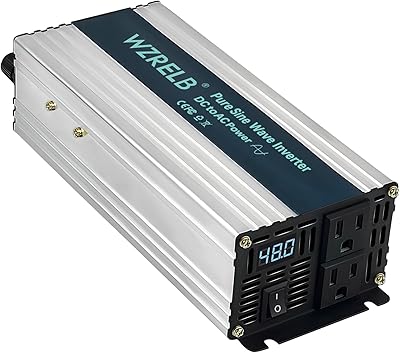
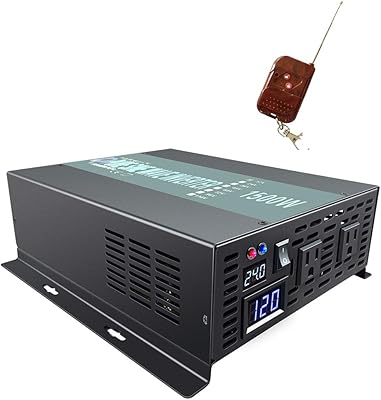
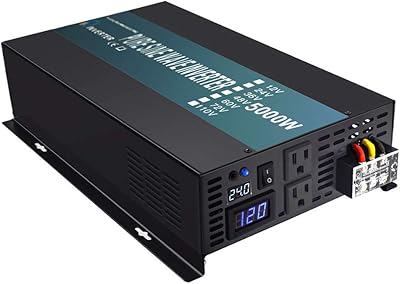
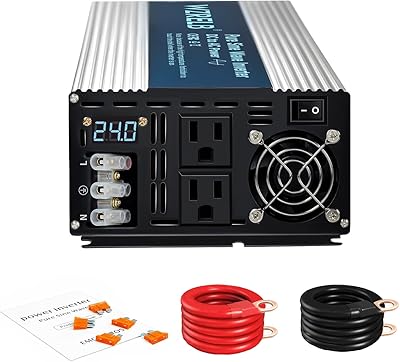
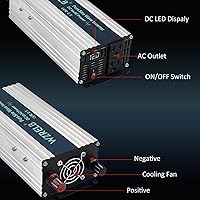
The WZRELB SE100048 1000W Pure Sine Wave Inverter enters a crowded market as a surprisingly capable budget option for anyone running a 48V battery bank off-grid. Manufactured by Yueqing Reliable Electric, a Chinese OEM with real inverter production experience, it arrived in late 2024 and has already gathered a respectable early following. At just 2.6 lbs and roughly the size of a thick paperback book, it is easy to tuck into a van cabinet or strap to an RV wall. The built-in LED voltage display is a small but practical touch — you can monitor your battery state at a glance without reaching for a separate meter.
Features & Benefits

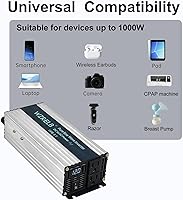
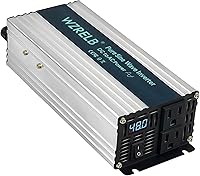
What separates this 48V inverter from cheaper modified sine wave alternatives is the quality of its output. Pure sine wave power matters when you are running a CPAP machine overnight or charging a laptop sensitive to electrical noise — modified wave can cause buzzing, overheating, or damage to certain devices. The soft-start design ramps voltage up gradually rather than hitting connected gear with an abrupt surge, which extends appliance life over time. Dual AC outlets handle two loads at once, and the all-aluminum housing works alongside an active cooling fan to manage heat. Conversion efficiency sits at 91.6% or better, meaning minimal wasted energy drawn from your battery bank.

Best For

This pure sine wave unit fits a fairly specific niche, and knowing whether you are in it matters. It is a strong match for van lifers and RV owners who have built a 48V lithium system and need clean, stable power for everyday electronics — a laptop, a small TV, a CPAP. Campers and truck drivers who want something lightweight to stow in a gear bag will appreciate the compact footprint. It also works well as a starting point for DIY solar builders still sizing their system who do not want to over-invest yet. One honest caveat: motor-heavy loads like refrigerators or air conditioners need an inverter rated several times higher.

User Feedback

With 94 ratings and a 4.0-star average, the WZRELB 1000W inverter has earned a cautiously positive early reputation. Buyers running sensitive electronics — CPAP users in particular — tend to report genuinely clean output with no audible hum or device interference, and the LED display gets consistent praise for its day-to-day utility. On the other side, some users note the fan runs from the moment you switch it on and can be noticeable in quiet spaces, and a few mention the housing gets warm enough under sustained loads that you would not want to touch it directly — something the manufacturer does flag in the documentation. Long-term reliability data is still limited given how recently this launched.

Pros

  • Pure sine wave output is genuinely safe for CPAP machines, laptops, and other electronics sensitive to power quality.
  • At under three pounds, this 48V inverter is light enough to carry in a gear bag or relocate between vehicles easily.
  • The soft-start feature reduces abrupt voltage spikes, which is a real benefit for extending appliance life over time.
  • Built-in low and high voltage shutoffs protect both the unit and your battery bank from potentially damaging conditions.
  • Dual AC outlets mean you can power two devices simultaneously without hunting for a separate power strip.
  • The LED DC voltage display adds genuine day-to-day utility, letting you monitor battery state without extra equipment.
  • All-aluminum housing doubles as passive heat dissipation, which is a smarter thermal design than plastic-bodied alternatives at this price point.
  • Conversion efficiency above 91% keeps energy waste from your battery bank low during normal operation.
  • The price point makes it accessible for first-time off-grid builders who are not yet ready to commit to a premium inverter brand.

Cons

  • Completely unsuitable for motor-heavy loads — refrigerators, pumps, and AC units will exceed its capacity instantly.
  • The cooling fan runs from the moment the unit powers on, which can be noticeably loud in quiet settings like a bedroom or cabin.
  • The aluminum housing gets hot enough during sustained loads that touching it is a real concern, requiring mindful placement.
  • With fewer than 100 reviews and a launch date of late 2024, there is not enough long-term data to assess durability confidently.
  • No remote on/off switch is included, which can be inconvenient if the inverter is mounted in a hard-to-reach location.
  • Battery cables and connection hardware are not included, adding to the total setup cost for new buyers.
  • Operating range tops out at 104°F ambient temperature, which may be limiting in hot climates or enclosed vehicle spaces during summer.

Ratings

The WZRELB SE100048 1000W Pure Sine Wave Inverter scores below are generated by our AI engine after analyzing verified buyer reviews from global sources, with active filtering applied to remove spam, incentivized submissions, and bot-driven feedback. The analysis surfaces both what owners genuinely praise and the real pain points that emerge with regular use, giving you an honest and balanced picture before you commit. Score gaps between categories are intentional and reflect genuine disparities in performance across different aspects of ownership.
Power Output Quality
88%
Users running CPAP machines, laptops, and smart TVs consistently report clean, interference-free operation — exactly what you expect from a true pure sine wave unit. Several buyers specifically noted that audio equipment and media devices ran without the hum or flicker that cheaper modified sine wave inverters typically cause. That confirmation from real sensitive-load users carries meaningful weight.
A small number of buyers have questioned whether the inverter actually delivers a full 1000W under sustained load, though few have tested it with a calibrated meter. The pool of reviews is still limited, so edge-case behavior under prolonged heavy use is not yet well-documented by the user base.
Value for Money
91%
Getting a true pure sine wave inverter at this price point on a 48V platform is genuinely good value — most comparable units from established brands cost significantly more. For a DIY solar builder or first-time off-grid user, this 48V inverter delivers the core functionality without a steep upfront investment.
The value case weakens somewhat if reliability turns out to be short-lived, since a replacement purchase erases the initial savings. Buyers who need robust warranty support or a proven service network may find the gap between this and a name-brand unit harder to justify over time.
Long-Term Reliability
61%
39%
Early user feedback over the first weeks of ownership is encouraging, with most buyers reporting consistent performance and no early failures. For buyers with occasional use patterns — a weekend camping trip or a backup power scenario — the early indicators are reasonable enough to be cautiously optimistic.
This product only entered the market in late 2024, and with fewer than 100 reviews, there is simply not enough data to assess how it holds up after six months to a year of regular use. Buyers who depend on uninterrupted power for critical applications like medical equipment should weigh this uncertainty carefully.
Thermal Management
67%
33%
The all-aluminum body is a smart design choice that gives the inverter passive heat dissipation across its entire surface area, and the active fan provides additional airflow during operation. Under typical light-to-medium loads, the combination keeps temperatures manageable and the unit continues to function reliably.
Under sustained near-capacity loads, the housing becomes hot enough that the manufacturer explicitly warns against touching it during operation — a real concern if it is mounted somewhere accessible. Users in warm climates or enclosed vehicle spaces should note the 104°F upper ambient limit, which can be reached quickly in summer.
Voltage Protection
84%
Automatic low and high voltage shutoffs give users meaningful protection against battery over-discharge and overcharge damage — a real concern in unattended off-grid setups. The soft-start feature also adds a layer of protection for connected appliances by avoiding the kind of abrupt power spike that strains motors and transformers.
There is no built-in resettable circuit breaker reported by users, meaning an overload event may require external fusing to prevent component damage. Some users also note the absence of a grounding terminal, which can be a consideration for safety-conscious or code-compliant electrical installations.
Build Quality
76%
24%
The full-aluminum enclosure is a meaningful step up from plastic-bodied inverters in the same price range, and most buyers describe it as solid and well-assembled out of the box. The housing's dual role as a structural shell and passive heat sink reflects at least some deliberate engineering intent behind the design.
Some reviewers have flagged concerns about the quality of wiring connectors and terminal hardware, noting they feel lightweight relative to the inverter's power rating. Long-term build durability is genuinely unknown at this stage, since the product launched in late 2024 and lacks a sufficient track record.
Portability
87%
At 2.6 lbs and under 11 inches long, this pure sine wave unit is easy to toss in a gear bag, mount on an RV wall, or reposition between setups. Van lifers in particular appreciate being able to install it in tight spaces without needing a dedicated equipment bay or mounting bracket system.
The compact size also means limited terminal space, and users with thicker battery cables have occasionally reported a snug or awkward fit at the connection points. No mounting hardware is included in the box, so permanent installation requires sourcing your own brackets or hardware separately.
Noise Level
58%
42%
For outdoor environments, worksites, or vehicle use while driving, the fan noise is largely inconsequential and easy to tune out alongside ambient road or wind noise. Buyers who use this 48V inverter in garages or utility sheds tend not to flag the fan as a meaningful issue.
The fan activates immediately at power-on and stays running regardless of how light the load is, which frustrates users who hoped for quieter operation in sleeping areas or small van builds. Several reviewers specifically noted it was distracting when trying to sleep with a CPAP machine running nearby.
LED Display
74%
26%
The DC voltage readout is a practical feature that off-grid users genuinely rely on — seeing your battery voltage in real time without a separate meter simplifies daily system monitoring. Campers and RV users on multi-day trips find it especially useful for gauging when to reduce load or start recharging.
The display shows only DC input voltage, with no readout for output wattage, AC voltage, or load percentage — data that more advanced users actively want for system management. Users coming from inverters with richer display panels may find it too limited for anything beyond basic battery monitoring.
Ease of Setup
82%
18%
The inverter's straightforward DC input terminals and dual AC output design mean most buyers have it running within minutes of unboxing, with no complex configuration required. Users with basic electrical knowledge consistently report that the setup process is intuitive enough to complete without consulting any documentation.
Battery cables are not included, which adds an extra purchasing step that first-time buyers sometimes miss until the unit arrives. The included documentation is minimal and may not provide enough guidance for users who are genuinely new to off-grid or 48V power systems.
Efficiency
86%
A rated efficiency of 91.6% or better is competitive for this class of inverter and translates to meaningfully lower battery drain over a full day of moderate use — something off-grid users living on limited solar harvest genuinely value. Less wasted energy means longer run times between recharge cycles.
Efficiency claims from budget OEM inverters are sometimes optimistic figures measured under ideal lab conditions rather than real-world variable loads. Independent buyer verification using power meters is sparse, so the rated figure is best treated as a best-case ceiling rather than a guaranteed daily average.
Outlet Configuration
78%
22%
Having two AC outlets built in is a practical convenience that most users in this category actually use — powering a laptop alongside a phone charger, or a CPAP alongside a small fan, without needing a separate power strip. It keeps the installation tidy in tight van or RV spaces.
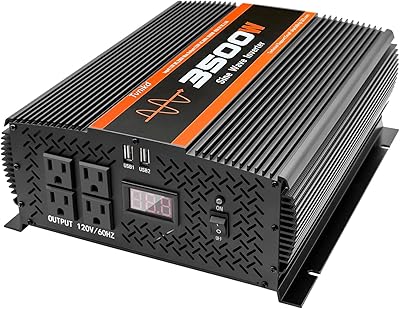
There are no USB charging ports, meaning any USB-powered device still requires an adapter block that occupies one of the two AC slots. Users who regularly charge multiple small devices may find two outlets insufficient fairly quickly without adding a separate power strip.
Soft-Start Function
83%
The soft-start function is a thoughtful inclusion that many budget inverters skip — it reduces the voltage spike when AC power first reaches a connected appliance, helping prevent premature wear on sensitive electronics over time. Users with CPAP machines and audio gear tend to notice and appreciate this feature more than they anticipated.
While soft-start helps most electronics, it does not meaningfully change the situation for compressor or motor-driven appliances, which still draw startup surges well beyond this unit's peak rating. Some buyers confuse soft-start with general surge tolerance and are caught off guard when heavy motor loads trip the inverter.
Load Compatibility
72%
28%
For the target use case — laptops, phones, televisions, CPAP machines, LED lighting, and small countertop appliances — the continuous rating covers the vast majority of real off-grid user needs without strain. Most campers and RV travelers report never approaching the wattage ceiling during typical daily routines.
The inverter is poorly matched for motor-heavy loads such as air conditioners, refrigerators, water pumps, and microwave ovens, all of which can demand startup surges that exceed even the peak rating. Buyers who discover this limitation after purchase sometimes feel the product marketing undersells how narrow the compatible load range actually is.

Suitable for:

The WZRELB SE100048 1000W Pure Sine Wave Inverter is a well-matched tool for anyone who has built or is building a 48V off-grid power system and needs clean AC power for everyday electronics without spending heavily on a name-brand unit. RV travelers and van lifers will find the compact, lightweight form factor easy to mount in tight spaces, and the pure sine wave output means sensitive gear like CPAP machines, laptops, and modern smart TVs will run without noise, interference, or risk of damage. Truck drivers who park overnight and want to power a small screen or charge devices during rest stops will appreciate how little space this takes up. It also suits homeowners with a modest solar backup setup who need occasional AC power during outages for non-motor loads. DIY solar beginners who are still learning their system's capacity will find the real-time LED voltage display genuinely useful for keeping tabs on battery health.
Not suitable for:

The WZRELB SE100048 1000W Pure Sine Wave Inverter is not the right choice if your power needs extend to motor-driven or compressor-based appliances. Refrigerators, air conditioners, water pumps, and microwave ovens draw startup surges that can be six to ten times their rated wattage, far exceeding what this unit can safely handle even at its 2000W surge ceiling. Anyone planning to run a whole-home backup system or a power-hungry workshop tool should be looking at inverters with substantially higher continuous ratings. Buyers who need proven long-term reliability data should also proceed with caution — this listing only launched in late 2024 and has under 100 reviews, so multi-year durability is simply unknown at this point. If you work in a noise-sensitive environment like a bedroom or recording space, the fan running continuously from startup may also be a dealbreaker worth considering before purchasing.
Specifications

  • Continuous Output: This inverter delivers a steady 1000W of continuous AC power under normal operating conditions.
  • Surge Output: Peak surge capacity reaches 2000W, providing brief headroom for appliances with higher startup draws.
  • Input Voltage: Accepts 48V DC input across a working range of 40V to 60V, compatible with standard 48V battery banks.
  • Output Voltage: Produces 120V AC output at 60Hz, matching the standard utility grid specification used across North America.
  • Output Waveform: Generates a true pure sine wave, making it safe for sensitive electronics including CPAP machines, laptops, and televisions.
  • Efficiency: Conversion efficiency is rated at 91.6% or higher, minimizing energy loss during DC-to-AC conversion.
  • Low Voltage Cutoff: Automatically shuts down at approximately 41V DC to protect the connected battery bank from deep discharge damage.
  • High Voltage Cutoff: Shuts off at 60V DC to prevent damage caused by an overcharged or runaway battery condition.
  • Standby Draw: Idle power consumption is under 15W when the inverter is on but no load is connected.
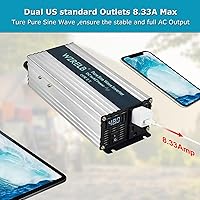
  • AC Outlets: Features two standard 120V AC outlets, allowing two devices to be powered simultaneously without a separate power strip.
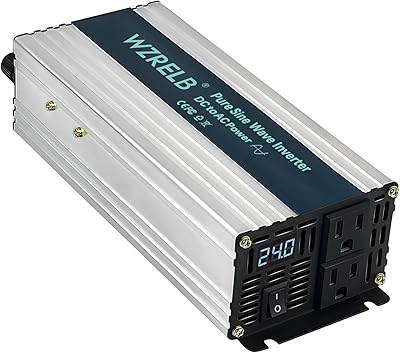
  • Display: An LED panel shows real-time DC input voltage, letting the user monitor battery state at a glance.
  • Soft Start: Built-in soft-start circuitry ramps AC voltage up gradually at startup to reduce inrush current stress on connected appliances.
  • Cooling System: Thermal management combines an active cooling fan that runs on startup with an all-aluminum chassis that passively dissipates heat.
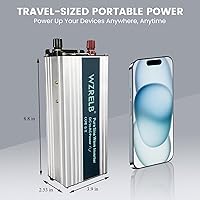
  • Dimensions: The unit measures 10.1 x 3.85 x 2.53 inches, making it compact enough to mount in confined spaces.
  • Weight: At 2.6 lbs, the inverter is light enough to be repositioned or transported without difficulty.
  • Operating Temp: Rated for ambient operating temperatures between 32°F and 104°F (0°C to 40°C).
  • Manufacturer: Produced by Yueqing Reliable Electric Co., Ltd., a Chinese OEM with a background in power inverter manufacturing.
  • Model Number: The official model designation is SE100048, useful for identifying compatible accessories or warranty support.

Related Reviews

KORKIE 1000W Pure Sine Wave Inverter
76%
88%
Output Signal Quality
82%
Port Variety & Charging
91%
Ease of Setup
79%
Fan Noise
63%
Build Quality
More
WZRELB 1200W Pure Sine Wave Inverter SE120048
83%
88%
Power Stability
85%
Ease of Setup
78%
Cooling System
90%
Display & Monitoring
87%
Portability
More
WZRELB 1500W 24V Pure Sine Wave Inverter
73%
88%
Output Power Quality
61%
Reliability & Longevity
84%
Cooling & Noise
82%
Ease of Installation
71%
Remote Control Function
More
WZRELB SE80024 800W Pure Sine Wave Inverter
77%
91%
Output Power Quality
87%
Value for Money
63%
Thermal Management
58%
Fan Noise
88%
LED Voltage Display
More
WZRELB SE80048 800W Pure Sine Wave Inverter 48V to 120V
86%
94%
Power Output Stability
91%
Conversion Efficiency
88%
Safety & Protection Features
85%
Portability & Size
90%
Cooling & Heat Management
More
WZRELB RBP-500024S 5000W 24V Pure Sine Wave Inverter
84%
91%
Power Performance
73%
Ease of Setup
85%
Safety Features
88%
Cooling Efficiency
90%
Build Quality
More
WZRELB 3000W 24V Pure Sine Wave Inverter
76%
91%
Output Power Quality
84%
Build Quality
78%
Thermal Management
61%
Fan Noise
66%
Voltage Display Accuracy
More
Tebrol 3500W Pure Sine Wave Inverter
79%
88%
Output Power Accuracy
92%
Pure Sine Wave Quality
79%
Build Quality
83%
Cooling & Thermal Management
81%
Ease of Installation
More
TVNIKD 3500W Pure Sine Wave Inverter
86%
92%
Power Conversion Performance
89%
Ease of Setup
72%
Portability & Size
90%
Reliability & Durability
91%
Power Output (Wattage)
More
SUNWHEEL 500W Pure Sine Wave Inverter
86%
92%
Power Conversion Efficiency
88%
Noise Level
85%
Build Quality & Durability
80%
Cooling System
83%
Portability
More

FAQ

Yes, the WZRELB SE100048 1000W Pure Sine Wave Inverter is specifically designed for 48V DC input and operates across a range of 40V to 60V, which aligns well with most 48V lithium battery systems. Just make sure your battery bank can supply enough current to support the load you plan to run.
Absolutely — this is actually one of the best use cases for a pure sine wave inverter like this one. CPAP machines are sensitive to power quality, and the clean output from this unit means you should not experience any humming, heating, or error codes that modified sine wave inverters can sometimes trigger. Just check your CPAP power draw to confirm it stays well under 1000W, which most models do.

The fan runs continuously from the moment you turn the unit on, not just when it reaches a certain temperature threshold. This is worth knowing if you plan to use it in a quiet space like a bedroom or small van, since the fan noise will be present the whole time it is powered.

Yes, it is expected. The all-aluminum body is intentionally used as a heat sink to help manage internal temperatures, so it will become noticeably warm or even hot during sustained loads. The manufacturer specifically advises not to touch the housing while the inverter is operating, so just make sure it is mounted or placed somewhere it cannot be accidentally contacted.

No, and this is an important limitation to understand before buying. Compressor-driven appliances like refrigerators and air conditioners draw startup surges that can be many times their rated wattage — often exceeding what this unit can handle even momentarily. For those loads, you would need an inverter with a much higher continuous and surge rating.

The inverter does not include battery cables, so you will need to source them separately. For a 1000W load at 48V, the current draw is relatively modest compared to 12V systems, but you should still use appropriately gauged cables — typically 6 AWG or better — and keep the cable run as short as practical to minimize voltage drop and heat.

The LED screen shows your DC input voltage in real time. On a typical 48V lithium battery pack, a reading around 54V or above generally indicates a healthy charge, while readings dropping toward 48V or lower suggest the battery is drawing down. The inverter will shut itself off automatically at around 41V to prevent over-discharging the battery.

Most compact inverters like this one are designed to be mounted in a horizontal or upright position to allow proper airflow and heat dissipation. Mounting it upside down or in a way that blocks the vents or fan is not recommended, as it can trap heat and reduce the lifespan of the unit.

It is a reasonable starting point if your solar system runs on a 48V battery bank and your planned loads are modest — think laptop charging, lighting, a small TV, or phone charging. The real-time voltage display is genuinely helpful while you are still learning how your system behaves under different loads. Just be clear-eyed about the 1000W ceiling and plan your loads accordingly.

Warranty terms are not explicitly detailed in the product listing, which is fairly common for budget-tier Chinese OEM products sold through Amazon. Your best practical recourse is Amazon's own return and buyer protection policies within the return window, and reaching out to the seller directly for any warranty claims beyond that. Given this is a relatively new product with limited long-term user feedback, it is worth keeping that in mind when weighing your purchase decision.