Overview

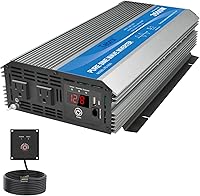
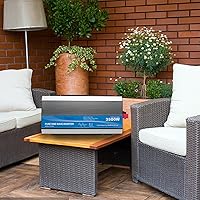
The Tebrol 3500W Pure Sine Wave Inverter entered the market in mid-2024 as a mid-range option aimed at RV owners, off-grid solar users, and anyone who needs a dependable emergency backup when the grid goes down. It delivers 3,500 watts continuously, with a 7,000-watt surge ceiling that handles the startup spike of compressors and motors without tripping. That is enough sustained power to run a microwave, a small window AC unit, or several appliances simultaneously. Tebrol is a newer brand and does not yet carry the decade-long reputation of some competitors, but early ratings are solid. The included wired remote controller is a small but genuinely practical convenience.

Features & Benefits

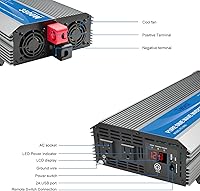
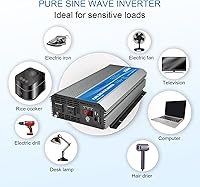
The core reason to choose a pure sine wave inverter over a cheaper modified sine wave unit comes down to compatibility. Modified sine wave can cause buzzing in audio equipment, shorten motor lifespans, and reject certain medical devices like CPAP machines outright. This sine wave inverter produces clean, utility-grade AC output that sensitive electronics handle without issue. The LCD battery status display lets you monitor voltage in real time, which is genuinely useful for protecting expensive AGM or lithium banks. Six built-in protections — including soft start, which ramps power up gradually rather than hitting a motor with full load instantly — add real peace of mind. Two AC outlets and a hardwire port cover most fixed installation needs neatly.

Best For

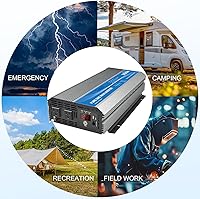
This 3,500-watt inverter is an especially strong fit for RV and van builds where you need clean power for a CPAP, a small microwave, or a laptop without worrying about waveform compatibility. Off-grid solar users will appreciate the pure output, since some charge controllers and inverter-chargers are selective about what connects to them. It also works well as emergency home backup during outages — not sufficient for central air, but plenty for fans, lights, a refrigerator, and phone charging. Truck drivers who want to avoid idling the engine for hours will find the wattage headroom genuinely useful. The remote controller is a particularly handy feature when the unit lives inside a locked storage bay.

User Feedback

Early buyers of the Tebrol unit are largely positive, with many confirming clean output on sensitive gear and calling the LCD more readable than expected. Installation gets favorable mentions as well. That said, a few recurring friction points are worth knowing upfront. Cable and fuse requirements are not clearly explained in the packaging — at this wattage, heavy-gauge wire and proper fusing are non-negotiable, something a handful of buyers discovered after the fact. The 2.4A USB port feels modest next to the fast-charging ports now common on newer devices. Fan noise at higher loads is audible and may bother light sleepers in a quiet cabin setting. Long-term reliability data remains limited given the product's recent launch date.

Pros

  • Pure sine wave output runs sensitive electronics — CPAPs, audio gear, variable-speed motors — without buzzing or compatibility issues.
  • The 7,000-watt surge capacity handles compressor and motor startup spikes that would trip a lesser inverter.
  • An LCD screen shows real-time battery voltage, making it easy to avoid running your battery bank dangerously low.
  • Six built-in protections, including soft start and short-circuit shutoff, add a meaningful layer of safety for unattended use.
  • Temperature-controlled fans only spin up when needed, which keeps noise down during light loads.
  • The hardwire AC port makes semi-permanent installation in a truck, van, or off-grid cabin clean and straightforward.
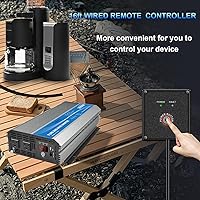
  • The wired remote controller is a practical touch for anyone mounting the unit in a hard-to-reach compartment.
  • 90% conversion efficiency is competitive for this power class and helps reduce unnecessary battery drain.
  • At 13.5 pounds, this 3,500-watt inverter is manageable to move and reposition without needing a second pair of hands.
  • Early buyers consistently report stable, clean output that matches rated performance under real-world loads.

Cons

  • Cable gauge and fusing requirements are not clearly documented in the box, which is a real gap at this wattage level.
  • The 2.4A USB port cannot fast-charge modern smartphones or tablets — it is essentially a legacy-speed port.
  • Fan noise at higher loads is audible enough to be a nuisance in quiet sleeping environments.
  • With only two AC outlets, users running multiple appliances simultaneously will likely need a power strip.
  • Tebrol is a newer brand with a relatively small review pool, so long-term durability data is still limited.
  • No built-in Bluetooth or app connectivity means there is no way to monitor the unit remotely beyond the wired remote.
  • The unit requires a 12V DC source only, so it is not compatible with 24V or 48V battery systems common in larger off-grid setups.
  • At 19 inches long, installation space needs to be planned carefully in tighter vehicle or cabinet builds.

Ratings

The scores below reflect an AI-driven analysis of verified global buyer reviews for the Tebrol 3500W Pure Sine Wave Inverter, with spam, bot-submitted, and incentivized feedback actively filtered out before scoring. Every category captures what real users actually experienced — not what the product spec sheet promises — so both the strengths and the friction points are represented honestly. If a category scores lower than expected, that signal comes directly from documented buyer experiences, not editorial bias.

Output Power Accuracy
88%
Buyers running real loads — microwaves, mini-fridges, power tools — consistently report that the inverter delivers its rated wattage without shutting down unexpectedly. The 7,000W surge headroom gets specific praise from users who run compressor-based appliances that spike hard at startup.
A small number of users report the unit tripping slightly earlier than the rated 3,500W under sustained combined loads, which may point to ambient temperature sensitivity rather than a true wattage shortfall. Testing under cooler conditions generally resolves the issue.
Pure Sine Wave Quality
92%
Confirmed by buyers using oscilloscopes and sensitive medical equipment alike, the waveform is genuinely clean — not the stepped approximation some budget units pass off as pure sine. CPAP users in particular report zero motor noise or pressure irregularities, which is a reliable real-world quality test.
There are no widespread complaints about waveform quality itself, but a handful of users with very high-end audio amplifiers mention wanting independent waveform verification before trusting expensive gear to a newer brand without an established track record.
Build Quality
79%
21%
The aluminum housing feels solid and dissipates heat effectively, and buyers describe the unit as heavier and sturdier than they expected at this price tier. Terminal connections are tight and the LCD bezel is well-fitted with no flex or rattling reported.
Some users note that the plastic end caps feel noticeably cheaper than the metal body, and the cable clamps included in the box are considered undersized for the current loads the inverter can handle. A few buyers replaced them immediately with higher-rated terminals.
Cooling & Thermal Management
83%
The temperature-activated dual fan system earns real appreciation from users who run the inverter at moderate loads — the unit stays quiet during light use and only spins up when it genuinely needs to. Buyers in hot climates report the thermal management holding up well during summer RV trips.
Under sustained heavy loads, the fans are noticeably loud — comparable to a mid-range box fan — which bothers buyers who installed the unit inside a small van or cabin sleeping area. The fan activation threshold also means the unit can run warm to the touch before cooling kicks in.
Ease of Installation
81%
19%
Most buyers describe the physical installation as straightforward, with clear terminal labeling and a sensible layout. The hardwire AC port is appreciated by van and truck builders who want a cleaner finished look than dangling extension cords.
The packaging provides minimal guidance on required cable gauge and fuse ratings, which is a recurring and legitimate complaint. At 3,500W continuous draw, under-spec wiring is a real safety risk, and first-time inverter buyers are left to figure out the correct wire gauge entirely on their own.
LCD Display Usefulness
86%
Buyers consistently call out the LCD as one of the more practically useful features, specifically because real-time battery voltage lets them avoid accidentally draining AGM or lithium banks below safe thresholds. The screen is described as bright and readable in direct sunlight, which matters for outdoor and vehicle use.
The display shows voltage only, with no wattage readout or load percentage — information that would genuinely help users manage their power budget. A few buyers mention the voltage alarm threshold feels slightly conservative, triggering warnings earlier than their battery specifications would require.
Remote Controller
77%
23%
The included wired remote gets positive mentions from buyers who mount the inverter inside locked storage compartments or under truck beds, where reaching the power switch manually would be inconvenient. It works reliably and requires no setup beyond plugging it in.
The remote cable is relatively short, limiting mounting flexibility for larger vehicle builds or installations where the inverter is more than a few feet from the operator position. There is no wireless option, and the remote itself has no status indicator to confirm whether the unit is actually on.
USB Charging Port
54%
46%
The USB port does its job for basic overnight charging of phones or small Bluetooth devices when no other charger is available, and buyers appreciate having it as a backup option without needing to plug in an adapter.
At 5V and 2.4A, the port is firmly legacy-speed in a world of 18W to 65W fast charging, and modern flagship phones charge frustratingly slowly from it. Several buyers specifically flag this as a missed opportunity, noting that a USB-C PD port would have meaningfully improved the value proposition.
Noise Level
68%
32%
During light loads the inverter runs silently, which buyers using it for laptop work or TV viewing in a parked truck find perfectly acceptable. The fan system only spools up when thermal load demands it, keeping idle noise genuinely low.
At 60 to 80 percent load the fan noise becomes the dominant sound in a quiet cabin or small van interior, and buyers who planned to run the inverter overnight near a sleeping area often express regret about not testing this beforehand. It is not abnormally loud for the wattage class, but it is loud enough to notice.
Value for Money
82%
18%
Buyers comparing this unit against better-known inverter brands consistently note they are getting pure sine wave performance and a solid feature set at a price point where many competitors still offer modified sine wave output. For RV owners and off-grid builders on a budget, the math works in its favor.
The value calculation depends heavily on factoring in the cost of proper cables, fuses, and potentially a better fuse holder — none of which are included. Buyers who discover this post-purchase feel the all-in cost is higher than the listing price implied.
Safety Protections
87%
The six-layer protection system — covering short circuit, overload, over and undervoltage, overheating, and soft start — performs as advertised based on buyer reports. Several users specifically mention the soft start preventing the harsh voltage spike that can damage motor windings on startup.
A few buyers report the overload protection triggering slightly inconsistently under mixed loads, cutting power when the combined draw should technically still be within spec. This appears to be an edge case tied to certain appliance combinations rather than a systemic design flaw.
Brand Reliability
63%
37%
Early adopters who purchased shortly after the July 2024 launch report their units are still performing without issues, which is an encouraging sign for a brand without years of market history. Customer service response rate gets occasional positive mentions in buyer comments.
Tebrol lacks the documented long-term track record of established inverter brands, and the review pool — while positive overall — is still too small and too recent to draw confident conclusions about multi-year durability. Buyers who prioritize brand pedigree will feel this uncertainty acutely.
Compatibility Range
84%
The pure sine wave output and standard 110–120V AC make this inverter broadly compatible with North American appliances, and the 50/60Hz switchable frequency extends usability for internationally sourced equipment. Buyers running a wide variety of appliances simultaneously report no compatibility issues.
The inverter is strictly a 12V input unit, which immediately excludes anyone with a 24V or 48V battery bank — a common configuration in larger off-grid or marine installations. There is no multi-voltage input option, so buyers need to verify their system voltage before purchasing.

Suitable for:

The Tebrol 3500W Pure Sine Wave Inverter is a genuinely practical choice for anyone whose power needs fall somewhere between a basic car inverter and a full generator setup. RV and van-life travelers will find it especially well-suited, since the clean sine wave output means CPAP machines, variable-speed appliances, and audio equipment run without interference or risk of damage. Off-grid solar users building out a 12V battery bank will appreciate that pure sine wave output plays well with sensitive charge controllers and inverter-chargers that a modified sine wave unit might disrupt. Truck drivers who want to power a mini-fridge, a small TV, or a laptop during rest stops without idling the engine all night will get solid, reliable mileage out of the 3,500-watt continuous rating. Homeowners looking for an emergency backup solution to keep fans, lights, and essential kitchen appliances running during a power outage will also find the wattage headroom more than adequate for those situations. The included remote controller makes it particularly appealing for anyone who plans to mount the unit inside a storage compartment or in an area that is not easily accessible.

Not suitable for:

The Tebrol 3500W Pure Sine Wave Inverter is not the right tool for every situation, and being clear-eyed about that saves a lot of frustration. If you are hoping to power a central air conditioning system, a large electric range, or any appliance with a sustained draw above 3,500 watts, this unit will not meet that demand — you will need to step up to a significantly larger inverter or a dedicated generator. Buyers who are not comfortable sourcing and installing the correct heavy-gauge battery cables and inline fusing should proceed with caution, since the packaging does not spell out those requirements clearly, and skipping proper wiring at this power level is a real safety concern. Anyone planning to use it in a quiet sleeping environment — a small cabin, a bedroom during a storm, or a camper van loft — may find the fan noise at higher loads disruptive. The single 2.4A USB port is also a limitation for users who expect to fast-charge modern smartphones or tablets directly from the inverter without an additional adapter. Finally, buyers who insist on a brand with a long, documented track record may want to wait, as this is a newer product with a review pool that is still building.

Specifications

  • Continuous Output: This inverter delivers a sustained 3,500W of AC power, sufficient for running appliances like microwaves, refrigerators, and power tools simultaneously.
  • Surge Capacity: A 7,000W peak surge rating handles the brief but demanding startup spike that motors and compressors produce when first switched on.
  • Input Voltage: The unit accepts a DC input range of 9.5V to 16V, making it compatible with standard 12V lead-acid, AGM, and lithium battery systems.
  • Output Voltage: AC output is regulated between 110V and 120V, matching standard North American household current.
  • Output Waveform: Power is delivered as a true pure sine wave, which is safe and compatible with sensitive electronics, medical devices, and motor-driven appliances.
  • Output Frequency: The inverter outputs at either 50Hz or 60Hz with a tolerance of plus or minus 1Hz, covering both North American and international appliance standards.
  • Efficiency: Conversion efficiency reaches up to 90%, meaning minimal energy is lost as heat during the DC-to-AC conversion process.
  • AC Outlets: Two standard three-prong AC sockets are provided for direct plug-in use, alongside one hardwire AC terminal for fixed installations.
  • USB Port: A single USB-A port supplies 5V DC at up to 2.4A, suitable for charging phones and small devices at standard speeds.
  • Display: An integrated LCD screen shows real-time battery voltage and provides visual alerts when the battery enters undervoltage or overvoltage territory.
  • Remote Control: A wired remote controller is included, allowing the inverter to be switched on or off from a distance without direct access to the unit.
  • Cooling System: Dual variable-speed fans activate automatically based on internal temperature rather than running continuously, reducing unnecessary noise during light loads.
  • Protections: Six onboard protection circuits cover overvoltage, undervoltage, overload, short circuit, overheating, and soft start to guard both the inverter and connected devices.
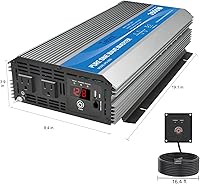
  • Dimensions: The unit measures 19 × 9.4 × 3.9 inches, requiring adequate mounting clearance on all sides for proper airflow.
  • Weight: At 13.5 pounds, the inverter is heavy enough to feel solid but light enough for a single person to install or reposition without assistance.
  • Model: The model designation is 3500W-P, manufactured by Tebrol and first made available in July 2024.

Related Reviews
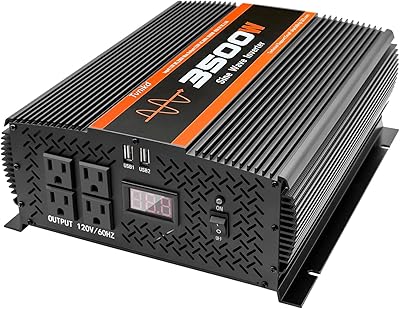
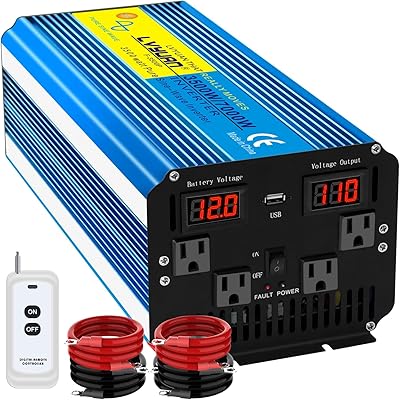
TVNIKD 3500W Pure Sine Wave Inverter
86%
92%
Power Conversion Performance
89%
Ease of Setup
72%
Portability & Size
90%
Reliability & Durability
91%
Power Output (Wattage)
More
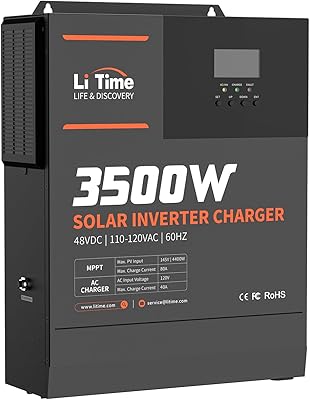
Yinleader 3500W Pure Sine Wave Power Inverter
73%
83%
Power Output Quality
61%
Build Quality
67%
Thermal Management
63%
Surge Performance
86%
Ease of Setup
More
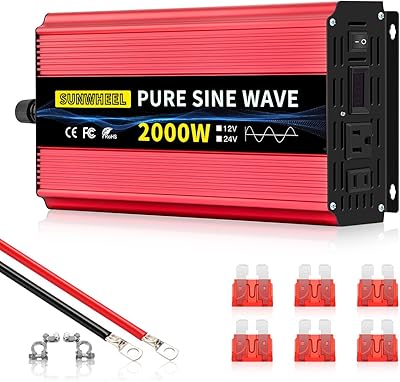
LiTime 3500W 48V Solar Inverter Charger
74%
83%
Value for Money
76%
Ease of Installation
81%
Power Output & Reliability
86%
Pure Sine Wave Quality
84%
Battery Compatibility
More
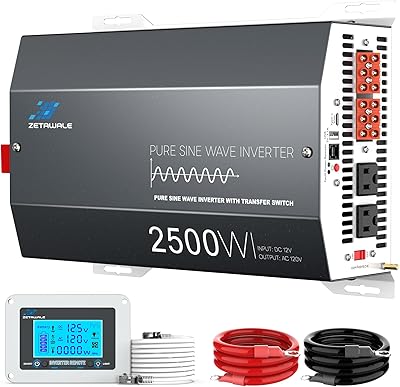
SUNWHEEL 2000W Pure Sine Wave Inverter
80%
86%
Power Output Reliability
91%
Waveform Quality
83%
Build Quality
88%
Noise Level
67%
LCD Display Usefulness
More
Novopal 1500W Pure Sine Wave Inverter
76%
83%
Power Output Accuracy
88%
Power Quality
74%
Build Quality
86%
Ease of Installation
89%
Remote Control Usability
More
TVNIKD 2500W Pure Sine Wave Power Inverter
77%
88%
Power Output Quality
81%
Build Quality
63%
Heat Management
86%
Ease of Installation
83%
LCD Display Usability
More
KORKIE 1000W Pure Sine Wave Inverter
76%
88%
Output Signal Quality
82%
Port Variety & Charging
91%
Ease of Setup
79%
Fan Noise
63%
Build Quality
More
SUNWHEEL 500W Pure Sine Wave Inverter
86%
92%
Power Conversion Efficiency
88%
Noise Level
85%
Build Quality & Durability
80%
Cooling System
83%
Portability
More
VOLTWORKS VS-3000PCR 3000W Pure Sine Wave Inverter
79%
83%
Output Power Accuracy
91%
Output Signal Quality
88%
Cooling & Noise Level
79%
Build Quality & Housing
86%
Installation Ease
More
ZETAWALE 2500W Pure Sine Wave Inverter
78%
91%
Pure Sine Wave Quality
87%
Auto Transfer Switch
84%
Value for Money
61%
Long-term Reliability
68%
Cooling & Noise
More

FAQ

Yes, and this is actually one of the best use cases for a pure sine wave inverter. CPAP machines rely on a clean, smooth AC signal to regulate motor speed and pressure accurately. A modified sine wave inverter can cause humming, reduced performance, or even void the warranty on some CPAP models, so using a unit like this one is the right call.

At 3,500 watts continuous, you are pulling roughly 290 to 300 amps from a 12V battery under full load, so you need very heavy-gauge cable — typically 2/0 AWG or larger for runs up to a few feet. The packaging does not spell this out clearly, which is a common complaint from buyers. You will also want an appropriately rated inline fuse within 18 inches of the battery terminal. Skipping proper cable sizing is the number one cause of poor performance and potential safety issues at this power level.

Most standard household microwaves draw between 900W and 1,500W while running, well within the 3,500W continuous rating. The 7,000W surge headroom also handles the startup spike cleanly. Just make sure your battery bank is large enough to sustain the draw for the duration you need — a microwave can pull a lot from a battery quickly.

At light loads the fans stay off entirely, so the unit runs silently. Under heavier loads the fans spin up and produce a noticeable hum — comparable to a desktop computer fan running at moderate speed. It is not disruptive in a truck cab or RV, but if you are planning to run it near a sleeping area in a quiet cabin, you will hear it.

No. The Tebrol 3500W Pure Sine Wave Inverter is designed exclusively for 12V DC input, with an operating range of 9.5V to 16V. If your battery bank is wired for 24V or 48V, you would need a different inverter model built for those voltages.

It will charge your phone, but slowly by modern standards. The port outputs 5V at 2.4A, which is roughly equivalent to the older 12W charging speeds. If you have a phone or tablet that supports 18W, 30W, or higher fast charging, the USB port on this inverter will not take advantage of that — you would need a separate fast charger plugged into one of the AC outlets instead.

Yes, and it is actually a cleaner solution for permanent installs. The unit includes a dedicated hardwire AC port specifically for this purpose. You will still need to connect the DC input side to your battery bank with appropriately sized cables and fusing, but the hardwire AC port lets you wire a built-in outlet or distribution panel directly to the inverter output.

The remote is a simple wired on/off switch that plugs into the inverter via a dedicated port. It lets you power the unit up or shut it down without needing physical access to the inverter itself, which is very handy when it is mounted inside a storage bay or under a truck bed. The cable length is modest, so plan your installation with the remote's reach in mind.

Yes, laptops are exactly the kind of load this inverter handles without any trouble. Most laptop adapters are switch-mode power supplies that work fine on pure sine wave power, and a typical laptop draws well under 150W, leaving plenty of headroom. You can run multiple laptops simultaneously with no concerns.

It works well in a solar context as long as your battery bank is sized to handle the load and your charge controller is compatible with 12V systems. The pure sine wave output is important here because some MPPT charge controllers and inverter-chargers can behave unpredictably when paired with modified sine wave inverters. That said, at 3,500W you are pulling significant current, so a robust battery bank — at least 200Ah, ideally more — is important to avoid rapid depletion and protect battery health.