Overview

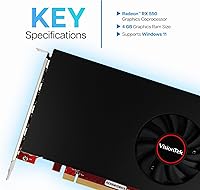
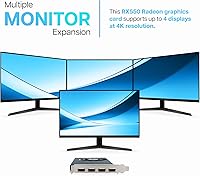
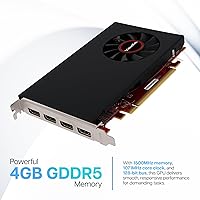
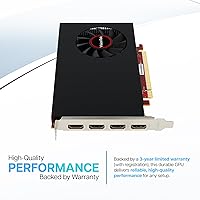
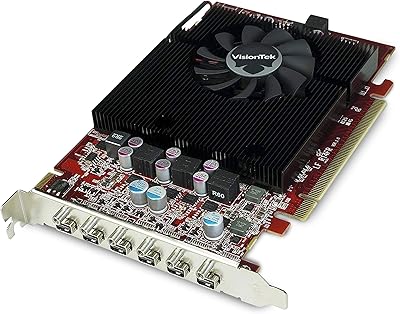
The VisionTek Radeon RX 550 4GB Graphics Card is a no-nonsense, budget-friendly GPU built around one specific strength: driving multiple monitors without complicating your PC build. It won't compete with mid-range gaming cards, and that's not the point. What sets this multi-display GPU apart at its price is the four HDMI outputs, letting you run up to four 4K displays simultaneously — something almost no other card in this tier offers. Because it pulls all its power directly from the PCIe slot, there are no extra cables to route and no power supply upgrades required. A 3-year limited warranty adds a layer of confidence that budget-tier hardware rarely provides.
Features & Benefits

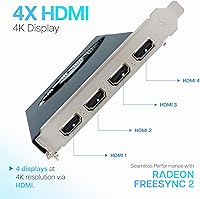
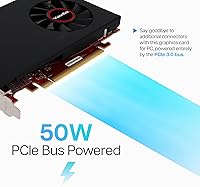
The most practical thing about this bus-powered graphics card is what it doesn't need: a separate power cable. It draws just 50 watts directly from the PCIe slot, which means dropping it into an older office desktop or a slim small-form-factor case is genuinely straightforward. The four HDMI ports each support 4K at 60Hz, covering nearly every monitor you would realistically pair with this chip. The 4GB GDDR5 memory running at 1500MHz handles spreadsheets, video calls, browser-heavy workloads, and light photo editing without issue. FreeSync 2 support is a nice touch for compatible monitors, and the single-slot design means it won't crowd adjacent expansion cards.

Best For

This multi-display GPU makes the most sense for a specific kind of buyer. If you're a day trader, analyst, or remote worker running three or four monitors off a single desktop, it handles that job cleanly and without fuss. It's also a smart pick for anyone working with an older or slim PC where the power supply is modest and adding a card with a six-pin connector simply isn't an option. Digital signage setups and information display kiosks fit squarely in its wheelhouse too. Casual gamers running older titles can get by, but anyone chasing modern game performance should look elsewhere — this card's ceiling is honest and clear.

User Feedback

Buyers have settled on a 4.1-star average across 122 reviews, reflecting genuine satisfaction tempered by realistic limitations. The most consistent praise centers on effortless installation — people appreciate plugging in a card and having it work without hunting for a spare power cable or worrying about PSU headroom. Multi-monitor office users and home theater enthusiasts tend to be the happiest group. On the other side, buyers hoping to run demanding modern games were disappointed, as frame rates in current titles expose the RX 550's age. A few users also raised questions about long-term value given newer budget options on the market, and isolated reports of driver hiccups on certain older systems are worth factoring in before purchasing.

Pros

  • Four HDMI outputs on a single card — genuinely rare at this price point and segment.
  • No external power connector needed, making installation straightforward even for first-timers.
  • Fits both full-size ATX and compact SFF cases thanks to included dual-bracket support.
  • Runs cool and nearly silent under typical office workloads, staying out of your way all day.
  • Drives up to four 4K displays at 60Hz reliably — ideal for productivity and trading setups.
  • The 3-year limited warranty is unusually generous for a GPU in this price range.
  • FreeSync 2 and HDR support add legitimate value for compatible monitor owners.
  • 4GB GDDR5 memory handles multitasking, light creative work, and video playback without breaking a sweat.
  • Single-slot design avoids blocking adjacent PCIe expansion slots in tight builds.

Cons

  • Modern AAA game performance is poor — this card struggles even at reduced settings in current titles.
  • Price-to-performance ratio looks weak when compared directly against newer budget GPU alternatives.
  • All-HDMI outputs exclude users with DisplayPort monitors without adding adapter complexity.
  • Driver conflicts on older motherboard chipsets have caused real headaches for a subset of buyers.
  • The 30-day warranty registration window is easy to miss and reduces coverage if overlooked.
  • Raw build quality feels lightweight and budget-grade, which may concern buyers used to sturdier hardware.
  • No upgrade path within this card — when you need more performance, you replace it entirely.
  • Value perception drops significantly if purchased primarily for gaming rather than multi-monitor productivity.

Ratings

The VisionTek Radeon RX 550 4GB Graphics Card has been evaluated by our AI rating system after processing verified global buyer reviews, actively filtering out incentivized, duplicate, and bot-generated feedback to surface only genuine user experiences. Scores reflect a balanced picture of where this bus-powered multi-display GPU genuinely delivers and where it falls short — no inflated praise, no unfair penalties. Both the standout strengths and the recurring frustrations are transparently baked into every number below.
Multi-Monitor Output
91%
For buyers who need four displays running simultaneously off a single card, this GPU is hard to beat at its price point. Office workers managing trading dashboards or multi-screen productivity setups consistently report that all four HDMI ports perform reliably at 4K resolution with no signal instability or port-switching headaches.
While four outputs is impressive, users who own DisplayPort-native monitors may find the all-HDMI configuration limiting, requiring adapters that can sometimes introduce compatibility hiccups. A mixed output selection would have broadened the appeal considerably.
Installation Ease
93%
Reviewers across the board highlight how refreshingly simple the installation process is. Because the card draws power directly from the PCIe slot, there are no additional cables to route, making it genuinely plug-and-play even for users who have never installed a GPU before.
A small number of users on older systems reported needing a BIOS update or driver rollback before the card was fully recognized. These cases appear isolated, but buyers with legacy hardware should be prepared to do a bit of troubleshooting before everything clicks into place.
Gaming Performance
44%
56%
For older or less demanding titles — think games from several years back or lighter indie releases — the RX 550 can deliver a playable experience at modest resolutions. Casual gamers running older libraries on a budget machine will find it more than adequate for relaxed sessions.
Modern AAA titles expose the chip's age quickly and without mercy. Users expecting smooth frame rates in current releases were consistently disappointed, with many noting the GPU struggles even at lower settings in demanding games. This card should not be purchased with serious gaming as the primary goal.
Power Efficiency
89%
Pulling just 50 watts from the PCIe slot is a genuine practical advantage, particularly for slim desktops or older office towers with modest power supplies. Users upgrading aging systems appreciated that they could add a capable GPU without budgeting for a new PSU at the same time.
The low power draw is a double-edged design choice — it keeps installation simple but also caps the card's performance ceiling permanently. Buyers who later want more graphical horsepower will find there is no headroom here, and an upgrade path means replacing the card entirely.
Build & Form Factor
82%
18%
The single-slot, dual-bracket design means this card fits neatly into both full-size ATX towers and compact SFF cases without sacrificing a neighboring expansion slot. For home theater PCs or small office builds where space is genuinely tight, that physical flexibility matters.
The card feels lightweight, and while that is partly a function of its efficient design, some buyers noted the construction does not inspire premium confidence. The plastic finish and overall material quality feel appropriate for the price tier but underwhelming compared to higher-end alternatives.
4K Display Quality
78%
22%
Driving four 4K monitors at 60Hz for productivity tasks — spreadsheets, video conferencing, document editing — produces crisp, stable output that users found fully satisfying. Home theater users also praised the clean signal quality on large-screen TVs via HDMI.
4K gaming is not a realistic use case here. The architecture simply cannot push enough frames at that resolution for anything beyond very old or very lightweight games, and buyers who conflated 4K display support with 4K gaming capability were justifiably frustrated.
FreeSync & HDR Support
71%
29%
On compatible monitors, FreeSync 2 does its job — screen tearing is visibly reduced during lighter gaming sessions and video playback, and the HDR flag is a welcome bonus for content consumption on HDR-capable displays.
The benefit is somewhat academic given the card's performance ceiling. FreeSync works best when a GPU is pushing a meaningful frame rate, and at the performance levels the RX 550 operates at in modern content, the technology's advantages are partially wasted.
Driver Stability
66%
34%
For the majority of users on modern Windows systems, AMD's driver package installed without incident and the card was detected and configured quickly. Regular AMD software updates have generally kept the experience stable over time for mainstream setups.
A recurring thread in user feedback involves driver conflicts on certain older motherboard chipsets, particularly on systems running legacy BIOS rather than UEFI. These issues are not universal, but they appear frequently enough in reviews to warrant caution for buyers with older hardware.
Value for Money
61%
39%
As a niche product — specifically a bus-powered, four-HDMI output card for multi-monitor office use — it fills a gap that few competitors address directly. For that specific use case, buyers generally feel the price is fair given the convenience it provides.
Viewed purely as a GPU purchase against the broader market, the price-to-performance ratio is difficult to defend. Newer competing cards offer significantly better raw performance at comparable or lower prices, and several buyers in reviews flagged this concern explicitly after shopping around.
Thermal Performance
77%
23%
Running at just 50 watts, the card stays cool under typical office workloads and never becomes an audible presence in a quiet workspace. Users in compact SFF builds appreciated that the thermal output did not contribute meaningfully to case temperatures.
Under sustained load — even lighter gaming sessions — some users noticed the card's passive or low-speed cooling becomes slightly less composed, with temperatures creeping up in poorly ventilated cases. It is not a serious issue, but case airflow does matter more than you might expect for such a low-power card.
Compatibility Range
73%
27%
PCIe 3.0 compatibility means this card slots into a wide range of desktop systems spanning many years of hardware generations. For IT departments refreshing older office machines, that breadth of compatibility is a meaningful practical advantage.
The all-HDMI output configuration excludes users with older VGA or DVI monitors without an adapter, and adapter chains can introduce signal reliability issues. Buyers should audit their display inventory carefully before assuming this card will connect cleanly to everything on their desk.
Warranty & Support
83%
A 3-year limited warranty is notably generous for a card in this price range, and VisionTek's support reputation among reviewers is generally positive. Buyers who registered within the required 30-day window reported smooth experiences when warranty service was needed.
The 30-day registration requirement is a potential stumbling block — buyers who forget or delay registration may find their warranty coverage reduced. This is a minor administrative friction point, but it is worth flagging since a few reviewers mentioned it after the fact.
SFF & Slim Case Compatibility
88%
The inclusion of both full-height and low-profile brackets in the box is a practical detail that SFF PC owners genuinely appreciate. Not having to source a replacement bracket separately saves time and frustration during what is already a tight build process.
Even with the low-profile bracket installed, buyers should double-check their specific case's clearance measurements. A handful of reviewers noted the card's length created minor fit issues in particularly compact enclosures, particularly with cable routing in cramped interiors.

Suitable for:

The VisionTek Radeon RX 550 4GB Graphics Card was built for a specific kind of buyer, and for that buyer it makes a lot of sense. If you're running a home office or trading workstation where three or four monitors are non-negotiable, this bus-powered GPU handles that setup without demanding anything exotic from your existing hardware. It's equally well-suited to anyone working with an older slim desktop or a small form factor PC where the power supply is modest and there's simply no room — or budget — for a card that needs an external power connector. IT administrators outfitting multi-display kiosk or digital signage deployments will also find the four-HDMI, low-maintenance design genuinely practical at scale. And if you're a casual gamer who plays older titles and just wants more screen real estate without rebuilding your entire system, this card checks that box cleanly.
Not suitable for:

The VisionTek Radeon RX 550 4GB Graphics Card is the wrong tool for anyone whose primary goal is gaming performance in modern titles. The RX 550 architecture is several generations old at this point, and current AAA games will expose that gap quickly — expect unplayable frame rates in demanding titles regardless of how you tune the settings. Buyers who are comparing raw price-to-performance against today's GPU market will also find the value proposition hard to justify; newer budget cards from AMD and Nvidia offer substantially better gaming throughput at comparable price points. If your monitor setup relies on DisplayPort connections, the all-HDMI output configuration means you'll be living with adapters, which introduces its own set of compatibility risks. Users on very old hardware with legacy BIOS systems should also be aware that driver installation has caused friction for a subset of buyers in that situation, and resolving it requires some patience and technical willingness.
Specifications

  • GPU: The card is powered by the AMD Radeon RX 550 graphics processor manufactured by AMD.
  • Memory: It features 4GB of GDDR5 video memory running at a 1500MHz memory clock speed.
  • Core Clock: The GPU core operates at a base clock speed of 1071MHz for consistent everyday throughput.
  • Stream Processors: The RX 550 architecture includes 512 stream processors handling parallel graphics and compute tasks.
  • Video Outputs: Four full-size HDMI ports allow simultaneous connection of up to four external displays.
  • Display Support: All four outputs support up to 4K resolution at 60Hz when connected to compatible monitors.
  • Power Draw: The card draws a maximum of 50W exclusively through the PCIe slot, requiring no external power connectors.
  • PCIe Interface: It connects via a PCI Express 3.0 x8 interface and is backward compatible with PCIe 2.0 slots.
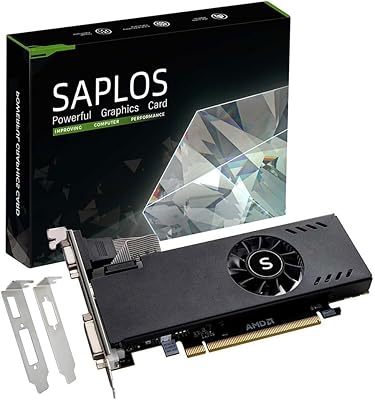
  • Form Factor: The card ships with both full-height and low-profile brackets, supporting standard ATX and SFF cases.
  • Slot Width: The card occupies a single expansion slot, leaving adjacent PCIe lanes free for other components.
  • API Support: DirectX 12, OpenGL 4.5, and Vulkan are supported for broad software and game compatibility.
  • FreeSync: Radeon FreeSync 2 is supported on compatible displays, including HDR and low-latency mode functionality.
  • Warranty: VisionTek backs the card with a 3-year limited warranty, requiring registration within 30 days of purchase.
  • Dimensions: The card measures 6.9 x 9.4 x 2.3 inches, making it compact enough for most desktop enclosures.
  • Weight: At 13.4 ounces, the card is lightweight and places minimal stress on the motherboard PCIe slot.
  • System PSU: VisionTek recommends a minimum 350W system power supply for stable and reliable operation.
  • OS Support: The card is compatible with Windows 10 and Windows 11 via standard AMD Radeon Software drivers.
  • Manufacturer: VisionTek Products, LLC is the manufacturer and warranty service provider for this card.

Related Reviews
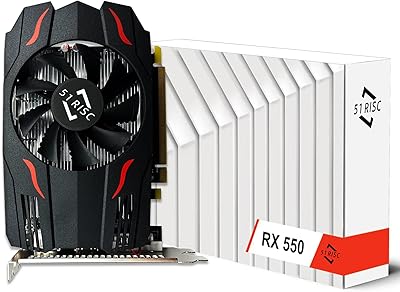
51Risc Radeon RX 550 4GB Graphics Card
81%
92%
Value for Money
85%
Gaming Performance (1080p)
88%
Power Efficiency
84%
Compatibility with Older PCs
89%
Compact Size
More
SAPLOS Radeon RX 550 4GB Graphics Card
81%
91%
Ease of Installation
88%
Compatibility
86%
Multi-Monitor Support
74%
Value for Money
58%
Gaming Performance
More
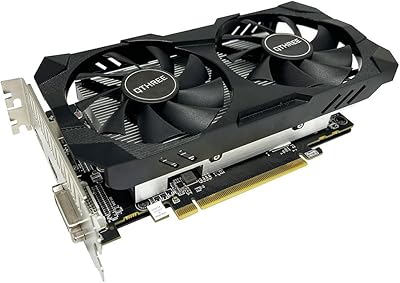
QTHREE Radeon RX 560 XT 8GB Graphics Card
68%
57%
Gaming Performance
61%
Value for Money
72%
VRAM & Memory Capacity
78%
Thermal Management & Cooling
67%
Build Quality & Physical Construction
More
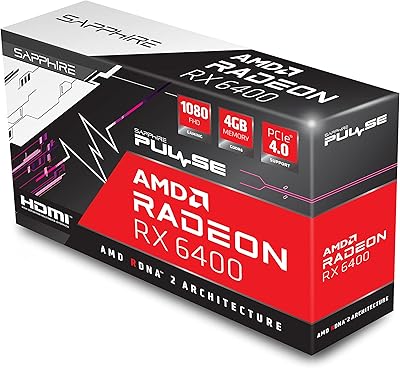
Sapphire Pulse AMD Radeon RX 6400 4GB Graphics Card
85%
91%
Value for Money
85%
Gaming Performance (1080p)
87%
Cooling System (Noise/Effectiveness)
92%
Compact Size for Small PC Builds
90%
Ease of Installation
More
GIGABYTE Radeon RX 6500 XT Eagle 4GB Graphics Card
83%
92%
Value for Money
88%
Gaming Performance (1080p)
90%
Cooling System Efficiency
63%
4K Performance
84%
Build Quality
More
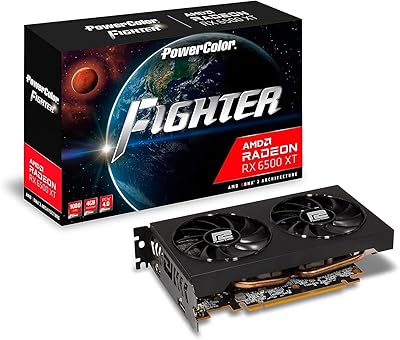
PowerColor Fighter AMD Radeon RX 6500 XT 4GB Graphics Card
82%
91%
Value for Money
89%
1080p Gaming Performance
85%
Build Quality
88%
Power Efficiency
84%
Setup & Installation
More
PowerColor AMD Radeon RX 550 2GB GDDR5 Low Profile Graphics Card
83%
91%
Value for Money
85%
Performance for Basic Gaming
96%
Low-Profile Design for Compact Builds
89%
Ease of Installation
92%
Power Efficiency
More
QTHREE Radeon RX 590 GME 8GB Graphics Card
69%
72%
Value for Money
67%
1080p Gaming Performance
63%
Cooling Efficiency
84%
Ease of Installation
68%
Driver Stability
More
AMD Radeon RX 6950 XT Graphics Card
72%
92%
4K Gaming Performance
94%
VRAM Capacity & Bandwidth
51%
Power Consumption
48%
Physical Size & Case Fit
67%
Driver Stability
More
Maxsun Radeon RX 550 4GB Graphics Card
78%
83%
Value for Money
61%
Gaming Performance
91%
Installation & Setup
78%
Noise Level
79%
Build Quality
More

FAQ

No, and that is one of its most practical advantages. The card pulls all the power it needs — just 50 watts — directly from the PCIe slot on your motherboard. There are no six-pin or eight-pin connectors involved, which makes installation genuinely simple and means you do not need to worry about whether your power supply has the right cables.

Yes, all four outputs support 4K at 60Hz at the same time, provided your monitors and HDMI cables are capable of handling that signal. In practice, most users running productivity or office workloads find the output stable and consistent across all four displays.

It is specifically designed to do so. The package includes both a standard full-height bracket and a low-profile bracket, so you can configure it for whichever case type you have. Just confirm your case has at least one free PCIe slot and enough internal clearance for a card just under 7 inches long.

It depends entirely on what you plan to play. Older titles, indie games, and less demanding releases run acceptably at modest settings. However, if your goal is playing current AAA releases at smooth frame rates, this card will disappoint — it simply lacks the horsepower for modern games, and you should look at a more capable GPU for that use case.

VisionTek recommends at least a 350W system power supply. Since the card itself draws only 50W from the PCIe slot, the remaining headroom in your PSU just needs to comfortably cover the rest of your system's components — CPU, storage, fans, and so on.

Yes, HDMI outputs on this card support HDR when used in conjunction with FreeSync 2 on a compatible display. For video playback or productivity use on an HDR monitor, the experience is solid. Just make sure your monitor and HDMI cable both support HDR signaling to get that result.

In most cases, yes. You install the card into an available PCIe slot, connect your monitors to the card's HDMI ports instead of the motherboard outputs, and AMD's driver handles the rest. Some older systems with legacy BIOS — not UEFI — have had occasional driver recognition issues, so if your machine is quite old, be prepared to update your BIOS or spend a bit of time with driver troubleshooting.

Not directly. This particular variant has four HDMI outputs and no DisplayPort connections. If your monitors use DisplayPort, you would need active HDMI-to-DisplayPort adapters, which adds complexity and can occasionally introduce compatibility issues depending on the adapter quality. If DisplayPort is important to you, VisionTek does offer other RX 550 variants with DisplayPort outputs.

You need to register with VisionTek within 30 days of purchase through their website to activate the full 3-year coverage. It is worth doing immediately after installation — a few buyers who skipped this step found their warranty options reduced when they needed support later. The registration process is straightforward and only takes a few minutes.

Under typical office workloads and multi-monitor desktop use, the card runs cool and quiet — most users report not noticing it at all. Under sustained load the temperatures tick up, particularly in cases with poor airflow, but it rarely becomes a problem for the workloads this card was designed for. Keeping your case reasonably well-ventilated is sufficient for the vast majority of use cases.

Where to Buy