Overview

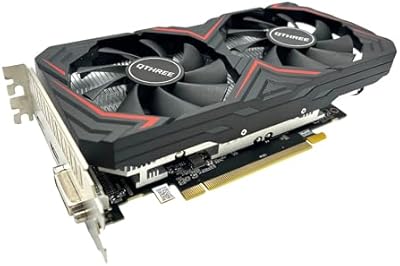
The QTHREE Radeon RX 560 XT 8GB Graphics Card is an entry-level discrete GPU aimed squarely at budget builders who are tired of relying on integrated graphics. It runs on AMD's Polaris 10 LE1 architecture, a 14nm design that is admittedly a few generations old but still capable enough for light workloads. One thing worth flagging upfront: the RX 560 XT is not a standard, widely documented AMD SKU, and that unusual branding deserves some healthy skepticism before buying. The 128-bit memory bus limits real-world bandwidth to around 96 GB/s, which is the card's biggest technical constraint. Expect comfortable performance at 1080p low-to-medium settings in older or less demanding titles — not AAA games at maximum detail.

Features & Benefits

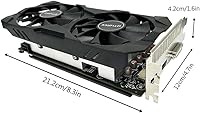
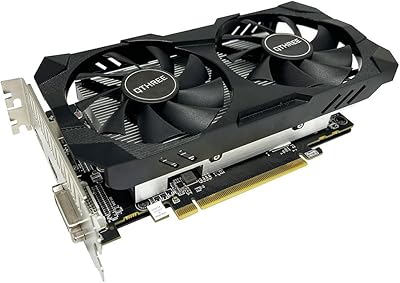
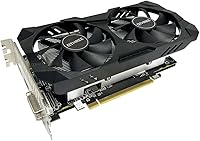
The RX 560 XT packs 1792 stream processors, a step up from a standard RX 560, but the narrow 128-bit bus remains a ceiling on what those extra cores can actually deliver. The 8GB of GDDR5 VRAM sounds generous — and for this price tier it is — but with bandwidth capped at 96 GB/s, don't expect it to behave like a card with a wider interface. On the connectivity side, the triple-output setup covering HDMI, DisplayPort, and DVI is a genuine practical win, especially for anyone building a multi-monitor workstation. The dual-fan cooler handles the 150W thermal load without turning into a jet engine, and broad PCIe 3.0 compatibility means it slots cleanly into most older systems.

Best For

This budget Radeon card makes the most sense for a fairly specific set of buyers. If you're coming from integrated graphics and just need something real in the slot, it gets the job done. HTPC and home theater builds are a natural sweet spot — the card outputs 4K at 60Hz and handles Blu-ray playback without much fuss. Office users who need three displays running simultaneously will appreciate the output variety without a large investment. Casual gamers playing older titles, indie games, or esports staples at 1080p medium should find it adequate. It's also a sensible pick for reviving a legacy system where a newer, power-hungry GPU simply isn't practical.

User Feedback

Verified buyers tend to land in two camps. Those who picked up this entry-level GPU for light gaming, multimedia, or a basic office setup generally come away satisfied — thermals stay manageable and the triple-output arrangement works as advertised. The dual-fan cooler draws consistent praise for keeping noise levels reasonable under typical loads. On the other side, buyers who expected mid-range gaming muscle are often let down when newer, graphically intense titles hit a wall. A few users have flagged driver setup friction on older Windows versions and Linux. The non-standard SKU name also creates buyer confusion, with some feeling the listing sets expectations the hardware cannot fully meet.

Pros

  • Broad PCIe 3.0 compatibility makes it an easy drop-in upgrade for older desktops without a PSU swap.
  • Triple display output covers HDMI, DisplayPort, and DVI simultaneously — useful for multi-monitor productivity setups.
  • 8GB of GDDR5 VRAM is generous for the price tier, avoiding the memory ceiling issues common on 4GB budget cards.
  • Dual-fan cooling keeps thermals manageable during light gaming and media playback without excessive noise.
  • 4K 60Hz output and Blu-ray support make it a functional choice for home theater PC builds.
  • Handles older titles and esports games at 1080p medium settings without major frame rate complaints.
  • Single 6-pin power connector means most decade-old power supplies can accommodate it without an upgrade.
  • DirectX 12 and OpenGL 4.6 support keeps the RX 560 XT technically compatible with modern game APIs.

Cons

  • The 128-bit memory bus limits bandwidth to 96 GB/s, creating a hard performance ceiling regardless of VRAM size.
  • The RX 560 XT is not a standard AMD SKU, and the lack of independent benchmarks makes pre-purchase verification difficult.
  • Used RX 580 and GTX 1060 cards often deliver significantly better gaming performance at a comparable or slightly higher cost.
  • Driver setup on Windows 7 and Linux environments has caused friction for a meaningful share of buyers.
  • Modern AAA titles at 1080p medium-to-high settings frequently produce unplayable frame rates on this entry-level GPU.
  • Build quality and fit-and-finish feel noticeably budget-grade compared to cards from established tier-one GPU manufacturers.
  • Fan noise ramps up audibly during sustained gaming loads, which can be distracting in quiet environments.
  • Inconsistent product page data — including an obviously erroneous thickness spec — reflects poor listing quality and erodes buyer confidence.

Ratings

The QTHREE Radeon RX 560 XT 8GB Graphics Card has been evaluated by our AI rating system after combing through verified global buyer reviews, actively filtering out incentivized, bot-generated, and duplicate submissions to surface genuine user sentiment. Scores reflect both what this entry-level GPU does well and where it falls short — no sugar-coating. The result is a transparent, balanced picture that helps budget-conscious buyers decide if this card actually fits their use case.

Gaming Performance
57%
43%
For older titles, indie games, and esports staples like League of Legends or CS2, the card holds up at 1080p on low-to-medium settings. Casual players who aren't chasing high frame rates in modern AAA titles tend to find it acceptable for weekend gaming sessions.
Push it toward anything released in the last two or three years at medium-high settings and frame rates drop noticeably. The 128-bit memory bus is the real culprit, starving the GPU of the bandwidth it needs to keep up, even with 8GB of VRAM on board.
Value for Money
61%
39%
As a first discrete GPU upgrade from integrated graphics, the price-to-capability ratio is defensible for very light use cases. Buyers who need basic display output, Blu-ray playback, or casual older-game performance without spending much more can get by.
Competing cards in the same price window — including older RX 580s or GTX 1060s available used — often deliver meaningfully better real-world performance. For anyone who does any amount of gaming, the value proposition weakens quickly against the secondhand market.
VRAM & Memory Capacity
72%
28%
8GB of GDDR5 is a genuinely generous allocation for this segment, and in productivity or multi-monitor desktop scenarios it avoids the texture memory ceilings that plague 4GB cards. Users running three screens simultaneously reported smooth desktop operation without memory-related slowdowns.
The 128-bit interface caps memory bandwidth at 96 GB/s, which significantly undermines the practical benefit of all that VRAM in gaming workloads. It ends up being more of a marketing talking point than a performance differentiator at this bus width.
Thermal Management & Cooling
78%
22%
The dual-fan cooler keeps temperatures in a reasonable range under typical loads, and most buyers noted the card never became alarmingly loud during light gaming or HTPC use. For a budget card drawing up to 150W, thermal performance is one of the more pleasant surprises.
Under sustained gaming loads over extended sessions, some users reported fan speeds ramping up more aggressively than expected. The cooling solution is adequate rather than impressive, and in a cramped or poorly ventilated case it may struggle to maintain comfortable temperatures.
Build Quality & Physical Construction
67%
33%
The card feels solid enough in hand, and the PCB materials have not drawn widespread complaints around flexing or cheap construction. For its price tier, it does not feel noticeably flimsy during installation.
The heatsink shroud and fan housing feel plasticky compared to cards from established GPU brands. A few buyers noted the bracket alignment required minor adjustment, and the overall fit-and-finish gives away that this is not a tier-one manufacturer product.
Multi-Monitor Support
83%
The combination of HDMI, DisplayPort, and DVI outputs covering three simultaneous displays is a genuine strength for office and HTPC users. Several buyers specifically praised this for driving a triple-screen productivity setup without any signal stability issues on Windows 10.
Display output works well in standard desktop environments, but users on Linux reported occasional configuration friction when setting up multi-monitor arrangements. Nothing insurmountable, but it adds setup time that plug-and-play buyers won't appreciate.
Driver Compatibility & Software
54%
46%
On Windows 10 64-bit, driver installation is generally straightforward and AMD's software stack is familiar to anyone who has used a Radeon card before. Most users in that environment reported getting up and running without major issues.
Windows 7 and Linux users encountered noticeably more friction, with some reporting driver conflicts or incomplete feature support. Given that this card targets legacy system owners — who are more likely to be running older operating systems — this is a meaningful pain point.
Noise Levels
74%
26%
Under light loads like video playback, web browsing, or desktop work, the dual fans spin quietly enough that the card is essentially background noise. HTPC builders specifically called out the acceptable noise floor during normal media consumption.
During gaming, fan noise becomes more audible than budget buyers might expect from a 150W card. It is not distractingly loud, but it is definitely present, and users in quiet rooms will notice the ramp-up after sustained gaming sessions.
Compatibility & Installation
81%
19%
The PCIe 3.0 x16 interface and single 6-pin power connector make this one of the more universally compatible upgrade options for older desktops. Buyers with decade-old platforms reported clean installations without needing to upgrade their power supply.
The product dimensions listed in the spec sheet raised some eyebrows — a stated thickness of 0.04 inches is clearly a data entry error and caused confusion for buyers trying to verify fit before purchasing. It's a minor issue but reflects sloppy product page management.
HTPC & Media Playback
84%
4K 60Hz output and Blu-ray support make this a capable living room card for users who just want clean video output on a large display. Several home theater builders cited it as a quiet, compact solution that handles their media library without any playback hiccups.
While media playback is smooth, the older Polaris architecture means some newer HDR and color pipeline features found on more recent GPUs are absent. Users chasing full HDR10 compliance in a modern home theater setup may find the feature set just slightly behind expectations.
Brand Transparency & SKU Clarity
41%
59%
The card does perform in line with what a Polaris 10 LE1 chip at this clock speed would be expected to deliver, so at a hardware level it is not completely misrepresenting itself. Technically literate buyers who understand what they are getting can calibrate accordingly.
The RX 560 XT name is not a standard, widely recognized AMD product designation, and that ambiguity creates real confusion. Multiple buyers expressed frustration that the branding implied a capability tier the card does not consistently meet, and the lack of independent benchmark documentation makes pre-purchase research difficult.
1080p Resolution Handling
63%
37%
For the specific category of older or lighter games — think titles from 2015 to 2019 on medium settings — the card manages 1080p output without embarrassing itself. Esports players running games with modest system requirements reported consistent, playable performance.
Step outside that comfortable zone into anything graphically intensive and the experience degrades fast. Buyers who purchased expecting general 1080p gaming capability across a modern library found themselves frequently dropping to low settings just to maintain playable frame rates.
Power Efficiency
66%
34%
The single 6-pin connector and 150W TDP mean most mid-range power supplies from the last decade can handle this card without an upgrade. That keeps total build costs low for buyers working with modest existing hardware.
For a card delivering entry-level performance, 150W is not particularly efficient by modern GPU standards. Newer budget-tier alternatives from more recent GPU generations deliver comparable or better output at significantly lower power draw, making the efficiency story here a relative weakness.

Suitable for:

The QTHREE Radeon RX 560 XT 8GB Graphics Card is a reasonable pick for a narrow but real group of buyers who know exactly what they need from a budget discrete GPU. If you're sitting on an older desktop with integrated graphics and just want something that can drive a proper display setup, handle Blu-ray playback, and push older games at 1080p without spending much, this card checks those boxes. Home theater PC builders who prioritize quiet operation and 4K 60Hz output over raw gaming horsepower will find it serviceable. Office users who need three monitors running simultaneously — on a platform that can't justify a pricier GPU — will appreciate the HDMI, DisplayPort, and DVI output combination. It also makes sense for anyone reviving a legacy system with an older PCIe 3.0 motherboard and a modest power supply, since the single 6-pin connector keeps compatibility broad and upgrade costs low.

Not suitable for:

The QTHREE Radeon RX 560 XT 8GB Graphics Card is a poor fit for anyone who expects to game regularly on modern titles, even at modest settings. The 128-bit memory bus caps real-world bandwidth in ways that 8GB of VRAM simply cannot compensate for — demanding games will expose this ceiling quickly, regardless of resolution target. Buyers who have been browsing used GPU marketplaces should also know that older RX 580s and GTX 1060s frequently surface at similar or only slightly higher prices with dramatically better gaming performance. Anyone planning to run Linux or Windows 7 as their primary OS should factor in the higher likelihood of driver friction before committing. The non-standard RX 560 XT branding is also a genuine concern — this is not a widely documented AMD SKU, and the absence of independent third-party benchmark data makes it hard to verify whether the hardware consistently delivers what the listing implies. Competitive gamers, content creators, or anyone expecting smooth performance in modern open-world or shooter titles will almost certainly feel let down.

Specifications

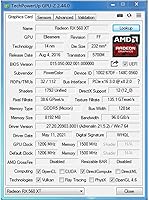
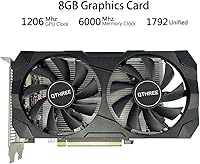
  • GPU Architecture: Built on AMD's Polaris 10 LE1 die using a 14nm manufacturing process, the same foundational architecture as the broader RX 500 series.
  • Stream Processors: The card carries 1792 stream processors, which is a higher count than a standard RX 560 but still constrained by the narrow memory interface.
  • Core Clock: The GPU core runs at 1206 MHz under standard operating conditions, with no official boost clock documented by the manufacturer.
  • Memory Size: 8GB of GDDR5 VRAM is onboard, offering more headroom than typical 4GB budget cards for multi-monitor desktop and media workloads.
  • Memory Speed: VRAM operates at 6000 MHz effective clock speed, delivering a memory bandwidth of 96 GB/s through the 128-bit interface.
  • Memory Interface: The 128-bit memory bus is the card's primary performance bottleneck, limiting data throughput despite the generous VRAM capacity.
  • Bus Interface: Uses a PCI Express 3.0 x16 slot, ensuring compatibility with a wide range of motherboards including older Intel and AMD platforms.
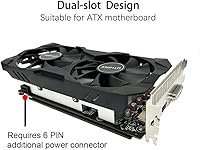
  • Power Draw: Rated at a maximum TDP of 150W, supplied through a single 6-pin power connector with no additional connectors required.
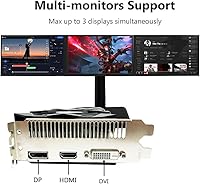
  • Display Outputs: Equipped with three independent output ports — one HDMI, one DisplayPort, and one DVI — supporting up to three monitors simultaneously.
  • Max Resolution: Capable of driving displays at up to 4K resolution at 60Hz via HDMI or DisplayPort under standard output conditions.
  • Cooling System: A dual-fan active cooling solution manages thermals across the card's full-length heatsink, designed for use in standard mid-tower cases.
  • Card Dimensions: The card measures approximately 8.27 x 4.72 inches in length and height, occupying a dual-slot profile in the PCIe bay.
  • Weight: The card weighs 1.32 pounds, which is typical for a dual-fan discrete GPU in this performance category.
  • OS Compatibility: Officially supported on Windows 10 64-bit, Windows 7 64-bit, Ubuntu Linux, and other x86 64-bit Linux distributions.
  • API Support: Compatible with DirectX 12 and OpenGL 4.6, meeting the baseline API requirements for the majority of current PC game titles.
  • Manufacturer: Produced and sold under the QTHREE brand, which is a third-party board partner rather than an AMD reference or major AIB manufacturer.

Related Reviews

QTHREE Radeon RX 560 XT 8GB Graphics Card
68%
61%
Value for Money
53%
Gaming Performance
88%
Installation & Setup
67%
Thermal Performance
58%
Fan Noise
More
QTHREE Radeon RX 590 GME 8GB Graphics Card
69%
72%
Value for Money
67%
1080p Gaming Performance
63%
Cooling Efficiency
84%
Ease of Installation
68%
Driver Stability
More
XFX QICK308 RX 6600 XT Graphics Card
79%
88%
1080p Gaming Performance
67%
1440p Gaming Performance
91%
Cooling Performance
86%
Noise Levels
53%
Ray Tracing Performance
More
MSI Radeon RX 5700 XT Gaming X 8GB GDDR6 Graphics Card
84%
91%
Gaming Performance
84%
Cooling Efficiency
88%
RGB Lighting Customization
70%
Driver/Software Installation
65%
Noise Levels Under Load
More
XFX RX 9060 XT 8GB Graphics Card
82%
88%
Gaming Performance at 1440p
93%
Gaming Performance at 1080p
67%
VRAM Adequacy
86%
Thermal Performance
89%
Noise Levels
More
AMD Radeon RX 6950 XT Graphics Card
72%
92%
4K Gaming Performance
94%
VRAM Capacity & Bandwidth
51%
Power Consumption
48%
Physical Size & Case Fit
67%
Driver Stability
More
Sapphire Radeon RX Vega 56 8GB HBM2 Graphics Card
83%
89%
Performance at 1440p and 1080p
84%
Cooling System Efficiency
91%
Value for Money
70%
Size and Compatibility
85%
Build Quality and Durability
More
Sapphire NITRO+ RX 580 8GB Graphics Card
80%
84%
1080p Gaming Performance
88%
Thermal Management
91%
Build Quality
83%
Value for Money
57%
Power Efficiency
More
Sapphire Radeon RX 7900 XT Graphics Card
78%
91%
Rasterization Performance
63%
Ray Tracing Performance
93%
VRAM Capacity
88%
Build Quality
84%
Thermal Management
More
GIGABYTE Radeon RX 6500 XT Eagle 4GB Graphics Card
83%
92%
Value for Money
88%
Gaming Performance (1080p)
90%
Cooling System Efficiency
63%
4K Performance
84%
Build Quality
More

FAQ

Honestly, it depends heavily on which games you mean. Older titles, esports games, and indie releases at 1080p medium settings run acceptably. But if you're thinking about recent open-world or AAA games at 1080p high settings, you'll likely hit frustrating frame rate drops. The 128-bit memory bus is the real limiting factor, not the VRAM amount.

The card draws up to 150W and uses a single 6-pin connector, so a 400W to 450W PSU is generally sufficient for a typical system build. If your existing rig has a 350W or larger supply with a spare 6-pin connector, you should be fine without upgrading.

Yes — the card has HDMI, DisplayPort, and DVI outputs, all of which can be active simultaneously. This is one of the more practical strengths of this budget Radeon card, especially for office setups or HTPC users who want multiple screens without spending much.

This is where things get murky. The RX 560 XT name is not a standard, widely documented AMD SKU, which makes finding reliable independent benchmark data difficult. QTHREE appears to be using a custom designation for a Polaris 10 LE1-based card, so treat any performance comparisons with some caution and manage expectations accordingly.

Under light workloads like video playback or desktop use, the fans are quiet enough that you'll barely notice them. During sustained gaming sessions, they do spin up audibly — not to an alarming degree, but enough to be noticeable in a quiet room. For HTPC use or casual gaming, most buyers find the noise level acceptable.

Technically yes — AMD's open-source Linux drivers support the Polaris architecture, and the card is listed as compatible with Ubuntu and other x86 64-bit Linux distributions. That said, some buyers have reported configuration friction and incomplete feature support on Linux compared to Windows 10, so budget extra setup time if Linux is your primary OS.

It's a bit of both. For desktop productivity, multi-monitor use, and media playback, 8GB is genuinely useful and avoids the memory ceiling problems that affect 4GB cards. For gaming, though, the 128-bit bus limits actual memory bandwidth to 96 GB/s, which means the card can't always take full advantage of that VRAM in demanding scenarios.

In most cases, yes. The card occupies a standard dual-slot PCIe bay and measures around 8.27 inches in length, which is well within the clearance limits of the vast majority of mid-tower cases. Just double-check your case's GPU length limit if you're working with a compact or mini-ITX build.

If gaming is your main goal, a used RX 580 or GTX 1060 will almost certainly outperform this entry-level GPU by a meaningful margin. Those cards have wider memory buses and more mature driver histories. The main trade-off is that used GPU reliability is harder to verify, while buying new gives you some peace of mind around condition and warranty.

The listing mentions VR compatibility, but temper your expectations. The RX 560 XT sits well below AMD's and Valve's recommended specifications for a smooth VR experience in most modern headsets. It might run basic or older VR content at reduced settings, but for any serious VR use, a more capable card would be a much better investment.