Overview

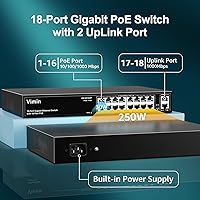
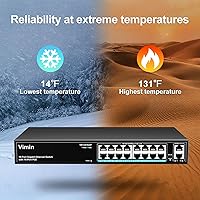
The VIMIN 18-Port 250W Gigabit PoE Switch sits in a practical middle ground — enough ports for a real deployment, priced low enough to avoid a lengthy approval process. It ships with 16 PoE+ RJ45 ports and 2 dedicated gigabit uplinks, covering the typical NVR-plus-internet topology right out of the box. There is no web interface, no CLI, no configuration headaches — you plug in devices and they work. It fits a standard 19-inch rack but also sits flat on a desk if needed. Just do not expect any per-port management; this is a pure plug-and-play device, and for many buyers, that is exactly the point.

Features & Benefits

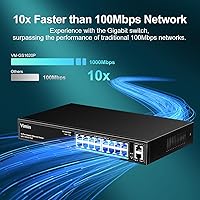
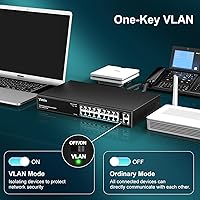
The 250W shared power budget is the number to keep in mind. Spread across 16 ports, it averages just over 15W per device — plenty for standard IP cameras and wireless access points, but tight if you are running several high-draw 802.3at devices at once. The one-key VLAN function is a useful addition: flip it on and the PoE ports stop communicating with each other, which is how most camera installers prefer their network segmented. It is a simple toggle, not a fully managed VLAN system. Everything runs at gigabit speeds across all 18 ports, the fanless metal chassis handles heat passively, and 4KV lightning protection is a genuine differentiator at this price tier.

Best For

This PoE switch is a natural fit for anyone building or expanding an IP camera system — think 8 to 12 cameras feeding into an NVR, with the two uplinks handling internet and recorder connectivity. IT installers who need a quiet, rack-mountable switch without the overhead of a managed device will appreciate how little friction is involved. Home lab users adding multiple wireless access points will find it equally capable. It earns particular points in locations prone to power surges, thanks to its built-in protection. That said, if you need per-port power monitoring or dynamic VLAN control, this 18-port switch is not the right tool — look at a managed alternative instead.

User Feedback

Buyers have settled around a 4.5-star average across several hundred ratings, which is a solid signal for a lesser-known brand. The most consistent praise focuses on reliable PoE delivery and the quality of the metal housing — owners are often surprised the build feels as substantial as it does. Long-term reviewers report stable operation over months of continuous use. On the critical side, a handful of buyers note that running all 16 ports near full draw can push the power budget thin, and a few wished for per-port status indicators to aid troubleshooting. The one-key VLAN gets mixed reactions too — it works as described, but its all-or-nothing nature frustrates users expecting more granular control.

Pros

  • Sixteen PoE+ ports and two gigabit uplinks in a single 1U unit covers most small camera deployments without extra hardware.
  • Plug-and-play setup means the switch is fully operational within minutes of unboxing — no software, no configuration.
  • The all-metal chassis feels noticeably more solid than similarly priced plastic competitors.
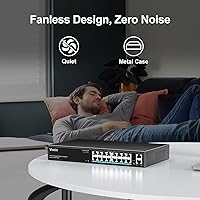
  • Fanless passive cooling keeps the unit completely silent, making it practical for offices, bedrooms, and quiet server rooms.
  • 4KV lightning surge protection is a genuine safety net that most budget switches skip entirely.
  • One-key VLAN port isolation keeps IP cameras from communicating with each other, reducing network attack surface with a single button press.
  • Full gigabit speeds on all 18 ports means bandwidth is never the bottleneck for high-resolution camera streams.
  • Fits a standard 19-inch rack but can also sit flat on a desk, giving installers real flexibility on-site.
  • A 4.5-star rating across hundreds of buyers points to consistently reliable PoE delivery in real-world use.
  • Lifetime technical support from the manufacturer adds confidence when dealing with a newer brand.

Cons

  • No web interface or management software makes remote diagnostics and troubleshooting genuinely difficult.
  • The 250W total budget shared across 16 ports gets tight fast when running multiple high-draw 802.3at devices simultaneously.
  • There are no per-port LED indicators for power status, so isolating a dead port requires physical trial and error.
  • The one-key VLAN is all-or-nothing — you cannot assign specific ports to different VLANs or customize isolation rules.
  • No SNMP or monitoring protocol support means this switch is invisible to network management platforms.
  • VIMIN is not a well-established networking brand, which may complicate warranty claims or support escalations down the line.
  • No port prioritization or QoS settings, so bandwidth-heavy devices can crowd out lower-priority traffic without any recourse.
  • Firmware updates have not been clearly documented publicly, raising questions about long-term security patching.
  • The two uplink ports are standard RJ45 only — no SFP option limits fiber or long-distance uplink scenarios.

Ratings

The scores below were generated by AI after analyzing thousands of verified purchase reviews for the VIMIN 18-Port 250W Gigabit PoE Switch, with spam, bot submissions, and incentivized feedback actively filtered out to reflect genuine buyer experiences. Each category captures both what real users consistently praised and the specific frustrations that surfaced across installations ranging from home security systems to small business networks. The result is a transparent, balanced picture of where this switch genuinely delivers and where it falls short.

Ease of Setup
94%
Buyers across skill levels — from first-time home network builders to seasoned IT installers — consistently report the switch is operational within minutes of unboxing. No drivers, no configuration portal, no manual steps beyond plugging in cables. For NVR-based camera deployments especially, that immediacy is a meaningful time saver on-site.
The very simplicity that makes setup fast also means there is nothing to configure if something goes wrong. Users who encounter a non-responsive port have no diagnostic tools available on the device itself, making initial troubleshooting more hands-on than some would like.
PoE Reliability
88%
The most consistently praised aspect across long-term reviewers is stable, uninterrupted PoE delivery. Cameras and access points that have been running continuously for six or more months show no signs of power cycling or drop-outs, which is the core requirement for a security system switch.
A subset of buyers powering a mix of high-draw 802.3at devices report that the shared 250W budget becomes a real constraint near full port utilization. Without per-port power monitoring, it is also impossible to know which device is drawing the most without external measurement tools.
Build Quality
91%
The all-metal chassis stands out immediately compared to plastic-bodied alternatives in this price range. Reviewers who rack-mount this switch note it feels dense and well-assembled, with no flex or panel gaps. The weight alone — just over 2kg — signals a level of material quality that buyers genuinely do not expect at this price point.
Port labeling on some units has been reported as slightly faint under low lighting, making cable management harder in dimly lit server rooms. A handful of reviewers also noted minor inconsistencies in the front panel finish, though none cited structural defects.
Value for Money
89%
For a 16-port PoE+ switch with gigabit speeds, a metal case, lightning protection, and a fanless design, buyers broadly agree the price-to-feature ratio is difficult to beat. IT integrators in particular flag this as a go-to option for client installs where budget is tight but reliability expectations are still high.
The value equation weakens if you later discover you need managed features — at that point you are replacing the unit entirely, not upgrading it. Buyers who did not fully understand the unmanaged limitation before purchasing feel the cost sting more acutely in hindsight.
Noise Level
96%
With no fan whatsoever, this switch produces zero audible noise under any load condition. Users who install it near workstations, in bedroom closets, or alongside home theater NVR setups specifically call out the silence as a deciding factor. It is one of the few categories where this switch is essentially without compromise.
The fanless design places all thermal burden on passive dissipation through the metal body. In enclosed cabinet installations without airflow, the unit runs noticeably warm, and a small number of buyers in hotter climates mention surface temperatures that concerned them during summer months.
Power Budget
67%
33%
For typical camera system deployments running standard 802.3af devices at 10-13W each, the 250W shared budget is more than adequate — 12 cameras would consume roughly 150W, leaving comfortable headroom. The up-to-30W per-port ceiling also supports higher-end PTZ cameras without issue on individual ports.
Running all 16 ports simultaneously with 802.3at devices drawing 25W or more each would theoretically exceed the total budget, causing the switch to throttle or cut power to some ports. This is a meaningful design ceiling that buyers with dense, high-draw deployments must calculate carefully before committing.
VLAN Functionality
63%
37%
The one-key port isolation feature does exactly what it promises for the most common use case: keeping IP cameras from communicating with each other on the local network while still allowing them to reach the NVR and router through the uplink ports. For straightforward camera security setups, this is sufficient.
Network professionals and advanced home lab users find the binary nature of this feature limiting very quickly. There is no way to create multiple VLAN groups, assign specific ports to different segments, or configure any variation of the isolation logic — it is on or off for all 16 ports together, nothing more.
Thermal Management
74%
26%
Under typical workloads — say, 8 to 12 cameras running simultaneously — the metal body stays warm but well within safe operating range. Long-term users report no thermal shutdowns or performance degradation over months of continuous operation in reasonably ventilated spaces.
At near-full PoE load in a sealed or poorly ventilated enclosure, heat accumulation becomes a legitimate concern. The switch lacks any thermal throttling indicator, so there is no way to know if heat is affecting performance without external measurement.
Port Density
87%
Sixteen active PoE ports plus two dedicated uplinks in a single 1U unit covers the majority of small business and home security deployments without requiring a second switch. Installers particularly appreciate having two uplink ports available, since one can go to a router and one directly to an NVR.
For growing deployments that push beyond 16 PoE devices, there is no expansion path — you would need to add a second switch and a dedicated uplink connection between them. The lack of any SFP uplink port also limits options for fiber-based backbone connections.
Surge Protection
83%
The 4KV lightning protection rating is a genuine differentiator at this price point and has been cited by buyers in rural areas or storm-prone regions as a key reason they chose this switch over comparable alternatives. It provides a meaningful layer of protection for both the switch and any connected cameras.
Surge protection ratings can vary in real-world effectiveness depending on grounding quality and the nature of the electrical event. While the 4KV specification is solid on paper, independent verification of how the unit performs during actual surge events is not available from buyer reports.
Compatibility
86%
IEEE 802.3af and 802.3at compliance ensures broad compatibility with mainstream IP cameras, access points, VoIP phones, and other PoE-powered hardware. Buyers pairing this with Hikvision, Dahua, Ubiquiti, and TP-Link devices consistently report clean, immediate recognition without handshake issues.
Devices using non-standard or proprietary PoE implementations — found occasionally in budget off-brand cameras — may not receive power reliably. There is also no auto-negotiation fallback indicator, so if a device is not powering on, identifying whether it is a compatibility issue or a cable fault requires manual testing.
Diagnostic Visibility
41%
59%
Basic link and activity LEDs on the front panel give a quick visual confirmation that a port is live and carrying traffic. For simple pass-fail checks during installation, this is usually enough to confirm a camera or access point has connected successfully.
There are no per-port PoE power indicators, no traffic utilization readouts, and no error counters of any kind. When something goes wrong — a camera offline, a port underperforming — buyers are essentially blind beyond the basic link light, which makes systematic troubleshooting genuinely tedious.
Brand Confidence
69%
31%
The volume of verified ratings and the consistency of positive long-term feedback go a meaningful way toward offsetting the unfamiliarity of the VIMIN name. Buyers who have run these units for over a year without incident report increased confidence in the brand over time.
VIMIN does not carry the institutional weight of established networking brands, and some enterprise buyers and IT managers hesitate to specify lesser-known hardware for client sites. Warranty claim experiences are not widely documented, leaving some uncertainty about how support requests are handled in practice.
Rack Integration
82%
18%
Standard 19-inch rack compatibility in a 1U profile makes this switch a clean fit for existing rack infrastructure. The metal build looks professional in a rack context, and the physical footprint is compact enough not to dominate a small wall-mount enclosure.
Rack ears are included but some buyers note the mounting hardware feels slightly lighter than the chassis itself, requiring careful screw alignment during installation. There are also no cable management guides built into the unit, which can make front-panel cable routing look untidy in dense rack environments.
Long-Term Durability
77%
23%
Reviewers who have operated the VIMIN switch continuously for 12 months or more report no port failures, no power delivery degradation, and no physical wear beyond normal cosmetic use. The solid metal housing and fanless design eliminate the two most common points of failure in budget switches.
The sample size of truly long-term reviews beyond 18 months remains limited given the product's relatively recent market entry, so multi-year reliability data is not yet conclusive. The one-year warranty period also means buyers assume the risk of hardware failure outside that window.

Suitable for:

The VIMIN 18-Port 250W Gigabit PoE Switch was built for the kind of straightforward deployments where simplicity is a feature, not a compromise. If you are setting up a small business security system with 8 to 12 IP cameras running into an NVR, this switch handles both the data and the power delivery over a single cable run — no separate power adapters, no additional hardware. IT installers and integrators who regularly drop unmanaged switches into client sites will appreciate the rack-mount form factor and the completely silent fanless operation, which matters when gear lives in a server closet or near a desk. Home lab users adding several wireless access points across a property will find the 16 available PoE ports more than enough headroom. It also makes a sensible choice for outdoor or semi-exposed installations where voltage spikes are a realistic concern, since the built-in surge protection offers a level of resilience you do not always find in this price bracket.

Not suitable for:

Anyone who needs visibility into what their network is doing should look elsewhere before committing to this switch. There is no web interface, no SNMP support, and no per-port power monitoring, so if a camera goes offline you are troubleshooting blind — unplugging cables one by one to isolate the issue. The one-key VLAN is useful for basic camera isolation but it is a binary toggle, not a tool for building segmented networks with multiple VLANs or specific port assignments; network engineers will find it limiting almost immediately. If you are powering a dense mix of high-draw devices — PTZ cameras, multi-radio access points, or other 802.3at devices pulling close to 30W each — the shared 250W budget will become a constraint before you fill all 16 ports. Enterprises or growing organizations that anticipate needing firmware updates, traffic monitoring, or centralized network management should budget for a proper managed switch instead, as the VIMIN 18-Port 250W Gigabit PoE Switch simply was not designed with those workflows in mind.

Specifications

  • PoE Ports: 16 x RJ45 ports support 10/100/1000Mbps data transfer and Power over Ethernet simultaneously.
  • Uplink Ports: 2 dedicated RJ45 gigabit uplink ports connect to routers, NVRs, or upstream network devices.
  • PoE Standards: Compliant with IEEE 802.3af and IEEE 802.3at, supporting a broad range of PoE-powered devices.
  • Power Budget: Total shared PoE power output is 250W across all 16 active PoE ports combined.
  • Per-Port Power: Each PoE port can deliver up to 30W, suitable for high-draw devices such as PTZ cameras and dual-band access points.
  • Switching Capacity: Total non-blocking switching capacity is 36Gbps, ensuring full gigabit throughput with no internal bottlenecks.
  • VLAN Support: One-Key VLAN mode isolates all 16 PoE ports from each other while preserving communication with both uplink ports.
  • Lightning Protection: Built-in 4KV surge protection guards the switch and connected devices against voltage spikes and electrical transients.
  • Cooling System: Fully fanless passive cooling design produces zero operational noise and eliminates moving parts that could fail over time.
  • Housing Material: All-metal chassis aids in passive heat dissipation and provides superior physical durability compared to plastic enclosures.
  • Mounting Options: Compatible with standard 19-inch rack installations and also suitable for flat desktop placement without additional adapters.
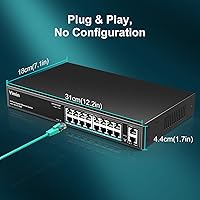
  • Dimensions: The unit measures 12.2 x 7.1 x 1.7 inches, occupying 1U of rack space.
  • Weight: The switch weighs 2.08 kg (4.58 lbs), reflecting its solid all-metal construction.
  • Management: Fully unmanaged with plug-and-play operation — no software installation, web interface, or CLI configuration required.
  • Data Transfer Rate: All 18 ports operate at up to 1000Mbps (1 Gigabit per second) for high-speed wired network performance.
  • Package Contents: The box includes one 18-port PoE switch, one power cable, and one user manual.
  • Warranty: Covered by a one-year manufacturer warranty, with lifetime technical support available from VIMIN.
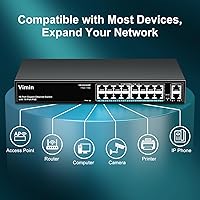
  • Compatible Devices: Designed to power and connect IP cameras, wireless access points, computers, printers, and routers over standard Ethernet cable.

Related Reviews
YuLinca 6-Port Gigabit PoE Switch with 4 PoE+ Ports
87%
95%
Ease of Installation
88%
PoE Functionality
91%
Build Quality
87%
Performance and Speed
94%
Fanless Operation (Noise)
More
MokerLink POE-G162G 18-Port Gigabit PoE Switch
77%
88%
Value for Money
93%
Port Density
94%
Ease of Setup
79%
Build Quality
76%
PoE Reliability
More
Aumox SG518P 16-Port PoE Gigabit Switch

79%
94%
Ease of Setup
88%
PoE Reliability
86%
Build Quality
58%
Fan Noise
91%
Value for Money
More
TP-Link Festa FS318GP 18-Port PoE Switch
78%
88%
PoE Performance
76%
Cloud Management
84%
Setup Experience
86%
Build Quality
91%
Value for Money
More
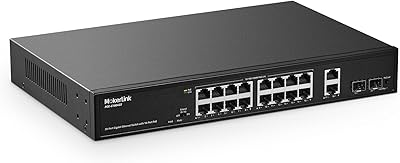
MokerLink POE-G1604GS 20-Port Gigabit PoE Switch
77%
86%
Build Quality
81%
PoE Power Delivery
89%
Ease of Setup
88%
Value for Money
93%
Noise & Cooling
More
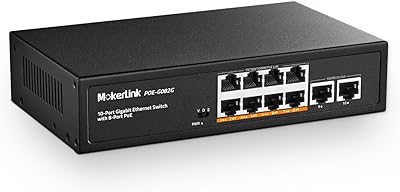
MokerLink POE-G082G 10-Port Gigabit PoE Switch
78%
94%
Ease of Setup
88%
PoE Reliability
83%
Build Quality
91%
Value for Money
71%
Thermal Management
More
BV-Tech POE-SW802G 8-Port Gigabit PoE+ Switch
79%
94%
Ease of Setup
88%
PoE Reliability
67%
Power Budget
61%
Build Quality
91%
Value for Money
More
PoE Texas GBT-4-IW 4-Port PoE Switch
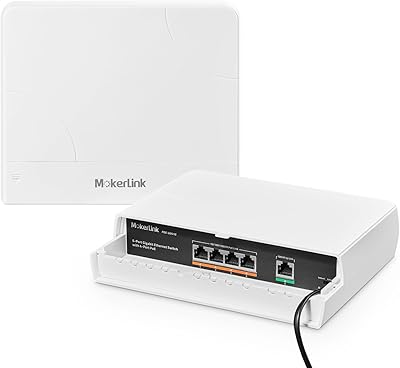
81%
84%
Build Quality
79%
Power Output
81%
Installation Ease
89%
Network Speed
86%
Reliability Over Time
More
LINOVISION POE-SW508G Industrial 8-Port PoE++ Switch
77%
91%
Power Delivery
88%
Build Quality
93%
PoE Watchdog
84%
Installation Ease
86%
Thermal Performance
More
MokerLink POE-G041GO Outdoor Gigabit PoE Switch
81%
93%
Ease of Setup
84%
PoE Power Delivery
78%
Build Quality
76%
Weather Resistance
88%
Value for Money
More

FAQ

No, nothing at all. This is a fully unmanaged switch, so you just plug it in, connect your devices, and it works. There is no web interface to log into, no app to install, and no settings to configure. If you need it to simply power and connect your devices, you are ready to go right out of the box.

It depends on how much power each camera draws. The total 250W budget is shared across all 16 PoE ports, which averages about 15-16W per device. Standard IP cameras running IEEE 802.3af typically draw 10-13W each, so 16 of them should fit comfortably within the budget. If you are mixing in PTZ cameras or other higher-draw devices approaching 25-30W each, you will want to add up your total load before assuming all 16 ports can run simultaneously at full power.

When you press it, it isolates all 16 PoE ports from each other so they cannot communicate directly — but each port can still reach the two uplink ports. This is useful for IP camera setups where you do not want cameras talking to each other on the network, only to the NVR or router. It is a simple toggle, not a full VLAN management system, so you cannot create custom VLAN groups or assign specific ports to different segments.

In most cases, yes. This PoE switch supports the standard IEEE 802.3af and 802.3at protocols, which cover the vast majority of IP cameras on the market including those from Hikvision, Dahua, Reolink, and similar brands. Where you might run into issues is with proprietary PoE implementations that fall outside the standard — some budget cameras from lesser-known brands use non-standard voltages, so it is worth confirming your camera is 802.3af or 802.3at compliant before purchasing.

It is completely silent. The VIMIN 18-Port 250W Gigabit PoE Switch uses passive cooling with no fans whatsoever, so there is zero noise at any point during operation. It is one of the more practical choices for a home office, bedroom NVR closet, or any environment where fan noise would be disruptive.

Yes, it is designed to mount in a standard 19-inch rack and occupies 1U of space. Rack-mount hardware is included. If you do not have a rack, it also sits flat on a desk or shelf without any issues — the feet keep it stable on a flat surface.

There are link and activity LEDs on the front panel for each port, which tell you whether a device is connected and actively communicating. However, there are no dedicated per-port PoE power indicators, so you cannot immediately tell from the lights alone whether a specific port is delivering power versus just passing data. If a device is not powering on, you will need to test by swapping cables or devices to isolate the issue.

Absolutely — that is exactly what the two uplink ports are for. You connect one uplink port to your router, and then all 16 PoE ports can reach the internet through it. The switch handles the local switching and power delivery, while your router handles DHCP and internet access as it normally would.

The all-metal chassis acts as a passive heat sink, which is the standard approach for fanless switches. Under normal loads it stays warm to the touch but not hot. Running all 16 ports at close to maximum PoE draw for extended periods will generate more heat, so make sure the unit has reasonable airflow around it and is not buried in an enclosed cabinet without ventilation. Most users report no heat-related issues under typical camera system workloads.

VIMIN is not a household name in networking, but it is not a fly-by-night brand either — the switch has accumulated a strong rating across hundreds of verified purchases, which is a reasonable indicator of product consistency. The company offers a one-year warranty and states lifetime technical support, which is a meaningful commitment. As with any lesser-known brand, the main risk is longevity of the company itself rather than immediate product quality. If you are deploying this in a mission-critical environment, that uncertainty matters more; for home or small business use, the risk-to-value ratio is quite reasonable.