Overview

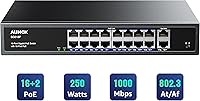
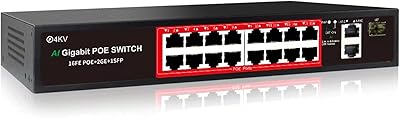
The Aumox SG518P 16-Port PoE Gigabit Switch is a straightforward, no-fuss option for small businesses and home lab builders who need reliable wired connectivity without the overhead of managed-switch complexity. It ships with a built-in 250W power supply, so there is no external adapter to source or mount — you rack it, plug in your devices, and you are running. The metal chassis fits a standard 19-inch rack but also sits fine on a shelf or wall bracket if racking is not an option. At its price point, it occupies a practical middle ground: more ports and power than entry-level desktop switches, without the cost of a fully managed unit.
Features & Benefits

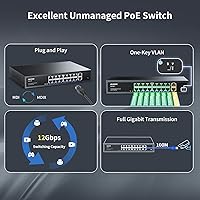
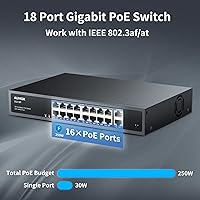
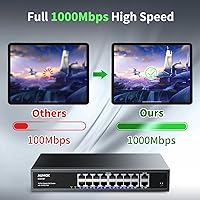
Every port on this PoE switch runs at full gigabit speed, which matters when you are pushing 4K camera streams or handling a busy wireless access point. The 16 PoE-capable ports support both IEEE 802.3af and 802.3at standards, powering anything from a basic IP phone drawing 7W to a high-output access point pulling the full 30W. One thing to keep in mind: the total power budget is 250W shared across all ports. Connect eight devices at 30W each and you have already hit the ceiling, so plan your load carefully. The One-Key VLAN function isolates PoE ports from one another — useful for camera segments, but not a substitute for the granular control a managed switch provides.

Best For

This gigabit PoE switch is a natural fit for anyone deploying a small IP camera system, a handful of wireless access points, or a VoIP setup where running separate power cables is not practical. IT installers who regularly spec out rackmount-ready hardware will appreciate that it drops into a standard 1U slot without fuss. It is also a solid upgrade path for someone outgrowing an 8-port desktop switch and needing to consolidate everything into a single unit. Where it falls short: anyone requiring per-port traffic shaping, SNMP monitoring, or granular VLAN rules should step up to a managed switch. Plug-and-play simplicity is the core value proposition here, and understanding that trade-off matters before you commit.

User Feedback

With nearly 7,000 ratings averaging 4.6 stars, the Aumox SG518P has built its reputation through sheer volume, not just positioning. Buyers consistently praise easy installation and dependable PoE delivery for cameras and access points, and the metal chassis earns frequent compliments for feeling solid rather than cheap. That said, fan noise surfaces repeatedly in reviews — under moderate to heavy load the unit is clearly audible, which could be a real concern in a quiet office or home setting. A smaller share of buyers also raise questions about long-term reliability once the one-year warranty expires, so if this is going into a permanent installation, that context is worth factoring into your decision.

Pros

  • All 18 ports deliver full gigabit speeds, with no bottlenecking on any connection.
  • The built-in 250W power supply means no external adapter to source, mount, or replace.
  • Rack-ready 19-inch form factor drops cleanly into a standard 1U slot without adapters.
  • Supports both IEEE 802.3af and 802.3at, covering the full range of common PoE devices.
  • One-Key VLAN provides basic port isolation useful for separating camera traffic from the main network.
  • Setup genuinely takes minutes — there is no learning curve for non-technical installers.
  • Metal casing feels solid and dissipates heat better than comparable plastic-bodied switches.
  • Nearly 7,000 customer ratings averaging 4.6 stars indicate broad, consistent real-world satisfaction.
  • Desktop and wall-mount options give flexibility for sites where rack installation is not available.
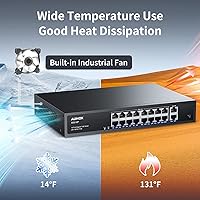
  • Rated to operate in temperatures from 14°F to 131°F, suitable for unconditioned spaces like garages or warehouses.

Cons

  • No web interface, CLI, or SNMP support makes remote monitoring completely impossible.
  • The 250W shared power budget can run short if several high-draw 30W devices are connected at once.
  • Fan noise is noticeable under moderate to heavy load — not suitable for quiet environments.
  • One-Key VLAN is a blunt instrument; it cannot replicate the granular control of a managed switch.
  • The one-year warranty period is shorter than what several competing brands offer at a similar price.
  • No port mirroring or traffic analysis tools, making network troubleshooting harder than it needs to be.
  • Long-term reliability data beyond the warranty window is limited compared to established enterprise brands.
  • No link aggregation support, which limits uplink redundancy options for more demanding setups.

Ratings

The scores below reflect AI-driven analysis of thousands of verified global reviews for the Aumox SG518P 16-Port PoE Gigabit Switch, with spam, bot activity, and incentivized feedback actively filtered out to ensure the ratings represent genuine buyer experiences. Both the strengths that make this gigabit PoE switch a popular choice and the real-world pain points that have frustrated some buyers are transparently reflected in every category score.

Ease of Setup
94%
Buyers consistently report that getting this PoE switch up and running takes under ten minutes in most cases. There are no drivers to install, no web portal to navigate, and no configuration steps to follow — connect power and cables and it works.
A small number of users noted that the lack of any interface also means there is no feedback when something is misconfigured upstream. If a device does not get power, there is no diagnostic tool on the switch itself to help pinpoint why.
PoE Reliability
88%
The vast majority of buyers report rock-solid PoE delivery to IP cameras, wireless access points, and VoIP phones over extended periods. Devices stay powered consistently, and the switch correctly identifies and negotiates power levels without manual intervention.
A recurring concern involves the 250W shared budget — when many high-draw devices are connected simultaneously, some users have experienced ports failing to deliver power until load is reduced. This is a budget-planning issue as much as a reliability one, but it catches buyers off guard.
Build Quality
86%
The all-metal enclosure stands out at this price tier, where plastic-bodied competitors are common. Buyers who have installed this switch in server closets and utility rooms report that it feels dense and well-constructed, with no flex in the chassis.
A few users noted that the port labeling can wear over time and that some rack-mounting hardware included feels lightweight relative to the chassis itself. Nothing that affects function, but it is a small finish detail that does not match the otherwise solid construction.
Fan Noise
58%
42%
For installations inside a closed network cabinet or server room, the fan noise is essentially a non-issue. Buyers deploying this switch in dedicated equipment spaces report they never think about it.
In open office environments, home offices, or any room where quiet operation matters, the fans are clearly audible under load — multiple reviewers specifically flagged this as a dealbreaker for their setting. This is the single most common complaint in negative reviews and is worth taking seriously.
Value for Money
91%
For the port count, power budget, and build quality delivered, buyers across a wide range of network backgrounds consistently describe this PoE switch as one of the better-value options available in its category. The built-in power supply alone removes a cost and complexity that competitors sometimes pass back to buyers.
Some users feel the value proposition weakens slightly for buyers who later realize they need even basic management features, since the next step up in capability requires moving to a significantly more expensive managed switch rather than a minor upgrade.
PoE Power Budget
67%
33%
250W is a genuinely useful total budget for mixed deployments of cameras and access points drawing between 8W and 15W each, and most small business installations stay well within this ceiling without careful planning.
Users running high-draw 802.3at devices at 25W to 30W each hit the ceiling faster than expected, and because there is no management interface, there is no built-in way to monitor actual consumption per port. Several buyers had to rethink their device selection after encountering power shortfalls.
VLAN Functionality
61%
39%
For users who specifically want camera traffic isolated from workstation traffic without any configuration, the One-Key VLAN function solves that narrow problem effectively. IT installers managing simple surveillance networks appreciate the convenience.
Buyers coming from even basic managed switches find the One-Key VLAN limiting — there is no ability to define VLAN IDs, assign specific ports to segments, or customize behavior in any way. Several reviewers explicitly noted it is not a substitute for real VLAN management and wished that was clearer before purchase.
Thermal Management
79%
21%
The combination of metal casing and active fan cooling keeps operating temperatures in check even in warmer utility spaces. Buyers running the switch in garages and server rooms report no heat-related shutdowns or performance degradation.
The trade-off for effective thermal management is the fan noise discussed separately. A small number of users in warmer climates also noted the fans run at higher speeds more consistently, increasing the noise issue year-round.
Port Count and Layout
83%
Sixteen PoE ports plus two uplink ports in a single 1U rackmount unit is a layout that hits a practical sweet spot for small business deployments. Buyers consolidating from multiple smaller switches appreciate being able to wire an entire location from a single device.
The two uplink ports are standard gigabit RJ45 rather than SFP slots, which limits flexibility for fiber uplinks or link aggregation to upstream equipment. For most small deployments this is irrelevant, but it is a real constraint for more complex network architectures.
Compatibility
87%
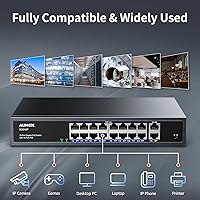
The switch works reliably with a broad range of PoE devices from major brands including Hikvision, Dahua, Ubiquiti, and Cisco IP phones. Auto-negotiation across all 18 ports means mixed-speed devices coexist without any manual adjustments.
The switch does not support IEEE 802.3bt (PoE++), so very high-draw devices requiring 60W or 90W per port — such as certain pan-tilt-zoom cameras or some next-generation access points — cannot be powered by this switch, which surprises some buyers who assume all PoE devices are covered.
Long-Term Reliability
72%
28%
A meaningful share of buyers report units running continuously for two or more years without issues. The metal chassis and industrial-grade fans suggest the hardware is built for sustained 24/7 operation, which aligns with how most surveillance and access point networks operate.
Because the product has only a one-year warranty, buyers whose units develop issues in year two or three have limited recourse. Some reviewers noted that Aumox support response quality varies, and the relatively shorter warranty window compared to enterprise brands creates lingering concern for permanent installations.
Rackmount Installation
89%
The 19-inch form factor and included rack ears make installation into a standard rack straightforward. IT installers report clean, professional results with minimal effort, and the 1U height keeps rack space consumption efficient.
A small number of buyers noted the rack ears feel slightly thin compared to the chassis, and that cable management at the front of the unit can get crowded when all 18 ports are populated. Neither issue is serious, but tidier rear-port designs from some competitors are occasionally cited by comparison.
Indicator Lights
74%
26%
Per-port LED indicators for link status and activity give useful at-a-glance feedback about which ports are active and connected, which helps during initial setup and basic troubleshooting without any software tools.
There is no LED or visual indicator specifically for PoE delivery status or power level per port, which means buyers cannot tell from looking at the switch whether a device is receiving PoE or just a data connection. A dedicated PoE status light would meaningfully improve the diagnostic experience.
Packaging and Included Accessories
71%
29%
Most buyers report the unit arrives well-protected and includes a power cord and rack mounting hardware, covering the basics needed to get started immediately without a separate accessories order.
The included manual is minimal and described by some reviewers as thin on practical guidance for less experienced buyers. A quick-reference card covering the One-Key VLAN function and power budget calculation would reduce the post-purchase confusion that appears in several reviews.

Suitable for:

The Aumox SG518P 16-Port PoE Gigabit Switch is built for small business owners, home lab enthusiasts, and IT installers who need to power and connect a meaningful number of PoE devices without wrestling with configuration menus. If you are running eight to twelve IP cameras alongside a couple of wireless access points and want everything powered from a single unit in a rack, this switch was designed with exactly that scenario in mind. It is equally well-suited to VoIP deployments where desk phones need power and connectivity from the same cable run, removing the need for individual power adapters at every station. Non-technical users will appreciate that there is genuinely nothing to configure — plug in the power cord, connect your devices, and the switch handles the rest. The rackmount form factor makes it a clean fit for server closets or network cabinets, and the metal chassis holds up better than the plastic-bodied alternatives common at this price range.
Not suitable for:

The Aumox SG518P 16-Port PoE Gigabit Switch is not the right tool if your network requires any meaningful level of traffic management, monitoring, or security policy enforcement. There is no SNMP support, no per-port bandwidth controls, no port mirroring for network diagnostics, and no CLI or web interface of any kind — what you see is what you get. Organizations running guest Wi-Fi that must be strictly isolated from internal systems, or teams that need to throttle bandwidth per device, will hit a hard wall quickly. The 250W total power budget also demands honest planning: if you intend to run more than eight high-draw 30W devices simultaneously, you will run out of headroom before you run out of ports. Buyers sensitive to fan noise should also think carefully — this is not a silent unit under load, and it would be a poor choice for a quiet home office or a recording environment. Finally, the one-year warranty is shorter than what some competing brands offer, which is worth weighing for installations where the switch is expected to run continuously for many years.
Specifications

  • Total Ports: The switch provides 18 ports in total: 16 PoE-enabled RJ45 ports and 2 dedicated gigabit uplink ports.
  • Port Speed: All 18 ports support auto-negotiation across 10, 100, and 1000 Mbps, delivering full gigabit throughput on every connection.
  • PoE Standard: PoE ports comply with IEEE 802.3af, supplying up to 15.4W per port, and IEEE 802.3at, supplying up to 30W per port.
  • PoE Budget: The total shared PoE power output across all 16 active PoE ports is capped at 250W.
  • Power Supply: A 52V 4.8A power supply is built directly into the unit, eliminating the need for a separate external adapter.
  • Switching Capacity: The internal switching fabric operates at 12 Gbps, supporting non-blocking throughput across all ports simultaneously.
  • Forwarding Mode: The switch uses store-and-forward processing, which checks each packet for errors before forwarding it to its destination.
  • MAC Table: The MAC address table holds up to 8,000 entries, sufficient for small to mid-sized network environments.
  • VLAN Support: A One-Key VLAN function isolates all PoE ports from one another while maintaining communication through the uplink ports.
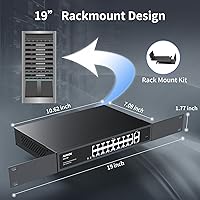
  • Form Factor: The unit is designed to mount in a standard 19-inch rack at 1U height, and also supports desktop or wall installation.
  • Dimensions: Physical dimensions are 19″ long by 7.08″ wide by 1.77″ tall (approximately 270mm x 180mm x 45mm).
  • Weight: The unit weighs 4.29 lbs (2.09 kg), which is typical for a metal-chassis switch of this port count.
  • Case Material: The enclosure is constructed from metal, providing structural rigidity and improved passive heat dissipation compared to plastic housings.
  • Cooling System: Industrial-grade active fans are integrated into the chassis to manage thermal output under sustained load conditions.
  • Operating Temperature: The switch is rated to operate reliably in ambient temperatures ranging from 14°F to 131°F (-10°C to 55°C).
  • Interface Type: All ports use the RJ45 connector standard, compatible with standard Cat5e, Cat6, and Cat6a Ethernet cabling.
  • Management: The switch is fully unmanaged and requires no software, web interface, or configuration of any kind to operate.
  • Warranty: Aumox provides one year of after-sales service coverage and technical support for this switch from the date of purchase.
  • PoE Pin Mode: The switch uses End-Span power delivery on pins 1/2 and 3/6, which is the standard mode for most commercial PoE devices.
  • Power Distance: PoE power can be delivered reliably to connected devices over cable runs of up to 100 meters.

Related Reviews
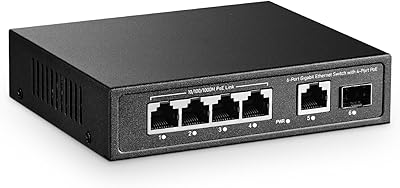
YuLinca 6-Port Gigabit PoE Switch with 4 PoE+ Ports
87%
95%
Ease of Installation
88%
PoE Functionality
91%
Build Quality
87%
Performance and Speed
94%
Fanless Operation (Noise)
More
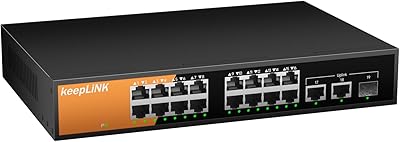
keepLiNK 16-Port Gigabit PoE Unmanaged Switch
81%
91%
Value for Money
93%
Ease of Setup
78%
PoE Power Delivery
84%
Build Quality
71%
Thermal Performance
More
AUMOX PRO SG305P 5-Port PoE Gigabit Switch
78%
88%
Build Quality
93%
Ease of Setup
79%
PoE Performance
97%
Noise Level
91%
Value for Money
More
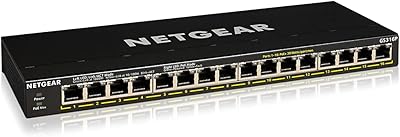
NETGEAR GS316PP 16-Port PoE+ Gigabit Ethernet Switch
85%
92%
Value for Money
89%
Ease of Use
86%
Energy Efficiency
76%
PoE Power Delivery
90%
Quiet Operation
More
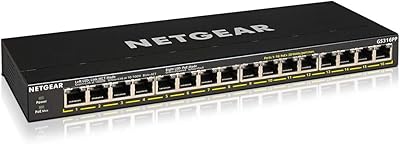
NETGEAR GS316P 16-Port PoE+ Gigabit Switch
77%
97%
Ease of Setup
94%
PoE Port Coverage
61%
PoE Power Budget
88%
Build Quality
96%
Noise Level
More
AUMOX PRO SG308P 8-Port PoE Gigabit Switch 120W
85%
85%
Performance
94%
Ease of Setup
89%
Build Quality
91%
Fanless Operation
87%
Power Efficiency
More
YuLinca F1602GP 16-Port PoE Switch with 2 Gigabit Uplink
84%
72%
Performance at Extended Ranges
92%
Setup & Installation Ease
88%
Build Quality & Durability
85%
Value for Money
90%
PoE Power Output
More
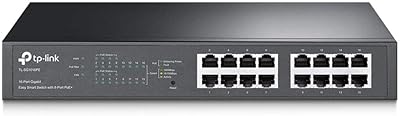
TP-Link TL-SG1016PE 16-Port Gigabit PoE Switch
80%
91%
PoE Reliability
88%
Build Quality
67%
Power Budget
63%
Management Interface
86%
Setup & Ease of Use
More
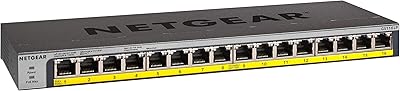
NETGEAR GS116LP 16-Port Unmanaged PoE+ Switch
86%
97%
Ease of Setup
93%
PoE Port Coverage
62%
PoE Power Budget
96%
Silent Operation
88%
Build Quality
More
STEAMEMO 16-Port 240W PoE+ Unmanaged Switch
79%
91%
Value for Money
93%
Ease of Setup
78%
PoE Power Delivery
63%
Port Speed Performance
87%
Build Quality
More

FAQ

No, there is nothing to configure at all. Plug the switch into power, connect your devices with Ethernet cables, and it handles everything automatically. It is as close to zero-setup as a network switch gets.

It depends on what you are connecting. A typical IP camera draws around 10 to 15W, so you could comfortably run 16 of them with headroom to spare. However, if you are using high-power access points or PTZ cameras that pull the full 30W, you can only run about eight of them before hitting the ceiling. Add up the wattage of your specific devices before assuming all 16 ports can be fully loaded simultaneously.

Yes, all 16 PoE ports are backward compatible with standard Ethernet devices that do not support PoE. The switch automatically detects whether a connected device needs power and only delivers it when appropriate, so you will not damage non-PoE equipment by plugging it in.

The fans are noticeable, particularly under moderate to heavy load. In a dedicated server closet or network cabinet with the door closed, it is a non-issue. In an open home office or a quiet room, some people find the fan noise distracting. If silence is important to your setup, that is worth factoring in before purchasing.

Partially. The One-Key VLAN isolates PoE ports from each other and directs their traffic only through the uplink ports, which helps keep camera traffic off the main device-to-device network. However, it is a fixed, simple isolation function — you cannot define custom VLAN IDs, assign specific ports to different segments, or enforce more complex policies. For true network segmentation, you would need a managed switch.

If your rack follows the standard 19-inch equipment width, yes. The unit is designed to 19-inch rackmount specification and occupies 1U of rack space. It ships with rack ears for mounting, though you should verify the included hardware against your specific rack before installation.

Most unmanaged PoE switches, including this one, will manage overload by throttling or cutting power to ports rather than damaging hardware. That said, relying on overload protection as a regular operating condition is not a good practice — it can lead to unreliable device behavior and put unnecessary stress on the power supply over time. Plan your installation so the expected load stays comfortably under the 250W ceiling.

Yes. The switch supports IEEE 802.3at, which is the PoE+ standard, delivering up to 30W per port. That covers the majority of higher-draw devices including many access points and PTZ cameras. It does not support IEEE 802.3bt (PoE++), which is the 60W or 90W standard used by some very high-power devices.

Cat5e is the minimum for gigabit speeds over 100-meter runs, but Cat6 is generally recommended for cleaner signal quality, especially in environments with electrical interference. The switch uses standard RJ45 connectors, so any Cat5e, Cat6, or Cat6a cable with RJ45 terminations will work.

First, try a different port to rule out a faulty port. Then confirm your device is actually PoE-compatible and falls within the 802.3af or 802.3at power range. Also check that the total power load on the switch has not exceeded 250W — if many ports are active, a new device may not receive power until load drops. If none of that resolves it, Aumox offers technical support within the warranty period, and reaching out to them directly is your best path forward.

Where to Buy