Overview

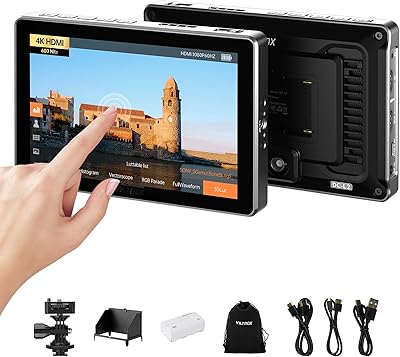
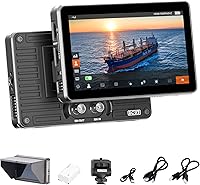
The VILTROX DC-X3 6″ Field Monitor sits in an interesting spot — capable enough to satisfy working videographers, but priced well below the broadcast-grade monitors it borrows ideas from. What makes it stand out in a crowded mid-range field is its 2000-nit brightness, which genuinely holds up under harsh midday sun rather than just looking good on a spec sheet. It arrives with a surprisingly complete kit: a battery, sunshade hood, carry case, and multiple cables all included out of the box. That said, this on-camera monitor is a practical working tool, not a color-critical reference display for a grading suite.
Features & Benefits

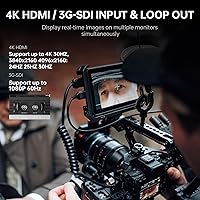
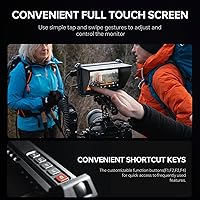
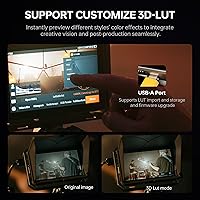
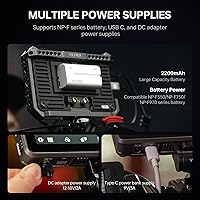
The IPS panel's wide viewing angle means a director standing off to the side still gets an accurate read on exposure — no color shift, no washed-out corners. The loop-in and loop-out ports cover both 4K HDMI (up to 30Hz) and 3G-SDI (up to 1080p at 60Hz), so you can daisy-chain feeds to another display or a recorder without extra adapters. Importing 3D LUTs via a USB drive lets you monitor log footage in a corrected look right on set, cutting down guesswork in post. The touchscreen is responsive, and four programmable shortcut keys mean your most-used tools — false color, peaking, waveform — are always one press away. Power options are flexible too: NP-F battery, DC barrel input, or USB-C.

Best For

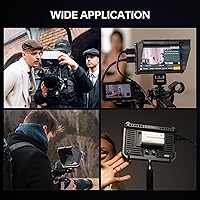
This field monitor punches above its weight for solo documentary shooters who need dependable focus peaking and exposure tools without hauling a full cart of gear. The SDI loop-out makes it practical on small narrative sets where an AC and a director want to share the same feed from a cinema camera. Outdoor content creators — the kind who shoot lifestyle or travel footage in unpredictable light — will appreciate not having to shade the screen with a free hand just to check a shot. At 350 grams, it mounts on a mirrorless rig without throwing off balance, and the included hard-shell case means it can actually survive a packed bag.

User Feedback

Buyers consistently highlight the brightness in sunlight as the feature that actually delivers on its promise, and most find the touchscreen far more responsive than they expected at this price point. The included accessory kit — hood, battery, case, cables — gets called out as genuinely useful, not the usual afterthought bundle. Where opinions get more mixed is around the 4K input ceiling: since it caps at 30Hz over HDMI, anyone shooting high-frame-rate content will hit a wall quickly. A handful of users also mention that importing LUTs or navigating the menu system takes patience the first time around. Overall, the 4.4-star average reflects a monitor that earns its place on most rigs, with only niche use cases exposing real limitations.

Pros

  • The 2000-nit panel holds up in direct sunlight where most mid-range monitors fall short.
  • 3D LUT import via USB drive lets you monitor log footage in a graded look without extra hardware.
  • Both 4K HDMI and 3G-SDI inputs with loop-out cover a wide range of camera types in one unit.
  • Four programmable shortcut keys cut down menu diving during fast-paced shoots.
  • The included kit — hard-shell case, hood, battery, cables — is genuinely complete, not filler.
  • At 350 grams, the DC-X3 mounts on a mirrorless rig without creating balance problems.
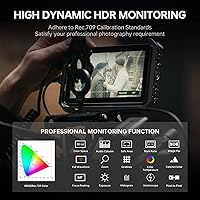
  • False color, waveform, and peaking tools are accurate enough to catch exposure issues before they become edit problems.
  • Three power input options mean you can adapt to almost any shooting situation without carrying a dedicated adapter.
  • The wide IPS viewing angle lets a director standing off-axis still get an accurate read on the frame.
  • Touchscreen control is responsive enough for on-the-fly adjustments without interrupting a take.

Cons

  • 4K HDMI input is capped at 30Hz, making it unsuitable for high-frame-rate monitoring workflows.
  • SDI tops out at 1080p 60Hz, which will frustrate shooters expecting full SDI bandwidth.
  • The LUT import process requires correct file formatting and folder structure — it is not plug-and-play.
  • Menu navigation has a learning curve that takes a dedicated session to work through properly.
  • The included NP-F550 battery runs short on longer shooting days without a spare on hand.
  • Sunshade hood attachment loosens with repeated removal and reattachment over time.
  • USB-C power delivery only triggers with specific voltage and current requirements — not every bank will work reliably.
  • Color accuracy drifts slightly at peak brightness settings, which can mislead critical exposure decisions.
  • The mounting depth of the unit can make packing into tight camera bags more awkward than the weight suggests.
  • Audio monitoring is functional but shallow — not suitable for productions where audio needs serious attention.

Ratings

The VILTROX DC-X3 6″ Field Monitor has been evaluated by our AI rating system after processing verified buyer reviews from global markets, with spam, bot-generated, and incentivized feedback actively filtered out. The scores below reflect a transparent synthesis of real-world strengths and recurring frustrations — nothing is smoothed over to flatter the product. Whether this on-camera monitor fits your workflow depends heavily on how you shoot, and those nuances are captured in each category.
Brightness & Outdoor Visibility
93%
This is where the DC-X3 genuinely earns praise. Buyers shooting in open fields, on beaches, or in direct afternoon sun report that the display stays readable without needing to duck under a jacket. For run-and-gun operators who move between shaded interiors and bright exteriors, the high-nit panel removes a constant friction point.
A small number of users note that sustained maximum brightness generates noticeable warmth on the unit over long shooting days. In extreme desert or high-altitude environments where ambient light is exceptional, even this brightness level can feel marginal for critical focus work.
Build Quality & Durability
81%
19%
For the price tier, the physical construction feels more substantial than many rivals. The casing has a solid, slightly rubberized feel that inspires confidence on a rig, and buyers report it surviving the bumps of regular location shooting without visible damage or loose ports.
A few users have flagged that the mounting points feel less confidence-inspiring under heavier cage setups, and the port area shows wear after extended field use. It is not fragile, but it is not ruggedized either — anyone working in genuinely harsh conditions should factor that in.
Touchscreen Responsiveness
78%
22%
Most buyers are pleasantly surprised by how well the touchscreen performs, particularly when adjusting brightness or pulling up monitoring overlays mid-shoot. The interface is responsive enough that you are not fighting the display when time is tight on set.
The touchscreen is less reliable with cold hands or gloves, which matters for outdoor winter shooters. Some users also report occasional missed taps in the menu edges, requiring two attempts — a minor annoyance that adds up during fast-paced production days.
Image Accuracy & Color Fidelity
74%
26%
The Rec.709 calibration is solid enough that exposure and white balance decisions made on this monitor hold up reasonably well in post. Colorists working on smaller productions report that the display gives a usable preview of graded log footage when a proper LUT is loaded.
This is not a reference monitor, and users with calibrated post-production setups notice the gap. Colors can skew slightly warm at higher brightness settings, and the contrast behavior in deep shadows is not as nuanced as on professional broadcast displays costing significantly more.
4K & SDI Connectivity
69%
31%
Having both 4K HDMI and 3G-SDI loop-in and loop-out in a monitor at this price point is genuinely useful on hybrid sets. Owners of cinema cameras with SDI outputs particularly appreciate not needing a separate converter or a more expensive monitor to access that signal.
The 4K HDMI input caps at 30Hz, which is a real limitation for anyone shooting high-frame-rate content or monitoring slow-motion setups. The SDI port tops out at 1080p 60Hz, so it is not a substitute for a proper broadcast SDI chain — buyers expecting full 4K SDI capability will be disappointed.
3D LUT Support
76%
24%
Loading a custom LUT via USB drive and watching log footage transform on set is a workflow upgrade that buyers coming from monitors without this feature notice immediately. It reduces the guesswork of shooting in flat profiles and helps directors and clients see a closer approximation of the final look.
The import process is not intuitive the first time around, and several users report needing to consult the manual or online forums to get the file format and folder structure right. There is also no onboard LUT management beyond basic switching, which limits flexibility mid-shoot.
Monitoring Tools (Waveform, Vectorscope, False Color)
83%
The suite of exposure and focus tools available here is genuinely above average for the price. False color is accurate enough to nail skin tone exposure without a separate light meter, and the waveform display is clean and responsive enough to catch clipping before it becomes a problem in the edit.
Overlaying multiple tools simultaneously can clutter the display on a 6-inch screen, making fine image assessment harder. Some users wish the peaking highlight colors were more customizable, as the default options do not always stand out clearly against all backgrounds or color palettes.
Power Flexibility
88%
Three distinct power input options — NP-F battery, DC barrel, and USB-C — make this monitor genuinely adaptable across different shooting environments. Buyers who already own NP-F batteries for other gear can standardize their power kit, and the USB-C input means a large portable charger can keep the monitor running off-grid.
The included NP-F550 battery is on the smaller end of the NP-F family, giving a runtime that some users find insufficient for longer shooting days without a spare. The USB-C power draw requirement is specific enough that not every USB-C cable or bank will trigger it reliably.
Included Accessories
86%
The kit that ships with this on-camera monitor is refreshingly complete. A hard-shell carry case, sunshade hood, screen protector, and multiple cables all included means buyers can be on a shoot the same day the package arrives without a separate accessories run.
The sunshade hood, while functional, attaches with a friction fit that loosens over time with repeated removal. The cold shoe adapter included in the box is basic, and shooters with more complex rig configurations will likely replace it with a dedicated mounting solution fairly quickly.
On-Set Workflow Efficiency
82%
18%
The four programmable shortcut keys are a small feature that pays off consistently in practice. Being able to map your most-used tools to single-press buttons rather than navigating nested menus means this field monitor keeps pace with fast-moving shoots rather than slowing them down.
The default key assignments take time to reprogram, and the process requires navigating a menu structure that is not the most logically laid out. New users should expect a learning session before the workflow benefits kick in rather than assuming everything will be intuitive from day one.
Menu Usability
63%
37%
Once learned, the menu structure covers a wide range of settings and is accessible directly from the touchscreen without needing to hunt for physical buttons. Experienced monitor users will find the logic familiar enough to work through it without the manual.
First-time users of dedicated field monitors consistently mention the menu as a sticking point. Categories are not always where you expect them, some settings are buried several layers deep, and the English translations in the interface occasionally feel awkward — a sign of the product's Chinese manufacturing origins that more polishing could address.
Weight & Portability
89%
At 350 grams, this on-camera monitor sits comfortably on a mirrorless or DSLR rig without creating serious balance issues. Shooters who hand-hold or operate from a shoulder mount for extended periods particularly appreciate that the added weight does not fatigue the arm over a full shooting day.
The monitor body, while compact in weight, is not the slimmest in its class depth-wise. Packed into a tight camera bag alongside lenses and bodies, the extra centimeter of depth can be a genuine logistical challenge, especially when combined with the attached sunshade hood.
Value for Money
91%
Across hundreds of verified reviews, the value assessment is the most consistently positive data point. Buyers repeatedly note that the combination of brightness, professional monitoring tools, connectivity options, and included accessories would have cost significantly more from competing brands even a few years ago.
Value is always relative to expectations, and buyers who approach this as a budget path to broadcast-quality monitoring will eventually notice the gaps. The 30Hz 4K ceiling and the color accuracy limitations become more apparent the more demanding the production context gets.
Audio Monitoring
61%
39%
Having a 3.5mm headphone jack on a field monitor at this size is a practical addition that lets operators confirm audio levels without pulling a separate recorder. It handles basic on-set audio checks adequately for most ENG and documentary-style productions.
The audio monitoring capability is functional but thin — there are no advanced audio tools beyond the basic column meter visible on screen. Operators working on productions where audio is critical will still want dedicated audio monitoring hardware rather than relying on this for anything beyond a quick sanity check.

Suitable for:

The VILTROX DC-X3 6″ Field Monitor is a strong match for solo videographers and small documentary crews who spend meaningful time shooting outdoors and need a display that actually holds up in sunlight without improvising a shade tent. If you shoot log footage and want to preview a corrected look on set rather than guessing in post, the onboard 3D LUT support makes that possible without adding another device to your kit. Content creators who regularly move between indoor and outdoor locations will appreciate the flexible power setup — being able to run off a USB-C battery bank is a genuine convenience when you are far from a wall outlet. The included accessory bundle means photographers transitioning into video work can be up and running immediately, without a secondary accessories order. Small narrative crews where an AC and a director both need to see the feed will find the SDI loop-out particularly useful for tethering a second monitor without a signal splitter.

Not suitable for:

Buyers who primarily shoot high-frame-rate content — slow motion at 60fps or above — will quickly run into the hard ceiling on the HDMI input, which tops out at 4K 30Hz; for that use case, this on-camera monitor simply is not the right tool. Colorists or directors of photography who need a display they can genuinely trust for critical color decisions should be aware that this field monitor, while well-calibrated for its tier, is not a substitute for a proper reference display. If your camera outputs 6K or higher and you want to monitor that resolution natively, you will not find it here — the panel resolves at 1080p regardless of the incoming signal. Broadcast professionals who rely on full-bandwidth SDI workflows will also find the 3G-SDI implementation limiting compared to higher-end options. Anyone working in genuinely extreme environments — sustained rain, heavy dust, or severe cold — should note that this is not a ruggedized unit and the build, while solid, was not designed for harsh field abuse.

Specifications

  • Screen Size: The display measures 6 inches diagonally with a 16:9 aspect ratio, providing enough screen real estate for comfortable on-set monitoring without adding excessive bulk to a rig.
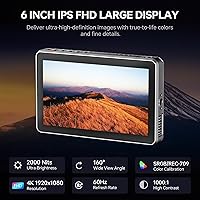
  • Panel Type: An IPS touchscreen panel is used, delivering consistent color and contrast across a 160-degree viewing angle — both horizontally and vertically.
  • Resolution: The native panel resolution is 1920x1080 pixels (Full HD), which applies to all input signals regardless of source resolution.
  • Peak Brightness: Maximum rated brightness reaches 2000 cd/m² (nits), making the display usable in direct outdoor sunlight without a blackout shade.
  • Contrast Ratio: The panel has a 1000:1 contrast ratio, providing clear differentiation between highlight and shadow detail under typical shooting conditions.
  • Color Standards: Factory calibration covers sRGB and Rec.709 color spaces, suitable for standard video production and broadcast-aligned monitoring workflows.
  • HDMI Input: One full-size HDMI input accepts signals up to 4K (3840x2160 and 4096x2160) at up to 30Hz, with a corresponding HDMI loop-out port for chaining to a second display or recorder.
  • SDI Connectivity: One 3G-SDI input and one 3G-SDI output support video signals up to 1080p at 60Hz, compatible with cinema cameras and broadcast equipment using BNC connectors.
  • Audio Output: A 3.5mm stereo headphone jack allows real-time audio monitoring directly from the incoming video signal.
  • LUT Support: Custom 3D LUTs can be imported from a USB drive via the USB-A port, enabling on-set log footage preview in any corrected or creative look.
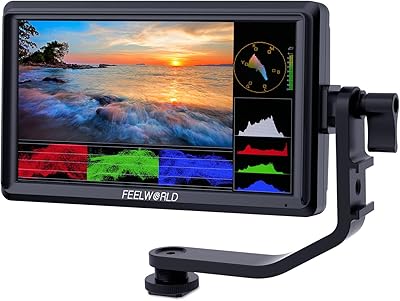
  • Monitoring Tools: Built-in professional tools include waveform parade, oscilloscope (Y), vectorscope, brightness histogram, false color, focus peaking, and audio level columns.
  • Shortcut Keys: Four physical shortcut keys (F1 through F4) are fully user-assignable, allowing one-press access to the monitoring functions used most frequently.
  • Battery: The monitor accepts NP-F series lithium-ion batteries and ships with one NP-F550 battery included in the box.
  • Power Input: In addition to NP-F battery power, the monitor accepts DC 12–18V via barrel connector and USB-C input at a minimum of 9V with 3A current output.
  • Monitor Weight: The monitor body alone weighs 350 grams (approximately 12.3 oz), excluding battery, hood, and mounting accessories.
  • Dimensions: The monitor body measures 155.4 x 98.4 x 30mm (approximately 6.1″ x 3.9″ x 1.2″), with a compact footprint suited for on-camera and cage mounting.
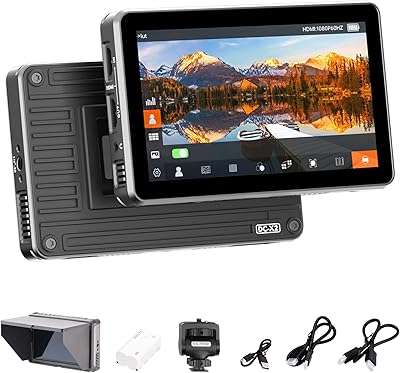
  • In-Box Accessories: Package includes the monitor, NP-F550 battery, sunshade hood, cold shoe adapter, Type-C cable, full-size HDMI cable, mini HDMI cable, screen protector, and a hard-shell carry case.
  • Heat Management: Active cooling is built in with automatic fan control plus three manual speed settings to manage heat during extended high-brightness use.

Related Reviews
VILTROX DC-X2 6-inch Field Monitor
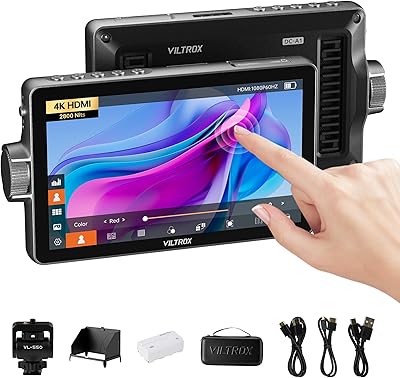
80%
93%
Outdoor Brightness
78%
Build Quality
71%
Touchscreen Responsiveness
67%
Color Accuracy
84%
3D LUT Support
More
VILTROX DC-A1 7-inch Field Monitor
86%
94%
Brightness Performance
90%
Display Clarity
85%
Touchscreen Responsiveness
88%
Portability
75%
Build Quality
More
VILTROX DC-L2 7″ 4K Camera Field Monitor
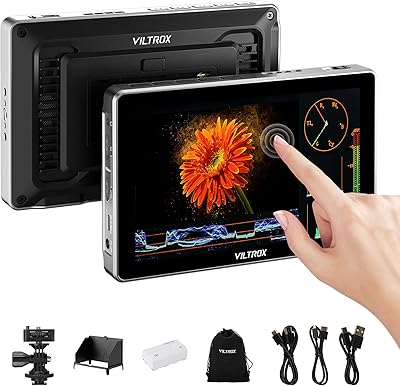
86%
93%
Display Quality
89%
Portability
70%
Battery Life
85%
Ease of Use
88%
Build Quality
More
VILTROX DC-L1 7-Inch Touchscreen Camera Field Monitor
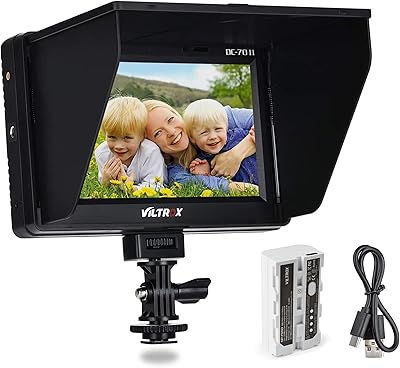
87%
93%
Display Quality
89%
Portability
85%
Power Options
91%
Sunshade Effectiveness
88%
Ease of Use
More
VILTROX DC-70 II 7″ Field Monitor
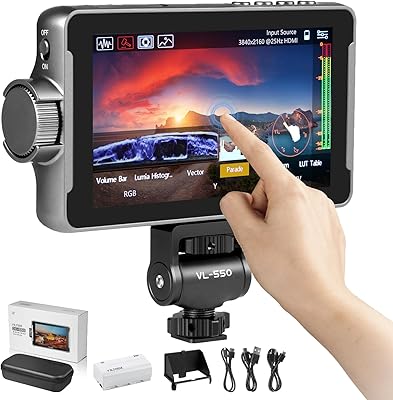
75%
88%
Value for Money
83%
Focus Peaking Performance
61%
Display Resolution & Sharpness
78%
Build Quality & Durability
74%
HDMI Connectivity
More
VILTROX DC-550 Pro 5.5-inch Touch Screen DSLR Camera Field Monitor
85%
89%
Brightness & Visibility
93%
Portability & Design
87%
Ease of Use & Touchscreen
78%
Color Accuracy & Calibration
85%
Build Quality
More
FEELWORLD FW568 6″ Field Monitor
77%
88%
Image Clarity & Sharpness
84%
Color Accuracy
91%
LUT Support & Preview
87%
Exposure & Focus Assist Tools
63%
Brightness & Outdoor Usability
More
FEELWORLD F5 Pro 6″ Field Monitor
78%
84%
Display Quality
79%
Touchscreen Responsiveness
86%
Color Accuracy & Calibration
88%
Monitoring Tools
67%
Build Quality & Durability
More
Topmonitor P15.6/2.5K Portable Monitor 15.6-inch 2560×1680
86%
94%
Display Quality
90%
Portability/Size/Weight
91%
Color Accuracy
87%
Connectivity (USB-C, HDMI)
85%
Build Quality
More
Upperizon 15.6″ Portable Monitor
86%
88%
Display Quality
93%
Portability
85%
Color Accuracy
90%
Ease of Setup
92%
Connectivity
More

FAQ

It accepts 4K signals over HDMI, but the input is capped at 30Hz — so if your camera outputs 4K at 60fps, the monitor either will not display it or will drop to a compatible mode. For most documentary and narrative work shot at 24 or 25fps in 4K, you will have no issues at all.

Yes, the 3G-SDI input is compatible with cinema cameras that output over BNC, including popular options like the Blackmagic Pocket Cinema Camera and Sony FX series. Just keep in mind the SDI port supports up to 1080p at 60Hz — it does not carry 4K SDI signals, so check your camera output settings accordingly.

You need a USB-A flash drive formatted to FAT32 with your LUT files placed in a folder the monitor can recognize — the exact folder name and file format (.cube is standard) should be confirmed in the manual, as the import process is specific. Once set up correctly, you select the LUT through the monitor menu and it applies in real time to whatever signal is coming in. It is not complicated once you have done it once, but the first attempt usually takes a bit of troubleshooting.

Yes, the HDMI loop-out passes the incoming signal to a second display without any processing delay, making it practical for small productions where a client or director needs their own screen. You can daisy-chain a larger monitor or a recorder simultaneously, which is one of the more useful aspects of having both loop-in and loop-out on the same unit.

The included NP-F550 is a smaller-capacity battery in the NP-F family, and real-world runtime at moderate brightness is roughly one to two hours depending on your settings. If you are shooting longer days, picking up one or two higher-capacity NP-F batteries like the NP-F750 or NP-F970 is a straightforward upgrade that buys you considerably more time between swaps.

You can, but the USB-C input requires a power bank that outputs at least 9V with 3A — standard 5V USB banks will not work. Most modern 45W or higher USB-C PD power banks will meet this requirement, but it is worth checking the output specs of your bank before relying on it in the field.

Not reliably. The touchscreen uses a standard capacitive panel that requires bare skin contact, so it does not respond consistently to gloves. For cold-weather shooting, the four physical shortcut keys become especially useful since they work regardless of what you are wearing on your hands.

The hood attaches via a friction fit rather than a locking mechanism, which works fine for most shooting situations but does loosen over time with repeated attachment and removal. For handheld or highly mobile shooting, it is worth checking the fit before each shoot rather than assuming it will stay locked in place.

The audio column meters on screen reflect whatever audio is embedded in the incoming HDMI or SDI signal. If your camera or recorder is passing audio through that signal, yes — you will see levels on the monitor. If the signal carries no audio, the meters will simply show nothing, so it depends on your specific camera and cable setup.

It is not designed for those use cases. The monitor has no USB video input and accepts only HDMI and SDI signals, so it cannot connect to a laptop as a secondary display via USB-C or DisplayPort. Teleprompter use is theoretically possible if you run an HDMI signal into it, but the lack of dedicated software support and the landscape-oriented form factor make it a poor fit for that application.