Overview

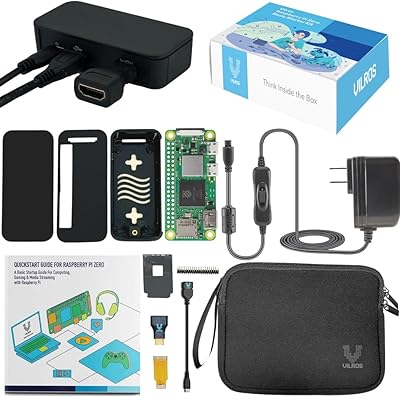
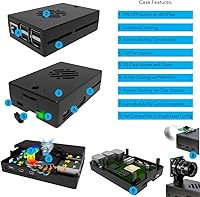
The Vilros Raspberry Pi 5 4GB Starter Kit positions itself as a genuine one-stop entry into the Pi 5 world — not just a board tossed in a box, but a nine-component bundle assembled with real usability in mind. Vilros is an approved reseller, which matters when you want confidence that you are getting legitimate hardware. The aluminum black case with its dual cooling setup immediately sets this apart from bare-board alternatives. Sitting at a mid-range price point, this all-in-one Pi bundle targets newcomers who do not want to hunt down accessories separately, as well as experienced makers returning to a new generation. This review focuses on how it holds up in actual use, not just on paper.

Features & Benefits

The heart of this Pi 5 starter kit is the Broadcom BCM2712 processor — a quad-core Arm Cortex-A76 running at 2.4GHz. That is a meaningful leap over the Pi 4 in day-to-day responsiveness: web browsing, compiling code, and running lightweight desktops all feel noticeably snappier. The 4GB of LPDDR4X RAM handles the vast majority of typical workloads comfortably, though power users eyeing Docker stacks or heavier multitasking should consider the 8GB variant. The metal case features a built-in thermal column contacting the main chip directly, and the PWM fan only spins up when temperatures demand it, so background noise is rarely an issue. The preinstalled OS on the 32GB card means you are up and running within minutes, and dual-band Wi-Fi plus Bluetooth 5.0 are built in — no adapters necessary.

Best For

This all-in-one Pi bundle is an especially strong fit for first-time Pi buyers who want everything in one shipment rather than piecing together a compatible power supply, case, and card on their own. Educators setting up small lab environments will appreciate the included quickstart guide and preloaded OS — two fewer hurdles to clear. Hobbyists building media centers, home servers, or lightweight network tools will find 4GB of RAM adequate for those workloads. Makers who want to attach HAT accessories should note that the case supports a single-layer configuration for that exact purpose. It also works well as a thoughtful gift option, particularly with a one-year manufacturer warranty included to back the purchase.

User Feedback

With a 4.6 out of 5 rating across more than 130 buyers, the Vilros kit earns its marks largely through consistency. Reviewers frequently highlight how smooth the initial setup is and how unobtrusive the cooling fan behaves in practice — it does not create constant background noise, which is a real-world concern many kits ignore. Case build quality earns genuine praise, not filler compliments. On the critical side, some users running memory-intensive tasks hit the 4GB ceiling sooner than expected, and a handful note the included microSD card, while convenient, is not the fastest available. The neoprene storage bag draws quiet appreciation as an unexpected bonus. Most buyers agree the warranty and reseller credentials add meaningful peace of mind.

Pros

  • Nine included components cover nearly every setup need, saving real time and compatibility guesswork.
  • The PWM fan only spins when temperatures actually rise, keeping the kit quiet during light everyday use.
  • Raspberry Pi OS comes preloaded on the microSD card, so first boot happens in minutes, not after a flashing session.
  • The aluminum alloy case makes a meaningful thermal difference versus a bare board or plastic enclosure.
  • Dual-band Wi-Fi and Bluetooth 5.0 are built in, so no USB dongles are needed for wireless connectivity.
  • The single-layer case configuration lets makers attach HAT accessories without replacing the enclosure.
  • Vilros is an approved reseller, which reduces the risk of counterfeit or gray-market Pi 5 boards.
  • A one-year manufacturer warranty adds a layer of confidence rarely seen with third-party Pi bundles.
  • The included HDMI and camera adapter cables are small additions that save a separate order for most new users.
  • The neoprene storage bag is a minor but genuinely useful bonus for makers who move their setup between locations.

Cons

  • 4GB of RAM becomes a real constraint if workloads grow beyond moderate multitasking or containerized applications.
  • The included microSD card is functional but not fast enough for storage-intensive or performance-critical projects.
  • PCIe expansion requires a separate adapter, so the headline connectivity feature adds extra cost to unlock fully.
  • No keyboard, mouse, or display is included, which can catch completely new buyers off guard.
  • The bundle premium may feel unnecessary for experienced users who already own most of these accessories.
  • Power over Ethernet is not supported natively, limiting certain always-on networking deployment scenarios.
  • The neoprene bag, while a nice touch, is not a substitute for a proper carry case if portability is a regular need.
  • Camera module support requires the included adapter cable, adding a small but fiddly step for photography projects.

Ratings

The Vilros Raspberry Pi 5 4GB Starter Kit scores here are generated by AI after analyzing verified global buyer reviews, with spam, bot activity, and incentivized feedback actively filtered out. The result is an honest breakdown that surfaces both what this all-in-one Pi bundle genuinely excels at and where real buyers have run into friction. Nothing has been smoothed over — the scores reflect the full picture.

Ease of Setup
92%
Buyers consistently describe the initial setup as one of the smoothest Pi experiences they have had — the preloaded microSD card means you skip the flashing step entirely, and the Vilros quickstart guide walks absolute beginners through the first boot without assuming prior knowledge. Most users report being at a working desktop within fifteen minutes of opening the box.
A small number of reviewers noted that the quickstart guide does not go deep enough for users who want to move beyond the default OS configuration, leaving intermediate users to seek documentation elsewhere. Keyboard, mouse, and display are also not included, which occasionally catches first-time buyers off guard.
Cooling Performance
89%
The dual passive-active cooling setup earns real praise in extended-use scenarios — the aluminum thermal column keeps the chip from hitting throttle temperatures during light and moderate workloads, and the PWM fan only kicks in when necessary, which keeps the setup quiet on a desk. Users running home servers report stable temperatures over long periods without manual intervention.
Under sustained heavy loads such as continuous video encoding or prolonged compilation jobs, the fan can ramp up noticeably and some users found the noise more distracting than expected at higher RPMs. A small number of users building compact enclosures also noted airflow can be restricted if the kit is placed in a confined space.
Build Quality
91%
The metal and aluminum alloy case consistently draws positive remarks for feeling substantially more premium than the plastic enclosures common in competing Pi kits. Buyers appreciate that the case contributes functionally to thermal management rather than just serving as a protective shell, and the integrated power button with LED indicator is a thoughtful detail that adds everyday convenience.
A few reviewers noted that assembly of the case layers requires patience and careful alignment, particularly when seating the thermal pad correctly on the chip. Minor fit-and-finish issues — such as slightly uneven panel alignment — were occasionally mentioned but were not considered dealbreakers by most users.
Value for Money
84%
For buyers starting from scratch, the bundle math works out favorably — sourcing a compatible case, power supply, preloaded microSD, and adapter cables separately often adds up to more than the premium over a bare board. The inclusion of a one-year warranty and approved-reseller status adds intangible value that budget alternatives rarely offer.
Experienced Pi users who already own accessories will find the bundle pricing harder to justify, since they are effectively paying for components they do not need. The microSD card included is not a high-performance unit, which some buyers feel is a missed opportunity at this price point.
RAM Adequacy
74%
26%
For the target audience — home servers, media centers, retro gaming, lightweight desktops, and automation scripts — 4GB handles everyday workloads without any perceptible strain. Users running Pi-hole, Plex in a lightweight configuration, or RetroPie report smooth performance with headroom to spare.
The 4GB ceiling becomes genuinely limiting for users who migrate toward more ambitious workloads over time, such as running multiple Docker containers, compiling large codebases, or using the board as a daily driver with many browser tabs open simultaneously. Several reviewers explicitly recommended the 8GB variant for anyone with even moderate multi-tasking ambitions.
Component Completeness
88%
Nine components in a single purchase eliminates the most tedious part of setting up a new Pi — the compatibility research and multi-vendor ordering. The inclusion of both the HDMI adapter cable and the camera module adapter cable is a particularly practical touch that most competing kits skip, covering connection scenarios that trip up new users regularly.
The absence of input peripherals and a display means this is not a fully self-contained computer kit, and buyers who expected otherwise have occasionally left disappointed reviews. A higher-capacity or faster microSD card would also make the bundle feel more complete at this price tier.
Fan Noise Level
83%
Under typical loads the fan is nearly inaudible, which users working in quiet home office environments specifically appreciate. The PWM behavior means the fan does not run at a constant flat speed, so it avoids the low-level drone that plagues always-on cooling solutions in competing kits.
At peak RPMs during demanding tasks, the fan is audible enough to be distracting in a quiet room, and a handful of buyers noted this was more noticeable than the product description implied. Users who specifically need silent operation under all conditions should factor this in.
Wireless Connectivity
86%
Dual-band 802.11ac Wi-Fi performs reliably across both 2.4GHz and 5GHz bands, with users reporting stable connections during continuous data transfer tasks like streaming and remote desktop sessions. The absence of any required dongle keeps the build clean and frees up USB ports for other peripherals.
Gigabit Ethernet remains the preferred option for latency-sensitive or bandwidth-heavy applications, and users who need wired reliability in server deployments will want to use the onboard Ethernet port rather than rely on Wi-Fi. There is no Power over Ethernet support, which limits certain always-on networking use cases.
Storage Speed
61%
39%
The included 32GB microSD card is perfectly adequate for casual use — booting the OS, running scripts, and storing small projects all work without issue. For a beginner getting started for the first time, the preloaded card removes a meaningful friction point from the setup process.
The card is not a high-speed unit, and users who run databases, record video, or perform frequent read-write operations will notice the bottleneck fairly quickly. Several reviewers replaced the included card with a faster alternative within weeks of purchase, which raises a fair question about the value of this specific component in the bundle.
PCIe Expandability
72%
28%
The presence of a PCIe 2.0 x1 interface on the Pi 5 board opens up genuine storage expansion possibilities — particularly NVMe SSDs — that were simply not available on earlier Pi generations, and technically minded buyers appreciate having this upgrade path available without switching boards.
Accessing the PCIe interface requires purchasing a separate HAT or adapter, which means the headline connectivity feature is not actually usable out of the box with this kit. Users expecting plug-and-play NVMe support are often surprised to discover the additional purchase required.
Warranty & Support
81%
19%
The one-year Vilros manufacturer warranty is referenced positively across buyer reviews as a meaningful differentiator from bare-board purchases or less reputable kit sellers. Buyers appreciate having a single point of contact for any component failure rather than chasing individual manufacturers for individual parts.
The warranty covers defects rather than accidental damage, so users who encounter issues through experimentation — a common occurrence in the maker community — may find coverage narrower than expected. Response time and claims experience are not widely documented in available reviews.
Case Thermal Design
87%
The integrated thermal column contacting the SoC directly via a thermal pad is a more engineered solution than the clip-on heatsinks common in budget kits, and sustained-load temperature readings from users confirm it makes a real difference. The passive element alone handles light workloads without the fan ever needing to engage.
Correct thermal pad placement during assembly is critical to performance, and users who do not seat it precisely may not get the full benefit of the passive cooling. A few buyers reported needing to reseat the pad after noticing higher-than-expected temperatures on first boot.
HAT Compatibility
78%
22%
The single-layer case configuration option is a genuinely thoughtful design decision that makes the Vilros kit more versatile than rigid enclosures that permanently block GPIO access. Makers building sensor arrays, display add-ons, or audio HATs can attach them without replacing the case entirely.
Switching between the single-layer and full-enclosure configurations requires partial disassembly, which is a minor but real inconvenience for users who frequently swap HATs during prototyping. The case does not accommodate taller or stacked HAT configurations when fully assembled.
Documentation Quality
79%
21%
The included Vilros quickstart guide is particularly effective for users who have never touched a Raspberry Pi before, covering the physical setup and first-boot configuration in plain language without assuming technical background. Multiple reviewers credit it with reducing the anxiety that typically comes with first-time SBC setup.
The guide does not extend much beyond initial setup, so users who quickly progress past the basics will need to rely on the broader Raspberry Pi community and documentation. For returning Pi users, the guide adds little value and feels oriented entirely toward a beginner audience.

Suitable for:

The Vilros Raspberry Pi 5 4GB Starter Kit is the right call for anyone who wants to get into the Pi 5 ecosystem without spending an afternoon tracking down compatible accessories. It particularly shines for first-time Pi buyers who would otherwise face the friction of sourcing a case, power supply, microSD card, and cables separately — only to discover compatibility headaches. Educators setting up a handful of machines for a classroom or workshop will appreciate that students can be up and running within minutes, not hours. Hobbyists building home servers, network-level ad blockers, retro gaming setups, or lightweight desktop environments will find 4GB of RAM genuinely adequate for those workloads. The HAT-compatible single-layer case configuration also makes this a practical choice for makers who plan to expand the board with add-on modules down the road. Gift buyers benefit from the complete, cohesive package — one box, one warranty, a quickstart guide, and nothing missing.

Not suitable for:

The Vilros Raspberry Pi 5 4GB Starter Kit is not the right fit for users who already own several Pi accessories and are simply upgrading the board itself — paying for a full bundle when you have a drawer full of cables and cards does not make financial sense. Power users planning to run demanding workloads such as large Docker environments, heavy compilation jobs, or multiple concurrent virtual machines will hit the 4GB RAM ceiling faster than they expect, and the 8GB variant is worth the extra cost in those scenarios. The included 32GB microSD card, while convenient, is not a high-speed card, so anyone building a performance-sensitive application or doing heavy read-write operations would likely want to swap in a faster card or use an NVMe drive via the PCIe interface instead. This all-in-one Pi bundle also does not include a keyboard, mouse, or monitor, so buyers expecting a fully ready desktop machine out of the box will need to budget for those separately. If wireless connectivity is not sufficient for your use case and you need a reliable wired Ethernet setup with a managed switch, the absence of Power over Ethernet support is worth noting upfront.

Specifications

  • CPU: The board is powered by a Broadcom BCM2712 quad-core 64-bit Arm Cortex-A76 processor running at 2.4GHz, delivering substantially faster single-core and multi-core performance compared to its Pi 4 predecessor.
  • RAM: 4GB of LPDDR4X-4267 SDRAM is soldered onboard, providing fast memory bandwidth suitable for desktop use, lightweight servers, and most hobbyist workloads.
  • GPU: The integrated VideoCore VII GPU supports Vulkan 1.2 and OpenGL ES, enabling hardware-accelerated graphics for media playback and basic 3D rendering tasks.
  • Storage: A 32GB microSD card with 64-bit Raspberry Pi OS preinstalled is included, allowing the system to boot without any additional setup steps.
  • Wireless: Dual-band 802.11ac Wi-Fi covers both 2.4GHz and 5GHz networks, and Bluetooth 5.0 with BLE support is included natively on the board.
  • Cooling: The aluminum alloy case incorporates a passive thermal column that contacts the main SoC directly via a thermal pad, supplemented by a PWM fan capable of up to 10,000 RPM that activates only when needed.
  • Case Material: The enclosure is constructed from metal and aluminum alloy, offering better heat dissipation and structural rigidity compared to standard plastic Pi cases.
  • Expansion: A PCIe 2.0 x1 interface is available on the board for connecting fast peripherals such as NVMe SSDs, though a separate adapter is required to use it.
  • Included Cables: The kit includes a standard HDMI to micro-HDMI adapter cable and a mini to standard camera module adapter cable to support display and camera connections out of the box.
  • Power Button: The case features an integrated power button that also reflects the onboard LED status, allowing clean shutdowns without hunting for the GPIO pins.
  • HAT Support: The case can be configured in a single-layer arrangement, exposing the GPIO header and making the board compatible with HAT add-on modules.
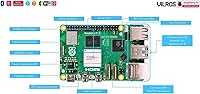
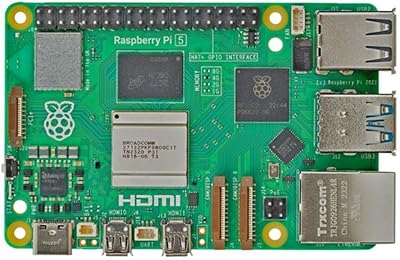
  • Connectivity Ports: The Raspberry Pi 5 board includes two USB 3.0 ports, two USB 2.0 ports, dual micro-HDMI outputs, a gigabit Ethernet port, and a dedicated PCIe connector.
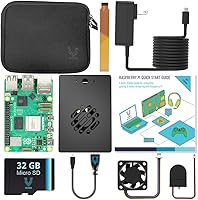
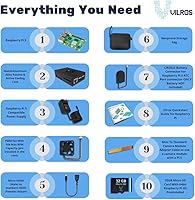
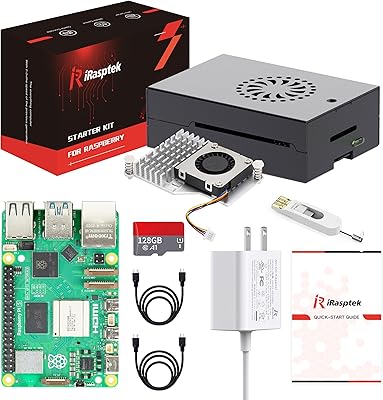
  • Bundle Contents: The kit ships with nine components in total: the Pi 5 board, aluminum case, power supply, PWM fan, 32GB microSD card, HDMI adapter cable, camera adapter cable, neoprene storage bag, and a Vilros quickstart guide.
  • Warranty: Vilros backs the kit with a one-year manufacturer warranty covering defects in materials and workmanship across all included components.
  • Package Weight: The complete retail package weighs 1.52 pounds, making it compact and straightforward to ship or carry to a classroom or workshop.
  • Package Dimensions: The retail box measures 8.62 x 6.38 x 3.46 inches, sized to fit all nine components securely without excessive packaging bulk.
  • Operating System: The included microSD card ships with the official 64-bit Raspberry Pi OS, which is the recommended and most widely supported operating system for this board.
  • Reseller Status: Vilros is an approved Raspberry Pi reseller, meaning the Pi 5 boards included in the kit are sourced through legitimate official channels.

Related Reviews
Vilros Raspberry Pi 4 4GB Starter Kit
81%
91%
Build Quality
88%
Thermal Management
84%
Ease of Setup
86%
Performance
89%
Power Supply Quality
More
Vilros Raspberry Pi 5 8GB Starter Kit
80%
93%
Ease of Setup
89%
Thermal Performance
91%
Build Quality
67%
Value for Money
88%
Cooling System Design
More
Vilros Raspberry Pi Zero 2 W Starter Kit
86%
91%
Value for Money
88%
Build Quality
85%
Setup & Installation
84%
Performance
90%
Accessories Included
More
Vilros Raspberry Pi 4 Starter Kit 8GB
82%
93%
Out-of-Box Readiness
88%
Value for Money
84%
Thermal Management
86%
Accessory Completeness
89%
Power Supply Quality
More
Raspberry Pi 5 8GB Starter Kit 64GB Edition
87%
88%
Performance
91%
Setup and Installation
83%
Cooling Efficiency
87%
Build Quality
92%
Value for Money
More
CanaKit Raspberry Pi 5 Starter Kit PRO (8GB RAM, 128GB)
87%
94%
Ease of Assembly
91%
Cooling Performance
93%
Processing Power & Speed
78%
Value for Money
96%
Multitasking Capability
More
iRasptek Raspberry Pi 5 Starter Kit 8GB RAM 128GB SSD Edition
85%
91%
Performance
88%
Build Quality & Durability
86%
Cooling & Thermal Management
94%
Ease of Setup
90%
Storage Speed & Reliability
More
CanaKit Raspberry Pi 5 Starter Kit MAX 16GB 256GB
83%
93%
Bundle Completeness
78%
Value for Money
81%
Thermal Management
67%
Storage Performance
94%
Power Supply Quality
More
Raspberry Pi 5 4GB
Raspberry Pi 5 4GB
82%
93%
CPU Performance
91%
Storage & Boot Speed
78%
Value for Money
67%
Thermal Management
74%
GPU & Graphics Capability
More
SunFounder Raspberry Pi Pico Starter Kit
88%
88%
Build Quality
94%
Component Variety
90%
Ease of Setup
92%
Instruction Clarity
89%
Programming Language Support
More

FAQ

Nearly everything. The Vilros Raspberry Pi 5 4GB Starter Kit includes the board, case, power supply, preloaded microSD card, and the necessary adapter cables, so you can connect it to a monitor and boot straight into Raspberry Pi OS. The one thing not included is a keyboard, mouse, and display — you will need to supply those separately.

For the majority of common use cases — browsing the web, running a home server, media playback, retro gaming, network tools, or learning to code — 4GB is genuinely sufficient. Where it starts to feel tight is when you are running multiple Docker containers simultaneously, doing heavy compilation work, or loading several memory-hungry browser tabs at once. If that describes your workload, the 8GB variant is worth the extra cost.

In practice, the fan is barely noticeable during light to moderate use because it only spins up when the board actually needs it. During typical desktop tasks or light server work, you will often not hear it at all. It can ramp up under sustained heavy load, but even then it is not particularly intrusive compared to a laptop fan.

Yes. The case supports a single-layer configuration that leaves the GPIO header accessible, so standard HAT modules can be attached without replacing the enclosure. Just be aware that stacking the case layers back fully will block HAT access, so you would need to plan your build accordingly.

The card is fine for everyday use and perfectly adequate for getting started. That said, it is not a high-performance card, so if you plan on running a database, doing heavy file operations, or anything that requires frequent read-write cycles, swapping to a faster microSD or using an NVMe SSD via the PCIe interface will make a noticeable difference.

The Raspberry Pi 5 board does have a PCIe 2.0 x1 interface that supports NVMe drives, but you will need a separate HAT or adapter to physically connect one — it is not included in this bundle. It is a legitimate upgrade path for users who want faster storage or larger capacity down the line.

The included Vilros power supply is designed specifically for the Pi 5 and meets its power requirements. Using an underpowered supply is one of the most common causes of instability on Pi boards, so having a properly rated one in the kit is a genuine practical advantage over buying a random third-party charger.

Yes, a mini to standard camera module adapter cable is included precisely for this purpose, since the Pi 5 uses a different camera connector size than older models. You will still need to purchase a compatible camera module separately, but the adapter means you are not immediately blocked from using one.

It is a soft protective pouch for storing or transporting the kit — useful if you bring your Pi 5 bundle to a school, makerspace, or friend's place regularly. It is not a rigid carry case, so do not expect hard-shell protection, but it does keep cables and components from getting scratched or tangled in transit.

The guide walks through the initial setup steps in plain language — connecting everything, first boot, and basic configuration — so you are not left staring at a blank screen wondering what to do. It is not a comprehensive programming manual, but it is genuinely helpful for getting past the first-time setup anxiety that stops a lot of beginners cold.

Where to Buy