Overview

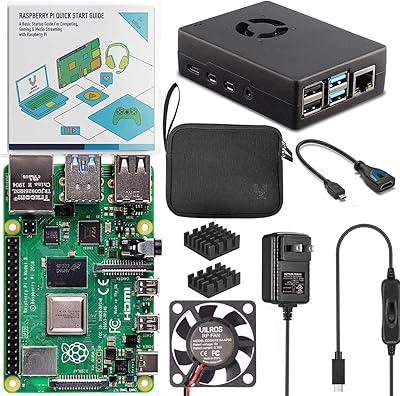
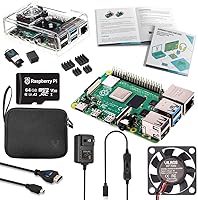
The Vilros Raspberry Pi 4 Starter Kit 8GB takes the frustration out of piecing together a compatible accessory list by shipping everything you need in one box — nine components, no guesswork. The 8GB RAM variant sits at the top of the Pi 4 memory lineup, which matters if you plan to run a media server, a lightweight desktop, or multiple services simultaneously. The transparent case looks sharp and the preloaded 64GB SD card means the board boots straight into Raspberry Pi OS without any flashing required. Just keep in mind this all-in-one Pi setup does not include a keyboard, mouse, or monitor — you will need those before anything lights up on screen.
Features & Benefits

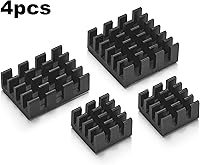
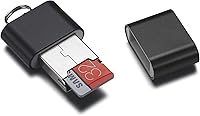
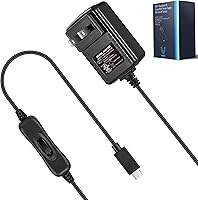
Thermal management is handled on two fronts: the fan built into the transparent case keeps airflow moving during sustained workloads, while four adhesive heatsinks handle spot cooling on the board itself. The power supply includes an inline on/off switch, a detail that sounds minor until you realize how many bare Pi kits leave you yanking the cable to power down. A 5-foot micro HDMI to HDMI cable and a microSD-to-USB adapter are tucked in as well, covering the two connectivity gaps that catch newcomers off guard. The neoprene bag holding all nine pieces is a thoughtful touch for anyone using the Vilros starter bundle in a classroom or carrying it between locations.

Best For

This Pi 4 kit makes the most sense for buyers who want to skip the compatibility research entirely — especially first-timers who have never flashed an SD card or hunted down a Pi-specific power supply. It also works well for educators running STEM programs, since buying kits in bulk sidesteps the per-student parts headache. On the more experienced side, the 8GB of RAM gives real breathing room for running a home media server, a lightweight desktop environment, or even experimenting with Docker containers. Gift buyers will appreciate that the box arrives complete and presentable rather than requiring the recipient to track down three more items before they can start.

User Feedback

Owners of this all-in-one Pi setup consistently highlight two standouts: the ready-to-boot SD card and the inline power switch, both of which appear in reviews far more than the case or cables. The fan draws some criticism — it is audible in a quiet room, which becomes noticeable if you park the board on a desk rather than in a rack or cabinet. The QuickStart guide earns solid marks from complete beginners but thinner praise from hobbyists already comfortable with Linux. A small group wished the case came in an opaque or aluminum finish, though the transparent look has its admirers. Most agree the bundle holds its own against assembling equivalent components individually.

Pros

  • The preloaded 64GB SD card means first boot happens in minutes, not after an OS-flashing session.
  • An inline power switch on the supply is a practical detail most budget Pi kits skip entirely.
  • Active fan cooling plus four heatsinks keeps the board stable under sustained, demanding workloads.
  • Nine components in one purchase eliminates compatibility guesswork for first-time buyers completely.
  • The neoprene storage bag makes this a genuinely portable kit for classrooms and makerspaces.
  • Built-in dual-band Wi-Fi and Bluetooth work out of the box on a fresh OS install with zero setup.
  • 8GB of LPDDR4 RAM provides real headroom for running multiple services or a full desktop environment.
  • The included micro HDMI cable prevents the common first-timer mistake of grabbing the wrong connector type.
  • Bundle pricing competes favorably against sourcing equivalent components individually from separate vendors.
  • The transparent case gives clean access visibility to ports and the board without tools.

Cons

  • Fan noise is continuous and noticeable in quiet environments — not loud, but impossible to ignore at a desk.
  • No keyboard, mouse, or monitor included, which surprises buyers who expected a plug-and-play experience.
  • The QuickStart guide runs out of useful content quickly, leaving intermediate users to find their own resources.
  • The plastic case feels lightweight and may disappoint users wanting a sturdier aluminum or premium enclosure.
  • The stock SD card is not rated for high-endurance use, making it a weak link in 24/7 server deployments.
  • A 5-foot HDMI cable limits display placement flexibility for wall-mounted or cabinet-installed setups.
  • Buyers who already own compatible accessories pay for redundant components with no option to customize the bundle.
  • The Pi 4 platform is no longer the newest generation, which may concern buyers focused on long-term software support cycles.

Ratings

The Vilros Raspberry Pi 4 Starter Kit 8GB has been evaluated by our AI rating system after analyzing thousands of verified global purchases, actively filtering out incentivized reviews, duplicate submissions, and bot-generated feedback. Scores reflect where this all-in-one Pi setup genuinely excels and where real buyers have hit friction — no airbrushing. Both the standout strengths and the recurring frustrations are transparently baked into every number below.
Out-of-Box Readiness
93%
The preloaded SD card is the single detail buyers mention most — plug in power, connect a display, and the board boots into Raspberry Pi OS without touching a computer first. For first-timers who have never flashed an image, that alone removes the steepest early hurdle.
Out-of-box readiness still hits a wall quickly: you need your own keyboard, mouse, and monitor before anything is usable, and that gap surprises a meaningful share of buyers who expected a fully self-contained experience.
Value for Money
88%
Reviewers who priced out the individual components — board, case, SD card, power supply, cables — consistently found the bundle competitive or cheaper than assembling equivalent parts separately. The 8GB RAM tier makes that math even more favorable given its premium positioning.
Budget-focused buyers occasionally note that the per-unit cost feels steep compared to bare-board pricing, especially if they already own some accessories. The value proposition is strongest for buyers starting from zero.
Thermal Management
84%
The combination of an active fan in the case lid and four adhesive heatsinks on the board gives this Pi setup real staying power under sustained loads. Users running media servers or emulation stations report stable temperatures without throttling over extended sessions.
The fan is audible — not loud, but noticeable in a quiet bedroom or study. A handful of users swapped it out for a quieter third-party fan, which suggests the stock fan prioritizes airflow over acoustic comfort.
Accessory Completeness
86%
Nine components in one purchase covers the non-obvious gaps that catch newcomers off guard — the micro HDMI cable, the microSD-to-USB adapter for reflashing, and the neoprene bag for storage are all items that rarely appear on a beginner's mental checklist.
The kit stops short of a complete desktop replacement since no input devices are included. For gift-givers or classroom purchasers, that missing trio (keyboard, mouse, monitor) requires a separate shopping trip that can frustrate recipients.
Power Supply Quality
89%
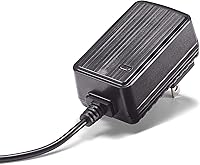
The inline on/off switch on the power cable is a small addition with a disproportionate impact on daily usability. Experienced Pi users know how many cheaper kits skip this entirely, forcing repeated cable-pulling that wears out the USB-C port over time.
A small number of users reported receiving a power supply with color variation from what was pictured, though function was unaffected. The cable length is adequate for most desk setups but can feel limiting if the outlet is positioned awkwardly.
Case Build Quality
78%
22%
The transparent case snaps together cleanly, sits firmly around the board, and shows off the Pi hardware in a way that enthusiasts genuinely appreciate. Access tabs for GPIO pins and ports are reasonably well-positioned for a budget-tier enclosure.
It is clearly a plastic case, not an aluminum or acrylic premium shell, and a small segment of users wished for something more robust or opaque. The snap-fit assembly is fine for stationary use but feels less confidence-inspiring for portable setups.
SD Card Performance
82%
18%
The 64GB card runs the preloaded OS without obvious bottlenecks for typical Pi workloads — web browsing, GPIO projects, and light server tasks all feel responsive. The included microSD-to-USB adapter means reflashing is straightforward if users want to try a different OS.
Enthusiasts pushing the card with heavy read/write workloads note it is not a high-endurance or application-class card, and long-term reliability under constant I/O stress (like a 24/7 Pi-hole or NAS) is a reasonable concern worth acknowledging.
Documentation & Guidance
74%
26%
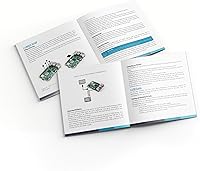
The Vilros QuickStart booklet covers first-boot steps clearly and is written specifically for the Pi 4 rather than recycled from older models. Total beginners consistently credit it for getting through the initial setup without needing to open a browser.
The guide runs out of runway fast — once past the first boot, intermediate users are on their own. It reads more like a setup pamphlet than a learning resource, which limits its value for anyone planning to do more than confirm the board powers on.
Cooling Noise Level
66%
34%
For users placing the Pi in a media cabinet, garage workshop, or office rack, the fan noise is essentially irrelevant. The airflow it provides is consistent and keeps the chip cool without requiring any software fan-curve configuration.
In quiet environments — a bedroom desk, a late-night coding setup, a classroom during independent work — the fan hum is a recurring complaint. It is not disruptive, but it is persistent enough that sensitive users will notice it within minutes.
Cable Quality & Length
77%
23%
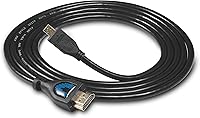
The 5-foot micro HDMI to HDMI cable is long enough to reach most monitor setups without looking cramped, and the connector feels solid on both ends. Having it included spares buyers from the common mistake of ordering a standard HDMI cable that simply will not fit the Pi 4.
A 5-foot cable works well on a desk but leaves little flexibility if the board is mounted behind a monitor or tucked into a media shelf. Users in unconventional setups occasionally wish for a longer cable option included in the box.
Board Performance (8GB Tier)
91%
The 8GB RAM variant handles multitasking workloads that would grind lower-memory Pi configs to a halt — running a full desktop environment alongside a few browser tabs and a background service is genuinely comfortable, not just technically possible.
The Broadcom quad-core processor is the real ceiling here, not the RAM. Users expecting desktop-PC responsiveness for video editing or compiling large codebases will run into CPU-bound limits before the memory becomes the bottleneck.
Portability & Storage
81%
19%
The neoprene bag that holds all nine components is far more useful than it sounds on paper. Educators moving kits between classrooms and hobbyists who bring their Pi setup to makerspaces appreciate having a single bag that keeps everything together without tangling cables.
The bag is a soft sleeve, not a rigid case, so it does not protect against drops or compression in a packed backpack. It is ideal for organized transport but not for anyone treating it as a true protective carry case.
Wireless Connectivity
83%
Built-in dual-band Wi-Fi and Bluetooth are part of the Pi 4 board itself, not add-ons, which means this kit connects to a 5GHz network and pairs Bluetooth peripherals without any extra hardware or driver headaches on a fresh OS install.
Wi-Fi performance is adequate for home and office environments but not exceptional. Users in signal-congested apartments or running latency-sensitive applications sometimes resort to a wired Ethernet connection instead, which requires an adapter not included in the kit.
Compatibility & Future-Proofing
79%
21%
The Pi 4 platform remains well-supported by Raspberry Pi OS updates and a large community, which means this hardware investment still has meaningful life ahead of it for most hobbyist and educational use cases.
The Pi ecosystem has moved forward since the Pi 4 launch, and buyers aware of newer Pi hardware generations may feel the Pi 4 is approaching the back half of its enthusiast relevance cycle, even if it remains functionally capable for most tasks.

Suitable for:

The Vilros Raspberry Pi 4 Starter Kit 8GB is the right call for anyone who wants to get into single-board computing without spending an afternoon cross-referencing compatible accessories on three different websites. First-time Pi buyers benefit most — the preloaded SD card and included cables mean the board can be up and running in under ten minutes, assuming a keyboard, mouse, and monitor are already on hand. STEM educators purchasing multiple units for a classroom will appreciate the consistent, repeatable setup experience that a standardized kit provides, rather than dealing with mismatched components across students. Hobbyists planning to run a home media server, a retro gaming station, or a lightweight Linux desktop will find the 8GB RAM headroom genuinely useful for those workloads. Gift buyers also land well here — the box arrives complete enough that the recipient can get started without a follow-up parts order, which is rarely true of bare-board Pi purchases.
Not suitable for:

The Vilros Raspberry Pi 4 Starter Kit 8GB is not the right fit for buyers who already own most of the accessories and just need the board itself — paying for a full bundle when half the contents will sit unused is a poor trade. Experienced makers who have strong preferences for specific case materials, high-endurance SD cards, or fanless passive cooling setups will likely find the included components adequate but not ideal, and may end up replacing parts shortly after unboxing. Anyone expecting a fully autonomous desktop experience out of the box will hit a wall fast: this all-in-one Pi setup still requires a separate keyboard, mouse, and monitor before it becomes functional. Users sensitive to ambient noise — those planning to place the board on a bedroom desk or in a quiet study — should factor in that the stock fan runs continuously and produces a low but persistent hum. Finally, buyers hoping for a powerful general-purpose computer for tasks like video editing, gaming, or running Windows applications will find the Pi platform itself, regardless of kit, is simply not designed for those workloads.
Specifications

  • RAM: The board ships with 8GB of LPDDR4 RAM, the highest memory configuration available in the Raspberry Pi 4 lineup.
  • Processor: A Broadcom BCM2711 quad-core Cortex-A72 processor runs at 1.5 GHz and handles the board's compute workloads.
  • Storage: A 64GB microSD card is included and arrives preloaded with Raspberry Pi OS, ready to boot without additional setup.
  • Cooling System: Thermal management combines an active fan integrated into the case lid with four adhesive-backed heatsinks applied directly to board components.
  • Power Supply: The included 5V USB-C power supply features an inline on/off switch and is rated for the Pi 4's power requirements.
  • Display Output: A 5-foot micro HDMI to standard HDMI cable is included to connect the board to any HDMI-compatible display.
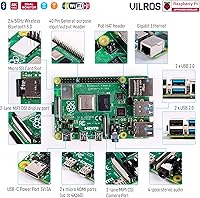
  • Wireless: Dual-band 802.11ac Wi-Fi and Bluetooth 5.0 are built into the Pi 4 board itself, requiring no external adapters.
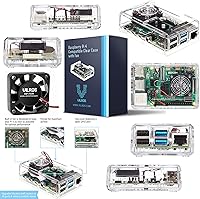
  • Case Style: The transparent plastic case accommodates the fan assembly in its lid and provides access cutouts for all major ports and the GPIO header.
  • SD Adapter: A microSD-to-USB adapter is included to allow users to reflash or reformat the SD card from any USB-equipped computer.
  • Storage Bag: A neoprene sleeve-style bag is included and sized to hold all nine kit components together during transport or storage.
  • Documentation: The Vilros QuickStart Guide is a printed booklet written specifically for the Pi 4, covering first-boot steps and basic setup procedures.
  • Package Weight: The complete kit package weighs 1.32 lbs, making it manageable for classroom transport or shipping as a gift.
  • Package Dimensions: The retail box measures 9.06 x 6.57 x 3.11 inches, compact enough to fit in a standard backpack or storage shelf.
  • Operating System: Raspberry Pi OS (Linux-based) is the preloaded operating system, though the SD card can be reflashed to run alternative supported OS images.
  • Ethernet: The Pi 4 board includes a native Gigabit Ethernet port, allowing wired network connections without any additional hardware.
  • USB Ports: The board provides two USB 3.0 and two USB 2.0 ports for connecting peripherals such as keyboards, mice, and external drives.
  • Input Voltage: The power supply operates at 5 volts, consistent with the USB-C power specification required by the Raspberry Pi 4 board.
  • Accessory Count: The kit contains nine distinct components in total, covering power, display, cooling, storage, and organization needs.

Related Reviews

Vilros Raspberry Pi 5 8GB Starter Kit
80%
93%
Ease of Setup
89%
Thermal Performance
91%
Build Quality
67%
Value for Money
88%
Cooling System Design
More
Vilros Raspberry Pi 4 4GB Starter Kit
81%
91%
Build Quality
88%
Thermal Management
84%
Ease of Setup
86%
Performance
89%
Power Supply Quality
More
Vilros Raspberry Pi 5 Starter Kit 4GB
86%
94%
Build Quality
91%
Cooling Performance
88%
Ease of Setup
90%
Included Accessories
85%
Performance under Load
More
Raspberry Pi 5 8GB Starter Kit 64GB Edition
87%
88%
Performance
91%
Setup and Installation
83%
Cooling Efficiency
87%
Build Quality
92%
Value for Money
More
Vilros Raspberry Pi Zero 2 W Starter Kit
86%
91%
Value for Money
88%
Build Quality
85%
Setup & Installation
84%
Performance
90%
Accessories Included
More
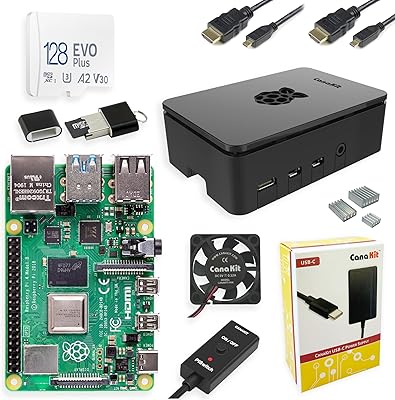
CanaKit Raspberry Pi 4 8GB Extreme Kit 128GB
84%
94%
Kit Completeness
91%
Thermal Management
93%
RAM & Multitasking Performance
71%
Storage — microSD Speed & Reliability
89%
Power Supply Quality
More
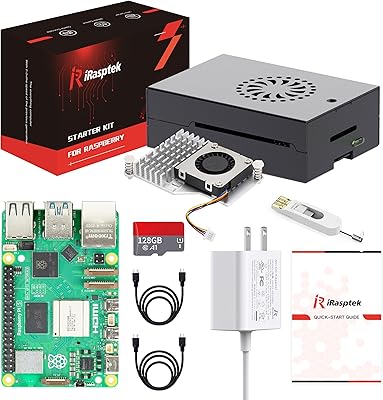
iRasptek Raspberry Pi 5 Starter Kit 8GB RAM 128GB SSD Edition
85%
91%
Performance
88%
Build Quality & Durability
86%
Cooling & Thermal Management
94%
Ease of Setup
90%
Storage Speed & Reliability
More
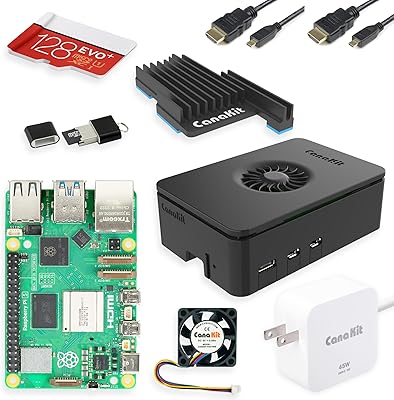
CanaKit Raspberry Pi 5 Starter Kit PRO (8GB RAM, 128GB)
87%
94%
Ease of Assembly
91%
Cooling Performance
93%
Processing Power & Speed
78%
Value for Money
96%
Multitasking Capability
More
SunFounder Raspberry Pi Pico Starter Kit
88%
88%
Build Quality
94%
Component Variety
90%
Ease of Setup
92%
Instruction Clarity
89%
Programming Language Support
More
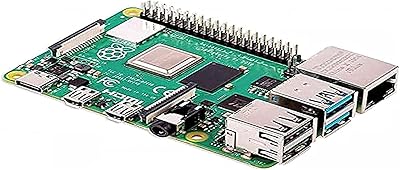
Raspberry Pi 4 Model B 8GB
80%
88%
Processing Performance
91%
RAM & Multitasking
58%
Thermal Management
87%
Video Output & Display
92%
Connectivity & Networking
More

FAQ

No, and this is the single most important thing to know before ordering. The Vilros Raspberry Pi 4 Starter Kit 8GB covers the board, case, power supply, cables, and storage — but you will need to supply your own keyboard, mouse, and HDMI-compatible display before the setup is usable.
No setup is required on that front. The included 64GB microSD card arrives preloaded with Raspberry Pi OS, so the board boots straight into the desktop environment the first time you power it on. If you ever want to switch to a different OS, the included microSD-to-USB adapter makes reflashing straightforward from any computer.

It is not loud in an absolute sense, but it does produce a consistent low hum that you will notice in a quiet room. For a garage workshop or classroom setting it is essentially irrelevant, but on a bedroom or study desk it can become a mild annoyance over time. Some users have swapped the stock fan for a quieter aftermarket option without much difficulty.

Yes, and the 8GB RAM variant is actually well-suited for that kind of workload. Running a Plex server, Pi-hole, or a lightweight home automation hub is comfortably within the board's capabilities. Just keep in mind that for 24/7 server use, the included microSD card is not a high-endurance model, so a more durable replacement card is worth considering for long-term reliability.

It is a solid gift choice because everything arrives in one box with no missing parts for the core setup. That said, the recipient will still need a keyboard, mouse, and monitor to get started — so either include those separately or confirm they already have them. The QuickStart guide is helpful for true first-timers, though it covers only the basics.

Absolutely — the Pi platform has a long track record in STEM education and the preloaded Raspberry Pi OS includes beginner-friendly coding tools like Scratch and Thonny Python IDE. The kit is a good starting point for classroom or home projects. Younger children will still need adult guidance, especially for the initial hardware setup, but the software environment is designed with learners in mind.

The Pi 4 supports 4K output at 30fps over micro HDMI, and the included cable is a standard micro HDMI to HDMI connector that will physically work with any HDMI display. That said, most everyday Pi tasks — browsing, coding, running servers — do not require or noticeably benefit from a 4K display, so a standard 1080p monitor is perfectly fine.

Yes, the Pi 4 accepts standard microSD cards and is not locked to the included card. If you want more storage, faster read/write speeds, or a high-endurance card for continuous server use, simply flash a new card with Raspberry Pi Imager and swap it in. The included microSD-to-USB adapter makes it easy to do this from a Windows or Mac computer.

No tools are needed. The transparent case snaps together around the board, the heatsinks have pre-applied thermal adhesive backing, and the fan connects directly to the board's fan header. Most users have the full kit assembled in under fifteen minutes, even without prior experience with single-board computers.

The Pi 4 remains a capable and well-supported platform for the vast majority of hobbyist, educational, and light server use cases. Newer Pi hardware exists, but the Pi 4 benefits from years of community support, extensive documentation, and a mature software ecosystem. For someone entering the Pi world or picking up a gift, it is still a practical and relevant choice rather than an obsolete one.