Overview

The Uniden R8W Radar Detector is Uniden's current flagship windshield-mount unit, built for drivers who take detection seriously and are willing to invest in hardware that reflects it. The headline engineering choice is the dual-antenna design, which separates it from virtually every competitor in its class by sensing threats from all four directions simultaneously. Pair that with the R/TACH companion app and you get a connected ecosystem capable of pulling crowd-sourced data and pushing firmware updates over Wi-Fi. Range claims from any manufacturer deserve healthy skepticism — terrain and local enforcement technology both matter — but the hardware foundation here is genuinely substantial.
Features & Benefits

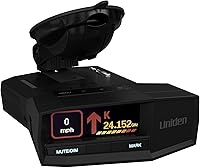
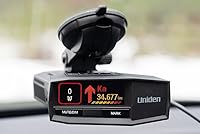
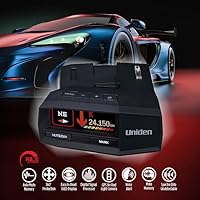
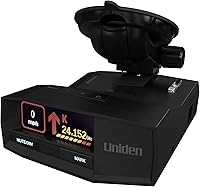
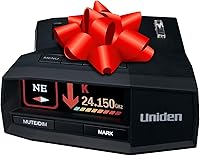
The R8W runs two Blackfin DSP chips in parallel, which in practical terms means it cross-references signals faster and discards more false positives before they ever reach your ears. Directional awareness comes through on-screen arrow indicators paired with voice alerts that name both the band and the direction — front, rear, left, right — so you rarely need to glance down to interpret anything. The built-in GPS quietly logs repeat false-alert locations and mutes them automatically on future passes. The OLED display holds up well in direct sunlight where cheaper LCD screens often wash out, and the free speed and red light camera database stays current without requiring a subscription.

Best For

This detector makes the most sense for highway and open-road drivers who regularly cover ground in regions with variable or aggressive enforcement patterns. Urban-only commuters may find the value proposition harder to justify — dense city environments generate more door-opener and adaptive cruise interference that any detector has to work through. Drivers stepping up from an older single-antenna Uniden will likely notice a real, tangible improvement in how early threats are flagged and how precisely their direction is communicated. If you prefer keeping your hands on the wheel and eyes on the road, the voice alert system earns its place rather than just padding a spec sheet.

User Feedback

With a 4.5-star average across 163 ratings gathered since the listing launched in April 2025, early reception to this radar unit has been strong — though the review pool is still relatively young and will likely evolve as owners accumulate serious highway miles. Buyers consistently highlight detection distance and the precision of the directional arrows as the standout wins. On the flip side, some users mention a setup learning curve, and a handful report that the companion app behaves inconsistently on certain Android devices. Drivers upgrading from older R-series Uniden models generally consider the jump worthwhile, and most note that false-alert frequency drops noticeably once the GPS memory has had a few weeks to learn their regular routes.

Pros

  • Dual-antenna design delivers 360-degree threat awareness that single-antenna competitors simply cannot match.
  • Directional arrow indicators paired with voice callouts tell you exactly where a threat is without a downward glance.
  • Dual Blackfin DSP chips process signals faster and reject more false positives than single-processor alternatives.
  • GPS mute memory silences repeat false-alert locations automatically after learning your regular routes.
  • Wi-Fi firmware updates keep the detector current without cables or a laptop.
  • The OLED display stays sharp and readable even in harsh direct sunlight.
  • Free red light and speed camera database updates remove the need for a recurring subscription fee.
  • Drivers upgrading from older R-series models consistently report a meaningful improvement in detection lead time.
  • Voice alerts are programmable so you can match verbosity to your personal driving style.
  • At its market position, the hardware specification represents a genuinely competitive package for serious highway drivers.

Cons

  • Android users face documented Bluetooth pairing and app stability issues that iPhone users largely avoid.
  • The companion app interface feels underdeveloped relative to the hardware it is meant to support.
  • The stock windshield mount struggles with suction retention in high summer heat, prompting many buyers to replace it immediately.
  • Initial setup involves a dense settings menu that rewards patience but frustrates drivers expecting plug-and-play simplicity.
  • The GPS learning period means the first few weeks of use can feel noisier and more alert-heavy than the long-term experience.
  • Detection range gains are terrain-dependent — hilly or wooded routes narrow the advantage compared to flat highway conditions.
  • Laser detection provides an alert after the speed measurement has already been taken, a limitation shared across the entire passive detector category.
  • Urban-only drivers may find the alert frequency in city environments difficult to manage before GPS muting matures.
  • The review pool, while positive, is still relatively small given the April 2025 launch date — long-term reliability data is still accumulating.
  • At the premium price tier, the mount and app shortcomings feel more glaring than they would on a budget alternative.

Ratings

The Uniden R8W Radar Detector earns its place among the most talked-about windshield-mount detectors released in 2025, and the scores below reflect what real drivers are actually experiencing — not marketing copy. Our AI has analyzed verified purchase reviews from buyers worldwide, actively filtering out incentivized, duplicate, and bot-generated submissions to surface honest signal from the noise. Both the hardware strengths and the friction points that show up in repeated complaints are transparently represented in every category score.
Detection Range
93%
Drivers on open interstates consistently report getting significantly earlier warnings than they did with previous single-antenna units. On flat highway stretches with minimal obstructions, the dual-antenna setup appears to deliver a genuine, noticeable lead time over comparable single-DSP detectors.
Range performance drops in hilly or heavily wooded terrain, as several users discovered on mountain routes in the Appalachians and Pacific Northwest. A handful of reviewers also note that K-band saturation in suburban corridors can occasionally mask weaker distant signals.
False Alert Filtering
88%
After the GPS memory has had a couple of weeks to map out repeat offenders — grocery store doors, parking garage sensors — daily commuters say the alert frequency becomes genuinely manageable. The dual Blackfin DSP processing handles BSM and Honda/Toyota collision system filtering notably well according to multiple owners.
During the initial learning period, some users find the alert volume frustrating enough to question the purchase. A few owners who drive irregular or varied routes report that the GPS mute memory never fully matures because the route set never stabilizes.
Directional Awareness
91%
The combination of on-screen arrows and spoken direction callouts — front, rear, left, right — gets singled out repeatedly as one of the most practically useful features in day-to-day driving. Road-trippers especially appreciate not having to interpret a raw signal strength bar while keeping eyes on a two-lane highway.
A small number of users note that in dense multi-threat environments, like a stretch of highway with both a speed sign and an oncoming patrol car, the directional display can momentarily feel cluttered. The voice cadence also takes some getting used to for drivers new to voice-guided detectors.
App Integration & Connectivity
74%
26%
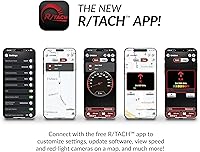
When the R/TACH app behaves, the live threat overlay and Wi-Fi firmware update pipeline are genuinely convenient — no laptop required and no hunting for USB cables. iPhone users in particular report a more stable pairing experience and appreciate the crowd-sourced alert layer on top of the built-in database.
Android compatibility is the most consistent sore spot in user feedback, with intermittent Bluetooth drops and failed pairing sessions cited by multiple buyers. A few users also note that the app interface feels underdeveloped relative to the hardware it supports, with navigation that is not always intuitive.
GPS & Camera Alert Accuracy
86%
The pre-loaded red light and speed camera database covers most major metro areas well, and the free update model means the data stays reasonably current without a recurring fee. Users who regularly drive known camera corridors find the advance audio cues reliably timed.
Database coverage in smaller cities and rural counties is noticeably thinner, and a few owners have flagged outdated entries for cameras that were removed months ago. The GPS lock time after a cold start can also lag by a few seconds in parking structures or dense urban canyons.
Display Quality
89%
The OLED panel holds up impressively in direct afternoon sunlight — a real differentiator versus the washed-out LCD screens found on competing units in the same class. Text and signal indicators remain sharp and legible at a glance without requiring the driver to shade the display.
A minority of users find the default brightness setting too intense for night driving, requiring a manual adjustment that not everyone discovers quickly. The display size, while sharp, is compact enough that some older drivers mention the signal strength numerals require a second look in low light.
Build Quality & Hardware
82%
18%
The chassis feels appropriately solid for a premium-tier unit — no flex or rattling reported during highway vibration, and the button layout is tactile enough to operate without looking. The OLED housing and antenna assembly both communicate that this is not a budget piece of hardware.
The included windshield mount draws mixed feedback, with some users finding the suction retention inconsistent in extreme summer heat. Several buyers chose to immediately replace it with a third-party mount, which suggests the mount is a known weak link relative to the main unit quality.
Voice Alert System
87%
The programmable voice alerts let drivers choose the verbosity level that suits them — whether that is a brief band callout or a full directional sentence. Long-haul drivers who spend hours on the road particularly value the hands-free operation that the voice system enables.
A few users describe certain default voice prompt phrasings as slightly awkward or repetitive after extended listening. The volume ceiling, while generally adequate, gets flagged as insufficient by a small number of users who drive with windows down or play audio at moderate levels.
Ease of Setup
71%
29%
Basic plug-in operation is genuinely straightforward — mount, connect the power cable, and the unit is functional within minutes. Drivers who stick to out-of-box defaults can be up and running on their first commute without reading a manual.
Unlocking the full potential of the R8W — custom alert profiles, GPS sensitivity tuning, app pairing, and band filtering — involves a settings menu that multiple users describe as dense. The learning curve is real for anyone who wants to move past defaults, and the printed documentation does not always help.
Value for Money
78%
22%
For drivers who spend serious time on highways and genuinely rely on a detector as a tool rather than a novelty, the hardware specification at this price tier is hard to argue with. The dual-antenna architecture, dual DSP processing, and free database updates together represent a meaningful package.
At its price point, the R8W is a deliberate purchase that not everyone will find justified — particularly urban-only drivers or those who only occasionally venture onto enforcement-heavy highways. The app reliability issues and mount shortcomings sting more at this price than they would on a budget unit.
Firmware & Update Experience
80%
20%
Wi-Fi updates are among the most praised convenience features — several owners note they received a meaningful performance update within the first month of ownership without any manual intervention. Uniden's update track record with prior R-series models gives buyers reasonable confidence in ongoing support.
A couple of early adopters report that an initial firmware update created temporary issues with alert sensitivity that required a reset. Given the April 2025 launch date, the update cadence is still being established and some edge cases may not yet be addressed.
Portability & Form Factor
83%
At 2.16 pounds and under five inches in length, the R8W is compact enough to move between vehicles without hassle. Drivers who share a household fleet or rent cars on road trips appreciate that the unit transfers quickly with just the mount and power cable.
The corded 12V power dependency means cable management is a consideration in every vehicle — there is no battery mode for temporary placement. Some compact car owners also note the unit footprint slightly encroaches on the rearview mirror sightline depending on windshield angle.
Band & Frequency Coverage
92%
Coverage of both Ka-band and K-band with accurate identification gives the R8W strong versatility across the diverse enforcement technology mix found across U.S. highways and across borders in Canada. Experienced detector users specifically call out Ka-band sensitivity as a highlight.
Laser detection, while present, draws the same caveat it does on virtually every passive detector — by the time the unit alerts to a LIDAR hit, the gun has already measured your speed. A few users wanted more nuanced laser band discrimination that the unit does not currently offer.
Noise & Alert Management in Urban Areas
63%
37%
With GPS muting active and sensitivity tuned down, the R8W can be made reasonably livable for mixed urban and suburban use. Drivers who split time between city streets and highway runs report the GPS learning curve eventually pays off in quieter city segments.
Dense urban environments are genuinely challenging for this detector — K-band interference from automatic doors, adaptive cruise systems, and parking sensors can produce a noisy experience before GPS learning matures. Purely city-bound drivers are likely to find the alert volume more irritating than useful on a daily basis.

Suitable for:

The Uniden R8W Radar Detector is built for drivers who spend meaningful time on highways and treat their detector as a serious tool rather than a casual accessory. If your weekly routine involves long interstate stretches, frequent interstate travel across state lines, or regular driving through regions known for aggressive speed enforcement, this radar unit was designed with your use case in mind. The dual-antenna architecture delivers a genuine advantage for open-road driving where early warning distance translates directly into reaction time, and the directional arrow system earns its keep when threats can come from multiple directions at once. Tech-forward drivers who appreciate a device that improves over time through firmware and database updates will find the Wi-Fi connectivity genuinely useful rather than a gimmick. Owners stepping up from an older single-antenna Uniden — or from any mid-tier detector — will likely feel the hardware difference most acutely, particularly in how cleanly the GPS mute memory settles in after a few weeks of regular use on consistent routes. Road-trippers and long-haul commuters who want hands-free, voice-guided operation without constantly glancing at a display will also find this detector fits naturally into their driving style.

Not suitable for:

Drivers who spend the vast majority of their time in dense urban environments will find the Uniden R8W Radar Detector a harder sell, and not because the hardware is weak — it is simply that city driving generates a volume of false-alert sources that tax any detector, and the GPS learning process requires repetitive routes to be truly effective. If your commute changes daily or covers unpredictable city grids, the mute memory may never fully mature, leaving you with a premium unit that still interrupts you constantly. Android users should also approach with measured expectations, as app connectivity issues and Bluetooth pairing inconsistencies appear often enough in early reviews to be a real consideration rather than an isolated complaint. The included windshield mount has drawn enough criticism that buyers who prioritize a rock-solid install out of the box may find themselves sourcing a replacement immediately — an added friction point for the price. Buyers who want a detector they can configure in five minutes and forget about will likely find the depth of the settings menu overwhelming without investing time upfront. Finally, if your driving is predominantly local errands and short suburban trips with little highway exposure, the feature set here outpaces your actual need.
Specifications

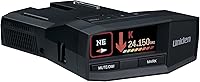
  • Brand & Model: Manufactured by Uniden under the model designation R8W, positioned as the brand's current top-tier windshield-mount radar detector.
  • Antennas: Equipped with dual antennas that together provide full 360° radar detection coverage across all four threat directions.
  • Signal Processors: Runs two Blackfin DSP (Digital Signal Processor) chips simultaneously to improve signal identification accuracy and false-alert rejection.
  • Frequency Bands: Detects radar signals across K-band (24.125 GHz) and Ka-band (34.7 GHz), covering the primary frequencies used by law enforcement speed-measurement equipment in North America.
  • Detection Coverage: Full 360° directional awareness with on-screen directional arrows and voice alerts that identify threat direction and band type.
  • Display: Uses an OLED panel that maintains sharp contrast and legibility in direct sunlight conditions where standard LCD displays typically wash out.
  • GPS: Built-in GPS module supports auto-mute memory, which records and silences repeat false-alert locations along regularly driven routes.
  • Connectivity: Supports both Wi-Fi and Bluetooth, enabling over-the-air firmware updates and integration with the companion R/TACH smartphone app.
  • Camera Alerts: Ships with a pre-loaded database of red light and speed camera locations, with free ongoing database and firmware updates provided by Uniden.
  • Companion App: Compatible with the R/TACH app on iPhone and Android smartphones, providing crowd-sourced threat data and remote configuration options.
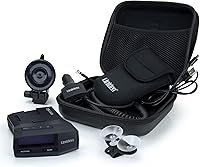
  • Power Source: Powered via a corded 12V DC connection, compatible with standard automotive 12V accessory and cigarette lighter sockets.
  • Dimensions: Measures 4.9″ in length, 3.5″ in width, and 1.5″ in height, making it a compact footprint for a dual-antenna windshield-mount unit.
  • Weight: Weighs 2.16 pounds, light enough for straightforward single-person mounting and easy transfer between vehicles.
  • Mount Type: Designed for windshield mounting using the included suction-cup bracket, oriented for standard dashboard or upper-windshield placement.
  • Voice Alerts: Programmable voice alert system delivers spoken notifications identifying threat direction, radar band, and signal strength without requiring the driver to look at the display.
  • Voltage: Operates on 12V DC input, consistent with standard passenger vehicle and light truck electrical systems.
  • BSR Ranking: Holds a Best Sellers Rank of number 5 in the Radar Detectors category on Amazon as of the product's early listing period.
  • Launch Date: First made available for purchase on April 1, 2025, making it one of the more recently introduced units in the premium detector segment.

Related Reviews
Uniden R3 Radar Detector
81%
96%
Detection Range
91%
GPS False Alert Filtering
93%
Radar Band Sensitivity
74%
Laser Detection
82%
BSM & False Alert Management
More
Uniden DFR5 Long Range Radar Detector
76%
88%
Detection Range
71%
False Alert Filtering
93%
Ease of Setup
86%
Spectre Undetectability
67%
Display Readability
More
Uniden R7 Radar Detector
79%
94%
Detection Range
86%
False Alert Filtering
91%
Dual-Antenna Design
83%
GPS & Camera Database
78%
Display Quality
More
Uniden DFR6 Radar Detector
80%
91%
Detection Range
73%
False Alert Filtering
88%
Display Quality
86%
Ease of Setup
67%
Build Quality
More
Uniden R4 Radar Detector
79%
94%
Detection Range
83%
False Alert Filtering
91%
GPS Auto-Mute Memory
78%
Red Light & Speed Camera Alerts
67%
App Integration (R/TACH)
More
Escort X80 Radar Detector
84%
92%
Long-Range Detection
88%
Ease of Installation
84%
Voice Alert Customization
90%
App Integration (Escort Live)
80%
Accuracy of Alerts
More
XpacEbank Car Radar Detector
81%
85%
Detection Performance
90%
Ease of Setup
88%
Voice Alert Clarity
65%
False Alerts
89%
GPS Accuracy
More
Radenso XP Radar & Laser Detector
88%
94%
Detection Range
89%
GPS Lockout Functionality
91%
Ease of Use
85%
False Alert Filtering
88%
Voice Alerts & Display Visibility
More
Escort MAX 4 Radar Detector
79%
88%
False Alert Filtering
91%
Detection Range
79%
CarPlay & Android Auto Integration
67%
Value for Money
63%
AutoLearn Setup & Learning Curve
More
Cobra RAD 450 Radar Detector
77%
88%
False Alert Filtering
71%
Detection Range
94%
Ease of Setup
67%
Mount & Build Quality
79%
Display Clarity
More

FAQ

It is a real feature, but it requires patience. The GPS auto-mute memory works by logging the location of repeat false triggers — like a grocery store door sensor you pass every morning — and automatically muting future alerts at those coordinates. After two to four weeks of driving your regular routes, most users report a noticeably quieter experience. The key word is regular: if your routes vary a lot day to day, the memory never fully matures.

A single-antenna detector has one point of reception, which means it is primarily optimized for forward detection with limited rear sensitivity. The R8W uses two antennas — one forward-facing, one rear-facing — so it is actively monitoring all four directions simultaneously rather than estimating. In practical terms, you get earlier rear alerts when a patrol vehicle is behind you and cleaner side detection when a threat is perpendicular to your travel direction.

The core detection hardware functions completely independently without the app — you do not need a phone connected to benefit from the radar and laser detection, GPS muting, directional alerts, or the built-in camera database. The app adds crowd-sourced real-time threat data and makes firmware updates more convenient, but it is genuinely optional. That said, keeping the firmware current is worth doing, and the Wi-Fi update path is easier than managing it manually.

Honestly, probably yes. Dense urban environments have a high concentration of K-band interference sources — automatic doors, adaptive cruise control systems on surrounding vehicles, parking sensors — and that creates a noisy alert environment that any detector has to fight through. The R8W handles it better than most once the GPS muting learns your routes, but if highway driving is not a regular part of your life, you are paying for capabilities you will rarely use in the conditions they shine.

The gap is real enough to mention upfront. iPhone users report a significantly more stable Bluetooth pairing experience and fewer app crashes. Android users have logged intermittent connectivity drops and occasional failures to pair, particularly on certain Samsung and Pixel devices. Uniden has been updating the app since launch, so the situation may improve, but if you are on Android and app integration matters to you, factor that uncertainty in before purchasing.

Updates are free — no subscription required. Uniden provides ongoing database and firmware updates at no additional cost, which is one of the more buyer-friendly policies in this product category. Wi-Fi updates can be pushed directly to the unit via the R/TACH app, or you can handle them manually via a USB connection if you prefer not to use the app.

The R8W adds Wi-Fi connectivity, Bluetooth, and the R/TACH app integration — features the original R8 lacked entirely. The underlying detection hardware has also been updated with the dual Blackfin DSP configuration. Drivers who owned the original R8 generally describe the upgrade as meaningful rather than incremental, particularly around app connectivity and the improved false-alert filtering. If you have been running an older R-series unit for several years, the hardware gap is real.

Yes, the mount uses a standard suction-cup windshield bracket that is compatible with a wide range of third-party mounts. Quite a few buyers proactively replace the included mount with an aftermarket option — particularly for vehicles with textured or curved windshield glass where suction retention can be inconsistent in hot weather. The unit itself connects via a standard cradle, so swapping mounts does not require any modification to the detector.

You have real control over it. The voice alert verbosity is programmable, so you can trim it down to brief band callouts if you find the full directional sentences repetitive after hours of highway driving. Most long-haul users settle into a middle setting after a few trips — enough spoken detail to react without needing to look at the display, but not so much narration that it competes with music or conversation.

Most users report that the GPS memory becomes noticeably effective within one to two weeks of consistent driving on the same routes. The unit needs to encounter the same false-alert source multiple times and confirm a pattern before it starts muting automatically. The first few days on a new commute will feel busier than the long-term experience, so give it time before judging the false-alert performance.

Where to Buy

Best Buy
In stock $799.99
TAG Performance
In stock $749.99
Bigbigmart.com
In stock $751.06
Uniden America Corporation
In stock $799.99
Abt Electronics & Appliances
In stock $799.99
Crutchfield
In stock $799.99
Radar Busters
In stock $799.99
Best Radar Detectors
In stock $799.99