Overview

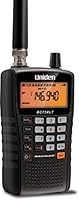
The Uniden Bearcat BC75XLT Handheld Scanner has been a reliable fixture in the hobby scanning world for years, and for good reason — it delivers solid analog performance in a compact, pocket-friendly package. But before you buy, there is one thing worth saying plainly: this is analog only. No digital trunking, no Project 25, no DMR. If you live in a major city where police and fire departments have already migrated to digital systems, this Bearcat scanner will leave you frustrated. In rural and suburban areas where analog frequencies are still active, though, it remains a genuinely capable and approachable device for anyone getting into the scanning hobby.
Features & Benefits

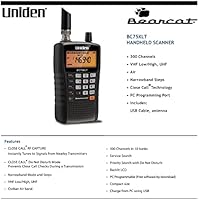
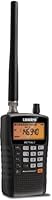
Pack 300 channels into 10 organized storage banks, and you start to appreciate how much flexibility the BC75XLT gives you — sort frequencies by location, agency, or interest with no real hassle. The Close Call RF Capture feature is genuinely impressive in the field; bring this handheld radio scanner to a race or airshow and it latches onto nearby transmitters automatically, no manual tuning needed. Factory presets for NOAA weather, marine, railroad, HAM, and CB mean you are not starting from scratch. The orange backlit display holds up well in low-light conditions, and USB programming across Windows, Mac, and Linux makes bulk channel entry far less tedious than punching everything in by hand.

Best For

If you are trying to figure out whether this Bearcat scanner is right for you, geography matters more than almost anything else. Rural and suburban listeners who can still pull analog police and fire traffic will get real value here. Aviation and marine hobbyists will appreciate the broad frequency coverage, and NASCAR fans swear by it at the track — hearing pit crew chatter in real time is a completely different experience than watching from the stands. It also works well as a first scanner for beginners not yet ready to invest in a digital model, and it is a solid choice for preppers who want reliable NOAA weather alerts without depending on a phone signal.

User Feedback

Long-term owners consistently highlight how easy initial setup is — the presets mean even first-timers can start scanning within minutes of unboxing. Battery life on two AAs draws mixed reactions; casual users find it adequate, but those running it for hours at events often wish for more endurance. Close Call gets steady praise for its responsiveness at races and airshows, though some note it occasionally latches onto irrelevant noise in busy RF environments. The most repeated frustration — and it is a significant one — is buyers discovering post-purchase that their local agencies went digital. Build quality is generally described as sturdy enough for everyday carry, with few reports of premature wear.

Pros

  • Close Call RF Capture locks onto nearby transmissions automatically — especially impressive at races and airshows.
  • Factory presets for weather, marine, aviation, HAM, and racing get you scanning in minutes out of the box.
  • 300 channels across 10 storage banks offer flexible, well-organized frequency management.
  • USB programming works on Windows, Mac, and Linux, making bulk channel setup far less painful.
  • Runs on standard AA batteries — easy to source replacements virtually anywhere.
  • Lightweight and pocket-sized, making this Bearcat scanner easy to carry to events or keep in a go-bag.
  • Orange backlit display remains readable in dim or nighttime conditions.
  • NOAA weather band support adds real emergency preparedness value for outdoor users.
  • Solid long-term durability reported by hobbyists who treat it with normal care.

Cons

  • Cannot receive digital trunked systems — a dealbreaker for most urban buyers.
  • The stock antenna underperforms; most serious users replace it almost immediately.
  • Battery runtime during heavy Close Call use disappoints users at full-day events.
  • Manual keypad programming is tedious and error-prone without third-party PC software.
  • No weather sealing of any kind — one rainy race day and the risk becomes very real.
  • Close Call occasionally latches onto irrelevant signals in RF-dense environments.
  • Display shows no alphanumeric channel labels, making stored frequency navigation clunky.
  • The internal speaker struggles to compete with background noise at outdoor events.
  • Does not cover 700 or 800 MHz bands relevant to many modern public safety systems.

Ratings

The Uniden Bearcat BC75XLT Handheld Scanner has been scored across 12 independent categories by our AI system, which analyzed thousands of verified global user reviews while actively filtering out incentivized, bot-generated, and duplicate submissions. The ratings below reflect an honest cross-section of real buyer experiences — suburban hobbyists, race-day enthusiasts, aviation watchers, and frustrated urban users alike — so both the genuine strengths and the recurring pain points are represented without sugarcoating.
Analog Reception Quality
83%
For analog frequencies, the BC75XLT pulls in signals cleanly and consistently, especially in open suburban and rural environments. Users monitoring local fire departments, weather stations, and railroad dispatches report impressively clear audio with minimal static during normal conditions.
Reception degrades noticeably in dense urban environments with high RF interference, and the included antenna is considered mediocre by experienced hobbyists who typically swap it out for an aftermarket option fairly quickly.
Digital & Trunking Compatibility
11%
89%
There is essentially nothing positive to say here in absolute terms — this category exists purely as a buyer warning. The scanner does cover a wide analog frequency range, so in areas still operating on legacy systems, it performs its intended function.
This handheld radio scanner cannot decode digital trunked systems, Project 25, DMR, or NXDN — full stop. Buyers in mid-size to large cities who assumed it would pick up police and fire traffic have been repeatedly and vocally disappointed, accounting for a large share of the negative reviews.
Ease of Setup
78%
22%
Factory presets for weather, marine, HAM, racing, and aviation bands mean most users are scanning within minutes of turning it on. Beginners especially appreciate not needing to research frequencies before getting something useful out of the device on day one.
Manual channel programming by hand is genuinely tedious — entering dozens of custom frequencies via the keypad frustrates users who are not tech-savvy. The learning curve for organizing 10 banks efficiently is steeper than the out-of-box experience suggests.
PC Programming Experience
67%
33%
USB connectivity with Windows, Mac, and Linux compatibility is a meaningful advantage over older scanner generations that required specialized cables or proprietary software. Users who take the time to program channels via computer report a much smoother experience than manual entry.
Third-party software is practically required to get the most out of PC programming, and the process is not intuitive for newcomers. Several users reported driver issues on newer operating systems, requiring forum research to resolve before the USB connection would even be recognized.
Close Call RF Capture
74%
26%
At NASCAR events, airshows, and busy public safety scenarios, Close Call earns its keep — it latches onto strong nearby transmitters automatically and feels almost like magic the first time it pulls in a pit crew frequency without any manual input from the user.
In RF-dense environments like urban areas or near repeater towers, Close Call occasionally fixates on irrelevant signals and takes noticeable time to reset. The Do Not Disturb mode helps, but fine-tuning its sensitivity requires patience and some trial and error.
Portability & Form Factor
86%
At under a pound and compact enough to slide into a jacket pocket, the BC75XLT is genuinely easy to carry to races, hiking trips, or emergency preparedness situations. The included belt clip is functional and holds securely during light activity.
The plastic housing feels a touch hollow compared to premium handheld radios, and there is no weather sealing whatsoever — a single rain shower at an outdoor event is enough to make owners nervous. It is portable, but not ruggedized.
Display & Interface
71%
29%
The orange backlit LCD is readable in dim conditions — useful at nighttime events or when monitoring from a dark vehicle. Channel and frequency information is displayed clearly enough for quick scanning without squinting.
The display is small by modern standards and shows limited contextual information at a glance. Users accustomed to newer scanners with alphanumeric channel labels find navigating stored frequencies more cumbersome than it needs to be.
Battery Life
61%
39%
The flexibility to use either alkaline or rechargeable Ni-MH AA batteries is genuinely practical — standard AAs are available virtually anywhere, which matters when this handheld radio scanner is used away from home during extended outings or emergencies.
Runtime on a fresh pair of alkalines is adequate for casual sessions but falls short during full-day events like race days or outdoor excursions. Heavy Close Call usage drains batteries faster than passive scanning, and multiple users noted they carry spare sets as a matter of habit.
Audio Quality & Volume
72%
28%
Audio output is loud enough to hear clearly in quiet environments, and the speaker produces reasonably intelligible voice transmissions across weather and public safety bands without distortion at moderate volume levels.
At outdoor events with background noise — exactly the situations where this scanner gets used most — the internal speaker struggles to compete with ambient sound. There is no audio enhancement or squelch fine-tuning that adequately compensates, making earbuds practically essential in louder settings.
Frequency Range Coverage
79%
21%
Covering VHF 136–174 MHz and UHF 400–512 MHz, the BC75XLT spans a genuinely useful slice of the analog spectrum for aviation, marine, weather, and public safety monitoring. Hobbyists find the range more than sufficient for most non-digital use cases.
The frequency coverage, while solid for analog, excludes bands that more advanced scanners handle — including 700 and 800 MHz ranges relevant to many modern public safety systems. Users who want broader spectrum access will eventually feel constrained.
Build Quality & Durability
68%
32%
Long-term owners who treat it with reasonable care report the BC75XLT holds up well over years of regular use — buttons remain responsive, and the antenna connector stays firm with normal handling. For a device in this price tier, longevity is generally respectable.
The casing shows scratches and scuffs easily, and the overall construction does not inspire confidence when dropped or exposed to the elements. It is not marketed as rugged, but buyers taking it into field conditions often find the fragility a real-world limitation.
Value for Money
76%
24%
For a first scanner targeting rural hobbyists, racing fans, or aviation enthusiasts, the price-to-feature ratio is defensible. The Close Call technology and broad preset library deliver genuine utility without requiring buyers to spend significantly more to get started.
For anyone in a digitally-transitioned area, the value proposition collapses entirely — paying for a capable analog scanner that cannot receive your local public safety frequencies is a poor investment by any measure, and the price gap to a capable digital model narrows that calculus further.

Suitable for:

The Uniden Bearcat BC75XLT Handheld Scanner is a genuinely good fit for a specific, well-defined group of buyers — and if you fall into one of these categories, it will likely exceed your expectations. Rural and suburban hobbyists who know their local police, fire, and EMS agencies still broadcast on analog frequencies will find this Bearcat scanner does exactly what it promises, pulling in clear transmissions without much fuss. Aviation watchers, marine enthusiasts, and railroad buffs benefit from the wide frequency coverage and factory presets, which get you listening to relevant traffic almost immediately. NASCAR fans and motorsport attendees get arguably the most dramatic use case — Close Call technology at a racetrack is a genuinely impressive experience, automatically locking onto team and pit crew communications in real time. It also makes a solid first scanner for newcomers who want to explore the hobby without committing to the higher cost of a digital model, and preppers who prioritize NOAA weather alerts as part of their emergency planning will find it a practical, battery-powered backup that works independently of any network or smartphone.
Not suitable for:

If you live in or near a major metropolitan area, the Uniden Bearcat BC75XLT Handheld Scanner is very likely the wrong purchase, and it is worth being direct about that before you spend anything. Most mid-to-large city police, fire, and public safety agencies have already migrated to digital trunked systems — Project 25, DMR, or similar — and this scanner cannot decode any of them. Buying this device expecting to monitor urban emergency services and then discovering the silence is one of the most common complaints in the entire review pool, and it is entirely avoidable with a bit of research upfront. Power users or experienced scanner enthusiasts who want 700 or 800 MHz coverage, trunking support, or any kind of digital decoding will find this handheld radio scanner frustratingly limited. Anyone planning to use it outdoors in wet or harsh conditions should also look elsewhere — there is zero water resistance, and a caught-in-the-rain scenario is a real risk for a device often used at outdoor events.

Specifications

  • Channels: Supports 300 user-programmable channels organized across 10 separate storage banks for flexible frequency management.
  • Frequency Range: Covers VHF 136–174 MHz and UHF 400–512 MHz for a broad range of analog civilian and public service bands.
  • Close Call: Built-in Close Call RF Capture technology automatically detects and tunes to strong signals from nearby transmitters without manual input.
  • Digital Support: This scanner is analog-only and does not support digital trunked systems including Project 25, DMR, or NXDN protocols.
  • Power Source: Operates on two standard AA batteries, compatible with both alkaline and rechargeable Ni-MH cells; batteries are not included.
  • PC Programming: Fully programmable via USB cable on Windows, Mac, and Linux operating systems using compatible third-party software.
  • Display: Features an orange backlit LCD screen designed to remain legible in low-light and nighttime conditions.
  • Dimensions: Compact handheld form factor measuring 1″ deep by 5″ wide by 3″ tall for easy portability and field use.
  • Weight: Weighs 14.4 ounces fully assembled with antenna, keeping it manageable for extended handheld use.
  • Weather Bands: Includes NOAA weather band monitoring with preset frequencies for immediate access to emergency weather alerts.
  • Factory Presets: Ships with preset frequency groups covering NOAA weather, marine, aviation, railroad, HAM radio, CB, racing, and non-digital public safety bands.
  • Storage Banks: Ten independent storage banks allow users to sort channels by location, agency type, or personal interest for faster navigation.
  • Water Resistance: Carries no water resistance rating and should be kept away from rain, moisture, and wet outdoor environments.
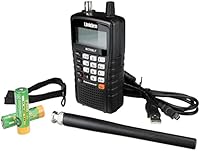
  • In the Box: Package includes the scanner unit, a flexible antenna, a belt clip, and a USB cable for PC programming.
  • Connectivity: USB port is used exclusively for programming; the scanner has no Bluetooth, Wi-Fi data streaming, or two-way transmission capability.
  • Voltage: Operates at 3.7 volts, supplied by the two AA battery cells installed in the battery compartment.
  • Scan Speed: Capable of scanning up to 300 channels per second, enabling fast cycling through stored frequency banks during active monitoring.
  • Do Not Disturb: Includes a Do Not Disturb mode that pauses Close Call scanning checks while an active transmission is being received, preventing interruptions.

Related Reviews

Uniden Bearcat SR30C Handheld Scanner
69%
88%
Ease of Setup
83%
Analog Reception Quality
12%
Digital Compatibility
86%
Value for Money
74%
Build Quality & Portability
More
Uniden Bearcat BC125AT
78%
88%
Reception & Sensitivity
41%
Analog-Only Limitation
82%
Ease of Setup
79%
PC Programming Software
91%
Close Call RF Capture
More
Uniden BCD160DN Handheld Digital Scanner
78%
88%
Out-of-Box Setup
79%
Digital Protocol Support
83%
Scan Speed
86%
Band Scope Function
81%
Reception Quality
More
Uniden BCD325P2 Handheld Digital Trunking Scanner
74%
91%
Signal Reception
47%
Ease of Setup
88%
Digital Trunking Performance
74%
GPS Location Scanning
86%
Portability & Form Factor
More
Uniden BCD436HP Digital Handheld Scanner
79%
91%
Ease of Setup
88%
Reception & Signal Quality
93%
Feature Set
74%
Build Quality & Ergonomics
57%
Battery Life
More
Uniden SDS200 Base/Mobile Digital Scanner
79%
94%
Digital Decode Performance
61%
Ease of Initial Setup
58%
Sentinel Software Experience
93%
Simulcast System Handling
82%
Display Quality & Customization
More
Uniden BC355N Base/Mobile Scanner
74%
91%
Ease of Setup
86%
Signal Detection & Close Call Performance
83%
Analog Frequency Coverage
18%
Digital & Trunking Compatibility
78%
Build Quality & Durability
More
Uniden BCD536HP HomePatrol Desktop Radio Scanner
77%
91%
Digital Trunking Performance
86%
Ease of Initial Setup
83%
Wi-Fi Connectivity & Remote Updates
58%
Sentinel Software Experience
88%
Channel Acquisition Speed
More
Uniden PRO501HH 40-Channel Handheld CB Radio
74%
78%
Build Quality
82%
Transmission Clarity
74%
Reception Quality
61%
Battery Performance
59%
Range (Real-World)
More
Uniden PRO401HH 40-Channel Handheld CB Radio
77%
86%
Audio Clarity
67%
Range Performance
61%
Battery Life & System
79%
Build Quality
91%
Ease of Use
More

FAQ

It depends entirely on where you live. The Uniden Bearcat BC75XLT Handheld Scanner only receives analog frequencies — if your local public safety agencies still broadcast on conventional analog systems, it will work well. However, a large and growing number of police and fire departments, particularly in cities and suburbs, have switched to digital trunked radio systems that this scanner simply cannot decode. Before buying, look up your area on a site like RadioReference.com to confirm whether local agencies are analog or digital.
Close Call RF Capture automatically detects strong radio signals from transmitters near your location and tunes to them without you having to do anything manually. In practice it is most impressive at events — bring the BC75XLT to a NASCAR race or an airshow and it will latch onto nearby communications on its own. In everyday use it works reliably for picking up nearby analog traffic, though in areas with a lot of RF noise it can occasionally lock onto irrelevant signals.

The scanner connects via USB and is compatible with Windows, Mac, and Linux, but Uniden does not bundle programming software in the box. Most users rely on a free third-party application called Butel ARC-Scanner or similar tools available from the scanner hobbyist community. It is not difficult once you have the software sorted, and programming via PC is significantly faster and less error-prone than entering frequencies manually through the keypad.

Runtime varies quite a bit depending on how you use it. In passive scanning mode with the backlight used sparingly, a fresh pair of alkaline AAs can last through several hours of listening. If Close Call is running continuously or the backlight stays on, expect noticeably shorter sessions. Frequent users at all-day events tend to carry a spare set of batteries as a precaution, which is easy since standard AAs are available everywhere.

Yes — the BC75XLT explicitly supports AA Ni-MH rechargeable batteries in addition to standard alkalines. Keep in mind that Ni-MH cells typically run at a slightly lower voltage than alkalines, which can marginally affect performance toward the end of a charge cycle, though most users report no practical issues. The scanner does not have a built-in charging circuit, so you will need to charge the batteries in a separate external charger.

This is actually one of the strongest use cases for this handheld radio scanner. Racing venues broadcast on analog frequencies, and the Close Call feature makes it particularly effective — it picks up nearby team and pit crew transmissions automatically as you walk around the track area. Many dedicated race fans consider a scanner like this essential equipment for getting the full experience of the event beyond what the broadcast coverage shows.

Yes, aviation monitoring is well within its capabilities. The VHF coverage from 136–174 MHz covers the civil aviation band, and the factory presets include Civil Air frequencies so you can start listening without researching specific frequencies first. It works well for monitoring approach and departure communications at airports, air shows, and flight operations — just be aware it covers conventional VHF aviation, not satellite or digital datalink communications.

No — this Bearcat scanner has absolutely no water resistance rating. Using it in rain, near water, or in humid field conditions carries a real risk of damage. If you plan to use it outdoors at events where weather is unpredictable, it is worth keeping it in a protective pouch or a zip-lock bag as a simple precaution. For genuinely rugged outdoor use, a scanner with an IPX rating would be a more appropriate choice.

For basic out-of-box use, it is quite accessible. The factory presets mean you can turn it on, scroll to a preset group like weather or marine, and start hearing transmissions without programming a single channel. Manual custom programming via the keypad has a learning curve and gets tedious for large frequency lists, but beginners who take advantage of the PC programming route find the process much more approachable. There is a solid online community of scanner hobbyists who post guides and frequency databases specifically for models like this one.

It is strictly a receive-only device — it cannot transmit on any frequency under any circumstances. It is a passive listening tool, not a two-way radio. If you need two-way communication capability, you would need a separate handheld radio or walkie-talkie for that purpose. This is also why no amateur radio license is required to own or operate it.

Where to Buy