Overview

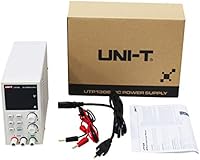
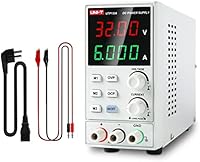
The UNI-T UTP1306 Variable Bench Power Supply sits in an interesting spot — capable enough for serious bench work, yet priced for hobbyists who don't want to compromise on fundamentals. UNI-T has built a credible name in test and measurement gear, and this bench supply reflects that experience. The output range of 0–32V and 0–6A covers the vast majority of low-voltage electronics tasks, and the 192W total power gives it real headroom. The 4-digit EBTN LCD is noticeably sharper and more readable than what you typically find on budget units. It also accepts both 110V and 220V AC input, making it usable internationally. Just don't expect it to match a high-end linear supply in raw noise performance.
Features & Benefits

One of the most practical touches on the UTP1306 is the three memory presets — labeled M1 through M3 — that let you store your most-used voltage and current settings and call them up instantly. If you regularly switch between 3.3V for logic circuits and 12V for motors, that alone saves real time. The independent output switch matters equally: you can dial in your target values with the output off, then apply power cleanly, protecting sensitive components from transient spikes. The user-settable OVP, OCP, and OTP thresholds add meaningful flexibility — fixed-threshold supplies simply don't give you that control. Ripple is rated at ≤10mVrms, which is fine for digital work, though analog purists will notice the switching-supply noise signature at higher sensitivity levels.

Best For

This adjustable DC supply is well-suited to everyday electronics work — Arduino and Raspberry Pi projects, breadboard prototyping, sensor testing, and similar tasks where you need a reliable, adjustable DC source without overspending on lab-grade equipment. Engineering students and instructors will appreciate the repeatability the memory presets and accurate readout provide during experiments. It also fits well in small QC or appliance repair contexts, where the protection features reduce operator error risk. That said, if your work involves testing audio amplifier circuits or anything demanding sub-millivolt noise floors, a linear bench supply is simply a better fit. The switching topology is efficient, but it does carry higher-frequency noise that linear designs avoid entirely.

User Feedback

Across a broad range of buyer reviews, a few patterns stand out consistently. People regularly praise the display clarity and the accuracy of voltage and current readings, noting the unit tracks closely with a dedicated multimeter. Build quality is generally considered solid relative to the price tier. On the downside, fan noise at higher load levels surfaces often — not disruptive, but audible in a quiet room. Some users find configuring the OVP and OCP thresholds unintuitive at first, and the included manual offers limited guidance. A handful of buyers have raised concerns about unit-to-unit consistency in quality control. UNI-T's email-based customer support is generally described as responsive and helpful when issues do arise.

Pros

  • Output accuracy tracks closely with a calibrated multimeter, even at lower voltage settings.
  • Three one-key memory presets make switching between common voltages fast and repeatable.
  • User-settable OVP, OCP, and OTP thresholds protect sensitive components far better than fixed-threshold alternatives.
  • The 4-digit EBTN LCD is sharp, wide-angle readable, and noticeably better than budget-tier displays.
  • Independent output switch lets you set voltage and current safely before applying power to a live circuit.
  • Dual 110V/220V AC input works internationally without needing a separate voltage converter.
  • At under 4 pounds, this bench supply is easy to move, store, and reposition on a crowded bench.
  • Ripple performance is clean enough for digital and mixed-signal work, including microcontroller and logic testing.
  • UNI-T email support has a solid track record of providing technically useful responses rather than generic replies.

Cons

  • The included paper manual is thin and offers almost no guidance on configuring protection thresholds.
  • Fan noise at sustained high current draws is clearly audible and can be distracting in quiet workspaces.
  • Bundled output cables use lightweight connectors and thin wire that struggle at sustained higher current levels.
  • Only three memory preset slots available — not enough for users juggling a wide variety of project types.
  • Quality control consistency is uneven; a small but notable share of buyers receive units with minor physical or functional variances.
  • No soft-start on the output switch means a small inrush transient occurs each time output is enabled.
  • Long-term ownership reviews include recurring reports of fan degradation and occasional display issues after extended use.
  • Support is email-only with no live chat or phone option, which slows resolution when urgent problems come up.

Ratings

The UNI-T UTP1306 Variable Bench Power Supply earned its scores through AI-driven analysis of verified global buyer reviews, with spam, bot activity, and incentivized feedback actively filtered out before scoring. Ratings reflect the full picture — where this adjustable DC supply genuinely impresses hobbyists and small-lab users alike, and where real-world frustrations have surfaced repeatedly across thousands of purchases. Strengths and shortcomings are weighted equally so you can make an informed decision.
Voltage & Current Accuracy
88%
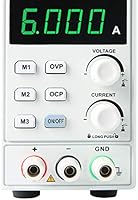
Users consistently report that measured output aligns closely with what a calibrated multimeter reads, which matters when you're powering microcontrollers or testing sensors where a 200mV error could cause misbehavior. The 10mV voltage resolution and 1mA current resolution give enough granularity for most bench tasks without constant fine-tuning.
A small but notable portion of buyers received units where the displayed reading drifted slightly from actual output at the lower voltage end of the range. While not a dealbreaker for most, it can be frustrating for users expecting tighter lab-grade accuracy out of the box.
Display Clarity
91%
The 4-digit EBTN LCD is one of the most consistently praised aspects of this bench supply. Users working in cluttered workshops or under mixed lighting find the display sharp and readable from wide angles, a genuine step up from the dim seven-segment screens common on cheaper units.
A handful of buyers noted the backlight intensity cannot be adjusted, which can cause minor eye strain during long sessions in dark environments. The display itself is excellent; the lack of brightness control is a small but real omission.
Build Quality
79%
21%
For its price tier, the enclosure feels more solid than most competitors, with a metal chassis that doesn't flex under normal bench handling. Knobs have a reassuring resistance and don't wobble, which users who've owned cheaper supplies particularly appreciate.
Some buyers reported visible inconsistencies between units — minor panel alignment issues or knobs that felt slightly looser than expected. Quality control appears generally good but not perfectly uniform, so there is a low but real chance of receiving a unit that feels slightly below par.
Output Protection (OVP/OCP/OTP)
86%
Having all three protections — over-voltage, over-current, and over-temperature — as user-settable thresholds rather than fixed factory values is a meaningful advantage. Users working with sensitive components, like bare ICs or custom LED drivers, can dial in tight protection windows that prevent expensive mistakes.
The process for configuring OVP and OCP thresholds is not intuitive, and the paper manual provides minimal guidance. New users frequently spend time searching online forums to understand the protection setup workflow, which adds unnecessary friction during initial setup.
Noise & Ripple Performance
71%
29%
At ≤10mVrms voltage ripple, this bench supply handles digital and mixed-signal work comfortably. Powering Arduino projects, logic analyzers, or Raspberry Pi boards produces no noticeable interference, and most hobbyist use cases fall well within the supply's clean output envelope.
As a switching-topology supply, higher-frequency noise is an inherent trade-off, and users testing audio amplifier stages or RF circuits have flagged it as a limitation. For those applications specifically, a linear bench supply remains the more appropriate choice, and the UTP1306 does not pretend otherwise.
Memory Presets (M1–M3)
84%
The three one-key recall presets are a genuinely useful workflow feature. Users who regularly cycle between fixed voltages — say 3.3V for logic, 5V for USB simulation, and 12V for motor testing — can switch configurations in seconds rather than re-dialing each time.
Three presets cover the most common use cases but feel limiting for users running diverse project types who might want five or six stored configurations. There is no way to label or annotate the preset slots, so remembering which memory slot holds which setting relies entirely on the user.
Fan Noise
63%
37%
Under light to moderate loads, the cooling fan is quiet enough that most users working in a normal workshop environment barely notice it. The switching topology also means the unit runs relatively cool compared to linear supplies of equivalent output, reducing how hard the fan needs to work overall.
At sustained higher current draws, the fan becomes clearly audible and has been described by several buyers as distracting in quiet home office or bedroom lab setups. It is not unusually loud by bench supply standards, but users expecting near-silent operation at full load will be disappointed.
Value for Money
87%
Considering the output range, protection features, memory presets, and display quality combined, most buyers feel the price is fair and the supply punches above its weight. Hobbyists upgrading from a basic unregulated supply consistently describe it as a significant capability jump for a reasonable investment.
A small segment of buyers feel the price is slightly high compared to visually similar supplies from lesser-known brands offering comparable specs on paper. However, UNI-T's brand track record and the measurable accuracy advantage generally justify the premium for informed buyers.
Ease of Setup
76%
24%
Out of the box, basic voltage and current adjustment is intuitive enough that experienced hobbyists can be running experiments within minutes of plugging in. The independent output switch adds a layer of safety that actually makes first use less stressful than on simpler supplies.
The included printed manual is thin and lacks depth on advanced features like protection threshold configuration and memory preset usage. Users without prior bench supply experience often need to supplement with online tutorials or community forum posts before they feel fully confident.
Output Switch Functionality
89%
The ability to set voltage and current limits with the output completely off before applying power to a circuit is a feature seasoned electronics builders particularly value. It eliminates the brief overshoot or transient spike that can occur when dialing settings while a sensitive circuit is live.
The switch itself is a simple toggle with no soft-start functionality, so there is still a small inrush transient when output is enabled. For most use cases this is inconsequential, but builders working with particularly sensitive analog circuits should be aware of it.
International Compatibility
92%
The auto-switching 110V/220V AC input means the supply travels well and works reliably across North American, European, and Asian outlets with only a plug adapter needed. International buyers and users who work across different regions specifically highlight this as a genuine convenience.
The included plug adapter is basic and covers only the most common outlet formats. Users in regions with less standard outlet types may need to source their own adapter separately, which is a minor but occasionally frustrating gap in the included accessories.
Physical Size & Bench Footprint
81%
19%
At under 4 pounds and with a compact footprint, the UTP1306 fits comfortably on a crowded workbench without dominating the space. Users with smaller home lab setups specifically appreciate that it doesn't require rearranging everything else just to find a home for it.
The roughly 10-inch cube form factor, while reasonable, is not the most compact available at this power level. Users with extremely tight bench space or those who need to store the supply between sessions may find it slightly bulkier than expected given its weight.
Long-Term Reliability
68%
32%
The majority of buyers who have owned the supply for a year or more report consistent, stable performance with no degradation in accuracy or output quality. UNI-T's manufacturing reputation in test equipment gives more confidence here than comparably priced unknown-brand alternatives.
There is a visible tail of reliability complaints in long-term ownership reviews — occasional fan failures, display flickers after extended use, and a few reports of output instability developing over time. The rate is not alarming, but it is present enough to be a legitimate consideration for buyers planning heavy daily use.
Customer Support
74%
26%
UNI-T's email-based support is generally described as responsive and technically competent. Buyers who reached out with setup questions or early-life defect issues report receiving helpful, specific replies rather than generic boilerplate responses, which is not guaranteed at this price point.
Support is exclusively email-based with no live chat or phone option, which slows resolution for urgent issues. International buyers outside of the primary market occasionally report longer response times, and the absence of a more robust self-service knowledge base means routine questions require direct contact.
Output Cable & Accessory Quality
62%
38%
The included output cables and barrel connector are functional and adequate for getting started immediately without purchasing additional accessories. For casual bench use and initial testing, most buyers find the bundled kit sufficient for their first several projects.
Repeated use tends to reveal the included cables as a weak point — connectors feel lightweight and the wire gauge is on the thin side for sustained higher-current applications. Users planning to regularly draw 4A or more should consider upgrading to heavier-gauge cables fairly early in ownership.

Suitable for:

The UNI-T UTP1306 Variable Bench Power Supply is a strong match for electronics hobbyists, makers, and students who need a dependable, adjustable DC source for everyday bench work without paying for capabilities they'll rarely use. If your typical sessions involve powering Arduino boards, Raspberry Pi setups, LED drivers, or breadboard prototypes, this adjustable DC supply covers all of it comfortably within its 0–32V, 0–6A envelope. Engineering students and instructors will find the repeatable output and memory presets particularly useful for structured lab experiments where consistent starting conditions matter. Small repair shops and appliance technicians will also benefit from the user-settable protection thresholds, which add a meaningful safety layer when working with unfamiliar circuits. Anyone who regularly switches between fixed voltage levels — say, 3.3V, 5V, and 12V — will find the three one-key memory presets cut setup time noticeably. The dual 110V/220V AC input makes it a practical choice for international users or anyone who works across multiple locations without wanting to manage voltage converters.
Not suitable for:

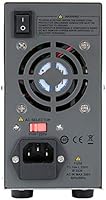
The UNI-T UTP1306 Variable Bench Power Supply is not the right tool for every situation, and being clear about that upfront saves real frustration. If your primary work involves testing audio amplifier circuits, RF front-ends, or any analog signal chain where noise floors matter at the millivolt level, the switching topology introduces higher-frequency interference that a linear supply simply does not. Professional R&D environments requiring certified lab-grade accuracy, comprehensive data logging, or remote programmability via USB or GPIB will quickly find this bench supply underpowered from a feature standpoint. Users expecting a completely silent workspace should also recalibrate their expectations — the cooling fan becomes clearly audible during sustained higher-current draws. Those planning to run the supply at or near its maximum output for extended periods should be aware that long-term reliability reports are mixed enough to warrant consideration. Finally, buyers who want deep configuration documentation or in-person technical support will find UNI-T's email-only support model a limiting factor when time-sensitive troubleshooting arises.
Specifications

  • Output Voltage: Continuously adjustable DC output from 0 to 32V with a resolution of 10mV per step.
  • Output Current: Continuously adjustable current limit from 0 to 6A with a resolution of 1mA per step.
  • Output Power: Maximum continuous output power is 192W under rated conditions.
  • Input Voltage: Auto-compatible with both 110V AC and 220V AC mains input at 50Hz to 60Hz frequency.
  • Display: 4-digit EBTN LCD shows voltage and current simultaneously with wide-angle visibility.
  • Voltage Ripple: Output voltage ripple and noise measured at ≤10mVrms across the 20Hz to 20MHz bandwidth.
  • Current Ripple: Output current ripple measured at ≤5mArms across the 20Hz to 20MHz bandwidth.
  • Protections: User-settable over-voltage protection (OVP), over-current protection (OCP), and over-temperature protection (OTP) are all included.
  • Memory Presets: Three independent one-key memory slots (M1, M2, M3) allow storage and instant recall of voltage and current configurations.
  • Load Regulation: Constant voltage load regulation is rated at less than 0.1% plus 5mV; constant current load regulation at less than 0.2% plus 3mA.
  • Connector Type: Output terminals use a standard barrel connector format compatible with common bench test leads.
  • Cooling Method: Active air cooling via an internal fan that adjusts to thermal load conditions.
  • Form Factor: Benchtop unit designed for stationary desk or workbench use.
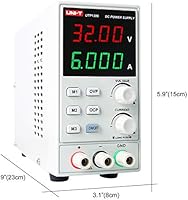
  • Dimensions: Physical dimensions are 9.84 x 9.06 x 9.84 inches (approximately 25 x 23 x 25 cm).
  • Weight: Unit weighs 3.96 pounds (approximately 1.8 kg), making it easy to reposition on a bench.
  • Topology: Switching regulated design offers high efficiency and lower weight compared to equivalent linear bench supplies.
  • Programming Accuracy: Voltage programming accuracy is rated at less than 0.1% plus 1 digit; current accuracy at less than 0.2% plus 3mA at 25°C ±5°C.
  • Output Switch: An independent output on/off switch allows users to configure voltage and current settings before applying power to a connected circuit.
  • MTBF: Mean time between failures is rated at a minimum of 2000 hours under normal operating conditions.
  • Included Accessories: Package includes one plug adapter, one power cord, one set of output cables, one printed English manual, and one digital English manual.

Related Reviews

Pyramid PSV150 Compact Bench Power Supply
89%
95%
Voltage Accuracy
93%
Current Stability
88%
Build Quality
91%
Safety Features
90%
Connection Versatility
More
Pyramid PS26KX Universal Compact Bench Power Supply
86%
91%
Power Output Consistency
88%
Build Quality
85%
Cooling Efficiency
80%
Ease of Use
94%
Safety Features
More
Pyramid PS7KX Bench Power Supply
80%
91%
Voltage Stability
88%
Value for Money
93%
Ease of Setup
74%
Build Quality
78%
Cooling Performance
More
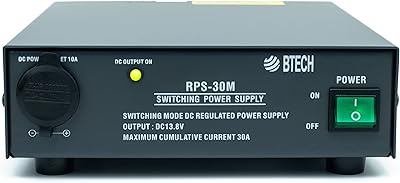
BTECH RPS-30M 30A Bench Power Supply
80%
93%
Voltage Stability
88%
Output Current Capacity
86%
Ripple & Noise
84%
Build Quality
91%
Compact Design
More
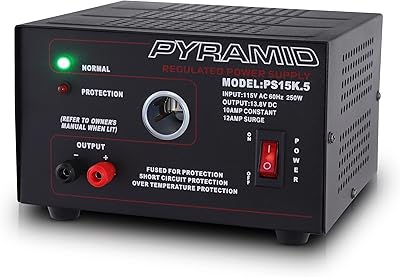
Pyramid PS15K.5 Universal Compact Bench Power Supply
85%
89%
Performance
91%
Build Quality
86%
Ease of Use
88%
Reliability
93%
Safety Features
More
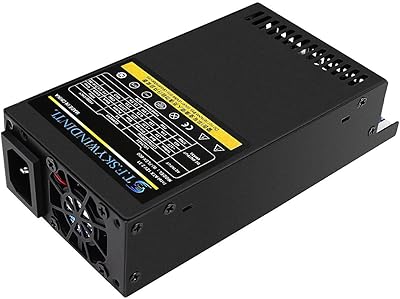
T.F.SKYWINDINTL TF600 600W Fully Modular Flex ATX Power Supply
84%
88%
Performance
91%
Modular Design
89%
Build Quality
54%
Noise Under Load
87%
Ease of Installation
More
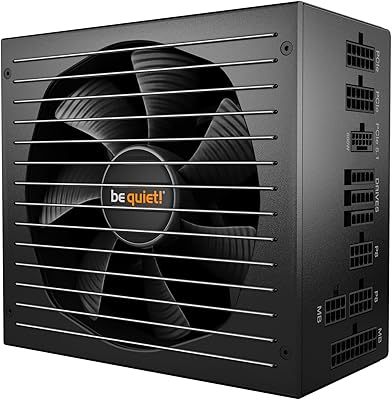
be quiet! Straight Power 12 1000W Power Supply
88%
94%
Quiet Operation
92%
Energy Efficiency
89%
Build Quality
90%
Modular Design and Cable Management
88%
Stability Under Load
More
LC-Power LC1200P 1200W Gaming PC Power Supply
85%
89%
Performance
91%
Energy Efficiency
85%
Cable Management
87%
Noise Level
88%
Reliability
More
be quiet! Pure Power 13 M 850W Power Supply
89%
92%
Performance
94%
Efficiency
88%
Noise Level
91%
Modular Design
89%
Build Quality
More
be quiet! Dark Power Pro 13 PSU
84%
96%
Voltage Stability & Regulation
93%
Noise Level
94%
Efficiency (80 Plus Titanium)
91%
PCIe 5.0 & 12VHPWR Compatibility
83%
Rail Configuration Flexibility
More

FAQ

Yes, the supply automatically accepts both 110V and 220V AC input at 50–60Hz, so you only need a plug shape adapter for local outlets — no separate voltage converter required. This makes it genuinely practical for international use or if you work across multiple locations.

You dial in your desired voltage and current settings, then hold the corresponding M1, M2, or M3 button to save them. From then on, a single press recalls those exact values instantly. It is especially useful when you regularly switch between fixed voltages like 3.3V, 5V, and 12V across different projects.

Yes, with some care it is well-suited for that. The key is to use the independent output switch — set your voltage and current limit with the output off, confirm the settings on the display, then switch the output on. Combined with user-configurable OVP and OCP thresholds, this workflow gives you a meaningful safety margin when powering delicate boards.

The process is not immediately obvious from the front panel, and the printed manual provides limited help here. Generally, you access the protection settings through a dedicated menu accessed by holding specific buttons — the exact sequence is covered in the digital manual included in the package. If you still have trouble, UNI-T's support team responds to email queries and can walk you through it.

Under light to moderate loads, most users find it quiet enough to ignore. At sustained higher current draws — roughly 4A and above — the fan becomes clearly audible. In a typical workshop it blends into background noise, but in a quiet home office or bedroom lab, it is noticeable during long sessions.

The UNI-T UTP1306 Variable Bench Power Supply is a switching-mode supply, which means it inherently carries higher-frequency noise components compared to a linear design. For digital circuits, microcontrollers, and general prototyping, the ripple spec of ≤10mVrms is perfectly adequate. For audio amplifier stages, RF circuits, or any application where you need a very low noise floor, a linear supply remains the technically correct choice.
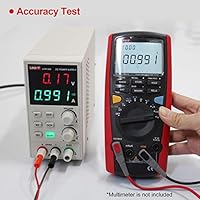
The rated output range starts at 0V, so in principle you can dial it down to zero. In practice, most switching supplies have a small offset at the very bottom of the range, and a few users have noted slight inaccuracy near 0V. For anything above a volt or two, accuracy is well within acceptable limits for bench work.

The supply will switch from constant voltage (CV) mode into constant current (CC) mode, clamping the output current at your set limit and allowing the voltage to sag below your set point. This is normal, protective behavior — the display typically indicates the active mode. No damage occurs to the supply; you simply raise the current limit until the load runs properly in CV mode.

They are adequate for light use and getting started straight out of the box. For sustained draws above 3–4A or regular daily use, many experienced users upgrade to heavier-gauge cables with more robust connectors. The bundled cables are functional but not the strongest part of the package.

UNI-T operates email-based customer support and, based on broad buyer experience, responses tend to be technically helpful rather than generic. Turnaround is generally reasonable for non-urgent questions, though there is no live chat or phone option. For buyers outside of the primary market region, response times can occasionally run longer, so factor that in if you are purchasing internationally.