Overview

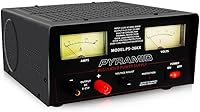
The Pyramid PS26KX 22-Amp Bench Power Supply is a linear regulated unit that has been on the market since 2007 — a long run that speaks to both its staying power and its age. It converts 115V AC to adjustable 6-15V DC, delivering a continuous 22A with a 25A surge capacity, making it a practical workhorse for CB, HAM, and scanner radio setups. Linear regulation is the right call when low RF noise matters, though it comes at a real cost: this thing is bulky. At 11.8 x 9.1 x 7.1 inches and roughly 16 pounds, it demands serious bench space before you even flip the switch.
Features & Benefits

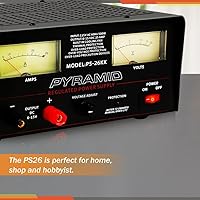
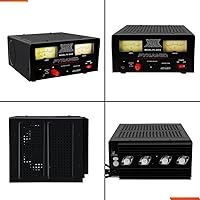
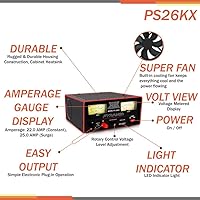
The adjustable voltage control lets you dial in anywhere from 6V to 15V DC — genuinely useful when testing equipment that does not want a flat 12V. Connections are handled by screw-type terminals, which are sturdier and more vibration-resistant than banana plugs, especially for permanent bench installs. The built-in analog amperage gauge is a practical touch; you can watch your load in real time without reaching for a separate meter. An auto-reset fuse combined with electronic overload and short-circuit protection adds a meaningful safety layer during device testing. The active cooling fan and heatsink work together to keep the PS26KX stable under sustained high draws.

Best For

This bench supply is a natural fit for HAM and CB radio operators who want a dedicated, always-on 12V source at the workbench — no batteries, no workarounds. Scanner users and two-way radio hobbyists will appreciate the stable, low-noise output that linear regulation delivers, particularly when RF interference is a concern. It also handles general electronics testing well, anywhere adjustable low-voltage DC is needed. That said, if portability or energy efficiency matters, a modern switching supply is the smarter pick. The PS26KX earns its place in setups where permanence and stability outweigh any premium on compactness or running costs.

User Feedback

With a 4.4-star average across 62 ratings, this linear power supply lands in solidly positive territory — though 62 reviews is a modest sample, so treat the consensus as directional rather than definitive. Owners frequently highlight the stable output and no-nonsense build quality, and most find the hookup process refreshingly straightforward. On the downside, the cooling fan attracts noise complaints at sustained higher loads, a trade-off common to active-cooled linear designs. A handful of buyers also mention the sheer footprint as a genuine surprise out of the box. The one-year warranty is category standard, nothing more. Long-term reliability feedback from extended users appears largely encouraging.

Pros

  • Linear regulation keeps RF noise low — a meaningful advantage for radio operators working near sensitive receive equipment.
  • Continuous 22A output handles demanding loads without throttling, with a 25A surge rating for transient spikes.
  • Adjustable 6-15V output range offers flexibility that fixed 12V supplies simply cannot match.
  • Screw-type terminals lock connections in firmly, reducing the risk of accidental disconnects during extended bench sessions.
  • The built-in analog amperage gauge means one less instrument cluttering your workbench.
  • Auto-reset short-circuit and overload protection adds a practical safety net when testing unfamiliar components.
  • Active cooling fan combined with a cabinet heatsink allows sustained high-current operation without manual intervention.
  • No complex setup required — plug in, switch on, and you have clean DC power within seconds.
  • A track record going back to 2007 suggests the core design is at least mechanically proven over time.

Cons

  • At 16 pounds and nearly a foot wide, this bench supply physically dominates smaller workspaces in a way that can be genuinely inconvenient.
  • The cooling fan generates noticeable noise under sustained high loads — a real irritant in quiet home environments.
  • Linear regulation is inherently less efficient than switching alternatives, meaning higher heat output and greater electricity draw for equivalent current.
  • The design has not been meaningfully updated since its 2007 debut, leaving it behind on features like digital displays or USB monitoring ports.
  • Only 62 Amazon ratings after nearly two decades on the market raises fair questions about long-term market confidence.
  • The one-year warranty is bare minimum for this product category and price tier — notably shorter than what some competitors offer.
  • No binding posts or banana-plug terminals means wiring flexibility is limited to whatever fits the screw connectors.
  • Heat buildup at sustained near-maximum draws can be noticeable, requiring adequate bench ventilation to stay comfortable.

Ratings

Our scores for the Pyramid PS26KX 22-Amp Bench Power Supply were generated by AI after analyzing verified buyer reviews from multiple global sources, with spam, bot activity, and incentivized feedback actively filtered out. The ratings below reflect a transparent look at both what this bench supply does well and where real users have run into friction. Strengths and pain points carry equal weight in how each score was determined.
Output Stability
88%
Radio hobbyists consistently single out the stable, clean DC output as the PS26KX's defining strength. HAM operators running SSB transceivers report noticeably less interference and voltage sag under load compared to budget switching supplies they had used previously.
A small number of users noted minor voltage fluctuations when the supply was pushed close to its 22A ceiling for extended periods. While not common, it suggests the regulation is best relied upon below the maximum rated draw.
RF Noise Performance
84%
The linear regulated design is specifically why many radio users chose this supply over cheaper switching alternatives. CB and scanner users frequently mention that background hiss and interference on their receivers dropped after switching to the PS26KX.
Linear regulation is inherently better at suppressing RF noise than switching designs, but it is not perfect — a handful of users in electrically busy environments still observed minor noise artifacts. It is excellent for its class, but not a laboratory-grade filtered supply.
Build Quality
79%
21%
The metal cabinet feels solid and the overall construction gives a sense of durability that buyers associate with equipment designed to sit on a bench permanently. Several long-term owners who have had theirs running for multiple years report no structural or functional degradation.
Some buyers feel the fit and finish is functional rather than refined — a few noted minor cosmetic inconsistencies on the cabinet or front panel. At this price tier the build is acceptable, but it does not feel premium in the way that comparable units from specialized brands might.
Ease of Setup
91%
Getting this supply running takes almost no time — plug it into the wall, strip your wire leads, tighten the screw terminals, and flip the switch. First-time bench supply users mention how approachable the setup feels, with no drivers, apps, or configuration menus to navigate.
The screw-terminal-only connection approach is simple but limiting for users who want to quickly swap between different devices or test rigs. Those accustomed to supplies with banana-plug sockets or quick-disconnect terminals find the setup less flexible in practice.
Thermal Management
73%
27%
The combination of a cabinet heatsink and active fan does its job under typical operating loads. Users running HAM radios at moderate duty cycles report that the supply stays warm but manageable, with no thermal shutdowns during normal operating sessions.
At sustained high current draws, the unit generates significant heat, and the cooling system has to work hard to keep up. A few users in warmer climates or enclosed spaces noted that surface temperatures climbed to uncomfortable levels after extended high-load sessions.
Fan Noise
58%
42%
The fan does its job reliably and has not been reported as a source of failure. Users who run the supply in a dedicated workshop or garage rarely flag the noise as an issue, treating the hum as just part of the bench environment.
In home office or listening room settings, the continuous fan noise is a recurring complaint. Several buyers specifically mention that the fan is audible even at low loads and becomes noticeably louder as current draw increases — a real irritant for anyone working in a quiet space.
Amperage Gauge Accuracy
67%
33%
The built-in analog gauge gives users a quick, at-a-glance read on current draw without needing a separate meter cluttering the bench. For general load monitoring — checking whether a radio is pulling within its expected range — it is genuinely useful.
The analog needle is not precise enough for users who need accurate current measurements for calibration or circuit analysis. Several technically-minded buyers noted discrepancies between the gauge reading and their dedicated digital multimeters, particularly at lower current levels.
Voltage Adjustability
76%
24%
The 6-15V adjustment range is a meaningful practical advantage over fixed 12V supplies. Electronics hobbyists testing components that need voltages outside the standard 12V mark appreciate having a single supply that can adapt rather than reaching for a second unit.
The front-panel control works, but some users find it imprecise — getting to an exact voltage requires patience and a separate voltmeter. There is no digital readout for voltage on the front panel, which feels like an oversight on a supply at this price point.
Protection Reliability
82%
18%
The auto-reset short-circuit and overload protection has earned genuine trust from users who regularly connect unfamiliar or prototype equipment. Several buyers specifically mention the auto-reset feature as a reason they feel confident testing circuits without babysitting the supply.
A small number of users reported that the protection circuit tripped under load conditions that should theoretically fall within the rated specifications. Whether this reflects unit variation or conservative trip thresholds is unclear, but it has caused frustration for a handful of buyers.
Physical Size & Weight
52%
48%
The large size and heavy transformer are inherent to the linear design and are accepted trade-offs by buyers who prioritize clean output. Users with dedicated workshop benches rarely cite the footprint as a problem once the supply has its permanent home.
At 16 pounds and nearly a foot across, this is a supply that genuinely dominates a small bench. Multiple buyers mention being surprised by the real-world size on arrival, and those in shared or compact workspaces have found it difficult to justify keeping it long-term.
Value for Money
69%
31%
For users whose primary need is low-noise, stable 12V DC power for radio use, the PS26KX delivers on its core promise, and the adjustable output adds flexibility that cheaper fixed supplies cannot match. Long-term owners who have used it for years feel the investment was justified.
At its asking price, buyers increasingly compare it against modern switching supplies that offer digital displays, tighter regulation, and programmable presets at a lower price point. The value proposition holds primarily if linear regulation specifically matters to your use case.
Compatibility Range
77%
23%
The adjustable 6-15V output covers a wide range of 12V-class devices beyond radio gear, including automotive accessories, lighting rigs, and small motors. The screw terminals accept a range of wire gauges, making it adaptable to different hookup configurations.
It is strictly a North American unit — 115V AC input only — which eliminates it entirely for international buyers. There is also no dual-output option or multiple isolated channels, which limits its use for more complex test bench scenarios.
Long-Term Reliability
74%
26%
The design has been on the market since 2007, and the bulk of long-term owners who revisit their reviews report continued reliable operation over multiple years of use. The simple linear topology has fewer failure-prone components than complex switching designs.
The modest review volume of 62 ratings after nearly two decades makes it harder to draw statistically confident conclusions about failure rates. A few buyers reported early failures, and without a large sample it is difficult to determine whether those represent an outlier or a pattern.
Warranty & Support
55%
45%
The one-year warranty provides a baseline level of coverage, and buyers who needed warranty service during that window generally report that the process was handled without significant friction.
A one-year warranty is the minimum expected for electronics at this price tier, and several buyers expressed disappointment when comparing it to competitors offering two- or three-year coverage. Post-warranty support options through the manufacturer are not well documented or consistently available.

Suitable for:

The Pyramid PS26KX 22-Amp Bench Power Supply is purpose-built for radio hobbyists and home lab users who want a stable, permanent DC power station on their workbench. HAM and CB radio operators are the clearest fit — the linear regulated design keeps RF noise low, which matters when you are transmitting or monitoring sensitive signals. Scanner enthusiasts and two-way radio users who are tired of managing batteries will find this a clean, always-ready alternative. The adjustable 6-15V output also makes it genuinely useful for electronics hobbyists who test components requiring voltages below the standard 12V mark. If your bench has the real estate and your use case is fixed rather than portable, this supply rewards you with straightforward, reliable operation.
Not suitable for:

Buyers expecting a compact, energy-efficient power source will find themselves frustrated almost immediately — the Pyramid PS26KX 22-Amp Bench Power Supply weighs 16 pounds and occupies a footprint close to a foot wide, which is a real constraint in smaller workshops or shared spaces. Linear regulation is intentionally inefficient by design, generating more heat than a comparable switching supply, so running costs and thermal output are genuine considerations in enclosed or warm environments. Anyone needing advanced digital controls, programmable voltage presets, or precision lab-grade regulation at the millivolt level should look at more modern alternatives. The design dates to 2007 and has not been substantially updated, so buyers who value current-generation engineering or a broader ecosystem of accessories will likely feel limited here. If portability, efficiency, or feature density drives your purchase, this is not the right tool.
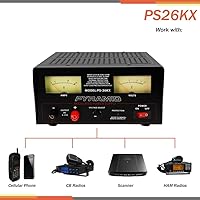
Specifications

  • Output Voltage: Continuously adjustable from 6V to 15V DC via a front-panel control knob.
  • Continuous Current: Delivers a steady 22 amps of continuous DC current under normal operating conditions.
  • Surge Current: Handles transient current spikes up to 25 amps to accommodate brief startup loads.
  • AC Input: Accepts 115V AC at 60Hz standard North American household current only.
  • Input Wattage: Rated at 500 watts maximum power input from the AC mains.
  • Regulation Type: Uses a linear regulated circuit design, which produces lower electrical noise compared to switching-mode alternatives.
  • Terminals: Connections are made via hardwired screw-type terminals that accept bare wire leads directly.
  • Current Display: An analog amperage gauge is built into the front panel for real-time load monitoring.
  • Cooling System: Combines a cabinet-mounted heatsink with an active internal cooling fan to manage thermal output under sustained loads.
  • Protection: Includes electronic overload protection, short-circuit protection, and an auto-reset fuse for operator and equipment safety.
  • Dimensions: The unit measures 11.8 x 9.1 x 7.1 inches (length x width x height).
  • Weight: Weighs approximately 16 pounds, which reflects the heavier transformer common to linear regulated designs.
  • Form Factor: Designed as a benchtop unit intended for stationary, permanent placement in a home lab or workshop.
  • Brand: Manufactured by Pyramid, a brand under the Sound Around umbrella specializing in power and audio accessories.
  • Model Number: The official model designation is PS26KX, which identifies this specific variant within the Pyramid lineup.
  • Warranty: Covered by a one-year limited manufacturer warranty from the date of purchase.
  • First Available: This model has been commercially available since November 2007, giving it a long production history.
  • Operation: Operates via a simple plug-in, switch-activated design requiring no software, drivers, or complex configuration.

Related Reviews

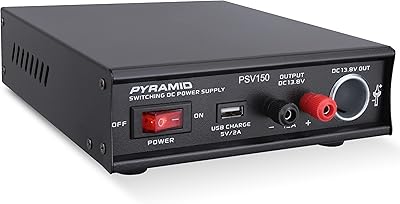
Pyramid PSV150 Compact Bench Power Supply
89%
95%
Voltage Accuracy
93%
Current Stability
88%
Build Quality
91%
Safety Features
90%
Connection Versatility
More
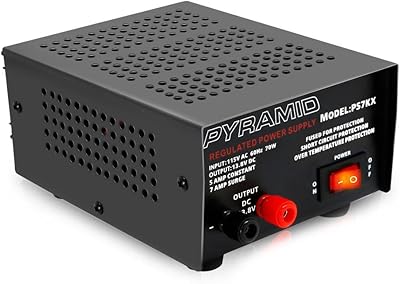
Pyramid PS7KX Bench Power Supply
80%
91%
Voltage Stability
88%
Value for Money
93%
Ease of Setup
74%
Build Quality
78%
Cooling Performance
More
BTECH RPS-30M 30A Bench Power Supply
80%
93%
Voltage Stability
88%
Output Current Capacity
86%
Ripple & Noise
84%
Build Quality
91%
Compact Design
More
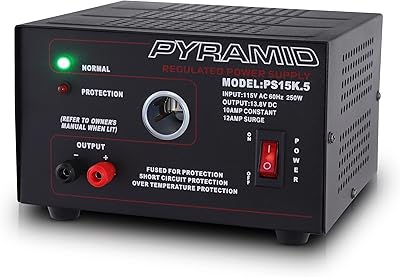
Pyramid PS15K.5 Bench Power Supply
81%
92%
Output Voltage Stability
89%
Electrical Noise
86%
Value for Money
76%
Current Capacity
58%
Fan Noise
More
BTECH RPS-30PRO 30A Bench Power Supply
84%
91%
Output Voltage Stability
83%
Noise & RF Interference
88%
Build Quality
87%
Current Delivery
93%
Ease of Setup
More
be quiet! Straight Power 12 1000W PSU
84%
91%
Acoustic Performance
89%
Build Quality
68%
Cable Quality
93%
Connector Compatibility
71%
Value for Money
More
be quiet! Pure Power 13 M 1000W PSU
84%
93%
Acoustic Performance
89%
Build Quality
88%
Efficiency & Heat Output
91%
PCIe 5.1 Compatibility
87%
Voltage Stability
More
be quiet! Pure Power 13 750W PSU
86%
93%
Noise Level
88%
Build Quality
86%
Value for Money
74%
Wattage & Power Headroom
84%
Cable Quality & Modularity
More
LC-Power LC1200P 1200W Modular Power Supply
81%
84%
Build Quality
88%
Power Delivery Stability
83%
Efficiency
87%
Noise Level
91%
Cable Management
More
be quiet! Pure Power 13M 850W PSU
85%
93%
Acoustic Performance
88%
Build Quality
91%
Voltage Stability
94%
Future Compatibility
79%
Value for Money
More

FAQ

In most cases, yes. The PS26KX delivers a stable 12V DC output at up to 22 continuous amps, which covers the power requirements of the majority of mid-range HAM transceivers. Just confirm your radio's peak current draw falls within the 25A surge rating, and you should be fine. The linear regulation also keeps RF noise low, which is a genuine advantage in radio applications.

It is designed for continuous 22A operation, and the combination of the internal cooling fan and cabinet heatsink is there to handle sustained loads. That said, like any linear supply running near its ceiling, it will get warm. Make sure there is reasonable airflow around the unit and it is not crammed into an enclosed cabinet.

The screw-type terminals accept bare wire leads directly, so you will need to strip the insulation from your wire ends before connecting. For a supply capable of 22A, use appropriately rated wire gauge — 10 AWG is a common and safe choice for runs at or near full current. Under-sized wire is a real safety risk, so do not cut corners here.

Based on the design of this class of linear supply, the cooling fan in the PS26KX runs continuously whenever the unit is powered on, not just under thermal stress. This is worth knowing upfront if you are working in a quiet space, as the fan does produce a noticeable hum, particularly at higher load levels.

No. The Pyramid PS26KX 22-Amp Bench Power Supply is rated specifically for 115V AC at 60Hz, which is the standard North American wall outlet. Plugging it into a 220-240V supply without a proper step-down transformer would likely damage the unit and void any warranty coverage.

The analog gauge gives you a reasonable real-time indication of your current draw, but it is not a precision instrument. For general monitoring of whether your load is within normal range, it does the job well. If you need precise measurements for calibration or circuit analysis, pairing it with a dedicated digital clamp meter is the smarter move.

The unit has built-in electronic short-circuit protection and an auto-reset fuse that kicks in to cut power before damage occurs. Once the fault is cleared, the supply should reset itself without needing a manual fuse replacement. It is a practical safety net, though it is still good practice to double-check your wiring before powering up unfamiliar equipment.

You can, as long as the combined current draw of all connected devices stays below the 22A continuous limit. The screw terminals are a single output point, so you would need to use a distribution block or bus bar to split the connection to multiple devices cleanly and safely.

It depends entirely on what you are doing. Linear supplies like this one produce significantly lower electrical noise, which makes them the preferred choice for radio communications and sensitive audio equipment. Switching supplies are more compact and efficient but can introduce interference. If RF noise is not a concern for you, a modern switching supply might actually be a more practical option overall.

The core linear regulation technology is well understood and inherently stable, so the age of the design is not necessarily a red flag for basic functionality. Where it shows its age is in the feature set — there is no digital display, no USB monitoring, and no programmable presets. For a straightforward, reliable bench supply for radio or hobbyist use, it still holds up. For anything requiring more sophisticated control, newer alternatives have caught up considerably.