Overview

The T.F.SKYWINDINTL TF600 600W Flex ATX Power Supply occupies a genuinely useful niche — compact 1U builds where standard ATX units simply won't fit. Flex ATX PSUs are a small but critical category: rack-mount servers, AIO desktops, and tight SFF cases all depend on them, yet the market offers relatively few options above 500W. The TF600 sits at the higher end of T.F.SKYWINDINTL's wattage lineup, and its fully modular design is rare at this form factor. Add universal 100-240V input support, and it becomes relevant beyond North America — useful for builders or businesses operating in regions with inconsistent mains voltage. It targets a mid-range buyer who needs real wattage headroom without stepping up to a full ATX unit.
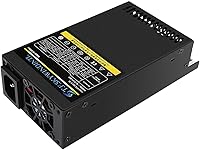
Features & Benefits

What makes the TF600 genuinely practical in a 1U chassis is fully modular cabling — you connect only the leads your system actually needs, which matters enormously when interior space is measured in millimeters. Under the hood, it uses a DC-DC conversion topology, which tends to produce cleaner, more stable output rails compared to older group-regulated designs. T.F.SKYWINDINTL claims 100% Japanese capacitors, a common marketing line in this segment that warrants some skepticism without independent verification, though the active PFC and six-layer protection suite — covering over-voltage, under-voltage, over-current, over-power, short-circuit, and over-temperature scenarios — are concrete and meaningful. The 40mm fan keeps it within its 1U envelope, but expect audible noise under load; that's physics, not a flaw.

Best For

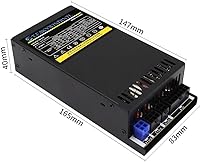
This Flex ATX PSU is built for a specific type of builder, and knowing whether you're in that group saves time. It fits cases with Flex ATX dimensions — 165×83×40mm — making it directly applicable to rack-mount enclosures, point-of-sale terminals, all-in-one desktops, and compact home servers where no alternative form factor will physically work. The universal input voltage is a practical bonus for international deployments or locations with unreliable grid power. DIY upgraders trying to squeeze more wattage out of an aging SFF system will find the 600W headroom useful. That said, if your build involves a discrete graphics card needing dedicated PCIe power, this 1U power supply lacks the connector set for it. Look elsewhere for gaming rigs.

User Feedback

With a 3.6 out of 5 average across 57 reviews, the TF600 sits in genuinely mixed territory — not condemned, but not celebrated either. Buyers who got it right tend to appreciate the clean cable routing it enables and stable power delivery under light to moderate loads. Critics point to two consistent issues: fan noise at load, which is an inherent consequence of a 40mm fan spinning fast in a tiny chassis, and a limited cable bundle that catches some buyers off guard. A handful of complaints also touch on packaging and shipping. Worth noting: some one-star reviews reflect wrong-use-case purchases rather than actual product failures. If you know what this 1U power supply is designed for and stay within its scope, the feedback picture improves noticeably.

Pros

  • Fully modular design eliminates cable clutter in tight 1U enclosures, improving airflow and simplifying assembly.
  • At 600W, the TF600 offers genuine wattage headroom rarely found in the Flex ATX form factor.
  • Universal 100–240V input makes it a reliable choice for international deployments or unstable-grid environments.
  • DC-DC conversion topology produces cleaner output rails, which benefits sensitive storage and server hardware.
  • Six-layer protection suite — including OVP, OCP, and OTP — guards against common electrical fault scenarios.
  • Compact 165×83×40mm footprint fits rack-mount, POS, and AIO cases that accept no other PSU format.
  • Active PFC improves power efficiency and reduces stress on the electrical circuit it draws from.
  • Modular cable management earns consistent praise from buyers who matched it correctly to their build.

Cons

  • The 40mm fan generates significant noise at load — not a unit for quiet or near-silent builds.
  • No PCIe power connector is included, ruling out any system with a dedicated graphics card.
  • The cable bundle is limited; buyers with more complex power needs may find themselves short on connections.
  • Manufacturer claims around Japanese capacitors and 90% efficiency lack independent third-party validation.
  • A 3.6 out of 5 average rating across 57 reviews indicates a meaningful proportion of dissatisfied buyers.
  • Packaging and shipping complaints appear with enough frequency to suggest inconsistent pre-delivery handling.
  • Only the included cables can be used with this unit, limiting future flexibility and replacement options.
  • A sibling model in the same lineup carries an even lower average rating, raising broader brand consistency questions.

Ratings

Our scores for the T.F.SKYWINDINTL TF600 600W Flex ATX Power Supply were generated by an AI system trained to analyze verified global buyer reviews, actively filtering out incentivized submissions, spam, and bot-generated feedback to surface genuine user experience. The scorecards below reflect both what this 1U PSU does well for the right buyer and where it genuinely falls short, without softening real trade-offs. Strengths and pain points are weighted equally, so every score represents an honest cross-section of real-world satisfaction.
Value for Money
71%
29%
For the Flex ATX segment, 600W with full modularity at this price point is genuinely competitive — comparable units from established brands often cost noticeably more for the same wattage tier. Users building POS terminals or compact servers on a defined budget consistently found the overall package reasonable for what it delivers in this niche.
Buyers who need PCIe connectors or additional SATA ports end up purchasing a different unit anyway, which undermines the value proposition for them. The absence of independent efficiency certification also makes it harder to justify the spend against better-documented competitors in adjacent form factors.
Build Quality
74%
26%
The DC-DC conversion topology and claimed Japanese capacitors suggest a manufacturer making at least some effort to meet a quality bar above the bare minimum for this price tier. Buyers who received working units report solid physical construction, with no loose connectors or flexing housing panels noted during installation or early use.
The Japanese capacitor claim is unverified marketing language in a segment where such assertions are extremely common, making it difficult to assess true internal quality without teardown testing. A subset of buyers reported units failing earlier than expected, and without third-party certification, there is no independent benchmark to hold the brand accountable.
Noise Level
44%
56%
Under light system loads — such as a server idling overnight or a POS terminal running routine transactions — the TF600 produces acceptable background noise that most users in non-silent commercial environments can tolerate. A handful of buyers in lightly loaded NAS builds reported the fan was barely noticeable during those low-demand conditions.
Once CPU load climbs during file transfers, compilation tasks, or any sustained processing, the 40mm fan ramps up aggressively and becomes the dominant sound in the room, which many buyers found distracting or outright unacceptable. This is a physics constraint rather than a defect, but it disqualifies this Flex ATX PSU from any build where acoustic comfort matters.
Cable Management
83%
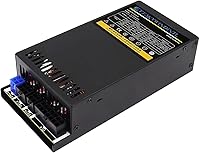
Full modularity in a Flex ATX chassis is a meaningful improvement over fixed-cable alternatives, and users building rack-mount servers or compact desktop towers consistently praised how clean and organized their internals looked post-installation. The ability to run only the cables a build actually needs makes routing inside a 165×83×40mm space far more manageable.
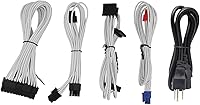
The cable bundle itself is limited — two SATA and one IDE connector covers basic storage but leaves builders with more complex multi-drive setups wanting more. The strict requirement to use only the included cables also means there is no practical way to expand connectivity options without purchasing an additional unit.
Power Stability
78%
22%
Users running home servers and NAS enclosures reported stable voltage delivery under sustained light-to-medium loads, with no random shutdowns or noticeable fluctuations affecting connected drives or network hardware. The DC-DC conversion structure appears to deliver on its promise of cleaner output rails compared to budget alternatives at this form factor.
A subset of reviewers reported unexpected shutdowns under high CPU load or during storage-intensive operations, raising questions about real-world sustained peak performance. Without third-party load testing data, it is difficult to determine whether those incidents represent edge-case failures or a broader consistency issue across production batches.
Compatibility & Fit
81%
19%
Among buyers who purchased for the correct use case — rack-mount enclosures, AIO desktops, and POS terminal housings specifying Flex ATX — the physical fit was consistently described as precise, with no modification required. The 165×83×40mm footprint aligned with case mounting points without issue across multiple enclosure brands mentioned in reviews.
A meaningful share of negative reviews came from buyers who did not confirm their case accepted Flex ATX dimensions before purchasing, which inflated the negative score unfairly. That said, the product is also strictly incompatible with standard ATX, SFX, or SFX-L cases, which limits its realistic audience to a narrowly defined group.
Connector Selection
52%
48%
For a POS terminal, basic AIO system, or single-drive compact server, the included connector set — one 20+4-pin motherboard, two SATA, and one IDE — covers the minimum requirements adequately. Buyers running straightforward, single-drive builds reported no cable shortages and found the bundle sufficient for their specific configuration.
The complete absence of a PCIe connector rules out any build involving a discrete graphics card, and two SATA ports is a tight constraint for multi-drive NAS or server applications. Buyers who discovered this limitation only after purchase were consistently among the most frustrated reviewers, making it one of the most recurring complaints across the feedback pool.
Thermal Performance
61%
39%
In low-to-moderate load scenarios typical of compact servers and POS terminals, the TF600 maintains acceptable operating temperatures and stays within its rated thermal envelope during normal operation. Users who ran the unit continuously in well-ventilated rack-mount enclosures reported no thermal shutdown events under those conditions.
This 1U power supply runs noticeably warm under sustained load, and in poorly ventilated enclosures or high-ambient-temperature environments, thermal headroom shrinks quickly. A few buyers in warmer climates reported occasional OTP-triggered shutdowns that resolved after improving case airflow, suggesting real sensitivity to the quality of the installation environment.
Protection Features
79%
21%
The six-circuit protection suite — OVP, UVP, OCP, OPP, SCP, and OTP — represents a thorough hardware safety net covering the most common failure scenarios a compact server or always-on system might encounter. Builders running this PSU in 24/7 rack environments appreciated having hardware-level protection against voltage spikes and unexpected overloads.
There is no way to independently verify whether each protection circuit performs to specification without instrumented testing, and a small number of reviewers reported unexpected shutdowns in scenarios that should not have triggered any protection threshold. Whether those were calibration issues or legitimate electrical events cannot be determined from review data alone.
Installation Experience
76%
24%
The fully modular design meaningfully reduces the hassle of fitting a PSU into a cramped enclosure — builders consistently noted routing the 20+4-pin cable cleanly without wrestling a bundle of unused wires into submission. Several users reported completing the installation faster than expected, even in challenging 1U chassis with minimal room to maneuver.
Buyers unfamiliar with Flex ATX form factor constraints occasionally encountered confusion matching proprietary modular connector orientations, leading to avoidable frustration during setup. The included documentation was also cited as thin on detail, which made the experience noticeably less smooth for first-time SFF builders approaching this format for the first time.
Universal Voltage Support
87%
The genuine 100–240V universal input is one of the TF600's most practical differentiators for international buyers, eliminating the need for a step-down transformer when deploying hardware in Europe, Southeast Asia, or other 220–240V regions. Business operators managing multi-country POS deployments specifically flagged this as a meaningful operational simplification.
Buyers in regions with severely unstable grid power reported that protection circuits occasionally triggered shutdowns during voltage spikes, suggesting the comfortable operating window may be narrower than the full 100–240V specification implies under extreme conditions. This is not a dealbreaker but is worth factoring in for off-grid or rural deployment scenarios.
Long-term Reliability
63%
37%
The subset of buyers who have run this Flex ATX PSU in rack-mount or NAS configurations for six months or more generally report continued stable operation with no capacitor bulging, coil whine, or voltage drift observed over time. These longer-term accounts are encouraging, even if they represent a smaller share of the total review pool.
Early failure reports do appear in the review set, and without independent quality certification or a clearly documented warranty process, buyers have limited recourse if the unit fails outside the return window. The brand's broader reputation is also tempered by a sibling model carrying a notably lower average rating, raising fair questions about production consistency across the lineup.
Packaging & Delivery
56%
44%
Most buyers who received intact units reported adequate protective packaging and an organized unboxing experience, with cables, the PSU, and included documentation arriving in acceptable condition. For straightforward domestic orders shipped under normal conditions, the packaging generally proved sufficient to protect the unit during transit.
Packaging and delivery complaints appear with notable frequency across the review set — dented boxes, loose components, and in some cases units that appeared to have been handled roughly before arrival. International buyers experienced higher rates of transit damage and longer wait times, contributing meaningfully to the negative review pattern for this product.

Suitable for:

The T.F.SKYWINDINTL TF600 600W Flex ATX Power Supply was clearly designed with a specific builder in mind, and it delivers well when matched to the right system. If your project lives inside a 1U rack-mount chassis, a compact all-in-one desktop, a point-of-sale terminal, or any enclosure that physically demands Flex ATX dimensions, this is one of the few 600W options available that won't require cutting corners on wattage. The fully modular cabling is a real advantage in these confined spaces — you strip out every unnecessary lead and reclaim airflow that a fixed-wire PSU would sacrifice. It's equally appealing for anyone deploying hardware internationally or in locations with unstable mains voltage, since the universal 100–240V input handles both scenarios without any adaptation. DIY builders upgrading an older small form factor system to support a more power-hungry CPU or multiple storage drives will also find the headroom genuinely useful.
Not suitable for:

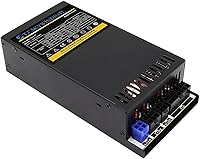
The T.F.SKYWINDINTL TF600 600W Flex ATX Power Supply is a poor match for anyone building a gaming rig or a workstation that depends on a dedicated graphics card. The cable bundle ships with a 20+4-pin motherboard connector, two SATA ports, and one IDE connection — there is no PCIe power connector in the package, which puts discrete GPUs firmly off the table. The 40mm cooling fan is another honest limitation: at high load, a fan this small must spin fast to move adequate air, and the resulting noise is noticeable — calling this unit quiet for a near-silent AIO build would be misleading. Buyers expecting platinum-tier build quality or independently certified efficiency standards should also temper expectations, since the 90% efficiency figure and Japanese capacitor claims come solely from the manufacturer. If your enclosure accepts a standard SFX or ATX unit, you will find a wider field of better-documented alternatives at a comparable spend.
Specifications

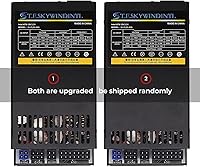
  • Form Factor: Follows the Flex ATX 1U standard with dimensions of 165 × 83 × 40mm (6.5 × 3.27 × 1.57 inches), designed exclusively for rack-mount and compact enclosures that specify this format.
  • Output Wattage: Rated at 600W continuous output, placing it at the higher end of what is widely available in the Flex ATX form factor.
  • Input Voltage: Accepts universal AC input ranging from 100V to 240V, covering mains power standards used in most countries without manual switching or external adapters.
  • Modular Design: Fully modular — no cables are permanently attached to the unit, so users connect only the leads their specific build requires and leave the rest unused.
  • Cooling: Cooled by a single 40mm axial fan, which is standard for 1U enclosures but must spin at high RPM under load, producing noticeable audible noise.
  • Connectors: Ships with one 20+4-pin ATX motherboard connector, two SATA power connectors, and one IDE (Molex) connector; no PCIe power connectors are included in the package.
  • Protections: Incorporates six hardware protection circuits: over-voltage (OVP), under-voltage (UVP), over-current (OCP), over-power (OPP), short-circuit (SCP), and over-temperature (OTP).
  • Topology: Built on a DC-DC conversion structure intended to deliver more stable and consistent voltage across all output rails compared to older group-regulated designs.
  • Power Factor: Equipped with Active Power Factor Correction (Active PFC) to reduce reactive power draw and improve compatibility with voltage-sensitive or unstable-grid environments.
  • Efficiency: Claimed efficiency of up to 90% under optimal load conditions per the manufacturer; this figure has not been independently certified at time of publication.
  • Capacitors: The manufacturer states that 100% Japanese-brand capacitors are used internally, though this claim has not been verified by independent third-party testing.
  • Weight: Weighs approximately 1.12 kg (2.46 lbs), which is typical for a fully modular PSU within this form factor class.
  • Model Number: Sold under the model designation TF600 by T.F.SKYWINDINTL, part of the brand's Flex ATX lineup spanning multiple wattage tiers.
  • Compatibility: Designed for use in AIO systems, compact desktops, micro-ATX and mini-ITX enclosures, POS terminals, and 1U rack-mount server cases that accept Flex ATX dimensions.
  • Cable Restriction: The manufacturer explicitly states that only the cables included in the package should be used, as third-party modular cables may carry incompatible pinouts and risk component damage.

Related Reviews

Apevia Essence 600W Semi-Modular ATX Power Supply
72%
78%
Value for Money
81%
Cable Management
74%
Noise Level
86%
Ease of Installation
62%
Build Quality
More
ESGAMING 600W Non-Modular ATX Power Supply
75%
88%
Value for Money
83%
Noise Level
91%
Ease of Installation
86%
Connector Coverage
67%
Cable Quality
More
KYLINTEC 600W Power Supply ATX PSU
81%
90%
Ease of Installation
85%
Cooling Performance
88%
Power Stability
75%
Cable Management
80%
Build Quality
More
Thermaltake SMART 600W ATX Power Supply
78%
91%
Value for Money
83%
Reliability & Longevity
86%
Power Stability
84%
Noise Level
48%
Cable Management
More
Apevia Jupiter 600W ATX Power Supply
72%
81%
Value for Money
58%
Long-Term Reliability
63%
Voltage Stability
86%
Installation Experience
78%
Noise Level
More
Apevia TFX-AP300W 300W Flex ATX Power Supply
80%
83%
Performance
89%
Value for Money
78%
Build Quality
75%
Cooling Efficiency
60%
Noise Level
More
Apevia Prestige 600W ATX Power Supply
73%
83%
Value for Money
88%
Efficiency & Thermals
81%
Noise Level
61%
Build Quality
86%
Installation Experience
More
Zalman GigaMax 600W ATX Power Supply
81%
88%
Value for Money
84%
Noise Level
76%
Efficiency
79%
Build Quality
58%
Cable Management
More
SilverStone FX500-G 500W Flex ATX Power Supply
78%
88%
Build Quality
91%
Efficiency & Power Delivery
61%
Noise Level
72%
Value for Money
84%
Thermal Performance
More
Apevia ITX-PFC400W 400W Flex ATX Power Supply
73%
88%
Modular Design
83%
Value for Money
91%
Form Factor Fit
54%
Fan Noise
63%
Cable Length
More

FAQ

To fit, your case needs to explicitly support the Flex ATX 1U form factor — the T.F.SKYWINDINTL TF600 600W Flex ATX Power Supply measures 165 × 83 × 40mm, which is not interchangeable with standard ATX, SFX, or SFX-L units. It targets rack-mount chassis, compact AIO enclosures, and small form factor cases that specifically list Flex ATX support. Before purchasing, check your case manual or product page to confirm the accepted PSU format.
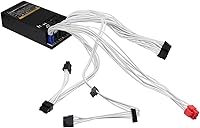
No — the TF600 does not include a PCIe power connector, which is required by virtually all discrete graphics cards. If your build depends on a dedicated GPU, you will need to look at a different power supply entirely. The connector set here is tailored for integrated-graphics systems such as home servers, POS terminals, and basic compact workstations.

Honestly, it is noticeable. A 40mm fan has to spin at a much higher RPM than a 120mm or 140mm fan to move adequate air, so audible noise is inherent to the design rather than a manufacturing defect. Under light load it is tolerable for most people, but once the system draws significant power, the fan becomes one of the louder components in the build. If near-silence is a priority, this is not the right PSU for your setup.

No, and this is an important safety point — the manufacturer explicitly warns that only the cables shipped with the unit should be used. Flex ATX PSUs frequently use proprietary pinouts that differ from standard ATX modular cables, and using incompatible cables risks damaging the PSU, your motherboard, or other components. Keep the original cable set and never mix it with cables from other brands.

Yes, the universal 100–240V AC input means it adapts automatically to both 110V and 230–240V mains without any manual switching or step-down transformer. This makes this Flex ATX PSU well-suited for international deployments, multi-country business installations, or any location where mains voltage is inconsistent or outside the North American standard.

Fully modular means none of the power cables are permanently attached to the PSU — you plug in only the connectors your specific build needs and leave the rest in the box. In a cramped 1U or SFF enclosure, this matters far more than in a full tower, because unused bundled cables would otherwise block airflow, create clutter in a space measured in millimeters, and make future maintenance significantly harder. It is a practical feature with real impact in tight spaces.

For the workloads this PSU is designed around — NAS storage arrays, low-power servers, AIO desktops, POS systems — 600W provides comfortable headroom. Most of those configurations draw well under 300W at peak. The extra capacity absorbs power spikes and leaves room to add drives or upgrade the CPU without immediately outgrowing the supply. It only becomes a limitation if you start adding high-draw components like a discrete GPU, which the connector set does not support regardless.

Each circuit acts as an automatic safety cutoff for a specific failure mode. Over-voltage (OVP) and under-voltage (UVP) protection shut the unit down if output drifts outside safe limits; over-current (OCP) and over-power (OPP) prevent overloading; short-circuit protection (SCP) triggers an instant shutdown if there is a wiring fault; and over-temperature protection (OTP) kicks in if the unit overheats. Together they are designed to protect both the PSU itself and your connected components from the most common electrical hazards.

The 3.6-out-of-5 average is genuinely mixed, and it is worth understanding what drives it. A notable portion of the negative reviews come from buyers who used this 1U power supply in scenarios it was never designed for — particularly GPU-based gaming rigs where the missing PCIe connector created frustration. Buyers who matched it correctly to a compatible Flex ATX build generally report stable voltage and reliable operation. That said, legitimate complaints about fan noise and packaging do exist, so go in with realistic expectations rather than dismissing the lower scores entirely.

Not really. The 40mm fan will likely become the loudest component in a living-room setup, and there is no low-noise mode or passive cooling option. Home theater PC builders who prioritize acoustic performance should look at PSUs with larger, slower-spinning fans or fanless designs. The TF600 is optimized for thermal management within a constrained chassis, not for environments where quiet operation matters.