Overview

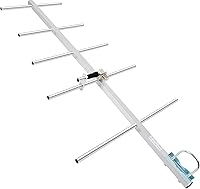
The TWAYRDIO TW-YG05 UHF Yagi Antenna is a purpose-built directional antenna aimed squarely at licensed ham radio operators who need reliable performance across the 400-470MHz range. At just 0.4 kg with an 85cm boom, it punches well above its weight class without being awkward to mount. The aluminum alloy build keeps things light without feeling flimsy. Sitting at mid-range pricing, it is clearly aimed at serious hobbyists rather than someone dabbling casually with handheld radios. Its #850 ranking in Two-Way Radio Antennas on Amazon reflects a consistent, if niche, buyer base that keeps coming back for a reason.

Features & Benefits

The 9 dBi directional gain is the headline here, and it does exactly what directional gain should: focus your signal toward one point rather than broadcasting it in every direction. That matters enormously when you are trying to hit a distant repeater on the 70cm band. The antenna covers 400-470MHz cleanly, which covers GMRS and most common UHF amateur allocations. A VSWR under 1.5 means minimal reflected power, and the 50-ohm impedance pairs naturally with standard transceivers. It handles up to 100W and is wind-rated to 60 m/s, so balcony or rooftop installations are genuinely practical, not just theoretically possible.

Best For

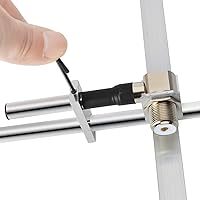
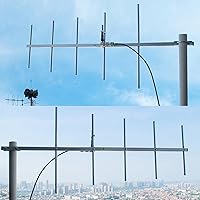
This directional UHF antenna makes the most sense for operators trying to extend their reach to a specific repeater or base station rather than communicate in all directions at once. Balcony and apartment installations are a natural fit given the compact footprint and manageable mast diameter requirement of 30-40mm. It also works well as a semi-portable directional option for operators who need quick deployment without a heavy setup. One important note: the SL16 female connector is standard in this product line, but if your radio or feedline uses a different fitting, budget for an adapter before assuming plug-and-play convenience.

User Feedback

Across 88 reviews averaging 4.4 out of 5 stars, buyers are largely satisfied, and the most consistent praise centers on how straightforward assembly is, with included instructions that actually make sense. Several operators report a meaningful improvement in repeater access after switching from an omnidirectional whip. On the critical side, a handful of reviewers flag that the mounting hardware feels like the weakest point of the build, with some wishing for heavier-duty clamps. The SL16 connector catch is real and worth repeating: check your existing coax before ordering. Overall, realistic expectations seem to produce happy buyers here.

Pros

  • Delivers genuine 9 dBi directional gain that meaningfully extends repeater range on the 70cm band.
  • Lightweight aluminum alloy build makes balcony and rooftop mounting practical without heavy rigging.
  • VSWR under 1.5 ensures efficient power transfer and minimal signal loss at the feedpoint.
  • Handles up to 100W, giving operators room to grow without outpacing the antenna.
  • Wind-rated to 60 m/s, so outdoor installations hold up in genuinely rough weather.
  • Assembly is straightforward, with clear instructions that most buyers complete without confusion.
  • The 400-470MHz coverage spans multiple useful UHF allocations including GMRS and common repeater frequencies.
  • 50-ohm impedance pairs cleanly with the vast majority of amateur radio transceivers and base stations.
  • Compact package dimensions make shipping and storage easy before and after field deployments.
  • At its price point, the build quality consistently meets or exceeds buyer expectations.

Cons

  • Mounting hardware quality lags behind the rest of the build, with clamps that feel undersized for permanent installs.
  • Requires precise aiming to capture the directional gain benefit; even moderate misalignment reduces effectiveness noticeably.
  • SL16 female connector limits plug-and-play use to operators already running matching coaxial cable.
  • No SMA, PL-259, or N-type adapter is included, meaning extra cost if your setup uses a different fitting.
  • Only 88 reviews on Amazon makes long-term durability data thinner than more established competing models.
  • The 85cm boom, while compact for a yagi, may still be too large for very restricted balcony or indoor spaces.
  • Gain is rated at 430MHz specifically; performance toward the edges of the 400-470MHz range may vary slightly.
  • Not suitable for operators who need to monitor or transmit across multiple azimuths without manual repositioning.

Ratings

The scores below reflect our AI-driven analysis of verified global buyer reviews for the TWAYRDIO TW-YG05 UHF Yagi Antenna, with spam, bot activity, and incentivized feedback actively filtered out before scoring. Each category captures both what real operators praised and where genuine frustrations surfaced, so you get an honest picture rather than a curated highlight reel. Strengths and pain points are weighted equally, giving you the clearest possible basis for a confident buying decision.

Signal Performance
88%
Operators aiming this directional UHF antenna at a fixed repeater consistently report a noticeable and immediate improvement in signal clarity and reach compared to the omnidirectional verticals they replaced. Several buyers working from apartment balconies managed to access repeaters they had previously struggled to hit reliably, even at modest transmit power.
The gain is genuinely directional, meaning any misalignment of even a few degrees toward the target can visibly degrade results. Buyers who expected broad coverage without careful aiming were disappointed, as the antenna does not compensate for poor installation planning.
Build Quality
74%
26%
The aluminum alloy elements and boom feel solid and well-finished for the price tier, and most buyers report that nothing arrived bent or poorly formed out of the box. The overall construction inspires reasonable confidence for a semi-permanent outdoor installation.
The mounting hardware is where the build noticeably steps down in quality, with clamps that feel adequate for light-duty use but underwhelming for anyone planning a permanent rooftop installation exposed to seasonal stress. A handful of buyers upgraded their own clamps shortly after installation.
Ease of Assembly
91%
Assembly consistently earns some of the warmest comments across all reviews, with buyers noting that the included instructions are clear enough that the whole process takes under 30 minutes even for first-timers. The element count is manageable and nothing requires specialized tools or guesswork.
A small number of buyers found the written instructions slightly ambiguous when it came to element orientation, particularly around which side faces the target. This is a minor issue but worth flagging for operators assembling the antenna alone without a reference diagram nearby.
Connector Compatibility
63%
37%
For operators already running SL16 coaxial infrastructure, the feedpoint connection is genuinely plug-and-play and the connector itself feels secure and well-machined. This is a non-issue for buyers who checked compatibility before ordering.
SL16 is not the most universal connector in the amateur radio world, and a recurring complaint from buyers is discovering only after delivery that they need an adapter to mate with their existing feedline or transceiver. The antenna ships with no adapter included, which adds cost and delays first use for many buyers.
Value for Money
83%
At its price point, the TW-YG05 offers a compelling combination of real directional gain, outdoor-rated construction, and respectable power handling that would cost noticeably more from competing Western brands. For hobbyists who want a step up from a basic vertical without a major investment, it represents solid value.
Buyers who compare it directly to higher-priced Japanese or European yagi antennas note that the mounting hardware and long-term weatherproofing quality do not quite match the premium tier. If you are planning a permanent installation and value longevity over upfront savings, the gap in hardware quality becomes more relevant.
Weather Resistance
77%
23%
The 60 m/s wind rating is legitimate for an aluminum alloy structure of this size, and buyers in coastal and elevated locations report the antenna holding its position through substantial wind events without structural damage to the elements or boom.
The connector junction and mounting clamp areas show the most vulnerability to long-term moisture ingress, and buyers in wet climates recommend applying weatherproof coax seal at installation rather than waiting for problems to appear. The antenna itself does not ship with any weatherproofing compound.
Gain Accuracy
81%
19%
The 9 dBi gain figure holds up credibly in real-world comparisons against known reference antennas, with several technically minded reviewers confirming the antenna performs close to its specification when properly aimed and installed at an appropriate height.
A minority of buyers felt the gain improvement was less dramatic than expected, typically because they were comparing it to a well-installed vertical rather than a rubber duck. Managing expectations around what directional gain actually means in practice is important before purchase.
Mounting Flexibility
69%
31%
The 30mm to 40mm mast diameter range covers a wide variety of standard poles, pipes, and commercial antenna masts, making it compatible with most existing infrastructure without requiring a custom bracket or adapter plate.
Buyers using non-standard mast sizes outside the specified range have reported difficulty finding a secure fit, and the supplied clamp offers no meaningful adjustment beyond its rated diameter window. Those mounting to railings or flat surfaces need to source their own creative hardware solution.
Package & Shipping Condition
86%
The compact package dimensions mean the antenna ships well-protected in most cases, and buyers rarely report receiving bent or damaged elements despite the delicate nature of yagi construction during transit.
A small number of buyers noted minor cosmetic marks on the elements upon arrival, likely from factory handling rather than shipping. None reported functional damage, but the packaging could benefit from individual element wrapping for added protection.
Instruction Clarity
79%
21%
The included documentation covers the key assembly steps and basic mounting guidance well enough for an experienced ham to get up and running without consulting external resources. Diagrams are present and reasonably detailed for the price level.
The instructions do not address connector compatibility or adapter requirements, which is a notable omission given how frequently this comes up as a buyer concern. A short compatibility note in the documentation would prevent a lot of post-purchase frustration.
Portability
72%
28%
At 0.4 kg and with an 85cm boom, the TW-YG05 is light enough that some operators use it as a semi-portable field antenna, packing it disassembled for events or temporary deployments without significant hassle.
The assembled length is not truly pocket-portable, and the elements do not fold back for compact transport the way some competing models in the TWAYRDIO lineup do. Buyers wanting a take-anywhere antenna for portable operation may prefer a folding-element variant.
Long-Term Durability
67%
33%
Most buyers who have had this directional UHF antenna installed for over a year report that the elements and boom remain structurally sound with no corrosion or fatigue cracking, which speaks reasonably well to the aluminum alloy choice.
The mounting clamp hardware shows signs of wear faster than the antenna itself in exposed environments, and a few long-term users report needing to replace or supplement the original clamps within 18 months of outdoor installation. This is the most cited durability concern across the review base.
Manufacturer Support
58%
42%
Some buyers report receiving helpful responses when contacting TWAYRDIO directly about technical questions, and the brand does appear to engage with product listings and buyer feedback more actively than many anonymous OEM suppliers.
After-sale support infrastructure is thin compared to established Western brands, and buyers who needed replacement parts or warranty assistance found the process slow and sometimes unresolved. This is a meaningful consideration for anyone planning a long-term installation.

Suitable for:

The TWAYRDIO TW-YG05 UHF Yagi Antenna is a strong fit for licensed amateur radio operators who need to punch through to a specific repeater or distant station on the 70cm band without spending a fortune on high-end directional hardware. If you are working from an apartment balcony or a rooftop with limited mounting options, the compact 85cm boom and low 0.4 kg weight make installation genuinely manageable rather than a weekend-long engineering project. Operators running mobile transceivers or base stations at low-to-mid power levels will appreciate the efficient 50-ohm match and sub-1.5 VSWR, which means more of your transmitted power actually reaches the antenna rather than bouncing back. It also suits those already invested in SL16 coaxial infrastructure, since the connector fits directly without extra adapters. For the ham who wants a practical, no-fuss directional antenna that handles real outdoor conditions, this is a well-considered option at a reasonable entry point.

Not suitable for:

The TWAYRDIO TW-YG05 UHF Yagi Antenna is not the right tool if you need wide-angle or omnidirectional coverage, since its entire value proposition depends on careful aiming toward a single target. Buyers expecting to communicate freely in multiple directions without repositioning the antenna will be disappointed by the inherent trade-off of any yagi design. If your feedline or radio uses a connector other than SL16, factor in the cost and hassle of sourcing an adapter before purchasing, as this adds friction that some buyers overlook. Those looking for a heavy-duty permanent installation with industrial-grade mounting hardware may find the clamps and hardware at the mounting point underwhelming for harsh long-term exposure. Casual or unlicensed radio users exploring the hobby on a whim will likely find this antenna overspecified and unnecessarily technical for their needs.

Specifications

  • Frequency Range: This antenna operates across the UHF band from 400 to 470MHz, covering the 70cm amateur radio band, GMRS, and many common repeater frequencies.
  • Gain: Rated at 9 dBi at 430MHz, the directional gain focuses signal energy toward a single azimuth rather than radiating it in all directions.
  • Max Power: The antenna is rated to handle up to 100W of continuous transmit power, accommodating most amateur radio base stations and mobile transceivers.
  • Impedance: Input impedance is 50 ohms, which matches the standard output impedance of virtually all amateur radio transceivers and coaxial feedlines.
  • VSWR: VSWR is specified at less than 1.5, indicating efficient energy transfer between the feedline and the antenna with minimal reflected power.
  • Connector Type: The antenna uses an SL16 female connector, designed to accept a standard SL16 male coaxial cable plug directly without an intermediate adapter.
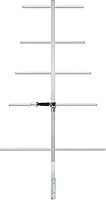
  • Boom Length: The main boom measures 85cm in total length, keeping the overall footprint compact enough for balcony or rooftop mast installations.
  • Element Length: The longest radiating element measures 38cm, consistent with a half-wave design optimized for the lower portion of the 400-470MHz range.
  • Number of Elements: The antenna array consists of 5 elements in total, contributing to its directional pattern and 9 dBi gain figure.
  • Weight: Total antenna weight is approximately 0.4 kg (14.1 oz), making it easy to handle during installation without requiring heavy-duty mast hardware.
  • Wind Rating: The structure is rated for sustained wind velocities up to 60 m/s, suitable for open outdoor environments including exposed rooftops and balconies.
  • Mast Compatibility: The mounting clamp accommodates mast diameters ranging from 30mm to 40mm, fitting most standard antenna poles and pipe mounts.
  • Material: The antenna elements and boom are constructed from aluminum alloy, providing a practical balance of corrosion resistance, rigidity, and low mass.
  • Package Dimensions: The packaged unit measures 17.8 x 2.52 x 2.32 inches, allowing for straightforward shipping and compact storage when not in use.
  • Orientation: The antenna performs best when its elements are oriented perpendicular to the ground, which is the standard vertical polarization for UHF repeater operation.
  • Manufacturer: The TW-YG05 is manufactured by Quanzhou Truest Communication Co., Limited, a Chinese OEM that produces a range of amateur and commercial radio accessories.
  • Model Number: The official model designation is TW-YG05, distinguishing it from other yagi variants in the TWAYRDIO lineup such as the 3-element TW-YG03F.
  • Availability Date: This antenna has been listed on Amazon since January 9, 2020, giving it several years of real-world buyer feedback to draw from.

Related Reviews
Antennas Direct ClearStream Eclipse Indoor TV Antenna
77%
74%
Signal Reception
67%
Amplifier Performance
93%
Design & Profile
91%
Ease of Setup
62%
Cable Length
More
Antennas Direct DB8e Outdoor TV Antenna
73%
83%
Signal Reception
88%
Build Quality
86%
Weather Durability
58%
Ease of Installation
71%
Value for Money
More
Sirio SY27-3 3-Element Yagi Antenna
75%
88%
Signal Gain Performance
84%
Build Quality
82%
Frequency Versatility
71%
Ease of Assembly
59%
Tuning Experience
More
RCA ANT751E Outdoor Yagi TV Antenna
75%
88%
Signal Reception
67%
Range Accuracy
83%
Build Quality
74%
Installation Experience
86%
VHF Performance
More
Tupavco TP514 Yagi Directional Antenna
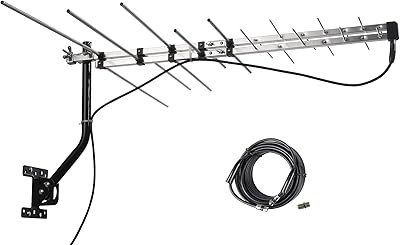
73%
83%
Signal Improvement
54%
Ease of Setup
86%
Build Quality
78%
Value for Money
74%
Compatibility
More
Stellar Labs 30-2370 91-Element Yagi TV Antenna
77%
91%
Signal Reception
74%
Value for Money
82%
Build Quality
47%
Ease of Installation
58%
Aiming Precision Required
More
McDuory UHD-3968 Outdoor Yagi TV Antenna
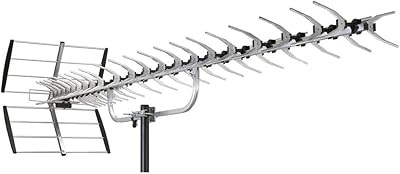
73%
78%
Signal Reception
51%
Range Accuracy
88%
Ease of Assembly
74%
Build Quality
81%
Value for Money
More
PBD HJK544 Outdoor Yagi TV Antenna
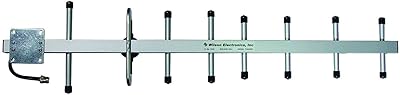
76%
83%
Signal Reception
89%
UHF Performance
61%
VHF Performance
78%
Build Quality
81%
Weather Resistance
More
weBoost Single-Band Yagi Antenna 700/800/900 MHz
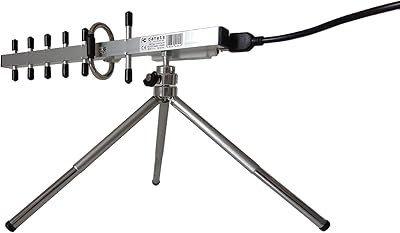
87%
89%
Signal Performance
88%
Ease of Installation
90%
Build Quality
91%
Durability in Harsh Conditions
92%
Compatibility with Signal Boosters
More
NextG USB-Yagi 11N Long Range WiFi Antenna 2200mW
78%
89%
WiFi Range & Signal Strength
83%
Compatibility with Systems
72%
Ease of Setup
85%
Build Quality
80%
Portability & Design
More

FAQ

It depends on the connector your radio uses. Most handheld transceivers come with SMA or BNC connectors, so you will need an SL16 male to SMA or BNC adapter to connect this antenna to a typical handheld. The antenna itself performs best as a fixed or semi-portable directional installation rather than a handheld attachment, so pairing it with a base station or mobile radio tends to make more practical sense.

A standard whip or vertical antenna radiates in all directions equally, while this yagi concentrates its energy in one specific direction. The 9 dBi figure means the signal in the aimed direction is significantly stronger than what a reference isotropic antenna would produce, but only in that direction. If you need to cover multiple directions, a directional yagi is not the right choice; it shines when you have a fixed target like a repeater in a known location.

Technically yes, but you will lose a meaningful amount of performance compared to an outdoor installation. Glass and building materials attenuate UHF signals, and the antenna works best in an open-air environment aimed directly at the target. A balcony or exterior wall mount is a much better option if a full rooftop install is not possible.

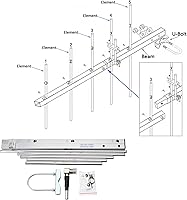
Assembly is generally straightforward and most buyers report completing it without any issues using just basic hand tools. The package includes installation instructions, and the aluminum elements slot or bolt into the boom in a logical sequence. Allow yourself about 20 to 30 minutes for a first-time setup.

The aluminum alloy construction is reasonably weather-resistant, and the 60 m/s wind rating suggests it is built for real outdoor exposure. Rain and moderate ice load should not cause structural problems, though like any outdoor antenna, long-term exposure to harsh freeze-thaw cycles may eventually affect the connector and mounting hardware. Applying a weatherproof coax seal at the feedpoint connection is always a good practice for outdoor installations.

You will want a coaxial cable with an SL16 male connector on the antenna end to mate with the SL16 female fitting on this directional UHF antenna. For the run between the antenna and your radio, low-loss 50-ohm coax such as RG-8X or LMR-400 is recommended, especially for longer cable runs where signal loss becomes a real concern at UHF frequencies.

GMRS operation in the US requires an FCC GMRS license, which is separate from an amateur radio license. The TW-YG05 covers the GMRS frequency range from a hardware standpoint, but you still need the appropriate license for your jurisdiction before transmitting. Always check your local regulations before putting any antenna on the air.

The mounting clamp on this yagi accepts mast diameters between 30mm and 40mm, which covers most standard antenna poles, fence pipes, and commercial mast sections. A simple 1.25-inch or 1.5-inch steel or aluminum pipe is typically sufficient for a balcony or rooftop installation.

That depends heavily on terrain, repeater height, output power, and your transceiver. In flat or elevated open terrain, extending your effective range by several kilometers compared to a stock rubber duck or omnidirectional vertical is a realistic expectation. The antenna does not create range out of nothing; it redirects your existing power more efficiently toward a specific point.

Basic mounting hardware is included in the package, but several users have noted that the clamps feel adequate rather than heavy-duty. For a temporary or light-duty installation they should be fine, but if you are planning a permanent rooftop mount in an exposed location, upgrading to heavier stainless hardware is worth considering for long-term peace of mind.