Overview

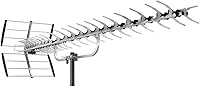
The Stellar Labs 30-2370 91-Element Yagi TV Antenna is a serious piece of hardware built for one specific job: pulling in UHF HDTV signals from a long distance. Its 91-element Yagi structure paired with a corner reflector puts it in a different category from the compact flat antennas most people start with. This is a mid-to-upper tier investment, priced accordingly — which makes sense given who it's designed for. If you're expecting to mount this indoors on a windowsill, recalibrate those expectations. It's a fixed directional installation, best suited for a rooftop or attic setup. And it's passive — no amplifier included — so real-world range depends heavily on terrain, obstructions, and how clean your coax run is.
Features & Benefits

The 91-element Yagi design with its corner reflector delivers noticeably higher gain than shorter or simpler antenna builds, and the tight directional pattern does double duty — it focuses signal pickup while aggressively rejecting interference coming from the sides and rear. That matters in areas where multipath bounce or co-channel noise is an issue. The antenna runs at 75-ohm impedance, connecting directly to standard coaxial cable and TV tuners with no adapter required. It covers up to 56 UHF channels, handling the vast majority of over-the-air HDTV broadcasts in most markets. At nearly 90 inches long, physical size itself is part of the performance equation. Stellar Labs has a solid track record in RF components, and the build quality here reflects that.

Best For

This Yagi antenna is squarely aimed at households sitting 40 to 80 or more miles from their nearest broadcast towers — the kind of distance where a flat amplified antenna simply gives up. It's a strong fit for rural and outer-suburban cord-cutters who want reliable, free HDTV and are prepared to do a proper installation rather than just plug something in. If you've already tried two or three smaller antennas and kept running into pixelation or dropouts, this is the logical next step. Attic mounting works well here — you get height and a clear line of sight without weather exposure. One important caveat: this is a single-direction antenna, so if your broadcast towers are scattered across different azimuths, you'll need a rotor or a second antenna.

User Feedback

Buyers who installed this long-range TV antenna in genuinely challenging locations — far from towers, hilly terrain — consistently report picking up channels that had been completely unreachable with smaller antennas. That's the clear win. The friction points are worth knowing upfront, though. Assembly takes real time, and aiming it precisely matters more than most people expect — using a signal strength app during setup is strongly recommended. Note that mast and brackets are not included, which catches a fair number of buyers off guard; you'll need to source mounting hardware separately. Feedback on the included fasteners is mixed, though the antenna elements themselves draw little criticism. A recurring tip from satisfied owners: if your coax run exceeds 25 feet, add a quality preamp — it makes a measurable difference.

Pros

  • Pulls in UHF channels at distances where most compact antennas simply cannot compete.
  • The 91-element Yagi structure with corner reflector delivers high gain and strong interference rejection.
  • Highly directional pattern cuts through multipath bounce and co-channel noise effectively.
  • Covers up to 56 UHF channels, handling the full range of typical over-the-air HDTV broadcasts.
  • 75-ohm impedance connects directly to standard coax and TV tuners — no adapters needed.
  • Attic-mounted, this long-range TV antenna avoids weather exposure while still delivering serious range.
  • Stellar Labs has a recognized track record in RF components, and the build quality reflects it.
  • Users in fringe reception areas consistently report channel counts they could not achieve with any previous antenna.

Cons

  • No mounting hardware or mast included — a genuine surprise cost that catches many buyers unprepared.
  • Assembly is time-consuming and fiddly; budget an afternoon, not an hour.
  • Precise aiming is critical; a few degrees off can noticeably hurt performance in weak-signal conditions.
  • Passive design means a preamplifier is effectively required for coax runs longer than 25 feet.
  • UHF-only coverage leaves VHF high-band channels completely unaddressed.
  • At nearly 90 inches long, finding a usable mounting location in tighter attics can be a real challenge.
  • Included fasteners and small hardware have drawn mixed feedback — consider having backup hardware on hand.
  • Single fixed direction means multi-tower markets require a rotor or a second antenna to fill in coverage gaps.

Ratings

Our AI rating system analyzed verified global buyer reviews for the Stellar Labs 30-2370 91-Element Yagi TV Antenna, actively filtering out incentivized, bot-generated, and spam submissions to surface what real users actually experienced. The scores below reflect both where this long-range TV antenna genuinely delivers and where it falls short — no score inflation, no glossing over friction points. If you are trying to decide whether this Yagi antenna fits your specific situation, these ratings are built to give you an honest picture.

Signal Reception
91%
In fringe reception scenarios — rural homes 50 to 80 miles from towers, locations surrounded by hills or heavy tree cover — buyers consistently report pulling in channels they had never successfully received before. The 91-element Yagi design with corner reflector is the core reason: it concentrates gain in a tight forward beam that outperforms anything in a smaller form factor.
Reception quality is highly dependent on precise aiming and terrain. Users in locations with complex multipath environments, such as valleys or areas flanked by ridges, sometimes find that even this antenna struggles to lock onto weaker signals consistently without additional fine-tuning or a preamplifier.
Value for Money
74%
26%
For buyers who have already burned through two or three cheaper antennas without success, the investment in this long-range TV antenna tends to feel justified quickly — one working installation that finally pulls in free HDTV pays for itself against a monthly cable or streaming bill in a matter of weeks.
The price sits in the mid-to-upper tier for passive antennas, and the omission of mounting hardware means the real out-of-pocket cost is higher than the sticker price suggests. Buyers who factor in a mast kit, coax cable, and a preamplifier often find the total project cost meaningfully higher than anticipated.
Build Quality
82%
18%
The antenna elements and boom structure itself draw consistent praise — the aluminum construction feels solid, and buyers who have had units mounted outdoors for multiple years report no significant degradation in the structural components. Stellar Labs has a reputation in RF hardware that the physical build largely supports.
The included small hardware — fasteners, washers, and element mounting clips — has received mixed feedback, with some buyers finding certain pieces undersized or prone to stripping during assembly. It is the one area where the build quality feels inconsistent relative to the main antenna structure.
Ease of Installation
47%
53%
For buyers with some DIY experience and familiarity with antenna installations, the assembly process is manageable and the element-to-boom attachment system is logical once you work through it. Experienced installers report that the overall mechanical design is sensible for a Yagi of this complexity.
This is the most consistently flagged pain point across user reviews. Assembly is time-consuming and fiddly, with 91 elements to attach individually and hardware that requires patience. No mounting hardware is included, which blindsides unprepared buyers. First-time antenna installers frequently describe the process as far more involved than expected.
Aiming Precision Required
58%
42%
Once properly aimed and locked in, the directional pattern rewards the effort — buyers who took the time to use a signal meter or smartphone app to fine-tune orientation report noticeably better results than those who simply pointed it in the approximate direction of their towers.
The tight directional beam that makes this antenna so effective at range also makes it unforgiving during setup. A few degrees off-target can produce a measurable drop in signal strength, and users in areas where towers are not clustered in one direction face a genuine usability challenge that no amount of careful aiming can fully resolve.
Range Performance
83%
In favorable terrain conditions — relatively flat land, minimal obstruction, clear atmospheric conditions — the Stellar Labs outdoor antenna performs at the longer end of what passive UHF antennas can realistically achieve, outpacing smaller directional and omnidirectional competitors at comparable or lower distances.
Range figures cited in marketing should be treated as best-case numbers under ideal conditions, not a reliable real-world guarantee. Buyers in hilly, forested, or otherwise obstructed environments report effective range falling well short of theoretical maximums, sometimes significantly.
Interference Rejection
88%
The combination of the Yagi element array and corner reflector gives this antenna a strong front-to-back rejection ratio that buyers in congested RF environments — areas with nearby industrial equipment, LTE towers, or co-channel interference from adjacent markets — notice as a tangible improvement in signal stability.
The antenna's interference rejection only works in the direction it is aimed; signals or noise arriving from the sides at certain angles can occasionally bleed through, particularly in environments with strong reflected signals bouncing off large structures or terrain features.
Compatibility
93%
The 75-ohm impedance and standard F-type coaxial connector mean this long-range TV antenna connects directly to any modern television with a coax antenna input and any standard RG-6 coax cable without adapters, baluns, or conversion hardware — a genuine plug-and-connect interface at the coax connection point.
The UHF-only design is a real limitation for markets where significant channels still broadcast on VHF high band. Buyers who discover post-purchase that local channels 7 through 13 are VHF must either add a second antenna or accept missing those channels entirely.
Attic Suitability
86%
At just under 90 inches long, this antenna fits in most standard attic spaces when mounted along the ridge line, and attic installation is widely regarded as the ideal setup — you get meaningful elevation and sightlines without exposing the antenna to wind loading or weather degradation.
Tighter or older attic spaces with cross-bracing, HVAC equipment, or limited headroom can make installation genuinely difficult. The length also makes maneuvering the assembled antenna into position a two-person job in most attic environments.
Wind Load & Weather Durability
76%
24%
Buyers who have maintained outdoor rooftop installations over multiple seasons generally report that the antenna holds up well structurally, with the aluminum elements resisting corrosion and the boom maintaining alignment under normal wind conditions when properly secured to a solid mast.
The large physical footprint creates meaningful wind surface area, and buyers in regions with frequent high-wind events have noted that a robust mast and quality mounting hardware are non-negotiable — the antenna's weight and size can stress a marginal installation significantly during storms.
Packaging & Unboxing
62%
38%
The antenna components arrive organized and the element layout is clearly structured enough that most buyers can work out the assembly sequence without confusion, even when the included documentation is sparse.
Several buyers note that the instructions provided are thin on detail for a product this complex, and the absence of any mounting hardware in the package means the unboxing experience ends with a list of additional purchases rather than a clear path to installation.
Long-Term Reliability
79%
21%
Users who have had this Yagi antenna installed for two or more years — particularly in protected attic environments — consistently report stable performance with no significant signal degradation or structural issues, which is the primary measure of reliability for a fixed passive antenna.
Outdoor rooftop installations in harsh climates show more variability in long-term outcomes, with occasional reports of element fasteners loosening over time and requiring re-tightening after seasons with heavy wind or ice loading.
Preamp Compatibility
84%
This antenna pairs cleanly with external preamplifiers — a well-chosen mast-mounted preamp placed at the antenna output before a long coax run is a straightforward upgrade that most experienced buyers include in their initial setup, and the results are consistently positive in user reports.
The fact that a preamplifier is effectively necessary for longer coax runs or multi-TV splits is a hidden cost that the base product does not communicate clearly. Buyers who do not know to budget for one upfront sometimes attribute signal problems to the antenna itself.

Suitable for:

The Stellar Labs 30-2370 91-Element Yagi TV Antenna was built for a specific kind of buyer, and if you fit the profile, it's hard to argue against it. Rural and outer-suburban households that sit 40 to 80 or more miles from broadcast towers — where flat or compact antennas have consistently failed — are the primary audience here. If you've already worked through one or two cheaper options and found yourself staring at pixelated screens or missing channels entirely, this is the logical upgrade. It also suits cord-cutters who are fully committed to free over-the-air HDTV and are willing to treat the installation seriously: planning a proper mount, running quality coax, and taking the time to aim it carefully. Attic installations are a particularly good match, since you get the elevation and sightlines you need without exposing the antenna to wind loading and weather. Anyone who primarily needs to lock onto a single broadcast market or tight cluster of towers will get the most out of its focused directional pattern.

Not suitable for:

This Yagi antenna is a poor fit for anyone expecting a quick, casual setup — and that mismatch frustrates buyers who go in without the right expectations. If your towers are spread across multiple compass directions, the highly directional design works against you; you'd either need a rotator or a second antenna to cover the spread, adding cost and complexity. It is also UHF-only, so if your local market still carries important channels in the VHF high band, you'll need a supplemental solution. Apartment dwellers, renters, or anyone without a rooftop or attic access will struggle to use this effectively, as the nearly 90-inch length demands real installation space. Buyers looking for a no-fuss amplified indoor antenna at a lower price point are genuinely better served elsewhere. And if your coax run is going to exceed 25 feet, budget for a quality preamplifier separately — this is a passive antenna, and signal loss over long cable runs is a real consideration that the base purchase does not address.

Specifications

  • Antenna Type: 91-element Yagi with corner reflector, designed for high-gain, long-distance UHF reception.
  • Band Coverage: UHF only; does not receive VHF low or VHF high band broadcast signals.
  • Channel Capacity: Supports reception of up to 56 channels across the UHF frequency band.
  • Impedance: 75 Ohm, matching standard residential coaxial cable and TV tuner inputs directly.
  • Connector Type: Standard F-type coaxial connector, compatible with typical RG-6 and RG-59 coax cable.
  • Length: 87.2 inches (approximately 7.25 feet) from front element to rear reflector.
  • Width: 14.8 inches across the widest point of the element array.
  • Depth: 4.5 inches from the boom face to the deepest structural point.
  • Weight: 5.49 pounds total antenna assembly weight, not including any mounting hardware.
  • Color: Black and silver finish across the boom, elements, and corner reflector structure.
  • Model Number: Stellar Labs model 30-2370, also referenced by ASIN B01BP4RF3O on Amazon.
  • Brand: Stellar Labs, a manufacturer with an established presence in RF and antenna components.
  • Amplifier: Passive antenna; no preamplifier or signal amplifier is included in the package.
  • Mounting Hardware: No mast, brackets, U-bolts, or mounting hardware of any kind is included in the box.
  • Directionality: Highly directional front-facing pickup pattern with strong front-to-back signal rejection ratio.
  • Availability: Listed as not discontinued by the manufacturer as of the most recent product data available.

Related Reviews
Sirio SY27-3 3-Element Yagi Antenna
75%
88%
Signal Gain Performance
84%
Build Quality
82%
Frequency Versatility
71%
Ease of Assembly
59%
Tuning Experience
More
Bahouloer Indoor Outdoor TV Antenna
71%
72%
Signal Reception Quality
41%
Range Accuracy
91%
Ease of Installation
88%
Cable Length & Flexibility
63%
Build Quality & Durability
More
Antennas Direct ClearStream 4V TV Antenna
74%
88%
Signal Reception
84%
Build Quality
81%
Multi-Directional Performance
67%
Ease of Installation
74%
Value for Money
More
Antennas Direct ClearStream 4MAX TV Antenna
86%
88%
Performance in Rural Areas
93%
Ease of Installation
85%
Signal Strength
91%
Build Quality
89%
Indoor/Outdoor Versatility
More
Antennas Direct ClearStream 2V TV Antenna
83%
88%
Signal Reception
91%
VHF Channel Coverage
84%
Build Quality
82%
Ease of Installation
79%
Value for Money
More
Antennas Direct ClearStream 2MAX TV Antenna
76%
83%
Signal Reception Quality
67%
Range Accuracy
88%
Ease of Installation
84%
Build Quality
79%
Multi-Directional Performance
More
GE 48732 Indoor HD TV Antenna
80%
78%
Signal Reception Quality
93%
Ease of Setup
74%
Amplifier Performance
76%
Build Quality & Durability
84%
Design & Aesthetics
More
Antennas Direct ClearStream MAX-V TV Antenna
76%
78%
Signal Reception
61%
Range Accuracy
84%
Installation Ease
82%
Build Quality
79%
Value for Money
More
Antennas Direct ClearStream Eclipse Indoor TV Antenna
77%
74%
Signal Reception
67%
Amplifier Performance
93%
Design & Profile
91%
Ease of Setup
62%
Cable Length
More
Antennas Direct DAX4 4-Output Distribution Amplifier
79%
83%
Signal Performance
88%
Build Quality
91%
Ease of Installation
79%
Value for Money
86%
ATSC 3.0 Compatibility
More

FAQ

It can, but with important caveats. In ideal conditions — flat terrain, minimal tree cover, clear line of sight toward the towers — this Yagi antenna is capable of reaching signals at that distance. Hilly or forested terrain will reduce effective range noticeably, and your coax run length matters too. Check a site like AntennaWeb or TVFool for your specific address before assuming distance alone tells the whole story.

Not necessarily, but it depends on your setup. Because it is a passive antenna, there is no built-in amplification. If your coax run from the antenna to your TV or splitter is longer than roughly 25 feet, most experienced users recommend adding a quality inline preamplifier to compensate for cable signal loss. Short runs in an attic setup to a single TV are often fine without one.

At minimum, you will need a mast or pipe, appropriate U-bolt clamps sized to the boom diameter, and any wall or roof brackets required for your installation location. None of this is included in the box, which surprises a lot of buyers. Pick up a standard antenna mast kit from a hardware or electronics retailer before you start the install — it will save you a trip mid-project.

Technically you can place it anywhere, but realistically it is far too large for typical indoor use — at nearly 7.5 feet long, most living spaces cannot accommodate it. An attic is the practical indoor option, and it works well there if you have the clearance and can orient it toward your target towers. A windowsill or behind a TV cabinet is not going to work.

Yes, as long as your TV has a coaxial antenna input (the round threaded port), it will connect directly with a standard RG-6 coax cable. The 75-ohm impedance matches what virtually every modern TV tuner expects. If you are running signal to multiple TVs through a splitter, keep in mind that each split reduces signal strength.

Use a free tool like AntennaWeb.org or the app RabbitEars to look up the compass bearing to your broadcast towers from your specific address. Then use a compass or your phone during installation to orient the front of the antenna in that direction. For best results, fine-tune the aim while monitoring signal strength on your TV or with a dedicated signal meter — a few degrees can make a real difference at long range.

The Stellar Labs 30-2370 91-Element Yagi TV Antenna is constructed to handle outdoor exposure, but like any large outdoor antenna, proper installation matters. Ensure all coax connections are weatherproofed with self-amalgamating tape, and make sure the antenna and mast are properly grounded according to local electrical codes — both for safety and to protect your equipment from lightning-induced surges.

This is a UHF-only antenna. If your local market has important channels broadcasting in the VHF high band (channels 7 through 13), this long-range TV antenna will not receive them. You would need to add a separate VHF antenna or a combo antenna to cover those frequencies, which adds complexity to the installation.

Assembly requires patience rather than specialized skills. The elements need to be attached to the boom individually, and the hardware fit can be fiddly. Most buyers complete it with basic hand tools — a screwdriver and adjustable wrench are typically all you need. Plan for an hour or two of careful assembly time rather than a quick 15-minute job.

Yes, with a coaxial splitter. Keep in mind that each two-way split introduces roughly 3.5 dB of signal loss, so for fringe-area installations with long coax runs, a quality preamplifier at the antenna becomes more important when splitting to multiple TVs. A distribution amplifier designed for antenna use is a cleaner solution than a basic passive splitter if you are feeding three or more televisions.