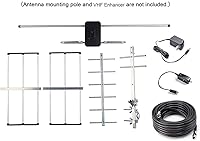
Overview

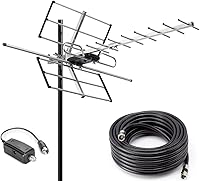
The PBD HJK544 Outdoor Yagi TV Antenna is built for one specific job: pulling in free over-the-air HD broadcasts for households that indoor antennas simply cannot serve. Whether you are cutting the cord in a rural area or living on the suburban fringe, this long-range OTA antenna positions itself as a practical, one-time investment rather than another monthly bill. It arrives mostly pre-assembled with a 40ft RG6 coaxial cable already in the box, and its lightning-protected housing means you can mount it outside and largely forget about it. The price sits comfortably in the mid-range — not disposable, but not a stretch either.

Features & Benefits

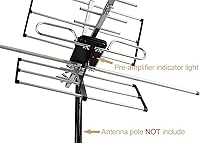
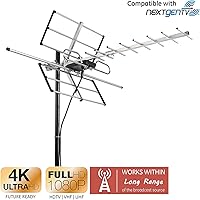
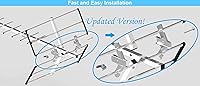
The amplifier built into this long-range OTA antenna is what separates it from passive alternatives. Rather than just catching whatever signal happens to drift by, the high-gain, low-noise amplifier actively strengthens weak broadcasts — a real advantage 50 miles or more from the nearest tower. It handles the full HD spectrum, from 720p up through 4K, and covers both VHF and UHF bands, though UHF performance is noticeably stronger than its VHF reception. The included 40-foot coaxial run handles most standard home installations without needing an extension. Assembly takes minutes, not hours. Worth noting upfront: no mounting pole is included, so budget for that separately before your install day.

Best For

This outdoor Yagi antenna makes the most sense for people who live well outside the easy signal bubble — think 50 to 100-plus miles from the nearest broadcast cluster. If an indoor flat antenna has already let you down, or if you are in a rural county where cable infrastructure is spotty or overpriced, this is the class of antenna worth considering. It is also a solid fit for anyone doing a permanent rooftop or attic install, where durability in rain, wind, and lightning exposure actually matters. Cord-cutters upgrading from a weaker unit will likely notice the biggest jump in channel count and picture stability.

User Feedback

With more than 6,000 ratings and a 4.3-star average, the PBD rooftop antenna has clearly worked well for a broad range of buyers. The most consistent praise centers on dramatic signal improvement over indoor or budget alternatives, particularly for viewers in genuinely remote locations. That said, the 120-mile range figure is a manufacturer maximum under ideal line-of-sight conditions — real-world results vary, and some buyers in fringe areas report more modest gains. VHF channel pickup draws occasional criticism compared to the stronger UHF performance. One recurring frustration: the pole sold separately catches buyers off guard at installation time, so factor that into your total cost before ordering.

Pros

  • Pulls in free HD channels at distances where most antennas simply give up.
  • The built-in amplifier makes a noticeable difference in fringe reception areas.
  • Comes with a 40-foot coaxial cable, so most homes need nothing extra to get started.
  • Weatherproofed housing holds up to rain, wind, and temperature swings without issue.
  • Lightning protection and grounding are built in — a genuine safety plus for rooftop installs.
  • Assembly is mostly done out of the box; no tools or technical skill required.
  • Over 6,000 buyer ratings with a 4.3-star average reflects consistently solid real-world results.
  • UHF band reception is especially strong, covering the majority of modern broadcast channels.
  • Mid-range pricing makes it accessible without feeling like a compromise on build quality.

Cons

  • The 120-mile range figure is a best-case maximum — expect more modest results in hilly or obstructed terrain.
  • No mounting pole is included, which catches many buyers off guard at installation time.
  • VHF reception is noticeably weaker than UHF performance, which can affect a handful of local channels.
  • Being directional means a single aim point; multi-direction channel lineups may require a rotor add-on.
  • Not practical for renters or anyone without the ability to mount hardware outdoors.
  • Amplifier-dependent performance means a power outage or failed adapter can knock out reception entirely.
  • Heavier and bulkier than indoor options, so installation genuinely requires planning and some physical effort.

Ratings

The scores below for the PBD HJK544 Outdoor Yagi TV Antenna were generated by our AI system after analyzing thousands of verified global buyer reviews, with spam, incentivized feedback, and bot activity actively filtered out. The result is an honest cross-section of what real users experienced — both the genuine strengths that keep this long-range OTA antenna consistently well-rated, and the friction points that have frustrated a meaningful portion of buyers. No score has been softened; the numbers reflect the full picture.

Signal Reception
83%
For buyers 50 to 90 miles from their nearest towers, this outdoor Yagi antenna delivers a channel count that flatly outperforms anything in the indoor antenna category. Rural users in particular report picking up networks they had completely written off, with stable, pixelation-free pictures on the channels that matter most.
Push beyond 90 miles or add terrain obstacles like hills and tree cover, and results become inconsistent. Some buyers in challenging geography found signal strength adequate on clear days but unreliable during heavy cloud cover or storms.
UHF Performance
89%
UHF reception is the clear standout here — most modern broadcast channels transmit on UHF, and this long-range OTA antenna handles that band with confidence. Buyers in fringe zones consistently note that UHF-based networks come in sharp and stable, even at distances where competing antennas struggle.
The strong UHF performance sets expectations that VHF reception does not always meet. For viewers whose local ABC, NBC, or PBS affiliate still transmits on a VHF frequency, there is a noticeable performance gap that can feel frustrating given the antenna's overall capability.
VHF Performance
61%
39%
For most suburban cord-cutters, VHF coverage is sufficient to pull in the major networks available in their area. Users living within a reasonable distance from VHF transmitters — generally under 60 miles — tend to report acceptable results on those channels.
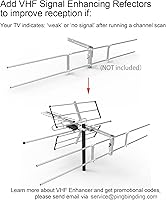
This is one of the most commonly flagged pain points across buyer reviews. VHF signal pickup is noticeably weaker than UHF, and for rural viewers where VHF towers are already far away, some local channels either come in poorly or not at all without an additional VHF enhancer.
Build Quality
78%
22%
The physical construction feels appropriately robust for an outdoor unit at this price point. Metal elements are solid enough to handle wind and temperature swings without flexing or rattling loose, and the overall fit of the assembled unit gives a reasonably premium impression for the cost.
A handful of buyers flagged that some plastic connectors and mounting hardware feel slightly underdimensioned, raising questions about multi-year durability in harsh climates. Nothing catastrophic, but it is not the kind of build you would expect from a dedicated commercial-grade installation product.
Weather Resistance
81%
19%
The weatherproofed housing holds up well through rain, wind, and seasonal temperature changes without requiring any special maintenance. Buyers in wet climates who have left this rooftop antenna installed through multiple seasons generally report no visible degradation or corrosion issues.
A small but consistent group of reviews note signal instability during heavy rain or thunderstorms, which points to limitations in the amplifier circuit rather than the housing itself. The physical shell survives the weather; the electronics inside are more sensitive to extreme conditions.
Lightning Protection
74%
26%
Built-in grounding and lightning protection are meaningful safety features for any permanently mounted outdoor unit, and buyers with rooftop installs specifically call this out as a confidence booster. Having protection integrated into the unit removes a step that many DIY installers would otherwise skip.
The manufacturer's grounding solution is adequate but relies on the installer completing the grounding correctly. Some buyers found the grounding instructions unclear, and an improperly grounded antenna effectively negates the protection — a gap that a better instruction manual could close.
Ease of Assembly
86%
The mostly pre-assembled design genuinely reduces setup time, and most buyers report having the antenna physically ready within 15 to 20 minutes of opening the box. The tool-free design is a real plus for less technically confident users who would otherwise hesitate at a more involved setup.
The missing mounting pole catches a surprising number of buyers off guard at the moment of installation, effectively pausing the process while they source one separately. This omission is not a flaw in the assembly itself, but it creates friction that a more complete package would avoid entirely.
Included Accessories
72%
28%
Including a 40-foot RG6 coaxial cable in the box is a genuinely useful decision — it covers the cable run for the majority of standard home installs without requiring an additional purchase on day one. The power adapter for the amplifier is also included, which removes another potential gap.
The absence of a mounting pole remains the single most-cited accessory complaint in buyer reviews. At this price point, including even a basic pole would meaningfully improve the out-of-box experience and reduce the number of surprised one-star reviews from otherwise satisfied customers.
Amplifier Quality
76%
24%
The built-in low-noise amplifier provides a real and measurable signal boost compared to passive alternatives, which is exactly what buyers in fringe reception zones need. Many users upgrading from non-amplified antennas note an immediate improvement in both channel count and picture consistency.
Amplifier-dependent performance introduces a single point of failure — if the power adapter fails or signal is lost, reception drops sharply rather than gracefully degrading. A few buyers also report the amplifier contributing noise on very strong nearby signals, a known limitation of always-on amplification.
Value for Money
82%
18%
At its mid-range price, the PBD rooftop antenna offers a compelling cost-per-channel outcome for rural and suburban viewers replacing a paid TV subscription. The combination of included cable, amplifier, and weatherproofing means buyers are not immediately spending more to fill obvious gaps.
Once you factor in the cost of a mounting pole and potentially a rotor for multi-direction reception, the total installation cost climbs meaningfully above the initial price tag. For buyers on a tight budget, that hidden cost stack can feel like a bait-and-switch experience.
Channel Count
79%
21%
Most buyers in the 40 to 80-mile reception zone report pulling in significantly more channels than they expected, particularly on UHF. For cord-cutters primarily after the major broadcast networks plus local affiliates, the channel count is more than satisfying in typical conditions.
Channel count varies widely based on location, terrain, and tower proximity, which makes it difficult to set accurate expectations before purchase. Buyers in genuinely remote areas sometimes receive far fewer channels than the antenna is theoretically capable of delivering.
Long-Range Accuracy
63%
37%
For buyers in the 60 to 90-mile range with relatively open terrain, the antenna performs well enough to validate the long-range positioning. Several verified buyers at these distances report stable reception on multiple networks, which is more than most competitors manage at similar distances.
The 120-mile maximum range claim is an idealized figure that most buyers in real-world conditions will not approach. Reviews from buyers beyond 90 miles are meaningfully more mixed, and treating that ceiling as a reliable guideline rather than an engineering best-case leads to disappointment.
Directionality
67%
33%
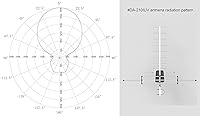
The directional Yagi design is genuinely efficient at long range — concentrating reception in one direction produces stronger signal gain than an omnidirectional antenna of similar size, which is exactly what fringe-area viewers need when all their towers cluster in one general direction.
Anyone whose local broadcast towers are spread across multiple compass headings will find single-direction pointing a real limitation. Capturing channels from different azimuths requires either repositioning the antenna or investing in a motorized rotor, adding cost and complexity to what otherwise seems like a plug-and-play setup.

Suitable for:

The PBD HJK544 Outdoor Yagi TV Antenna was built for a specific kind of buyer, and if you fit the profile, it delivers real value. The ideal candidate lives 50 to 100-plus miles from the nearest broadcast towers — far enough that indoor antennas produce a frustrating mix of pixelation, dropped channels, and outright signal loss. Rural households are the obvious sweet spot, especially where cable infrastructure is limited, unreliable, or simply not worth the monthly cost. It also works well for suburban cord-cutters who have already tried cheaper flat antennas and hit a wall. Anyone planning a permanent rooftop or attic installation will appreciate the weatherproofed housing and built-in grounding, which make it a set-it-and-forget-it solution rather than something you are pulling down every winter.

Not suitable for:

The PBD HJK544 Outdoor Yagi TV Antenna is a poor fit for anyone who lives close to broadcast towers and just wants a quick, low-hassle channel fix. If you are within 20 to 30 miles of a major city transmitter, a simple indoor antenna will do the same job for less money and zero installation effort. This long-range OTA antenna is also directional by design, meaning it needs to be physically aimed toward your broadcast towers — if your local channels come from multiple directions, you may not pull them all in without a rotor, which adds cost and complexity. Renters or anyone without permission to mount hardware on an exterior wall or roof will find it impractical. The missing mounting pole is also worth factoring in: it is not a dealbreaker, but it does mean your out-of-pocket cost is higher than the sticker price alone suggests.

Specifications

  • Antenna Type: Amplified outdoor Yagi directional antenna designed for long-range over-the-air TV reception.
  • Brand & Model: Manufactured by pingbingding (PBD), model number HJK544.
  • Max Range: Manufacturer-stated maximum reception range is 120 miles under ideal, unobstructed line-of-sight conditions.
  • VHF Coverage: Receives VHF band signals across the 170–230MHz frequency range, rated as good performance.
  • UHF Coverage: Receives UHF band signals across the 470–860MHz frequency range, rated as excellent performance.
  • HD Support: Compatible with all major HD broadcast formats: 720p, 1080i, 1080p, and 4K pass-through.
  • Impedance: Standard 75 Ohm impedance, consistent with most modern televisions and coaxial cable setups.
  • Included Cable: Comes with one 40ft RG6 coaxial cable included in the box at no additional cost.
  • Amplifier: Features a built-in high-gain, low-noise amplifier to strengthen weak signals in fringe reception areas.
  • Weather Resistance: Constructed to withstand outdoor conditions year-round, with built-in lightning protection and a grounded design.
  • Assembly: Arrives mostly pre-assembled and requires only minor setup steps; no tools are needed for assembly.
  • Mounting Pole: A mounting pole is not included in the package and must be purchased separately.
  • Item Weight: The complete antenna unit weighs 3.58 pounds.
  • Package Dimensions: Packaged dimensions measure 17.48 x 9.33 x 4.61 inches for shipping and storage reference.
  • Color: Available in black finish only.
  • Power Supply: Includes a power supply adapter to operate the built-in signal amplifier.
  • ASIN: Amazon product identifier is B07PFFYX5L for reference and reorder purposes.

Related Reviews
PBD WA-2608 Motorized Outdoor TV Antenna
74%
82%
Signal Reception Quality
78%
Motorized Rotation
84%
Installation Experience
74%
Dual TV Output
71%
Build Quality & Durability
More
PIBIDI UHD-8903 Outdoor TV Antenna
77%
73%
Signal Range & Reception
67%
VHF Band Performance
84%
UHF Band Performance
78%
Build Quality & Durability
81%
Lightning & Grounding Protection
More
UltraPro Outdoor 70-Mile HD TV Antenna
76%
73%
Signal Reception
61%
Range Accuracy
82%
Installation Ease
78%
Build Quality
81%
Weather Resistance
More
McDuory UHD-3968 Outdoor Yagi TV Antenna
73%
78%
Signal Reception
51%
Range Accuracy
88%
Ease of Assembly
74%
Build Quality
81%
Value for Money
More
iGENJUN ANT-CS8218 Amplified Indoor Outdoor TV Antenna
72%
73%
Signal Reception Quality
67%
Amplifier Performance
88%
Ease of Installation
48%
Range Accuracy vs. Claimed Specs
71%
Build Quality & Materials
More
MATIS FBA08D Outdoor TV Antenna
73%
71%
Signal Reception
88%
Ease of Setup
84%
Dual TV Output
76%
Motorized Rotation
73%
Weather Resistance
More
1byone 360° Omni-Directional Outdoor TV Antenna
73%
74%
Signal Reception
91%
Ease of Installation
72%
Build Quality
68%
Amplifier Performance
63%
4G LTE Filtering
More
GE 29884 Outdoor Long-Range TV Antenna
79%
83%
Signal Reception Strength
88%
Ease of Installation
86%
Build Quality & Durability
79%
Channel Count & Variety
84%
Value for Money
More
Antop AT-414BG Omni-Directional Outdoor TV Antenna
85%
90%
Reception Quality
88%
Ease of Installation
86%
Durability in Outdoor Conditions
92%
Value for Money
87%
Signal Range
More
PBD WA-2900-4G Outdoor HDTV Antenna
87%
94%
Signal Reception Quality
91%
Range Performance
88%
Ease of Installation
85%
Build Durability
89%
Weather Resistance
More

FAQ

That 120-mile figure is the manufacturer maximum under perfect, open line-of-sight conditions. In practice, factors like hills, dense trees, buildings, and atmospheric interference all reduce effective range. Most buyers in the 50 to 80-mile zone report solid results, while those pushing past 100 miles see more variable performance depending on terrain.

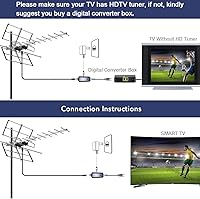
You will need a mounting pole, which is not included in the box. Beyond that, the 40-foot coaxial cable is already in the package, so most standard home installs will not require additional cable. If you are running it to a TV farther than 40 feet away, you may need a cable extension.

Setup is pretty approachable for most people. The PBD HJK544 Outdoor Yagi TV Antenna comes mostly assembled, and the remaining steps require no tools. The trickier part is physically mounting it on a roof or exterior wall, which may need a second pair of hands for safety reasons.

Attic installation is a popular option and works well for many people, since the antenna is still elevated and away from ground-level obstructions. Keep in mind that roofing materials — especially those with metal components — can reduce signal strength somewhat, so results will vary depending on your home construction.

Yes, but you will need a coaxial splitter to do it. Each split does reduce signal strength slightly, so if your reception is already marginal, adding a splitter may cause issues. Using a quality amplified splitter helps offset that loss.

You can use a free website like AntennaWeb.org or TVFool.com to find the direction of your nearest broadcast towers based on your zip code. Since this is a directional Yagi antenna, pointing it accurately makes a real difference in how many channels you receive.

That is a genuine limitation of any directional antenna. If your VHF and UHF towers are spread across very different compass headings, you may not be able to capture all of them from a single fixed position. In that case, an antenna rotor — which lets you remotely repoint the antenna — is worth considering, though it adds to the overall cost.

The antenna has built-in lightning protection and a grounded design, which adds a meaningful layer of safety compared to ungrounded units. That said, proper grounding during installation is important — follow the grounding instructions carefully, and if you are unsure, consult a licensed electrician.

This is actually a known characteristic of this long-range OTA antenna — its UHF reception is noticeably stronger than its VHF performance. Low-band VHF channels are inherently harder to pull in at long distances. If VHF channels are critical for you, look into whether a dedicated VHF enhancer accessory might help.

Without the power adapter, the built-in amplifier will not function and signal strength will drop significantly — you will essentially be running it as a passive antenna. Standard replacement adapters are widely available, so losing the original is not a permanent problem, but make sure the replacement matches the correct voltage and connector specs.