Overview

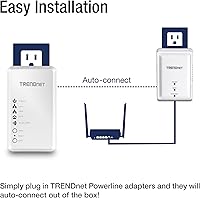
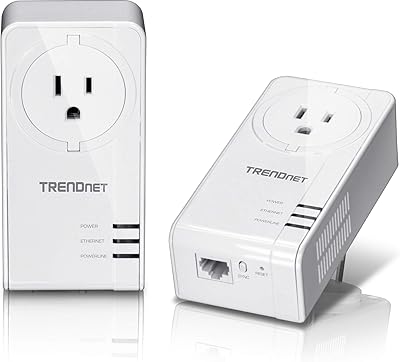
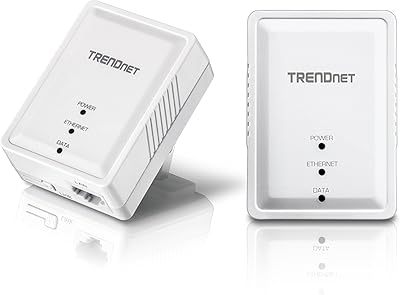
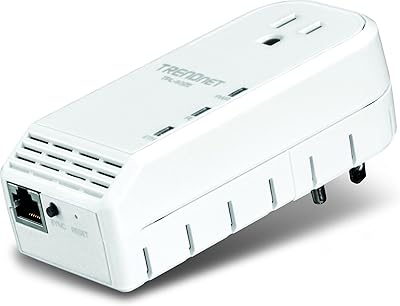
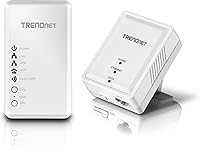
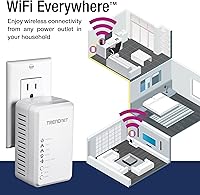
The TRENDnet TPL-410APK Powerline Wi-Fi Extender Kit takes a smarter approach to dead zones than a typical repeater — instead of rebroadcasting a weak signal, it pushes your internet connection through the electrical wiring already inside your walls. The kit ships as two adapters: one connects to your router via Ethernet, and the other plugs in wherever you need coverage, delivering both wireless N300 access and two wired Ethernet ports at that remote location. Setup is genuinely painless — the adapters auto-pair out of the box, pre-encrypted and ready to go, no software involved. If you live in a home with thick plaster walls or a basement that swallows Wi-Fi signals, this kind of solution makes far more practical sense than fighting your router's range.
Features & Benefits

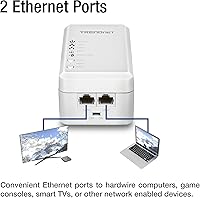
The 500 AV powerline backbone is the headline spec here, but real-world throughput will land noticeably below that ceiling — expect something closer to 80–150 Mbps depending on your home's wiring age, the distance between adapters, and which electrical circuit each one occupies. The N300 wireless side handles HD streaming and casual browsing without complaint, though it won't impress anyone running several 4K devices simultaneously. Those two Ethernet ports on the access point unit are genuinely useful — plug in a smart TV and a gaming console at once, no switching required. The TRENDnet extender bundle also plays nicely with older AV200 and AV1200 TRENDnet adapters, so existing users can expand without replacing their entire setup.

Best For

This powerline Wi-Fi kit is a strong pick for homeowners dealing with a stubborn dead zone — think a detached garage, a finished basement, or a bedroom on the far end of the house from your router. It suits anyone who wants a wired connection for streaming or gaming without drilling holes or pulling cable through walls. That said, temper your expectations if you live in an apartment with a shared electrical panel, since powerline adapters can behave unpredictably across circuits you do not control. Older homes with aging wiring can also see reduced performance. This adapter set works best as a focused single-room fix, not a whole-home network overhaul for a large, multi-device household.

User Feedback

With a 3.9-star average across 140 ratings, the TRENDnet extender bundle lands in comfortable but not glowing territory. Buyers who praise it consistently highlight effortless plug-in setup and the dependability of the wired Ethernet connection — several noted it outperformed the Wi-Fi repeaters they had tried previously. Criticism clusters around two areas: wireless speeds that underwhelm anyone expecting router-level performance, and inconsistency tied to home electrical layouts. A few users on a different circuit than their router found the connection unpredictable — that is a known powerline technology limitation, not a defect unique to this kit. On longevity, feedback skews positive; most buyers report months of stable operation without needing resets or intervention.

Pros

  • Plug-and-play setup takes under two minutes — no app, no CD, no configuration screens required.
  • Ships pre-encrypted out of the box, so your powerline connection is secured from the very first use.
  • Two Ethernet ports on the remote adapter let you wire a TV and a console simultaneously without a switch.
  • Delivers a far more stable connection than wireless repeaters in thick-walled or multi-floor homes.
  • Compact form factor fits most standard outlets without awkward protrusion.
  • Backward compatible with TRENDnet AV200 and AV1200 adapters, making it a clean upgrade for existing users.
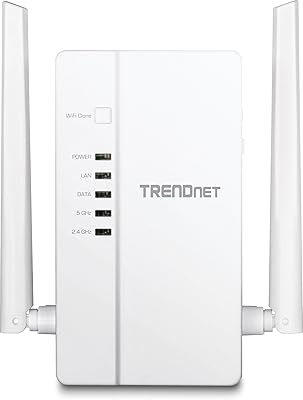
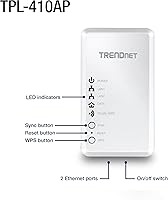
  • LED indicators give instant visual feedback on connection strength, which helps troubleshoot circuit issues fast.
  • Most long-term buyers report months of reliable, hands-off operation without needing to reboot or re-pair.

Cons

  • Real-world throughput falls well short of the 500 Mbps headline — expect 60 to 150 Mbps in most homes.
  • N300 wireless is noticeably underpowered for households running multiple 4K streams or several active devices.
  • Performance varies significantly based on home wiring age and circuit layout, making outcomes hard to predict before buying.
  • Adapters on separate electrical circuits may fail to pair reliably, a frustrating outcome with no easy fix.
  • No passthrough outlet means you permanently sacrifice the wall socket the adapter occupies.
  • Apartment and rental residents face real compatibility risks due to shared electrical infrastructure.
  • The remote adapter can block adjacent outlets depending on socket spacing in older or tightly spaced panels.
  • A subset of buyers reports one adapter failing within the first year, leaving the entire kit unusable until replaced.
  • No mobile app or web interface means zero visibility into connection diagnostics beyond the indicator lights.

Ratings

The scores below for the TRENDnet TPL-410APK Powerline Wi-Fi Extender Kit were generated by our AI rating engine after analyzing verified buyer reviews from multiple global sources, with spam, incentivized, and bot-flagged submissions actively filtered out. The result is a balanced, data-driven snapshot that surfaces what real users genuinely appreciate — and where this adapter set leaves them wanting more. Both the strengths and the friction points are reflected honestly so you can make a confident decision.
Ease of Setup
91%
Buyers consistently describe the pairing process as the easiest networking gear they have ever configured — plug both adapters in, and they find each other automatically. No CD, no app, no frustrating configuration screens. Several reviewers noted they were up and running within two minutes of opening the box.
A small number of users found that adapters on different electrical circuits did not auto-pair as expected, requiring them to use the sync button manually. This catches people off guard when the out-of-box experience is marketed as completely effortless.
Real-World Powerline Speed
62%
38%
For everyday tasks — loading web pages, streaming HD video, or downloading moderate-sized files — the throughput is more than adequate. Users replacing older AV200 adapters noticed a meaningful jump in responsiveness, and wired devices connected to the remote unit fare better than anything running over Wi-Fi.
The 500 Mbps headline figure is theoretical and rarely approached in practice. Most users report actual speeds between 60 and 150 Mbps, and homes with aging or complex wiring see the lower end of that range. Heavy streamers and anyone transferring large files regularly will notice the ceiling quickly.
Wi-Fi Coverage & Signal Quality
67%
33%
In a focused single-room scenario — a basement bedroom, a home office at the end of a hallway — the N300 wireless output does a solid job replacing what was previously a dead zone. Buyers report clean, stable connections for video calls and standard-definition or HD streaming within a reasonable radius of the access point unit.
N300 is a modest wireless standard by today's benchmarks, and multi-device households quickly expose its limits. Users trying to serve several phones, a laptop, and a streaming stick simultaneously from this unit describe noticeable slowdowns. The coverage radius also shrinks considerably through walls or floors.
Wired Ethernet Ports
88%
Having two Ethernet ports on the remote adapter is a genuinely practical feature that buyers highlight often. Connecting a smart TV and a game console simultaneously without any switching is exactly the kind of real-world convenience that justifies choosing this kit over a wireless-only extender.
Two ports cover most single-room setups, but users with a media cabinet housing three or more devices — say a console, a streaming box, and a NAS drive — find themselves needing a small switch anyway. The wired speed cap at around 100 Mbps is also a limiting factor for high-bandwidth wired use cases.
Reliability & Connection Stability
71%
29%
The majority of long-term buyers report months of uninterrupted operation without needing to reboot or re-pair the adapters. The wired Ethernet connection in particular earns praise for being far more consistent than what these same users experienced with wireless repeaters or mesh satellite units in challenging spaces.
Stability is heavily dependent on the home's electrical environment. Users whose router adapter and remote unit end up on separate electrical circuits — a common situation in split-level homes or larger houses — report frustrating drop-outs that are difficult to diagnose without understanding how powerline technology works.
Compatibility with Existing TRENDnet Gear
83%
Users already invested in TRENDnet's powerline ecosystem find this adapter set slots right in alongside AV200 and AV1200 units with no friction. It is a genuine upgrade path rather than a rip-and-replace situation, which matters when you already have adapters spread across a house.
Compatibility is naturally limited to TRENDnet's own product line. Buyers coming from a different brand's powerline adapters will need to replace everything, which adds unexpected cost. Cross-brand powerline interoperability exists in principle but is inconsistent enough in practice that mixing is rarely advisable.
Build Quality & Physical Design
74%
26%
The adapters feel sturdy and well-constructed for their weight class — at 8 ounces and a compact footprint, they sit flush against most wall outlets without dominating the socket. The matte finish resists fingerprints reasonably well, and indicator lights give a clear read on connection status at a glance.
The plug-in form factor means the adapter can block adjacent outlets depending on socket spacing, which frustrates users in tight electrical panels or older outlet configurations. There is no passthrough outlet, so you permanently lose that socket while the adapter is in use.
Security & Privacy
86%
Shipping pre-encrypted out of the box is a meaningful touch that most budget-tier powerline kits skip. Users who are security-conscious but not technically inclined appreciate that they do not have to navigate encryption settings themselves — the protection is active from the first plug-in.
Advanced users who want to customize their encryption keys or audit the security configuration have limited options. The simplicity that makes setup easy also means there is not much room to manage security beyond the factory defaults.
Performance in Older Homes
54%
46%
In homes with reasonably maintained wiring from the 1980s onward, many buyers report workable performance that still beats a wireless extender. For a basement workshop or a garage where Wi-Fi simply does not penetrate, even modest powerline speeds feel like a significant practical improvement.
Homes with knob-and-tube wiring, heavily loaded circuits, or electrical panels that are decades past their prime see inconsistent and sometimes unusable results. This is a technology-level limitation, but buyers in older properties should research their wiring situation before committing to any powerline solution.
Value for Money
69%
31%
As a two-adapter kit that includes both a powerline sender and a combined powerline-plus-Wi-Fi receiver, the bundle pricing is reasonable for what is in the box. Users who compare it to buying two separate adapters from competing brands generally find the all-in cost competitive for the feature set offered.
At its price point, buyers are brushing up against newer Wi-Fi 6 mesh systems that offer substantially better wireless performance across an entire home. For users with a single targeted problem — one dead room — the value holds. For those with broader coverage needs, the math starts to favor alternatives.
Multi-Device Household Performance
48%
52%
For a single user or a couple with light, predictable usage — one streaming device, occasional laptop browsing — the adapter set handles concurrent connections without obvious strain. Low-demand households rarely push it hard enough to notice its bandwidth ceiling.
Homes with three or more simultaneous active users hit a wall quickly. Gamers and 4K streamers sharing the N300 wireless access point report buffering and latency spikes that make the kit impractical as a daily driver for a family. It was simply not designed for that workload.
Apartment & Shared-Building Suitability
41%
59%
In purpose-built apartment blocks with individual metered electrical circuits — which some modern buildings do have — the adapter set can function adequately if both units land on the same circuit. A handful of apartment-based reviewers report successful deployments in this specific scenario.
Shared electrical infrastructure is the single biggest risk factor for powerline networking, and apartment dwellers bear the brunt of it. Neighbors on the same panel can cause interference, and many apartment buildings simply do not have the circuit architecture that makes powerline adapters reliable.
Long-Term Durability
77%
23%
A meaningful portion of the 140 reviewers have owned the kit for over a year without hardware failures. The adapters run warm but not hot under normal use, and there are no widespread reports of sudden failures or degraded performance over time in homes with stable electrical environments.
A small cluster of buyers reports one of the two adapters failing within six to twelve months, which effectively kills the entire setup since the adapters are co-dependent. Warranty support experiences in these cases receive mixed feedback, with response times cited as inconsistent.
Indicator Lights & Status Visibility
79%
21%
The LED status indicators give users a quick way to gauge connection quality without logging into any interface — a green light signals a strong powerline link, amber signals moderate, and so on. Buyers troubleshooting a slow connection find this visual feedback genuinely useful for diagnosing circuit issues.
In a bedroom installation, the LEDs can be bright enough to be noticeable in a dark room, which a few users mention as a minor but persistent annoyance. There is no brightness control or scheduled dimming option available.

Suitable for:

The TRENDnet TPL-410APK Powerline Wi-Fi Extender Kit is built for homeowners who have exhausted their patience with dead zones and do not want to run Ethernet cable through walls or ceilings. It is a natural fit for someone who needs internet in a finished basement, a detached garage, or a far bedroom where the router signal simply cannot reach — places where a wireless repeater would only rebroadcast a weak signal and make things worse. If your goal is to hard-wire a smart TV or a gaming console in that remote room without any drilling or cable management, the two built-in Ethernet ports on the access point unit solve that problem cleanly. It also appeals to anyone already using TRENDnet powerline adapters who wants to add wireless capability at the far end without replacing their existing setup. Non-technical users especially benefit from the plug-and-play design — there is genuinely nothing to configure, which removes a real barrier for less confident buyers.
Not suitable for:

The TRENDnet TPL-410APK Powerline Wi-Fi Extender Kit is the wrong tool if you are expecting router-level wireless performance or trying to serve a busy, multi-device household from a single access point. Apartment dwellers should approach with real caution — shared electrical panels are common in multi-unit buildings, and when your neighbors share the same circuit infrastructure, powerline adapters can behave unpredictably or fail to connect at all. Homes with very old wiring, knob-and-tube installations, or heavily loaded circuits are similarly risky; the technology depends on clean, consistent electrical lines that aging infrastructure often cannot provide. If you need 4K streaming on multiple screens simultaneously, or if you regularly transfer large files across your network, the real-world throughput ceiling will frustrate you. And if you are renting or living somewhere you cannot control how electrical circuits are laid out, this adapter set introduces a variable you cannot fix regardless of how good the hardware is.
Specifications

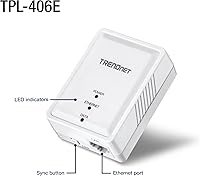
  • Model Number: This kit ships as the TPL-410APK bundle, containing one TPL-406E powerline sender adapter and one TPL-410AP powerline Wi-Fi access point adapter.
  • Powerline Standard: Both adapters operate on the HomePlug AV 500 standard, with a theoretical maximum powerline throughput of 500 Mbps.
  • Wireless Standard: The TPL-410AP access point unit supports 802.11b, 802.11g, and 802.11n (N300), delivering up to 300 Mbps theoretical wireless speed.
  • Wired Ports: The remote TPL-410AP unit includes two Fast Ethernet ports (10/100 Mbps) for connecting wired devices directly at the extended location.
  • Wired Data Rate: Wired Ethernet connections through the adapter support data transfer rates of up to 100 Mbps under the Fast Ethernet standard.
  • Powerline Range: The adapters communicate over electrical wiring with a maximum rated distance of approximately 300 meters (984 feet) measured as linear cable distance.
  • Coverage Claim: TRENDnet rates the powerline signal as capable of reaching throughout homes up to 5,000 square feet, though actual results depend heavily on wiring quality and circuit layout.
  • Security: The adapters ship with 128-bit AES encryption pre-configured and active, so the powerline network is secured from the moment both units are plugged in.
  • Setup Method: No software, CD, or manual configuration is required — the two adapters auto-pair with each other when plugged into outlets on the same electrical circuit.
  • Compatibility: This adapter set is backward compatible with TRENDnet AV200, AV500, and AV1200 powerline adapters, allowing integration into an existing TRENDnet powerline network.
  • OS Support: The kit is compatible with Windows 10, 8.1, 8, 7, Vista, and XP operating systems for any utility-based management if needed.
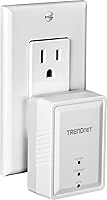
  • Dimensions: Each adapter measures 2.56 x 1.97 x 3.94 inches, providing a compact wall-plug profile that fits most standard household outlets.
  • Item Weight: The combined kit weighs 8 ounces, making each individual adapter lightweight and easy to reposition between outlets if needed.
  • Brand & Manufacturer: The TPL-410APK is designed, manufactured, and supported by TRENDnet, a networking hardware brand headquartered in Torrance, California.
  • Availability Date: This kit was first made available for purchase on January 15, 2014, and is listed by TRENDnet as not discontinued as of the time of publication.
  • Market Ranking: The kit holds a Best Sellers Rank of #1,184 in the Powerline Network Adapters category on Amazon, based on recent sales velocity data.

Related Reviews

TP-Link TL-WPA7817 Powerline Wi-Fi 6 Extender Kit
86%
88%
Wi-Fi Performance
94%
Setup & Installation
91%
Value for Money
85%
Powerline Range
89%
Dual-Band Speeds
More
TRENDnet TPL-430AP Powerline Wireless Access Point
75%
91%
Ease of Setup
64%
Powerline Throughput
78%
Wi-Fi Coverage & Signal Quality
88%
Wired Port Performance
74%
Build Quality & Durability
More
TRENDnet TPL-423E2K Powerline 1300 AV2 Adapter Kit
75%
88%
Ease of Setup
63%
Real-World Data Speed
74%
Connection Stability
91%
Pass-Through Outlet
67%
Build Quality & Durability
More
TRENDnet TPL-406E2K Powerline 500 Adapter Kit
78%
91%
Ease of Setup
67%
Real-World Speed
83%
Connection Stability
78%
Build Quality & Form Factor
74%
Value for Money
More
TRENDnet TPL-402E 500 Mbps Powerline Adapter
73%
88%
Setup & Ease of Use
58%
Real-World Speed Performance
71%
Connection Stability
84%
Pass-Through Outlet Design
81%
Compatibility & Standards
More
TP-Link RE813XE Wi-Fi 6E Range Extender
86%
91%
Performance
89%
Wi-Fi Coverage
81%
Ease of Setup
95%
Compatibility with TP-Link Routers
88%
Streaming & Gaming Performance
More
TP-Link TL-WPA7617 Powerline WiFi Extender Kit
70%
91%
Ease of Setup
67%
Real-World Throughput
88%
Wired Ethernet Performance
72%
Wi-Fi Coverage & Signal Quality
38%
Surge Protector Compatibility
More
TP-Link RE705X Wi-Fi 6 Range Extender
84%
89%
Performance
87%
Wi-Fi Coverage Range
93%
Ease of Setup
85%
Connectivity Reliability
70%
App Experience
More
Cudy RE3000 AX3000 Wi-Fi 6 Extender
74%
88%
Setup & Ease of Use
76%
Wi-Fi Coverage
67%
5 GHz Band Performance
81%
2.4 GHz Band Reliability
63%
Real-World Speed Throughput
More
TP-Link TL-WA860RE Wi-Fi Range Extender
86%
95%
Ease of Setup
84%
Performance in Larger Homes
90%
Wi-Fi Range Extension
88%
Reliability
85%
Build Quality
More

FAQ

Ideally, yes — powerline adapters perform best and pair most reliably when both units share the same electrical circuit. In practice, many homes have interconnected circuits that allow the signal to pass through, but if your router adapter and the remote unit are on completely separate circuits (common in larger homes or split-level layouts), you may see reduced speeds or pairing failures. It is worth testing placement before assuming a specific outlet will work well.

The 500 Mbps figure is a theoretical maximum under laboratory conditions — real-world speeds typically land between 60 and 150 Mbps over the powerline connection, depending on your home's wiring age, electrical noise on the circuit, and the distance between adapters. The N300 wireless side adds another ceiling on top of that. For HD streaming, video calls, and casual browsing, it is plenty. For 4K multi-device households or large file transfers, it will feel limited.

It might, but apartments carry real risk for powerline networking. If your unit has its own dedicated electrical meter and circuit panel — which some modern apartment buildings provide — you have a reasonable chance of success. In older buildings with shared panels, your neighbors' electrical loads can interfere with the powerline signal, and you may not be able to pair the adapters reliably at all. It is a variable you genuinely cannot control, so apartment residents should weigh that uncertainty carefully before purchasing.

No software or disc is needed at all. The TRENDnet TPL-410APK Powerline Wi-Fi Extender Kit is designed to auto-pair straight out of the box — plug the sender adapter into a wall outlet near your router and connect it via Ethernet, then plug the second adapter wherever you need coverage, and they find each other automatically. Most users are up and running within two or three minutes.
This is strongly discouraged. Surge protectors and power strips often contain noise filters that actively suppress the powerline signal the adapters use to communicate, which can dramatically reduce speeds or prevent the connection from working entirely. Always plug powerline adapters directly into a wall outlet for reliable performance.

Yes, this adapter set is backward compatible with TRENDnet AV200, AV500, and AV1200 adapters. You can mix it into an existing TRENDnet powerline network without replacing what you already have. Keep in mind that the overall network speed will be limited by the slowest adapter in the chain, so an AV200 unit in the same network will create a bottleneck on that segment.

For a focused single-room deployment, the N300 wireless output from the remote adapter is generally adequate for one or two devices doing standard streaming, browsing, or video calls. It is not a high-performance access point, and the signal radius through walls or floors is limited. Think of it as a targeted fix for one problem room, not a broadcast solution for a large open area.

You get two wired Ethernet ports on the access point unit, which handles two wired devices simultaneously — a smart TV and a game console, for example. Beyond that, additional devices would need to connect over Wi-Fi. If you have three or more wired devices to connect, a small unmanaged switch plugged into one of the Ethernet ports is an inexpensive and practical solution.

Depending on your outlet spacing, it can. The adapter plugs directly into the wall without a passthrough outlet, and its physical footprint may cover an adjacent socket depending on how close together your outlets are mounted. This is worth checking against your specific outlet configuration, especially in older homes where outlets were installed to older spacing standards.

Most long-term users report that the connection remains stable and consistent for a year or more in homes with solid electrical wiring. There are no firmware updates or calibration requirements that degrade over time. The main variable is your electrical environment — if wiring conditions or circuit loads change seasonally (for example, heavy HVAC use in summer), you may notice some fluctuation, but that is a property of powerline technology generally rather than a defect in this particular kit.