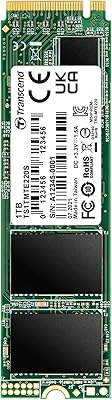
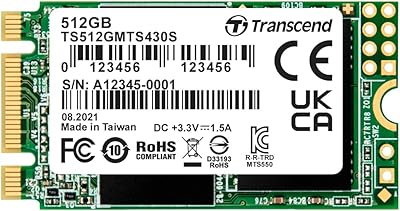
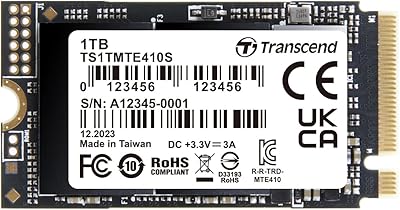
Overview

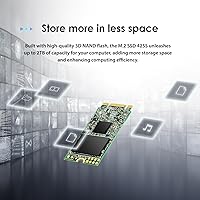
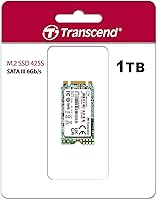
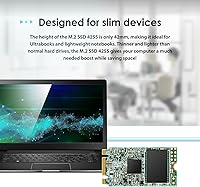
The Transcend MTS425S 1TB M.2 2242 SSD occupies a very specific niche in the storage market — one that most shoppers never consider until their upgrade hits a wall. The 2242 form factor measures just 42mm long rather than the 80mm of a standard 2280 drive, and that shorter length is the entire point. Many slim ultrabooks, older business laptops, and compact mini PCs were designed around this smaller slot and physically cannot fit a full-length drive. Transcend has spent decades building a reputation for dependable storage hardware, and this compact solid state drive backs that standing with a 3-year limited warranty — a meaningful confidence signal for a component you are trusting with your data.
Features & Benefits

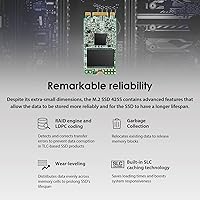
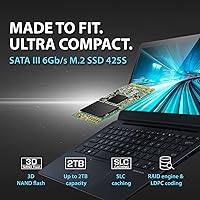
The built-in SLC cache acts as a fast buffer for incoming writes, so copying a batch of files or launching a heavy application feels noticeably quicker than the underlying TLC speed would otherwise allow. On the reliability side, LDPC error correction paired with an internal RAID engine quietly catches and fixes data errors before they compound — the kind of protection you only appreciate when nothing ever goes wrong. DevSleep mode cuts power to the SATA interface during idle periods, which is a real advantage in laptops running on battery. Sequential reads reach around 550 MB/s, roughly the difference between loading a large project folder in seconds versus waiting uncomfortably long on a spinning hard drive. Transcend SSD Scope rounds things out by giving you a simple dashboard to monitor drive health over time.

Best For

The clearest use case for this compact solid state drive is a targeted one: you have a device with a 2242 M.2 slot and you need a meaningful storage upgrade. That might be an older ThinkPad, a fanless mini PC, or an Intel NUC-style build where a standard 2280 drive physically will not seat. It also works well as secondary storage in machines that already run an NVMe primary drive, adding a clean terabyte of SATA capacity without touching your fast boot volume. Buyers who do not require NVMe throughput for their workloads — everyday office use, media archiving, or a secondary file store — will find the price-to-capacity ratio genuinely hard to argue with at this size.

User Feedback

Sitting at a 4.5-star average across more than 1,200 ratings, the Transcend MTS425S has earned a quietly solid community reputation. Most buyers praise how painless the installation is and how striking the jump feels moving from an old spinning drive — even SATA flash is night and day for responsiveness. The most common criticism is not really a product flaw: some buyers arrive expecting NVMe-level throughput and feel let down by the SATA bandwidth ceiling, which is a research gap rather than a defect. A handful of low ratings trace directly to form factor confusion — ordering a 2242 when their slot required a 2280. The takeaway is simple: verify your exact slot length before purchasing, and this drive rarely disappoints.

Pros

  • Solves a real compatibility problem — one of the few quality 1TB options in the rare 2242 form factor.
  • Noticeably faster than any spinning hard drive, making older compact laptops feel responsive again.
  • SLC cache keeps short burst transfers quick, so day-to-day tasks do not feel sluggish.
  • LDPC error correction adds a meaningful layer of data protection without any user configuration required.
  • DevSleep mode actively conserves battery in laptops rather than idling at full power draw.
  • Transcend SSD Scope gives non-technical users a simple way to check drive health over time.
  • At just 5 grams, it adds virtually no weight to any portable build.
  • A 3-year warranty from a well-established storage brand provides genuine peace of mind.
  • Clean, tool-friendly installation that most users complete without professional help.
  • Strong community track record with a 4.5-star average across well over a thousand real buyers.

Cons

  • SATA III bandwidth caps real-world speeds well below what modern NVMe drives routinely deliver.
  • Not compatible with standard 2280 slots, making it easy to order the wrong drive by mistake.
  • 3D TLC NAND can slow noticeably on sustained large writes once the SLC cache is exhausted.
  • No included cloning software or migration tool; users must source their own solution for OS transfers.
  • At 1TB with 360 TBW, heavy daily writers will need to think ahead about long-term endurance.
  • Transcend SSD Scope software is Windows-focused and offers limited support for other operating systems.
  • Sequential write speed drops significantly compared to read, which matters for write-heavy workflows.
  • No hardware encryption support, which can be a requirement in some business or compliance environments.

Ratings

Our AI rating engine analyzed verified global buyer reviews for the Transcend MTS425S 1TB M.2 2242 SSD, actively filtering out incentivized, bot-generated, and unverified feedback to surface what real users actually experienced. The scores below reflect a balanced synthesis of genuine praise and recurring frustrations — nothing is glossed over. Where this compact solid state drive genuinely excels and where it falls short are both represented transparently across each category.

Compatibility & Fit
93%
For buyers with a genuine 2242 slot requirement, this drive fits and works without any fuss — something users repeatedly call out as a relief given how few quality options exist at this length. Owners of older ThinkPads, compact NUCs, and select Asus ultrabooks consistently report a perfect physical fit on the first try.
The very specificity that makes it so useful also creates a sharp edge: buyers who did not verify their slot length before ordering account for a disproportionate share of negative reviews. The drive does nothing wrong in these cases, but the frustration is real and worth flagging clearly.
Read & Write Speed
74%
26%
Coming from a spinning hard drive, users describe the speed jump as dramatic — boots that used to take over a minute dropping to under 15 seconds, and everyday file operations feeling nearly instant. For SATA-class storage, the sequential read performance holds up well in practical workloads.
Anyone comparing this drive against NVMe alternatives will feel the SATA ceiling quickly, especially during large sustained transfers. Video editors or users moving multi-gigabyte archives regularly report noticeable slowdowns once the SLC cache is exhausted, which is an honest limitation of SATA TLC architecture.
Value for Money
88%
In a category where 2242 options are scarce, getting a full terabyte from a reputable brand with a 3-year warranty at a competitive price point earns genuine appreciation from buyers. Users who understand what they are buying — a niche SATA drive solving a specific compatibility gap — consistently rate the value as strong.
Measured purely against what the same money buys in a standard 2280 NVMe drive, the cost-per-performance ratio looks less flattering. Buyers who did not need the 2242 format and simply wanted a budget SSD often felt they left performance on the table.
Installation Ease
91%
The installation experience draws consistent praise — users with minimal technical background describe completing the swap in under ten minutes using nothing more than a small screwdriver. The B+M Key design means there is no guesswork about physical connector orientation, and the drive seats cleanly.
A small number of users noted that their devices required tracking down the correct standoff screw size separately, which added minor friction. There is also no included migration software, so first-time upgraders who wanted to clone their existing drive had to source a third-party tool on their own.
Build Quality & Durability
86%
At just 5 grams with no moving parts and a shock-resistant design, the drive inspires confidence for use in laptops that get carried daily. Long-term owners report no degradation in performance or reliability after a year or more of regular use, which aligns with the 2,000,000-hour MTBF rating.
The drive lacks any visible heatspreader or thermal protection layer, which is not unusual at this size but means sustained heavy workloads in poorly ventilated enclosures could push temperatures upward. A small subset of users in mini PC builds noted higher-than-expected idle temperatures in tight chassis.
Endurance & Longevity
82%
18%
For typical home and office workloads, the 360 TBW rating on the 1TB model is more than enough — most users writing 20 to 30GB per day would take decades to approach that threshold. The LDPC error correction gives an added layer of reassurance that the drive is actively protecting data integrity over its lifespan.
Heavier users — those running local backups, frequent large downloads, or write-intensive applications — may find the endurance rating less comfortable over a 5-year horizon. It is not alarming, but it is a factor worth noting for anyone planning to use this as a high-churn workhorse drive.
Power Efficiency
84%
DevSleep mode earns quiet but genuine appreciation from laptop users, who notice slightly improved battery run times compared to older HDDs or even some competing SATA SSDs that lack aggressive idle power management. The low operating voltage keeps the thermal footprint minimal during everyday tasks.
The efficiency gains, while real, are incremental rather than transformative — users expecting a dramatic battery life improvement over their previous drive may be underwhelmed. DevSleep is also dependent on the host system supporting the feature, and some older ultrabooks do not fully implement it.
Software (SSD Scope)
67%
33%
For Windows users, Transcend SSD Scope provides a clear, beginner-friendly dashboard that displays drive health, temperature, and S.M.A.R.T. data without overwhelming non-technical buyers. The interface is clean and the health indicators are easy to interpret at a glance.
The software is Windows-only, leaving macOS and Linux users with no first-party monitoring tool whatsoever. Even on Windows, some users find the feature set limited compared to third-party utilities — it covers the basics but lacks advanced diagnostics, detailed wear tracking, or firmware update notifications.
Thermal Performance
71%
29%
Under typical workloads — web browsing, document editing, media playback — the drive runs comfortably cool and never throttles, which is exactly what you want from a storage component that should operate invisibly in the background.
Under sustained sequential writes, temperatures can climb into ranges that prompt occasional concern in passively cooled enclosures. Users running this drive in a sealed mini PC with limited airflow have reported throttling during large file operations, though it recovers quickly once the write burst ends.
Capacity Satisfaction
89%
A full terabyte in a 2242 form factor is genuinely rare, and buyers upgrading from 128GB or 256GB factory-installed drives describe the capacity difference as life-changing for their day-to-day workflow. The ability to store a full OS, applications, and a substantial media library on a single compact drive is a clear win.
Users with very large media libraries or local backup requirements may find 1TB tighter than expected over a two-to-three year period, particularly as operating system and application footprints continue to grow. The 2TB variant addresses this, though at a higher price point.
Brand Reliability & Trust
87%
Transcend has decades of storage manufacturing history behind it, and buyers in the enterprise and prosumer space in particular cite that track record as a key purchase factor. The 3-year warranty and responsive customer support reputation add a layer of post-purchase confidence that lesser-known brands struggle to match.
Among mainstream consumers less familiar with storage brands, Transcend carries less name recognition than Samsung or Western Digital, which occasionally leads to pre-purchase hesitation. A handful of users also noted longer-than-expected warranty claim processing times, though outright defects appear to be rare.
Out-of-Box Experience
78%
22%
The drive arrives in simple, no-waste packaging that feels appropriate for a component product — no unnecessary bulk. Users report that it is immediately recognized by Windows and Linux without any driver installation required, which makes the first boot after installation reassuringly uneventful.
The package contains only the drive itself with no accessories, adapter, or documentation beyond basic warranty information. For buyers doing their first-ever SSD upgrade, the lack of any quick-start guidance or even a link to a setup tutorial can leave the experience feeling slightly bare.
Noise & Vibration
97%
Being a solid state drive with no mechanical components whatsoever, this compact solid state drive operates in complete silence under all conditions. Users replacing aging HDDs consistently mention the absence of clicking, spinning, or vibration as an immediately noticeable quality-of-life improvement.
There is essentially nothing negative to report in this category — silent operation is a baseline expectation for any SSD, and this drive meets it without exception. The score reflects a ceiling inherent to the product type rather than a standout achievement.

Suitable for:

The Transcend MTS425S 1TB M.2 2242 SSD is the right call for anyone whose device physically requires the shorter 2242 slot — a group that is larger than most people realize. Owners of older ThinkPad business laptops, certain Asus ultrabooks, Intel NUC mini PCs, and various small-form-factor desktops often discover their M.2 slot tops out at 42mm, making this compact solid state drive the only viable flash storage option for a meaningful upgrade. It is equally well-suited to anyone still running a spinning hard drive in one of these machines, where even SATA flash will feel like a dramatic transformation in boot times and general responsiveness. Secondary storage builders will also find it a clean solution — dropping a full terabyte of reliable capacity into a 2242 slot alongside an existing NVMe boot drive is straightforward and effective. For budget-conscious upgraders who do not need NVMe throughput for their workloads, the value on offer here is genuinely hard to beat.
Not suitable for:

If your device has a standard-length M.2 2280 slot, the Transcend MTS425S 1TB M.2 2242 SSD is simply not the drive you are shopping for — and buying it by mistake is the single most common source of negative reviews, so checking your motherboard or laptop manual before ordering is non-negotiable. Power users running demanding workloads like 4K video editing, large database operations, or heavy virtual machine use will find the SATA interface a genuine bottleneck; this compact solid state drive tops out around 550 MB/s sequential read, while a mid-range NVMe drive can deliver four to five times that throughput. Gamers chasing fast level load times or content creators moving large files continuously should look toward NVMe options instead, even if it means spending more. The 360 TBW endurance rating is reasonable for everyday use over several years, but high-write enterprise or prosumer environments will wear through it faster than a purpose-built workload drive. If none of these edge cases apply to you, this drive rarely gives buyers a reason to complain.
Specifications

  • Form Factor: This drive uses the M.2 2242 format, measuring 42mm x 22mm x 3.58mm — noticeably shorter than the common 2280 standard.
  • Interface: It connects via SATA III at 6Gb/s, using a B+M Key edge connector compatible with both B-Key and M-Key M.2 slots.
  • Capacity: The drive offers 1TB of usable storage, with additional capacity options available in the same product family at 250GB, 500GB, and 2TB.
  • Sequential Read: Maximum sequential read speed reaches up to 550 MB/s under optimal conditions.
  • Sequential Write: Maximum sequential write speed reaches up to 500 MB/s, with lower figures on smaller capacity variants.
  • Random Read: 4K random read performance is rated at up to 55,000 IOPS for the 1TB model.
  • Random Write: 4K random write performance is rated at up to 72,000 IOPS for the 1TB model.
  • Flash Type: Storage cells use 3D TLC NAND flash, which layers cells vertically to improve density and manage cost effectively.
  • Cache: An integrated SLC caching layer accelerates burst write operations by temporarily treating TLC cells as faster single-level cells.
  • Endurance: The 1TB model is rated for 360 TBW (terabytes written), which equates to roughly 197GB of writes per day over five years.
  • Error Correction: LDPC (Low-Density Parity-Check) coding combined with an internal RAID engine detects and corrects bit errors before data corruption can occur.
  • Reliability: Mean time between failures is rated at 2,000,000 hours under standard operating conditions.
  • Power Mode: DevSleep mode intelligently powers down the SATA interface during extended idle periods to reduce energy consumption.
  • Operating Voltage: The drive operates at 3.3V with a ±5% tolerance, consistent with standard M.2 SATA power delivery.
  • Operating Temp: Rated for reliable operation between 0°C and 70°C (32°F to 158°F).
  • Weight: The drive weighs just 5 grams, adding negligible mass to any portable or compact build.
  • Warranty: Transcend covers this drive with a 3-year limited warranty from the date of purchase.
  • Software: Transcend SSD Scope is included — a Windows-compatible utility for monitoring drive health, temperature, and overall performance status.
  • Certifications: The drive carries CE, FCC, UKCA, BSMI, KC, and RCM certifications for use across major global markets.
  • Technologies: Supported drive technologies include TRIM, NCQ, S.M.A.R.T. reporting, and Advanced Garbage Collection for long-term performance maintenance.

Related Reviews

GAMERKING 1TB M.2 2242 SSD
84%
90%
Performance
84%
Build Quality
91%
Ease of Installation
78%
Durability
88%
Compatibility
More
Kingdata M.2 2242 1TB SSD
87%
89%
Performance
91%
Value for Money
87%
Read Speed
84%
Write Speed
88%
Build Quality
More
KingSpec XG7000 1TB M.2 2242 SSD
88%
94%
Performance
96%
Read Speed
89%
Build Quality
90%
Reliability
85%
Compatibility
More
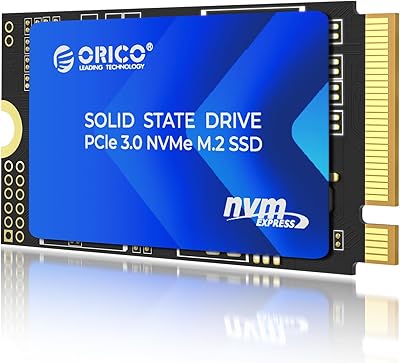
ORICO M.2 2242 NVMe SSD 1TB
87%
89%
Performance
92%
Value for Money
88%
Heat Dissipation
75%
Installation Ease
91%
Build Quality
More
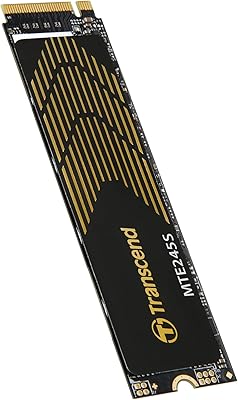
Transcend MTE245S 1TB M.2 PCIe Gen4x4 SSD
88%
92%
Performance (Read/Write Speeds)
89%
Cooling Efficiency (Graphene Heatsink)
93%
Endurance (TBW and MTBF)
82%
Value for Money
90%
Compatibility (Desktops, Laptops, PS5)
More
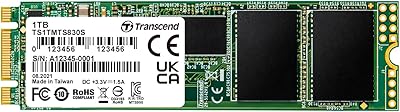
Transcend MTS830S 1TB M.2 SATA SSD
82%
83%
Read Performance
71%
Write Performance
78%
DRAM Cache Effectiveness
91%
Compatibility
93%
Installation Experience
More
Transcend MTE410S 1TB M.2 PCIe Gen4x4 NVMe SSD
89%
93%
Performance
91%
Speed (Read/Write)
89%
Power Efficiency
88%
Reliability
85%
Compatibility with Devices
More
Transcend MTS430S 512GB M.2 SSD
85%
94%
Form Factor Compatibility
76%
Read & Write Speed
83%
Real-World Responsiveness
91%
Installation Ease
89%
Long-Term Reliability
More
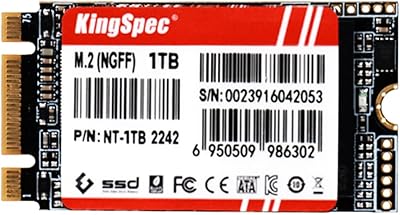
KingSpec NT Series 1TB M.2 2242 SATA SSD
86%
89%
Performance Boost Over HDDs
93%
Ease of Installation
85%
Compatibility with Devices
88%
Speed (Read/Write)
92%
Value for Money
More
Transcend TS1TMTE220S 1TB M.2 NVMe PCIe Gen3x4 SSD
87%
89%
Performance
91%
Value for Money
94%
Read Speed
88%
Write Speed
85%
Reliability
More

FAQ

The easiest way is to check your laptop or motherboard manual — it will list the supported M.2 lengths. If you can open the device, look at the position of the standoff screw on the board; a 2242 slot has its screw mounting point roughly 42mm from the connector edge, while a 2280 slot sits at 80mm. When in doubt, search your exact model number alongside the term M.2 slot length.

It works perfectly fine as a primary boot drive. As long as your system supports SATA M.2 and can boot from it, you can install your operating system directly onto this compact solid state drive without any issues.

The honest answer is: you would only pick this if your device requires a 2242-length slot or specifically supports SATA M.2 only, not NVMe. If your machine supports NVMe in a 2280 slot, a comparable NVMe drive will be significantly faster. The Transcend MTS425S 1TB M.2 2242 SSD exists to solve a compatibility problem, not to compete with NVMe on raw speed.
Once the SLC cache is saturated — which typically happens during very large sustained transfers — write speeds will drop to the native TLC rate, which can be noticeably slower. For everyday workloads like file browsing, app launches, and moderate file moves, the cache refills quickly enough that most users never notice. It only becomes a real concern for people regularly writing hundreds of gigabytes in a single session.

Transcend SSD Scope is primarily designed for Windows. macOS and Linux users can still use the drive normally, but the monitoring software will not run natively on those platforms. For drive health checks on non-Windows systems, third-party tools like CrystalDiskInfo alternatives or smartmontools can read S.M.A.R.T. data from the drive directly.

Yes, provided your motherboard has an M.2 slot that supports SATA mode and physically accommodates the shorter 2242 length. Many desktop boards only have 2280 mounting points, so check whether your board has a secondary screw hole at the 42mm position before ordering.

At the 1TB endurance rating of 360 TBW, the average home user writing 20 to 40GB per day would take well over 20 years to reach that threshold. The MTBF of 2,000,000 hours is a manufacturer reliability figure, but in practice the 3-year warranty is the more meaningful real-world safety net for most buyers.

No, the MTS425S does not offer hardware-based AES encryption. If data security at rest is a requirement — for business use or compliance reasons — you would need to look at drives that explicitly list TCG Opal or AES-256 hardware encryption support.

B-Key slots have a notch toward the left side of the connector, M-Key slots have one toward the right, and B+M Key drives like this one have notches on both sides, making them physically compatible with either slot type. That said, protocol support still matters — the slot needs to support SATA mode, not just NVMe, for this drive to function.

In most cases, all you need is a small Phillips-head screwdriver to remove the panel and secure the drive with the standoff screw. No adapters are required as long as your slot is the correct 2242 length and SATA-compatible. Some mini PCs include a small retention bracket instead of a screw, but fitting the drive itself is straightforward in either case.

Where to Buy