Overview

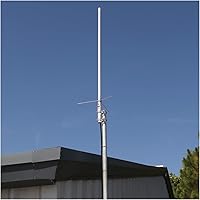
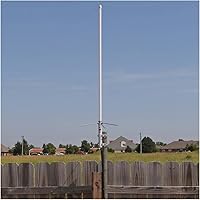
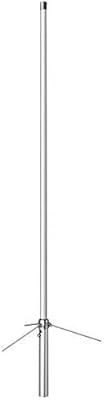
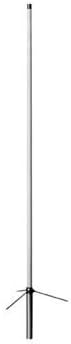
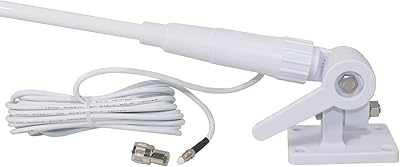
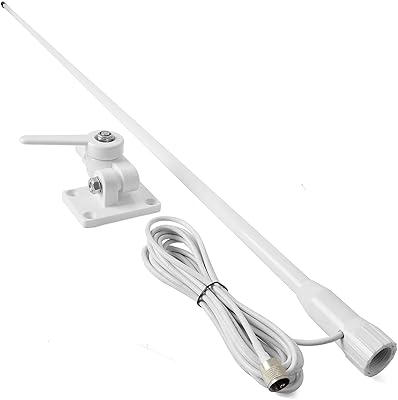
The Tram 1477 Dual-Band VHF/UHF Base Antenna sits comfortably in the mid-range of the ham radio antenna market — not a bargain-bin throwaway, but not a boutique engineering showpiece either. Tram has been making radio accessories long enough to earn a solid reputation among hobbyists who need reliable gear without obsessing over perfection. What stands out immediately is that this antenna arrives pre-tuned and ready to mount — no analyzer required, no fussing with element lengths in the field. Built from white fiberglass, it holds up well outdoors and on rooftops. Just be clear going in: this is a fixed base station antenna, not something you clip to a vehicle or carry in a bag.
Features & Benefits

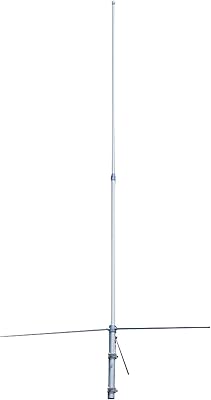
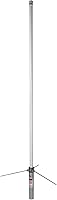
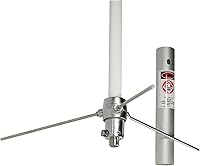
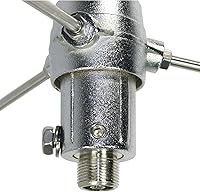
This dual-band base antenna covers 144–148 MHz on VHF and 430–460 MHz on UHF — the two most active bands for licensed ham operators. The gain figures are quoted in dBd, which measures performance relative to a dipole rather than an isotropic radiator. That makes the numbers more conservative and honest: 3.5 dBd on VHF and 6 dBd on UHF represent real, usable improvement over a basic whip. The omnidirectional radiation pattern means you are not sacrificing coverage in any direction. Three stainless steel radials handle ground plane duties, and the SO-239 connector is the standard for most ham rigs. The 150-watt rating and 50-ohm impedance keep it compatible with virtually any modern transceiver.

Best For

The Tram 1477 makes the most sense for Technician-class hams and above who want a dedicated home base setup without spending a fortune on high-end yagis or stacked arrays. If you are working local repeaters, joining a net, running APRS, or just simplex chatting with nearby operators, this fiberglass ham antenna gives you solid coverage in every direction. It is also a natural step up for anyone tired of using a rubber duck or indoor mobile whip. Operators in suburban neighborhoods tend to appreciate the low-profile white exterior — it blends into a roofline without drawing attention. One practical caveat worth flagging upfront: you will need to supply your own coax cable, as none is included.

User Feedback

Among several hundred verified buyers, this dual-band base antenna carries a strong overall rating, and the feedback patterns are telling. Most owners highlight how painless the initial setup is — mount it, connect your feed line, and you are on the air. The improvement over stock rubber duck antennas is consistently described as significant, particularly on UHF. That said, a recurring point of frustration is the missing coax cable — first-time buyers occasionally overlook that it is not included. A handful of users in wetter climates have noted that proactively weatherproofing the SO-239 connection is worth the extra effort. Minor complaints aside, its standing in the radio antenna category reflects consistent real-world satisfaction across a wide range of home station configurations.

Pros

  • Arrives fully pre-tuned — no antenna analyzer or field adjustments needed before getting on the air.
  • Covers both the 2-meter and 70-centimeter bands with a single antenna and a single feed line.
  • The 6 dBd gain on UHF delivers a meaningful real-world signal improvement over basic whip antennas.
  • Omnidirectional pattern means you never have to rotate or re-aim it to reach local repeaters.
  • White fiberglass construction blends into rooflines and eaves without drawing attention.
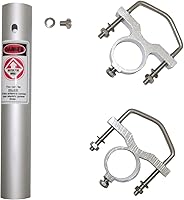
  • Mounting bracket and hardware are included, so the installation checklist is shorter than expected.
  • 50-ohm impedance and SO-239 connector make it plug-and-play compatible with virtually any ham transceiver.
  • Stainless steel radials resist corrosion and hold their adjustment well over time.
  • The 150-watt power rating comfortably covers any standard transceiver output without headroom concerns.
  • Strong ownership satisfaction across a large review base signals consistent real-world reliability.

Cons

  • Coax cable is not included — a frustrating and easy-to-miss omission for first-time buyers.
  • At 43 inches, this fiberglass ham antenna requires a proper outdoor mast; it is not a shelf or desk option.
  • The SO-239 connector is exposed to weather and needs periodic weatherproofing in damp or coastal environments.
  • VHF gain of 3.5 dBd is modest — operators in fringe or hilly terrain may find it underwhelming.
  • No HF capability whatsoever, so it cannot serve as a multi-purpose antenna for operators working lower bands.
  • Mast diameter requirements are specific enough that some common mounting setups may not be compatible without an adapter.
  • Not rated for amplified outputs above 150 watts, limiting usefulness for operators running linear amplifiers.
  • Single-section design at 43 inches can be awkward to transport or store during off-season or moves.

Ratings

The scores below reflect an AI-driven analysis of verified global user reviews for the Tram 1477 Dual-Band VHF/UHF Base Antenna, with spam, bot-generated, and incentivized feedback actively filtered out to ensure accuracy. Ratings span both the aspects buyers consistently praise and the friction points that surface in honest, critical feedback — nothing has been smoothed over.

Ease of Setup
91%
The pre-tuned design is the single most praised aspect of this antenna among new and returning hams alike. Buyers consistently report going from unboxing to first QSO in under an hour, with no analyzer, no SWR drama, and no guesswork about element lengths.
A meaningful number of first-time buyers were caught off guard by the missing coax cable, which stalled their installation until a separate order arrived. The experience is smooth once you have all the parts, but the omission creates an avoidable frustration.
RF Performance
78%
22%
For local and regional use — hitting repeaters, joining nets, running APRS — this dual-band base antenna consistently outperforms rubber duck and mobile whip substitutes. The UHF performance in particular draws positive remarks, with users noting noticeably cleaner audio and more reliable repeater access.
Operators in fringe coverage areas or hilly terrain find the VHF gain less impressive, and a handful of technically oriented users note that the 3.5 dBd VHF figure leaves little headroom for weak-signal work. It is a solid local performer, not a DX machine.
Build Quality
83%
The white fiberglass sleeve feels solid and holds up well through rain, wind, and seasonal temperature swings according to owners who have run it for multiple years outdoors. The stainless steel radials resist corrosion and maintain their set position without drifting.
Some users report that the connector area at the base feels like the weakest structural point, and in climates with persistent humidity or salt air, weatherproofing it is not optional — it is necessary. A few owners also noted that the fiberglass sleeve showed minor cosmetic yellowing after extended UV exposure.
Value for Money
86%
Among mid-range dual-band base antennas, the Tram 1477 consistently earns high marks for delivering reliable, out-of-box performance at a price that does not require justification to a skeptical spouse. Buyers upgrading from budget whips or temporary indoor setups describe it as a clear and immediate improvement in capability.
The value equation shifts slightly once you factor in the separately purchased coax cable and any weatherproofing materials, which push the real cost of a complete installation above the sticker price. A small number of buyers felt the overall finish and connector quality did not quite match the price tier.
Connector Quality
67%
33%
The SO-239 connector is the correct and expected interface for this class of antenna, and it mates cleanly with standard PL-259 terminated feed lines. For most installations in dry or temperate climates, it performs without issue right out of the box.
In wetter or coastal environments, the bare connector attracts moisture over time, and multiple users have reported SWR degradation traced back to an unprotected junction. It is a solvable problem with self-amalgamating tape, but the antenna should arguably ship with at least a basic weatherproofing wrap.
Mounting Hardware
74%
26%
The included bracket and hardware are functional and cover the most common mast configurations, making the installation process approachable for operators without a garage full of specialized tools. Most buyers find they can complete a clean mount using only what comes in the box.
The mast diameter range is specific enough that operators with non-standard pipe sizes occasionally need an adapter, which is not included. A few users also noted that the bracket hardware felt on the lighter side for permanent rooftop installs in areas prone to high winds.
Omnidirectional Coverage
82%
18%
The 360-degree radiation pattern is one of the most practical attributes of this fiberglass ham antenna for base station use — owners routinely check into repeaters in multiple directions without ever repositioning the antenna. This is especially appreciated by operators in suburban areas surrounded by repeaters on different headings.
The omnidirectional pattern, while convenient, inherently means gain is spread equally in all directions, including toward the ground. Operators in single-direction use cases — for example, pointing at one distant repeater — would ultimately extract more performance from a directional Yagi at a similar price point.
Weather Resistance
71%
29%
The fiberglass construction itself holds up reliably in rain, cold, and moderate wind, and long-term owners in four-season climates report no structural degradation after years of outdoor exposure. The stainless steel radials add confidence that ground plane elements will not rust or weaken.
The antenna's weather resistance story falls apart at the connector, where no factory sealing or moisture protection is provided. Owners in the Pacific Northwest, Gulf Coast, and similar high-humidity regions emphasize that skipping the weatherproofing step leads to eventual signal problems.
UHF Band Performance
84%
The 6 dBd gain figure on UHF is where this antenna punches above its weight class, and users switching from a simple quarter-wave ground plane or rubber duck antenna report the improvement is immediately audible on local repeaters. APRS reception in particular benefits noticeably from the UHF gain.
Coverage on the upper edge of the UHF amateur allocation, specifically the 450–460 MHz range, is sometimes reported as slightly less consistent than in the core 430–440 MHz segment. This is unlikely to affect most users but is worth noting for those operating near the band edges.
VHF Band Performance
73%
27%
On the 2-meter band, this dual-band base antenna delivers consistent and clean performance for the core use cases it is designed for — local simplex contacts, net check-ins, and satellite pass monitoring. Users in flat terrain and suburban environments typically report strong results across the entire 144–148 MHz allocation.
The 3.5 dBd VHF gain figure is the more modest of the two bands, and operators in challenging RF environments — valleys, dense urban canyons, or areas with heavy tree cover — sometimes find it falls short of their expectations. A higher-gain VHF-only antenna would outperform it in those conditions.
Aesthetics & Profile
79%
21%
The clean white fiberglass finish is consistently praised by owners in HOA-regulated neighborhoods or suburban homes where a conspicuous antenna would attract unwanted attention. At 43 inches, it is tall enough to perform well but compact enough to avoid looking industrial on a roofline.
Over time, the white fiberglass can develop a faint yellowish tint from prolonged UV exposure, which a small number of long-term owners have flagged. It is a cosmetic issue only and does not affect RF performance, but it is worth noting for buyers with strict aesthetic expectations.
Compatibility
88%
The 50-ohm impedance and SO-239 connector cover the overwhelming majority of dual-band ham transceivers on the market today, including popular models from Yaesu, Kenwood, Icom, and Alinco. Most buyers are able to connect their existing radio and coax without any adapters or impedance matching devices.
Operators using less common connector types or low-impedance rigs may need an adapter, and the 150-watt power ceiling means the antenna is not suited for users running legal-limit amplifiers on these bands. These are edge cases, but they do affect a small segment of the potential buyer pool.
Packaging & Unboxing
69%
31%
The antenna generally arrives well-protected and undamaged, and the included hardware components are organized in a way that makes inventory straightforward before starting the install. Most buyers report a clean unboxing experience with no missing hardware.
The packaging omits any mention that coax cable is not included, which is the single most common source of negative unboxing feedback. A simple note in the box alerting buyers to this requirement would eliminate a frustration that surfaces repeatedly in user reviews.
Long-Term Reliability
81%
19%
Owners who have run this fiberglass ham antenna continuously for two or more years generally report that performance has remained consistent, with no degradation in SWR or signal quality when the installation is properly weatherproofed from the start. The fiberglass and stainless construction ages predictably and without drama.
Reliability over the long term appears strongly correlated with whether the buyer took the time to weatherproof the SO-239 connection at installation. Units that skipped this step show higher rates of moisture-related performance issues reported in follow-up reviews at the 12-to-18-month mark.

Suitable for:

The Tram 1477 Dual-Band VHF/UHF Base Antenna is a natural fit for licensed amateur radio operators — particularly those holding a Technician class license or higher — who want a capable, no-fuss home base station antenna without diving into complex installation projects. If you spend your radio time checking into local nets, monitoring nearby repeaters, running APRS tracking, or simply making simplex contacts in your area, this fiberglass ham antenna gives you reliable omnidirectional coverage on both the 2-meter and 70-centimeter bands without requiring a separate antenna for each. It is especially well suited for operators upgrading from a rubber duck or a mobile whip temporarily pressed into base station duty, since the improvement in both transmit and receive performance tends to be immediately noticeable. Suburban and rural hams who want something that mounts cleanly on a mast without looking industrial will also appreciate the low-profile white fiberglass exterior. And because it arrives pre-tuned, anyone who does not own an antenna analyzer — which is most newcomers — can get on the air the same afternoon it arrives.
Not suitable for:

The Tram 1477 Dual-Band VHF/UHF Base Antenna is not the right tool for operators who need anything beyond reliable local and regional coverage, and buyers expecting long-distance or weak-signal performance on VHF should look at directional options like a yagi or a dedicated weak-signal antenna. This is strictly a fixed base station antenna — it has no place on a vehicle roof, a portable mast for field day, or a handheld setup, and trying to repurpose it that way would be impractical. Operators living in very humid or coastal climates should be aware that the SO-239 connector will need weatherproofing attention over time, which adds a small but real maintenance consideration. If you are working on HF bands, this antenna is entirely irrelevant — it only covers VHF and UHF frequencies. Power users running high-output amplifiers significantly above 150 watts will also need to look elsewhere, as this dual-band base antenna is not rated for those levels.
Specifications

  • Frequency Range: Covers 144–148 MHz on VHF and 430–460 MHz on UHF, addressing the two most commonly used amateur radio bands for local and regional communication.
  • VHF Gain: Provides 3.5 dBd of gain on the VHF band, measured against a reference dipole for an accurate and conservative real-world performance figure.
  • UHF Gain: Delivers 6 dBd of gain on the UHF band, offering a meaningful signal improvement over standard rubber duck or mobile whip antennas.
  • Power Rating: Handles a continuous input power of up to 150 watts, which comfortably exceeds the output of virtually all standard amateur radio base transceivers.
  • Impedance: Designed with a 50-ohm impedance, ensuring direct compatibility with the vast majority of modern ham radio transceivers and feed lines without a matching unit.
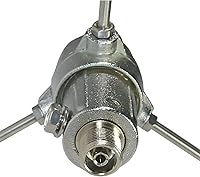
  • Connector Type: Equipped with an SO-239 (UHF female) connector, the standard interface found on most amateur radio transceivers and PL-259-terminated coax cables.
  • Antenna Length: The antenna measures 43 inches in total length and ships as a single section, requiring no assembly of radiating elements before mounting.
  • Wave Design: Uses a 1/2-wave radiation pattern on VHF and a 5/8 over 5/8-wave stacked design on UHF to achieve omnidirectional coverage with practical gain on both bands.
  • Radials: Includes three stainless steel radials, each 7 inches long, which form the ground plane required for proper antenna performance when mounted on a non-conductive mast.
  • Mast Compatibility: Fits mast diameters ranging from 1-13/16 inches to 2-7/16 inches, accommodating most standard antenna masts used in home and rooftop installations.
  • Construction: The radiating element is enclosed in a white fiberglass sleeve, providing weather resistance and a low-visibility profile suitable for outdoor and rooftop use.
  • Radiation Pattern: Operates with a fully omnidirectional radiation pattern, transmitting and receiving equally in all compass directions without requiring aiming or rotation.
  • Included Hardware: Ships with a mounting bracket and all necessary hardware for mast installation; a coax feed line is not included and must be purchased separately.
  • Dimensions: Overall packaged dimensions are approximately 44″ in length by 4″ wide by 1.5″ deep, making it straightforward to handle and transport before installation.
  • Model Number: Manufactured under item model number 1477, produced by Tram, a brand with an established history in the amateur and CB radio antenna accessory market.

Related Reviews

Tram 1480 Dual-Band Fiberglass Base Antenna
76%
88%
Signal Performance
83%
Build Quality
86%
Weather Resistance
91%
Ease of Installation
89%
Connector Compatibility
More
Diamond Antenna X30A Dual-Band Base Antenna
80%
91%
Signal Performance
88%
Build Quality
86%
Weatherproofing
84%
Ease of Installation
89%
SWR Consistency
More
Diamond X50A Dual-Band VHF/UHF Base Antenna
78%
88%
RF Performance
91%
Out-of-Box SWR
84%
Build Quality
79%
Weather Durability
76%
Ease of Assembly
More
Icom IC-2730A Dual Band VHF/UHF Mobile Radio
78%
93%
Transmit Power
91%
Dual-Band Receive
88%
Build Quality
89%
Audio Clarity
54%
Menu Navigation
More
TYT MD-UV390 Dual Band VHF UHF DMR Radio
82%
86%
Overall Performance
92%
Build Quality & Durability
81%
Ease of Use & Programming
88%
Battery Life
94%
Waterproofing & Ruggedness
More
TYT MD-UV380 Dual Band VHF/UHF Two-Way Radio
77%
92%
Value for Money
88%
Range and Performance
85%
Build Quality and Durability
80%
Ease of Use
65%
Software and Setup Experience
More
BTECH UV-PRO Dual Band Two-Way Radio
79%
86%
Build Quality
88%
Waterproofing & Durability
78%
Bluetooth App Integration
81%
APRS & GPS Performance
67%
Range & Signal Clarity
More
Tram 1607-HC VHF Marine Fiberglass Antenna
77%
91%
Ease of Installation
83%
Signal Performance
78%
Build Quality
72%
Durability in Saltwater
74%
Ratchet Mount Reliability
More
UAYESOK VHF Marine Base Antenna 48 Inch
87%
87%
Performance at Sea
92%
Durability in Harsh Conditions
91%
Installation Ease
89%
Signal Range and Clarity
85%
Compatibility with Marine Radios
More
Tram 1600-HC 35-Inch VHF Marine Antenna
84%
88%
Signal Performance
91%
Build Quality
86%
Ease of Installation
93%
Corrosion Resistance
84%
Value for Money
More

FAQ

Yes. This is an amateur radio antenna designed for use on the 2-meter and 70-centimeter ham bands, which require a valid FCC amateur radio license in the United States — at minimum a Technician class license. Transmitting on these frequencies without a license is illegal, though you can legally use it for receive-only purposes without one.

No, a coax cable is not included in the box. You will need to supply your own feed line — typically an RG-8X or LMR-400 type cable with PL-259 connectors on each end to mate with the antenna's SO-239 port and your transceiver. This is one of the most common surprises for first-time buyers, so budget for it before ordering.

Almost certainly yes. The Tram 1477 Dual-Band VHF/UHF Base Antenna uses a standard SO-239 connector and 50-ohm impedance, which matches the output specifications of virtually every modern Yaesu, Kenwood, Icom, and Baofeng transceiver on the market. Just confirm your radio's output power does not exceed 150 watts and you are good to go.
No tuning is required. The antenna is pre-tuned at the factory for the 144–148 MHz and 430–460 MHz ranges, which cover the standard amateur allocations on those bands. If you have an SWR meter you can verify performance after installation, but most users report excellent readings straight out of the box without any adjustments.

The antenna includes a mounting bracket and all needed hardware. It fits masts with an outer diameter between 1-13/16 and 2-7/16 inches, which covers most standard schedule-40 pipe or antenna mast tubing. A common and inexpensive approach is to mount it on a length of 1-1/2 inch galvanized pipe secured to a chimney, eave, or wall bracket.

Good question — this trips up a lot of buyers. dBd measures gain relative to a basic dipole antenna, while dBi measures gain relative to a theoretical perfect point-source radiator. A dBi figure is always about 2.15 higher than the equivalent dBd figure, so an antenna rated at 3.5 dBd is the same as roughly 5.65 dBi. The dBd rating this fiberglass ham antenna uses is the more conservative and arguably more honest standard.

It is designed for vertical polarization, which is the standard for VHF/UHF FM repeater and simplex communication — mounting it horizontally would create a polarization mismatch with most local stations and degrade performance significantly. An attic install can work in a pinch, but building materials will attenuate the signal to varying degrees depending on your roof construction. Outdoor mounting always gives you the best results.

The white fiberglass construction handles typical outdoor weather well, and the stainless steel radials resist corrosion over time. The main area to watch is the SO-239 connector at the base — in persistently wet or coastal climates, moisture can work its way into an unprotected connection and degrade performance. Wrapping the connection with self-amalgamating tape after installing your coax is a simple and highly recommended precaution.

It can receive signals outside the strict amateur allocations, including NOAA weather satellites around 137 MHz and ADS-B aircraft transponders at 1090 MHz, though performance at those frequencies will not be optimized since the antenna is tuned for the 144 and 430 MHz ranges. For casual receive-only use with an SDR dongle it is still a capable option, but a dedicated wideband antenna would outperform it at those fringe frequencies.

It is one of the more practical starting points available at its price level. The dual-band base antenna is pre-tuned, includes all mounting hardware, and works reliably with entry-level dual-band radios right out of the box. The main thing new hams need to plan for is purchasing a coax cable separately, and ideally adding weatherproofing tape to the connector after installation. Beyond that, it is about as low-friction as outdoor antenna installations get.

Where to Buy