Overview

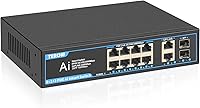
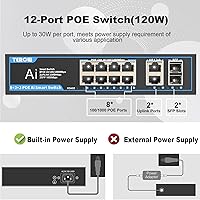
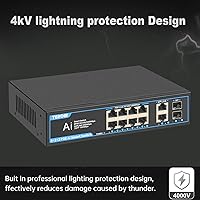
The TEROW 12-Port PoE+ Gigabit Network Switch sits in a crowded corner of the market — budget unmanaged switches aimed at home labs, small offices, and anyone building a basic IP camera network without overspending. What makes this PoE switch worth a closer look is the port variety: eight powered RJ45 ports, two Gigabit uplinks, and two SFP slots packed into a compact metal body. There's no configuration required — plug it in and it works. No fan, no software, nothing to set up. For buyers paying name-brand premiums for this kind of flexibility, that combination is genuinely hard to overlook.

Features & Benefits

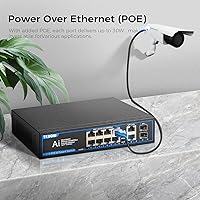
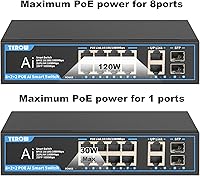
The headline spec is the 120W total PoE budget, split across eight ports at up to 30W each. That covers a decent mix of 802.3af cameras and 802.3at access points — but load up six or seven high-draw devices and you will feel the ceiling. A smart overload-protection circuit helps: rather than dropping all ports when power is exceeded, it cuts the highest-consuming port first, keeping everything else running. The two SFP slots support 1.25G fiber modules for longer cable runs or upstream connections. Per-port isolation rounds things out, ensuring one misbehaving device does not drag down the rest of the network.

Best For

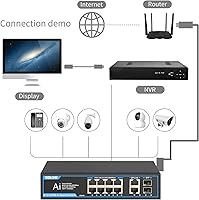
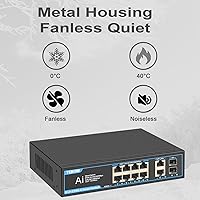
This 12-port gigabit switch is a solid pick for anyone running a handful of IP cameras, a VoIP phone or two, and a wireless access point — all without touching a management interface. It also appeals to home lab users who want SFP uplink capability without crossing into managed switch territory. Installers working in quiet environments — a small reception area, a home office, or a living room AV rack — will appreciate that the fanless metal chassis produces no audible noise. And if you are replacing a cheap plastic switch with something more durable, this is a sensible, practical step up.

User Feedback

Buyers generally praise the value for money, especially those who compared the TEROW switch against pricier alternatives and found the performance difference negligible for everyday home or office use. The plug-and-play experience draws consistent positive mentions. On the downside, some buyers were surprised to find that SFP modules are not included — worth knowing upfront. There are also occasional reports of inconsistent PoE detection on specific ports, and long-term reliability data remains thin given the brand's relative newness. For mission-critical setups, that's worth weighing carefully. For basic deployments, though, most users seem genuinely satisfied.

Pros

  • Eight PoE+ ports and two SFP slots at this price point is genuinely hard to beat in the unmanaged category.
  • Plug-and-play setup means no configuration headaches — connect it and it works immediately.
  • The metal fanless chassis runs completely silently, making it a natural fit for quiet indoor spaces.
  • Overload protection intelligently cuts the highest-draw port first rather than crashing the entire switch.
  • Per-port isolation keeps one troubled device from disrupting the rest of your connected equipment.
  • Wide 110V–240V input voltage makes this PoE switch usable anywhere in the world without an adapter.
  • The compact footprint fits easily on a shelf or desktop without dominating the space around it.
  • Solid metal shielding provides better durability and interference resistance than typical plastic-bodied alternatives at this price.
  • Buyers who switched from name-brand options frequently report no meaningful performance difference for basic home or office use.

Cons

  • The 120W PoE budget runs out quickly if you mix multiple high-draw 802.3at devices across the eight ports.
  • SFP modules are sold separately, which catches some buyers off guard after unboxing.
  • As a relatively new brand, TEROW lacks the years of field reliability data that established manufacturers can point to.
  • Some users have reported inconsistent PoE detection on specific ports, requiring cable swaps or reboots to resolve.
  • No management interface means zero visibility into traffic, port status, or power consumption — what you see is what you get.
  • There is no VLAN or QoS support, which rules this switch out for anyone with basic traffic segmentation needs.
  • Heat can accumulate on the metal chassis under heavy load — not dangerous, but worth factoring in for enclosed rack spaces.
  • Customer support and warranty experience from smaller brands like this can be unpredictable compared to tier-one networking vendors.

Ratings

Our AI-generated scores for the TEROW 12-Port PoE+ Gigabit Network Switch are based on a systematic analysis of verified global buyer reviews, with spam, bot activity, and incentivized feedback actively filtered out before scoring. Every category reflects the full spectrum of real user experience — from genuine praise to recurring frustrations — so you get an honest picture rather than a curated highlight reel. Strengths and pain points are weighted equally to help you make a genuinely informed decision.

Value for Money
91%
Buyers who compared this PoE switch side-by-side with TP-Link and Netgear equivalents consistently noted they were getting comparable everyday performance for significantly less. The combination of eight powered ports, two SFP slots, and a metal enclosure at this price tier is difficult to match in the unmanaged segment.
A small number of buyers who factored in the separately purchased SFP modules found the true out-of-pocket cost slightly higher than the listing price implied. For users who need fiber uplinks from day one, that omission narrows the value gap more than the headline price suggests.
PoE Performance
78%
22%
For home camera systems and VoIP handsets drawing under 15W per port, the TEROW switch handled power delivery reliably and consistently in the majority of user reports. Buyers running three to five 802.3af devices reported stable operation with no dropped power events over extended periods.
The 120W shared budget becomes a real constraint once buyers start mixing multiple 802.3at devices like high-powered access points alongside cameras. Several users powering six or more devices reported hitting the ceiling unexpectedly, and occasional PoE detection failures on specific ports were noted in a meaningful number of reviews.
Build Quality
83%
The shielded metal chassis was a recurring positive across user feedback, particularly from buyers upgrading from plastic-bodied budget switches. The solid construction gave installers confidence when mounting the switch on shelves or in open rack spaces where physical durability matters.
A few buyers noted that the metal body develops noticeable warmth under sustained heavy PoE load, which raised concerns in poorly ventilated installations. The fit and finish was praised overall, but edge seams and port alignment were occasionally inconsistent on units received by some reviewers.
Ease of Setup
94%
Plug-and-play really does describe the experience here — buyers with little to no networking background reported having cameras and phones running within minutes of unboxing. There is no app to install, no browser interface to navigate, and no configuration steps that could go wrong.
The simplicity is also a ceiling. Users who expected even basic LED-based port status indicators for troubleshooting found the feedback limited. If a port is not delivering power and you do not know why, there is no diagnostic tool available on the device itself to help isolate the issue.
Port Variety & Flexibility
88%
Having eight PoE+ ports alongside two dedicated uplinks and two SFP slots in a single unmanaged unit is genuinely uncommon at this price point. Home lab users and small installers praised the SFP slots specifically, as they allowed fiber uplinks without forcing a jump to a more expensive managed switch.
SFP modules are not included, which consistently surprised buyers who assumed the slots were ready to use out of the box. The uplink ports, while gigabit-capable, lack any link aggregation support — a limitation for users hoping to bond connections for higher throughput.
Noise Level
97%
Fanless operation was one of the most unanimously praised aspects across all user feedback. Buyers who placed the switch in living rooms, home offices, or reception areas reported absolutely no audible noise under any load condition, which matters considerably in quiet shared environments.
There are essentially no cons to report here from a noise standpoint. The only indirect trade-off is that the absence of active cooling means heat management relies entirely on the metal chassis, which becomes relevant only in sealed or confined installation spaces.
Thermal Management
67%
33%
Under light to moderate loads — say, four or five cameras and a VoIP phone — the metal case handles heat dissipation capably without any hot spots that concerned users. In open-air desktop or shelf deployments, passive cooling performed as expected for this class of device.
Under sustained high PoE loads, the chassis surface temperature climbed enough to be noticeable and, in some cases, alarming to users unfamiliar with fanless thermal design. Buyers who installed the switch in enclosed cabinets or AV closets without airflow reported accelerated warmth that prompted concerns about long-term component stress.
Long-term Reliability
62%
38%
A portion of buyers who had been running this PoE switch for six months to a year reported zero issues and expressed confidence in the hardware. The per-port isolation design at least limits the blast radius if a port does develop a fault over time.
TEROW does not yet have the multi-year reliability track record that established networking brands carry, and that gap is visible in the reviews. There are enough reports of units developing port-level issues after several months of use to warrant caution for anyone deploying this in a set-and-forget environment.
PoE Overload Protection
81%
19%
The automatic overload protection behavior — cutting the highest-draw port first rather than crashing all ports simultaneously — was appreciated by users who actually triggered it. It kept the majority of connected devices online during an overload event, which is meaningfully better than a full shutdown.
The protection mechanism operates silently with no visual or audible alert, so users had no immediate way of knowing which port had been cut until they noticed a device had gone offline. A simple LED indicator for overload state would make this feature considerably more useful in practice.
Compatibility
86%
The switch worked without issue alongside widely used 802.3af and 802.3at devices from Ubiquiti, TP-Link, Hikvision, and Dahua in the majority of reported setups. The auto-negotiation across 10/100/1000 Mbps also meant older devices connected cleanly without requiring manual configuration.
A small but consistent subset of buyers reported that certain non-standard or proprietary PoE devices did not receive power correctly, requiring those devices to be moved to a dedicated PoE injector instead. Compatibility with passive PoE equipment is not supported, which caught some less experienced buyers off guard.
Packaging & Documentation
58%
42%
The unit arrived well-protected in the majority of shipments, and buyers generally reported no physical damage on arrival. The included power cable was noted as adequate for immediate use without needing additional accessories beyond SFP modules.
The documentation included in the box was sparse and, in some cases, machine-translated in ways that made technical details ambiguous. Buyers looking for guidance on port numbering behavior during overload events or SFP module compatibility were largely left to figure things out independently or search online.
Brand Trust & Support
59%
41%
Buyers who reached out to TEROW with product questions generally reported receiving a response, which is better than some competing budget brands at this tier. A handful of users mentioned that replacement units were dispatched without excessive friction when hardware faults were confirmed.
The overall support experience was inconsistent enough that it appeared frequently as a concern in negative reviews. Response times varied widely, warranty terms were not always clearly communicated, and buyers outside major markets expressed difficulty getting any meaningful assistance at all.

Suitable for:

The TEROW 12-Port PoE+ Gigabit Network Switch is built for practical, low-complexity deployments where simplicity and value matter more than advanced management features. It fits home and small office users who need to power a mix of IP cameras, VoIP phones, and wireless access points without running separate power adapters to each device. The two SFP slots make it especially useful for anyone who wants to extend a network run over fiber — a capability that usually costs considerably more in comparable unmanaged switches. Network hobbyists building out a home lab on a budget will appreciate the metal construction and port variety without paying a premium for features they will never use. Installers working in quiet environments like reception areas or home entertainment setups will also benefit from the completely silent, fanless operation.

Not suitable for:

The TEROW 12-Port PoE+ Gigabit Network Switch is not the right choice for anyone who needs VLAN support, traffic prioritization, or any form of network monitoring — it is strictly unmanaged, and that is unlikely to change with a firmware update because there is no management interface at all. The 120W power budget, while reasonable on paper, fills up faster than most buyers expect; anyone planning to run six or more 802.3at devices simultaneously should do the math carefully before purchasing. IT professionals managing business-critical infrastructure will likely find the limited long-term reliability data from this newer brand difficult to justify to stakeholders. Users in regions with strict network equipment certifications should also verify compliance before deploying. And if SFP modules are part of your plan, budget for them separately — they are not included in the box.

Specifications

  • PoE Ports: The switch includes 8 Gigabit RJ45 ports capable of delivering Power over Ethernet to connected devices.
  • Uplink Ports: Two dedicated Gigabit RJ45 uplink ports allow connection to a router, modem, or upstream network switch.
  • SFP Ports: Two SFP slots support 1.25G fiber modules, enabling longer-distance or fiber-based uplink connections.
  • PoE Standard: All 8 PoE ports comply with both 802.3af (up to 15.4W) and 802.3at (up to 30W) standards.
  • PoE Budget: The total shared power budget across all 8 PoE ports is 120W, with a maximum of 30W per individual port.
  • Data Rate: Each port operates at up to 1 Gbps (1000Mbps), supporting 10/100/1000 Mbps auto-negotiation.
  • Input Voltage: The unit accepts a wide AC input range of 110V to 240V, making it compatible with power supplies globally.
  • Cooling: Passive fanless cooling is used throughout, with no internal moving parts and no audible noise output.
  • Enclosure: The chassis is constructed from shielded metal, providing durability and basic electromagnetic interference resistance.
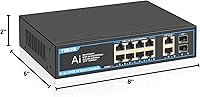
  • Dimensions: The switch measures 7.9″ long by 5.6″ wide by 1.8″ tall, making it compact enough for desktop or shelf placement.
  • Weight: The unit weighs 1.9 lbs, light enough for easy repositioning or bracket mounting in a small rack.
  • Max Temperature: The switch is rated for continuous operation in ambient temperatures up to 55°C (131°F).
  • Port Isolation: Each port operates independently, so a failure or loop on one port does not affect traffic on any other port.
  • Overload Protection: When total PoE draw exceeds the 120W budget, the switch automatically disables the highest-consuming port to protect remaining connections.
  • Configuration: The switch is fully unmanaged and plug-and-play; no software, drivers, or web interface is required or available.
  • Total Ports: The unit provides 12 physical ports in total: 8 PoE+ RJ45, 2 Gigabit uplink RJ45, and 2 SFP.

Related Reviews
YuLinca 6-Port Gigabit PoE Switch with 4 PoE+ Ports
87%
95%
Ease of Installation
88%
PoE Functionality
91%
Build Quality
87%
Performance and Speed
94%
Fanless Operation (Noise)
More
MokerLink 12-Port Gigabit PoE+ Unmanaged Switch
74%
93%
Ease of Setup
86%
PoE Reliability
88%
Build Quality
91%
Value for Money
94%
Fanless & Noise
More
MokerLink POE-G082G 10-Port Gigabit PoE Switch
78%
94%
Ease of Setup
88%
PoE Reliability
83%
Build Quality
91%
Value for Money
71%
Thermal Management
More
MokerLink POE-G1604GS 20-Port Gigabit PoE Switch
77%
86%
Build Quality
81%
PoE Power Delivery
89%
Ease of Setup
88%
Value for Money
93%
Noise & Cooling
More
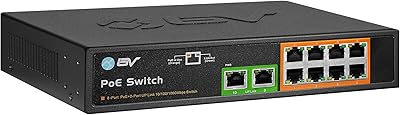
BV-Tech POE-SW802G 8-Port Gigabit PoE+ Switch
79%
94%
Ease of Setup
88%
PoE Reliability
67%
Power Budget
61%
Build Quality
91%
Value for Money
More
LINOVISION POE-SW508G Industrial 8-Port PoE++ Switch
77%
91%
Power Delivery
88%
Build Quality
93%
PoE Watchdog
84%
Installation Ease
86%
Thermal Performance
More
PoE Texas 12-Port Gigabit Passive PoE Injector
84%
88%
Ease of Installation
61%
Power Budget Clarity
91%
Device Compatibility
84%
Build Quality
96%
Noise Level
More
PoE Texas 4 Port in-Wall Gigabit PoE Extender Switch
87%
92%
Installation Ease
88%
Power Output & Range
90%
Aesthetic & Design
89%
Reliability & Stability
84%
Compatibility with Devices
More
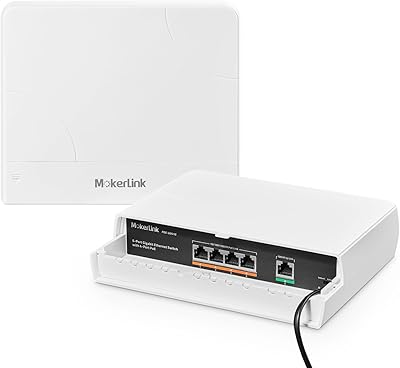
MokerLink POE-G041GO Outdoor Gigabit PoE Switch
81%
93%
Ease of Setup
84%
PoE Power Delivery
78%
Build Quality
76%
Weather Resistance
88%
Value for Money
More
YuanLey YS4802GS-P8 48-Port Gigabit PoE Switch
79%
91%
Value for Money
93%
Ease of Installation
84%
PoE Performance
86%
Build Quality
52%
Fan Noise
More

FAQ

No, SFP modules are not included in the box. You will need to purchase compatible 1.25G SFP modules separately. This trips up quite a few buyers, so it is worth budgeting for those upfront if you plan to use the fiber ports.

Yes, that is exactly the kind of setup this PoE switch handles well. Just keep a close eye on your total power draw. A typical 802.3at access point pulls around 15 to 25W, and cameras vary from 6 to 15W each, so running five or six devices simultaneously can bring you close to the 120W ceiling.

None at all. The TEROW 12-Port PoE+ Gigabit Network Switch is a fully unmanaged device, which means you just plug it in and it works. The trade-off is that there are no settings to adjust, no traffic monitoring, and no VLAN configuration — it is purely hands-off.

In most cases, yes. As long as your access points support 802.3af or 802.3at PoE standards, this switch will power and connect them without issue. Ubiquiti UniFi and TP-Link EAP access points are both 802.3at compliant, so they should work fine.

The chassis does get warm to the touch, especially under moderate to heavy PoE load — that is normal for fanless designs, which rely on the metal body to dissipate heat passively. It should not get uncomfortably hot under typical home or office loads, but you will want to make sure it has some airflow around it and is not tucked into a completely sealed enclosure.

The switch has built-in overload protection that handles this automatically. Rather than cutting all ports or resetting, it identifies the port drawing the most power and disables that one first, keeping the remaining connections intact. It is a sensible safeguard, but ideally you want to plan your setup so you are not regularly bumping against the ceiling.

Yes. The two Gigabit uplink ports are designed for exactly this — you can daisy-chain multiple switches together using standard Ethernet cables. The SFP ports can also serve as uplinks if you prefer a fiber connection between switches or to your router.

Yes, the wide AC input range of 110V to 240V means it will work with standard power supplies in most countries without needing a voltage converter. Just check that you have the appropriate plug adapter for your region.

The per-port isolation is a real hardware feature, not a vague claim. It means that a broadcast storm, loop, or hardware fault on one connected device is contained to that port and does not cascade across the others. It is a genuinely useful safeguard in mixed-device environments like home labs or camera installations.

That is a fair concern and worth thinking through honestly. TEROW is a smaller brand without the decades of track record that companies like Netgear or TP-Link carry. Most buyers who have reviewed this 12-port switch report solid performance for home and light office use, but multi-year reliability data is still thin. For non-critical deployments where you can tolerate some uncertainty, it is a reasonable risk. For mission-critical environments, you may prefer a brand with a longer history and more established support infrastructure.