Overview

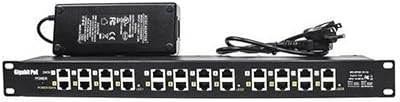
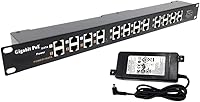
The PoE Texas 12-Port Gigabit Passive PoE Injector is a rack-mountable midspan solution designed to bring Power over Ethernet to networks that already have a perfectly good non-PoE switch — no rip-and-replace required. It's a passive unit, meaning there's no management interface or configuration overhead; you patch it in between your switch and your endpoints and you're done. What you need to understand upfront is the 120W shared power budget — that's 120 watts split across all 12 ports, not per port. The included 48V UL-certified supply handles that load, and the whole thing appeals most to IT installers, small business owners, and security integrators who need a clean, affordable path to powering cameras or VoIP phones.
Features & Benefits

Each of the 12 data-in ports feeds a corresponding PoE-out port, delivering up to 1000 Mbps per port while simultaneously powering the connected device — per-port speed, not aggregate, so don't confuse this with total system throughput. The unit supports both 802.3af and 802.3at (PoE+) standards, with Mode A and Mode B options making it broadly compatible with access points from Meraki and Ruckus, IP cameras, and most mainstream VoIP gear. Transparent VLAN passthrough means your existing network segmentation carries through without modification. LED indicators handle basic monitoring: green for normal operation, red when you're approaching the current ceiling. And the fanless passive cooling keeps things genuinely quiet — a real advantage when the unit lives in a shared office or equipment closet.

Best For

This passive PoE injector shines in situations where you have a solid existing switch and just need to add power to endpoints without buying entirely new hardware. It fits small-to-medium deployments well — think a retail location adding a dozen IP cameras, or a small office rolling out VoIP phones across a single floor. The 1U rack-mount form factor slots into a standard enclosure cleanly, which integrators will appreciate. One important caveat: devices requiring the newer 802.3bt standard need an additional power supply sold separately. For anyone running standard af/at loads, the 12-port midspan unit is a practical, no-fuss choice. Just plan ahead — extra patch cables are not included and you will need them to complete the installation.

User Feedback

Buyers consistently praise how straightforward this PoE midspan is to get running and how reliably it works with popular 802.3af/at gear — Meraki access points and IP cameras from major brands come up often in positive reviews. The metal enclosure earns credit too; people note it feels more solid than the price tier typically delivers. The recurring criticism centers on the shared power budget: installers who populate all 12 ports with higher-draw devices sometimes hit the ceiling sooner than expected. A number of buyers were also caught off guard by the patch cable requirement, adding unexpected friction to setup. On the support side, direct phone access to PoE Texas staff is frequently called out as a genuine differentiator in an industry where support usually means waiting on email.

Pros

  • Adds PoE capability to an existing non-PoE switch without any hardware replacement.
  • Plug-and-play setup — no configuration software, drivers, or management interface required.
  • Fanless passive cooling keeps operation genuinely silent in noise-sensitive environments.
  • Solid metal chassis feels durable and holds up well in rack installations over time.
  • Transparent VLAN passthrough means existing network segmentation requires zero changes.
  • Compatible with 802.3af and 802.3at devices from major brands including Meraki and Ruckus.
  • LED indicators give instant visual feedback when the power budget is nearing its ceiling.
  • Included 48V, 120W UL/CE/FCC-certified power supply is a meaningful inclusion at this price tier.
  • PoE Texas offers direct phone support, which is rare and genuinely useful when troubleshooting.
  • One-year replacement warranty and a 30-day no-questions-asked return policy reduce purchase risk.

Cons

  • The 120W power budget is shared across all 12 ports — high-draw devices will exhaust it quickly.
  • No per-port power management means you cannot prioritize or throttle individual endpoints.
  • Additional patch cables are required to complete installation but are not included in the box.
  • 802.3bt (PoE++) support requires purchasing a separate power supply, adding unexpected cost.
  • No SNMP, web interface, or any remote monitoring capability for network administrators.
  • Power budget splits unevenly in practice — 4-port groupings complicate load planning for some users.
  • Not a viable option for enterprise environments that require redundant or managed power delivery.
  • The shared budget ceiling can be hit mid-deployment if device wattage is not carefully calculated upfront.

Ratings

Our AI-generated scores for the PoE Texas 12-Port Gigabit Passive PoE Injector were produced by analyzing verified buyer reviews from multiple global markets, with spam, bot activity, and incentivized feedback actively filtered out before scoring. The ratings reflect both the genuine strengths that keep buyers recommending this unit and the friction points that have generated real complaints — nothing is glossed over. Every score below represents how actual users experienced this hardware in working deployments, not ideal lab conditions.

Ease of Installation
88%
Most buyers report getting this passive PoE injector up and running within minutes. The plug-and-play design means there is no firmware to update, no browser UI to navigate, and no configuration steps — you patch in the cables and devices start powering on almost immediately. Integrators in particular appreciate how predictable the setup process is across different site visits.
The one consistent friction point is the missing patch cables, which are required to connect the switch to the injector but not included in the box. Buyers who don't realize this in advance face a frustrating delay before they can complete the installation.
Power Budget Clarity
61%
39%
The LED indicators do their job well — a steady green light gives installers quick visual confirmation that a port group is operating normally, and the shift to red is an immediate signal to check load calculations before something drops off the network.
The shared 120W budget is the single most misunderstood aspect of this unit, and it generates a disproportionate share of negative reviews. A large number of buyers assume 120W is available per port, only discovering the reality mid-deployment when high-draw devices begin underperforming or losing power unexpectedly.
Device Compatibility
91%
Broad 802.3af and 802.3at support, combined with Mode A and Mode B wiring options, makes this PoE midspan one of the more universally compatible passive injectors in its class. Buyers routinely confirm successful deployments with Meraki access points, Axis and Hikvision cameras, Cisco VoIP phones, and Ruckus gear without any adaptation required.
The hard ceiling is 802.3bt — newer high-wattage devices that require the PoE++ standard will not work without an additional power supply sold separately, and this limitation isn't always obvious to buyers shopping by port count alone.
Build Quality
84%
The all-metal chassis consistently earns praise from buyers who are accustomed to finding plastic enclosures at this price point. It feels appropriately substantial in a rack, and the construction holds up well in warmer equipment closets where the rated 65°C ceiling provides genuine real-world headroom.
Some buyers note that the external power brick, while UL-certified, has a utilitarian build that contrasts with the sturdier main chassis. A few rack installers also mention that cable management around the dual port rows requires more attention than a typical PoE switch.
Noise Level
96%
Fanless passive cooling means this unit produces absolutely zero noise in operation — no hum, no spin-up sound, nothing. For deployments in open offices, reception areas, or library AV closets where fan noise from standard PoE switches would be an ongoing nuisance, this is a genuinely meaningful advantage.
There is essentially no downside to the fanless design in normal operating conditions. The only theoretical concern is sustained operation at the very top of the 65°C temperature rating in a poorly ventilated enclosure, though this scenario is uncommon in typical installations.
Value for Money
83%
For adding PoE capability to an existing non-PoE switch across 12 ports, this passive injector is widely regarded as a cost-effective path compared to replacing the switch outright with a managed PoE model. Buyers treating it as a targeted infrastructure upgrade generally feel the price is well justified.
Buyers who factor in the cost of separately sourced patch cables and, in some cases, an additional power supply for 802.3bt support find that the total project cost creeps up beyond initial expectations. For very small deployments of two or three devices, the per-port economics are less compelling.
Throughput Performance
86%
Gigabit throughput on each port handles IP camera streams, VoIP traffic, and access point backhaul without any bottlenecks in standard small-to-medium deployments. Buyers running multiple HD or 4K camera feeds report no data-side issues under typical real-world loads.
The 1000 Mbps figure applies per port and is not aggregate — a detail that matters in high-density environments. While this is standard behavior for an unmanaged injector, buyers expecting aggregate gigabit performance across all 12 ports simultaneously may find the distinction relevant to their design.
VLAN Passthrough
89%
Transparent VLAN passthrough works exactly as advertised, which is the highest compliment you can pay to this kind of passive infrastructure component. Network engineers appreciate that existing VLAN tagging and segmentation require zero reconfiguration when the injector is introduced into the path.
Because the unit is entirely passive and unmanaged, there is no ability to assign, modify, or inspect VLAN behavior at the injector level. In environments where per-port VLAN assignment would be useful — such as mixed camera and voice deployments on the same physical injector — this is a real limitation.
Thermal Management
82%
18%
The metal chassis acts as a passive heat sink effectively enough that the unit stays cool to the touch under moderate loads in a reasonably ventilated rack. The 65°C upper rating provides practical headroom for most real-world server room and wiring closet conditions.
Under sustained full-load operation in a poorly ventilated rack, the chassis does accumulate noticeable heat. Buyers in unusually warm environments report keeping a closer eye on deployment conditions than they expected, since there is no active thermal management or temperature alarm to warn of approaching limits.
Indicator Feedback
74%
26%
The dual-state LED system — green for normal, red for max current — gives field technicians an immediate, no-tools-required way to verify operational status at a glance. For passive unmanaged hardware, this level of visual feedback is appropriate and consistently mentioned as useful during initial commissioning.
Beyond the basic two-state LED, there is no additional diagnostic visibility — no per-port LEDs, no link-speed indicators, and no way to identify which specific device is causing an overload condition. Troubleshooting a red-light situation in a fully populated 12-port deployment requires manual trial-and-error.
Customer Support
87%
Direct phone access to PoE Texas support staff is genuinely rare in this product category, and buyers who have called in report responsive, knowledgeable assistance. For integrators working on deadline who need a fast answer about compatibility or a specific wiring configuration, this stands out noticeably against email-only competitors.
Support availability is subject to business hours and call volume, and buyers outside North American time zones may find real-time phone support less accessible. Some users note that online self-service documentation could be more detailed for advanced deployment scenarios.
Rack Integration
91%
The 1U, 19-inch form factor slides into a standard rack enclosure cleanly, and the low profile means it occupies minimal vertical space alongside switches, patch panels, and other equipment. Integrators who are mindful of rack density appreciate that the unit does not waste a second rack unit.
The dual-row port layout — 12 data-in ports on one side and 12 PoE-out ports on the other — means front-panel cable density gets high when all ports are populated. In tight rack builds, cable management requires deliberate planning to avoid blocking airflow to adjacent equipment.
Warranty & Returns
85%
A one-year replacement warranty and a 30-day no-questions-asked return window are both above average for passive networking hardware at this price tier. Buyers who have needed to invoke the return policy report a straightforward process without the typical friction of restocking fees or lengthy RMA procedures.
One year is a reasonably standard warranty for this product category, but buyers deploying this hardware in long-term infrastructure roles — where five or more years of operation is expected — may wish for an extended coverage option. No extended warranty plan is currently offered.

Suitable for:

The PoE Texas 12-Port Gigabit Passive PoE Injector is a strong fit for IT installers, small business owners, and surveillance integrators who already own a capable non-PoE switch and want to add powered endpoints without purchasing entirely new infrastructure. If you're deploying up to 12 IP cameras, VoIP phones, or 802.3af/at wireless access points — and your per-device power draw is moderate — this passive midspan slots cleanly into your existing rack and handles the job reliably. It's especially well-suited for environments where fan noise is a concern, like shared office spaces or light-duty server closets, since there are no moving parts generating sound. Integrators who regularly work with Meraki or Ruckus gear will find the broad af/at compatibility and Mode A/B support genuinely useful. The 1U rack footprint, transparent VLAN passthrough, and included 48V power supply make this a tidy, low-friction addition to a standard rack build.

Not suitable for:

Buyers expecting granular per-port power control or any form of network management should look elsewhere — the PoE Texas 12-Port Gigabit Passive PoE Injector has no management interface whatsoever, and that is a deliberate design choice, not an oversight. If you plan to run a full complement of 12 high-draw PoE+ devices simultaneously, the 120W shared budget will become a real constraint; this is not 120W per port, and overcrowding the power envelope will trigger red-light warnings and potentially cause device instability. Anyone requiring 802.3bt (PoE++) support out of the box should also pause — that standard requires a second power supply sold separately, making this unit a poor starting point for high-wattage endpoints like pan-tilt-zoom cameras or certain Wi-Fi 6 APs. Large enterprise deployments needing redundant power, SNMP monitoring, or centralized management will outgrow this hardware immediately. Finally, buyers who do not already own patch cables need to factor those in before ordering, or they will hit a frustrating gap on installation day.

Specifications

  • Port Count: The unit provides 12 data-in (RJ45) ports and 12 corresponding PoE-out ports, supporting up to 12 powered endpoints simultaneously.
  • PoE Standards: Compatible with IEEE 802.3af and 802.3at (PoE+) standards, with both Mode A and Mode B wiring configurations supported.
  • Power Budget: Total power output is 120W shared across all 12 PoE ports — not 120W per port — so real-world load planning is essential.
  • Power Supply: Includes a 48V, 120W external power supply certified to UL, CE, and FCC standards.
  • Data Rate: Each port supports 10/100/1000 Mbps (Gigabit) Ethernet, with the 1000 Mbps figure applying per port, not as an aggregate throughput.
  • Form Factor: Designed as a 1U rack-mount unit fitting standard 19-inch equipment racks.
  • Dimensions: The chassis measures 19 × 1.7 × 2 inches, occupying a single rack unit of vertical space.
  • Weight: The complete unit weighs 3.5 pounds, not including the external power supply.
  • Case Material: The enclosure is constructed from metal, contributing to durability and passive heat dissipation.
  • Cooling Method: Passive fanless cooling is used throughout, resulting in completely silent operation with no moving parts.
  • Temp Rating: The unit is rated for operating environments up to 65°C, making it suitable for warmer server closets or equipment rooms.
  • VLAN Support: Provides transparent VLAN passthrough, meaning existing VLAN configurations on your network pass through without modification.
  • LED Indicators: Each port group has an LED that glows green during normal operation and turns red when maximum current draw is reached.
  • Interface Type: All connections use standard RJ45 ports; there is no SFP, fiber, or management interface of any kind.
  • 802.3bt Support: The unit does not natively support the 802.3bt (PoE++) standard; a second power supply sold separately is required to enable that capability.
  • Patch Cables: Patch cables are not included in the box and must be purchased separately to connect the switch, injector, and endpoints.
  • Warranty: All units are backed by a 1-year replacement warranty covering manufacturing defects.
  • Return Policy: PoE Texas offers a 30-day no-questions-asked return policy from the date of purchase.

Related Reviews

WiFi-Texas 12 Port Gigabit Passive PoE Injector 24V 120W
86%
94%
Ease of Installation
88%
Build Quality
85%
Power Output Reliability
92%
Compatibility with Devices
89%
Gigabit Ethernet Performance
More
PoE Texas 4 Port in-Wall Gigabit PoE Extender Switch
87%
92%
Installation Ease
88%
Power Output & Range
90%
Aesthetic & Design
89%
Reliability & Stability
84%
Compatibility with Devices
More
YuLinca 6-Port Gigabit PoE Switch with 4 PoE+ Ports
87%
95%
Ease of Installation
88%
PoE Functionality
91%
Build Quality
87%
Performance and Speed
94%
Fanless Operation (Noise)
More
MokerLink 12-Port Gigabit PoE+ Unmanaged Switch
74%
93%
Ease of Setup
86%
PoE Reliability
88%
Build Quality
91%
Value for Money
94%
Fanless & Noise
More
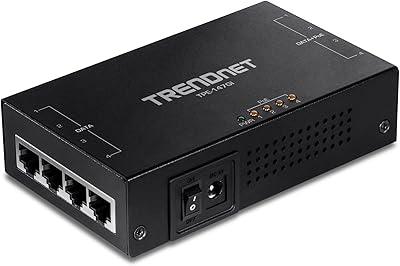
TRENDnet TPE-147GI 4-Port Gigabit PoE+ Injector
79%
96%
Ease of Setup
93%
Reliability
61%
Power Budget Adequacy
82%
Build Quality
74%
Thermal Management
More
MokerLink POE-G1604GS 20-Port Gigabit PoE Switch
85%
88%
Performance
93%
Ease of Setup
90%
Build Quality
89%
PoE Power Budget (200W)
91%
Noise Level
More
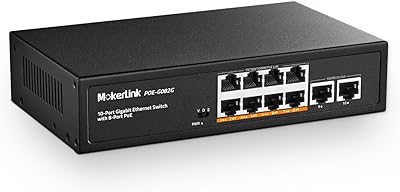
MokerLink POE-G082G 10-Port Gigabit PoE Switch
78%
94%
Ease of Setup
88%
PoE Reliability
83%
Build Quality
91%
Value for Money
71%
Thermal Management
More
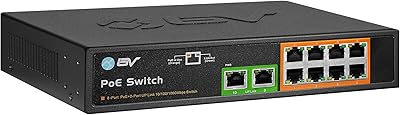
BV-Tech POE-SW802G 8-Port Gigabit PoE+ Switch
79%
94%
Ease of Setup
88%
PoE Reliability
67%
Power Budget
61%
Build Quality
91%
Value for Money
More
MokerLink POE-G041GO Outdoor Gigabit PoE Switch
81%
93%
Ease of Setup
84%
PoE Power Delivery
78%
Build Quality
76%
Weather Resistance
88%
Value for Money
More
LINOVISION POE-SW508G Industrial 8-Port PoE++ Switch
77%
91%
Power Delivery
88%
Build Quality
93%
PoE Watchdog
84%
Installation Ease
86%
Thermal Performance
More

FAQ

It's shared — 120W is the total power budget across all 12 PoE ports combined, not per port. If you're running 12 devices, you have an average of 10W available per port under full load. Before deploying, add up the wattage of every device you plan to connect to make sure you stay within that ceiling.

Yes, that's exactly what this passive PoE injector is designed for. You connect your existing switch to the data-in ports, and the unit injects power on the outgoing PoE ports. Your switch doesn't need to know anything about PoE — the injector handles it entirely.

Yes, and this catches a lot of buyers off guard. The unit does not include patch cables, so you'll need separate cables to run from your switch to the injector's data-in ports, and from the PoE-out ports to your endpoints. Factor those into your order before you start the installation.

Generally yes, as long as those devices operate on the 802.3af or 802.3at standard, which most Meraki and Ruckus access points do. Always confirm the specific model's PoE standard and wattage requirement against the 120W shared budget before committing.

The red LED indicates that a port group has hit or is approaching its maximum current threshold. It doesn't necessarily mean something has failed, but it's a signal to check your load distribution. If it's staying red consistently, you may be overloading that section of the power budget and should redistribute or reduce the number of connected devices.

Not out of the box. The PoE Texas 12-Port Gigabit Passive PoE Injector only supports 802.3af and 802.3at natively. Supporting 802.3bt requires a second power supply that is sold separately. If most of your endpoints are high-wattage 802.3bt devices, a purpose-built 802.3bt injector or switch might be a better fit.

No. This is a fully passive, unmanaged unit with no web interface, SNMP support, or CLI access. What you see is what you get — the LED indicators are your only real-time feedback mechanism. If per-port monitoring or remote management is important to your deployment, you'll need a managed PoE switch instead.

Completely silent. There are no fans or moving parts of any kind, so it generates zero noise. This makes the 12-port midspan unit a particularly good choice for installations in open offices, reception areas, or any space where a noisy rack component would be disruptive.

Most buyers who comment on build quality are pleasantly surprised. The metal chassis feels solid and handles the heat load without issues, which is part of why the passive cooling approach works — the enclosure itself acts as a heat sink. It holds up well in standard rack deployments.

PoE Texas offers direct phone support, which is genuinely uncommon for this product category. Their number is listed publicly and real buyers frequently mention it as a differentiator when troubleshooting compatibility or setup issues. The 30-day return window and 1-year replacement warranty also give you reasonable coverage if something goes wrong early.

Where to Buy