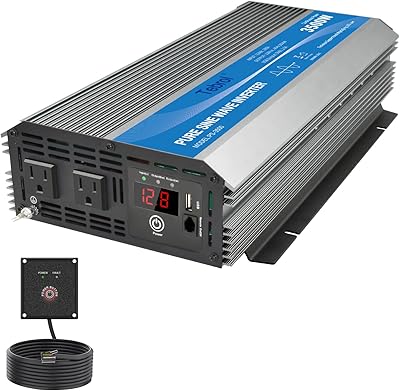
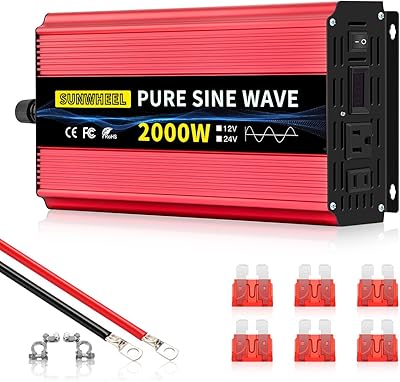
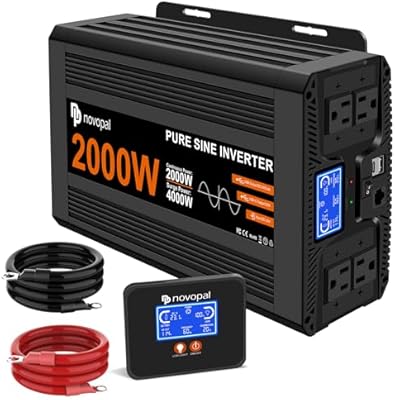
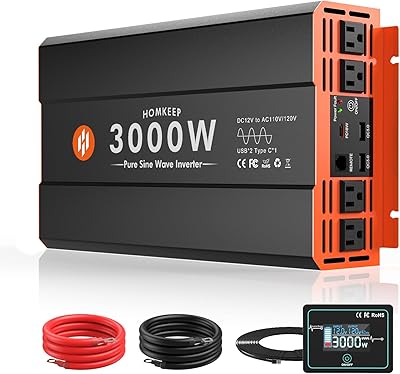
Overview

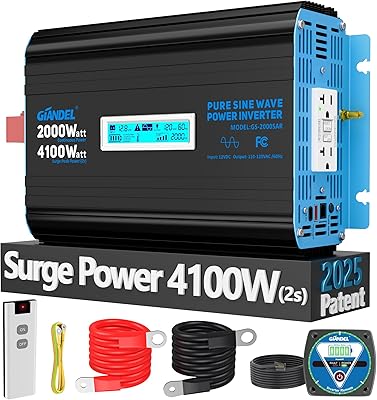
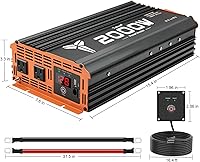
The Tebrol 2000W Modified Sine Wave Power Inverter is a practical, no-frills unit from a newer brand quietly building a foothold in the portable power market. It converts 12V DC battery power to standard 110V AC, delivering 2000 watts continuously — with a 4000-watt peak for brief motor startups, not sustained draw. At 15.4 x 7.6 x 3.3 inches and under 10 pounds, it moves around easily. Worth flagging upfront: this is a modified sine wave device, which matters for anyone running sensitive electronics. Launched in late 2024, it has already collected over 100 ratings sitting at 4.5 stars — a solid early signal for a brand still establishing itself.

Features & Benefits

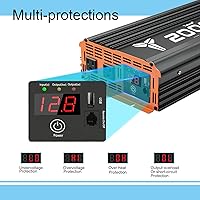
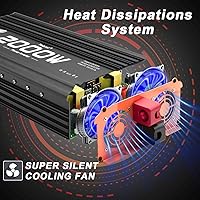
The standout convenience features are the remote controller and LCD display, which let you monitor voltage, load, and operating status without crawling under a dashboard or digging into a storage compartment. The built-in 5V/2.1A USB port keeps phones or small devices topped up without consuming an AC outlet. The AC hardwire port makes semi-permanent installation in a van, truck cab, or solar panel setup genuinely straightforward. On the safety side, this 2000W inverter covers six protection layers — overvoltage, undervoltage, overload, short circuit, overheating, and soft start — backed by dual cooling fans that spin up only when internal temperatures warrant it, rather than running at full blast constantly.

Best For

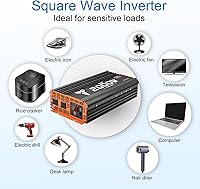
This Tebrol inverter suits a few specific use cases well: RV and van builds where you need reliable AC for a TV, laptop, or small appliance without shore power; truck cabs where a driver wants to run tools or accessories between hauls; and off-grid solar setups pairing a 12V battery bank with a capable, affordable inverter. It also works as a reasonable emergency backup during short outages at home. That said, anyone whose priority is a CPAP machine, precision audio gear, or appliances with variable-speed motors should step up to a pure sine wave inverter — this unit simply is not engineered for those loads.

User Feedback

With just over 100 ratings, the review pool is still relatively thin — worth keeping in mind before drawing firm conclusions. That said, positive notes cluster around easy installation, the remote control being genuinely useful when the unit is tucked into an awkward spot, and the LCD readout being clear at a glance. On the downside, some buyers mention the cooling fans get audible under heavier loads, and a few flag the included battery cables as feeling undersized for sustained high-draw use. There are also scattered reports confirming that the modified sine wave output causes minor issues with certain sensitive devices. Long-term reliability remains an open question given the product's short time on the market.

Pros

  • Remote controller is genuinely useful when the inverter is tucked into a tight or hard-to-reach space.
  • LCD display gives clear, real-time readouts of voltage and load without guesswork.
  • Built-in USB port keeps phones and small devices charging without sacrificing an AC outlet.
  • AC hardwire port makes semi-permanent vehicle or solar installation clean and straightforward.
  • Six-layer protection system covers the most common failure scenarios, including soft start to protect connected devices.
  • At under 10 pounds, the unit is light enough to reposition or move between vehicles without much hassle.
  • Dual cooling fans are temperature-controlled, so the unit stays relatively quiet at lighter loads.
  • Strong early rating of 4.5 stars across more than 100 verified buyers is a reassuring signal for a newer brand.
  • 2000W continuous output handles most everyday AC appliances without tripping protection circuits.

Cons

  • Modified sine wave output is incompatible with CPAP machines, sensitive audio gear, and many variable-speed appliances.
  • Tebrol has a limited track record — long-term durability beyond the first year is still an unknown.
  • Cooling fans reportedly become noticeably loud under sustained heavy loads, which can be irritating in a cab or sleeping area.
  • Included battery cables have been flagged by some buyers as undersized for high-draw usage.
  • The 4000W peak rating is a brief surge figure only — sustained loads approaching 2000W continuously will stress the unit.
  • With just over 100 ratings, the review base is too small to draw reliable conclusions about edge-case reliability.
  • No pure sine wave option available in this model line for buyers who want to future-proof against sensitive device compatibility.
  • Brand support and warranty service are harder to evaluate given how recently Tebrol entered the market.

Ratings

Our AI has analyzed verified buyer reviews for the Tebrol 2000W Modified Sine Wave Power Inverter from across multiple global platforms, actively filtering out incentivized, repetitive, and bot-flagged submissions to surface what real users genuinely experienced. The scores below reflect a balanced picture — where this inverter earns its praise and where recurring pain points pull the needle down. No category has been softened or inflated.

Value for Money
83%
For buyers running standard AC loads in an RV, truck cab, or off-grid solar setup, the price-to-output ratio is hard to argue with at this wattage. Most users felt they were getting a capable, feature-rich inverter without paying a premium brand tax, and the included remote and LCD added perceived value.
A handful of buyers who compared it directly against slightly pricier competitors noted the included battery cables felt like an afterthought for a 2000W unit. If you end up replacing those cables immediately, the total cost of ownership creeps up and the value equation shifts a bit.
Ease of Installation
88%
The straightforward clamp-to-battery connection meant most users had the unit running within minutes of unboxing, with no special tools or technical background required. Buyers who used the hardwire port for a more permanent van or RV setup also appreciated that the process was clearly documented and not overly fiddly.
A few users doing a clean hardwire install noted the instructions could be more detailed about recommended cable gauges and fuse sizing for sustained high-draw scenarios. Without that context, first-time inverter buyers could inadvertently undersize their wiring.
Power Output Reliability
76%
24%
For typical loads — a TV, laptop, coffee maker, or a set of power tools drawing well under the 2000W ceiling — the unit performed consistently and without unexpected shutdowns. Users running moderate, real-world loads found the continuous rating held up well during normal day-to-day use in vehicles and weekend camping setups.
Under sustained loads pushing closer to the 2000W limit, some buyers reported the unit getting noticeably warm and the protection systems occasionally tripping — suggesting the real comfortable operating zone sits somewhat below the rated ceiling. Long-duration high-draw scenarios remain a weak spot based on current feedback.
Waveform Compatibility
61%
39%
For the majority of everyday devices — basic appliances, TVs, LED lighting, phone chargers, and standard power tools — the modified sine wave output is entirely functional and buyers reported no operational issues with these types of loads.
This is the most consistently flagged limitation in user reviews. Buyers who attempted to run CPAP machines, certain battery chargers with smart circuitry, or newer appliances with variable-speed motors reported problems ranging from unusual buzzing to devices outright refusing to function properly. It is a real constraint that affects a meaningful portion of potential buyers.
Remote Control Usability
84%
The remote was one of the most praised features among buyers who mounted the inverter inside a compartment, under a truck seat, or behind an RV panel. Being able to check status and toggle the unit from across the vehicle without contorting into an awkward position was cited repeatedly as a practical day-to-day convenience.
Some users noted the remote connection range felt limited in larger vehicles, and a few reported the controller feeling plasticky relative to the inverter body itself. There is also no indication of remote battery life expectations in the documentation, which became a minor irritant for some buyers.
LCD Display Clarity
86%
Users consistently appreciated being able to glance at the display and know exactly what load they were drawing and what voltage the battery was sitting at — particularly useful for solar users monitoring their battery health across the day. The readout was described as clear and legible in typical indoor and vehicle lighting conditions.
A small number of buyers found the display harder to read in direct sunlight, which is a relevant scenario for units mounted on a dash or near a window in an RV. No backlight brightness adjustment is available, which limits adaptability across different installation environments.
Cooling & Fan Noise
67%
33%
The temperature-controlled fan design is a genuine positive — at lighter loads the unit runs quietly or silently, which matters in a camper or cab where background noise is noticeable. Buyers running the inverter at under half load for TV watching or device charging rarely had noise complaints.
Under heavier loads, the fans ramp up to a level that multiple reviewers described as intrusive, particularly in a sleeping cabin or small van build at night. This is not unique to this unit among modified sine wave inverters in the class, but it is a consistent enough complaint to warrant realistic expectations before buying.
Build Quality
71%
29%
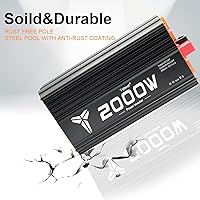
The overall chassis feels solid for the price tier, and the unit's weight distribution suggests a reasonably dense internal build rather than a hollow, lightweight shell. For buyers using it in a truck or RV where it sees occasional jostling and vibration, the physical construction has not been a significant complaint source.
The included battery cables drew criticism from more experienced inverter users, who flagged them as undersized for the unit's rated capacity. The remote controller also felt noticeably cheaper in hand compared to the inverter body, creating a slight mismatch in perceived quality between the components.
Safety Protections
82%
18%
The six-layer protection system gave buyers peace of mind, and several users specifically called out the soft-start feature as preventing the kind of sudden load spike that can damage connected devices. In practice, the overload and overheat protections appeared to trigger correctly without false alarms under normal operating patterns.
A few buyers running loads closer to the inverter's upper limit reported the protection systems tripping more readily than expected, which some interpreted as conservative calibration rather than a true fault condition. Whether this is a feature or a limitation depends on how aggressively you intend to load the unit.
USB Charging Port
78%
22%
Having a dedicated 5V/2.1A USB port is a practical touch that buyers genuinely used — keeping a phone or tablet charging without tying up the AC outlet for a small wall adapter is a small but real convenience during road trips and campsite stays.
With only one USB port at 2.1A, the charging capability feels modest relative to current device standards where 18W or faster USB charging has become common. Users with multiple devices or those wanting to charge a tablet quickly alongside a phone found themselves still reaching for a separate USB hub or adapter.
Brand Reliability & Support
58%
42%
Early buyers have not widely reported unit failures or defects at a rate that stands out for a product this new, and the initial batch appears to have passed basic quality checks. The 4.5-star average across over 100 ratings is an encouraging early signal for a brand establishing itself.
Tebrol's newness to the market is a genuine concern for buyers thinking about long-term ownership. There is limited documentation of how the brand handles warranty claims, replacement parts availability, or firmware-level issues — all questions that more established inverter brands have answered through years of customer interactions.
Portability
81%
19%
At under 10 pounds and a relatively compact footprint, this 2000W inverter is easy to move between a truck, a camper, and a home backup setup without treating it as a fixed installation. Buyers who wanted flexibility across multiple vehicles found the dimensions and weight to be genuinely manageable.
There are no integrated handles or mounting brackets included in the package, which makes repositioning slightly more awkward than it needs to be during a hasty setup. For a unit that some buyers use across multiple contexts, a simple carry handle would have been a practical addition.
Long-Term Durability
63%
37%
Within the review window available — essentially the first several months since launch — buyers have not reported widespread early failures, and the unit appears to handle the thermal demands of regular moderate use without obvious degradation in performance.
With the product barely past its first year on the market and a review pool of just over 100 ratings, there is simply not enough longitudinal data to make confident claims about multi-year durability. This is a known unknown, and buyers who prioritize a proven track record will need to factor that uncertainty into their decision.

Suitable for:

The Tebrol 2000W Modified Sine Wave Power Inverter is a practical fit for RV owners, van-lifers, and long-haul truck drivers who need dependable 110V AC power drawn from a 12V battery, without the complexity or cost of a full pure sine wave system. If your typical load list includes a flat-screen TV, laptop, LED lighting, a small coffee maker, or basic power tools, this unit handles those comfortably within its continuous 2000W rating. Off-grid solar enthusiasts building out a 12V battery bank will also find it a cost-effective bridge between stored DC energy and everyday AC appliances. It works equally well as a straightforward emergency backup at home — enough to run a lamp, charge devices, and keep a small fan going when the grid goes down for a few hours. For buyers whose power needs are ordinary and whose devices are not particularly sensitive to waveform quality, this inverter delivers solid utility at a fair price point.
Not suitable for:

Anyone who needs to run waveform-sensitive equipment should look elsewhere before purchasing the Tebrol 2000W Modified Sine Wave Power Inverter. CPAP and BiPAP machines, in particular, are notorious for performing poorly or even sustaining damage on modified sine wave power — this is a firm dealbreaker for travelers who depend on sleep therapy equipment. The same concern applies to high-end audio amplifiers, certain laser printers, and newer appliances with variable-speed motors or microprocessor-controlled compressors, all of which tend to run hotter, noisier, or less efficiently on a modified waveform. Buyers who are upgrading from a pure sine wave inverter and expect equivalent compatibility will likely be disappointed. Additionally, anyone looking for a proven, long-term track record from a well-established brand should note that Tebrol is still relatively new to the market, and multi-year reliability data simply does not exist yet for this model.

Specifications

  • Continuous Output: The inverter delivers a sustained 2000 watts of continuous AC power under normal operating conditions.
  • Peak Surge Power: A 4000-watt peak rating covers brief motor startup surges only and is not a sustained output figure.
  • Input Voltage: Designed to accept 12V DC input, connected directly to a vehicle or battery bank via cable clamps or hardwire.
  • Output Voltage: Produces standard 110V AC output compatible with North American household-style appliances and devices.
  • Waveform Type: Outputs a modified sine wave, which works well for most resistive loads but is not suitable for all sensitive electronics.
  • USB Output: Includes one built-in USB charging port rated at 5V and 2.1A for phones, tablets, and small accessories.
  • Hardwire Port: An AC hardwire port allows the unit to be semi-permanently wired into a vehicle panel or off-grid system.
  • Remote Control: A dedicated remote controller is included for monitoring and operating the inverter from a distance.
  • Display: An onboard LCD screen shows real-time operating data including input voltage and current load.
  • Cooling System: Dual internal fans operate on a temperature-controlled basis, activating automatically when internal heat reaches a set threshold.
  • Protections: Six protection layers are built in: overvoltage, undervoltage, overload, short circuit, overheating, and soft start.
  • Dimensions: The unit measures 15.4 x 7.6 x 3.3 inches, making it compact enough for most under-dash or compartment installations.
  • Weight: At 9.87 pounds, the inverter is portable enough to reposition between vehicles or storage locations without difficulty.
  • Brand: Manufactured by Tebrol, a newer entrant in the portable power inverter market that launched this model in November 2024.
  • AC Outlets: The unit provides standard AC outlet connections for plugging in appliances alongside the dedicated hardwire port.
  • Efficiency Note: As with all modified sine wave inverters, some devices may run slightly warmer or less efficiently compared to pure sine wave alternatives.

Related Reviews

Joemnwart 1000W Pure Sine Wave Power Inverter
79%
88%
Power Output Quality
79%
Build Quality
84%
USB Charging Performance
86%
Safety Protection System
82%
Noise Level
More
SUNWHEEL 2000W Pure Sine Wave Inverter
80%
86%
Power Output Reliability
91%
Waveform Quality
83%
Build Quality
88%
Noise Level
67%
LCD Display Usefulness
More
Tebrol 3500W Pure Sine Wave Inverter
79%
88%
Output Power Accuracy
92%
Pure Sine Wave Quality
79%
Build Quality
83%
Cooling & Thermal Management
81%
Ease of Installation
More
BESTEK 400W Pure Sine Wave Power Inverter
81%
91%
Power Output Quality
74%
Real-World Wattage Reliability
88%
USB Charging Speed
83%
Fan Noise
76%
Build Quality & Durability
More
XYZ INVT 2000W Pure Sine Wave Inverter
75%
88%
Power Output Quality
58%
Thermal Management
83%
Surge Handling
91%
Portability & Size
86%
Conversion Efficiency
More
LEESKY 1500W Pure Sine Wave Power Inverter
82%
88%
Output Power Quality
84%
Build Quality
86%
Value for Money
91%
Remote Controller Usefulness
79%
Noise Level
More
Homkeep 3000W Pure Sine Wave Power Inverter
88%
93%
Power Performance
88%
Ease of Use
90%
Build Quality
85%
Noise Level
91%
Safety Features
More
Novopal 2000W 24V Pure Sine Wave Inverter
79%
88%
Power Output Quality
83%
Build Quality
79%
Value for Money
74%
Ease of Installation
81%
Remote Control Functionality
More
Yinleader 3500W Pure Sine Wave Power Inverter
73%
83%
Power Output Quality
61%
Build Quality
67%
Thermal Management
63%
Surge Performance
86%
Ease of Setup
More
VOLTWORKS VS-2000SCR 2000W Pure Sine Wave Inverter
81%
88%
Output Power & Reliability
91%
Sine Wave Quality
83%
Surge Performance
86%
Lithium Battery Compatibility
79%
Build Quality & Housing
More

FAQ

This is one of the most important questions to get right before buying. The Tebrol 2000W Modified Sine Wave Power Inverter outputs a modified sine wave, and most CPAP and BiPAP manufacturers explicitly recommend pure sine wave power for their devices. Running a CPAP on modified sine wave can cause the motor to run hotter, create noise interference, or in some cases void the device warranty. If a CPAP is on your must-power list, you should look for a pure sine wave inverter instead.
At 2000W on a 12V system, you are drawing roughly 167 amps continuously — that is a serious current demand. You would need a large-capacity battery bank (typically 200Ah or more of lithium, or a pair of heavy-duty AGM batteries) along with appropriately thick cabling to avoid dangerous voltage drop. Most casual users running lighter loads will never approach the full 2000W, but it is worth sizing your battery and wiring for your actual peak draw, not just the inverter rating.

Based on the product design, the remote controller is primarily intended for monitoring operating status and basic control functions from a distance — useful when the unit is mounted inside a compartment or under a seat. For precise details on which functions the remote supports beyond monitoring, it is worth checking the included manual upon receipt, as remote control feature sets can vary between firmware versions.

Yes, as long as your solar system charges a 12V battery bank, this inverter can draw from that bank to produce 110V AC output. The inverter itself does not connect directly to solar panels — it connects to the battery. So the real question is whether your charge controller and battery bank are properly sized to sustain the loads you want to run. For light to moderate off-grid use, this is a cost-effective option.

The fans are temperature-controlled, so at lighter loads they either stay off or run quietly. Several buyers have noted that under sustained heavy loads — especially above 1500W — the fans become quite audible. If you are using this unit in a sleeping area or a quiet cab, that is something to be aware of. For daytime use running tools or appliances, it is unlikely to be a meaningful issue.

Yes, the unit includes an AC hardwire port specifically for semi-permanent installation. This is a useful feature if you want a cleaner setup without visible extension cords. Just make sure to use appropriately rated wiring for the current draw, and consider installing an inline fuse near the battery for safety — standard practice for any permanent inverter installation.

At 2000W continuous, you can comfortably run a large flat-screen TV, a laptop, LED lighting, a standard coffee maker, a small microwave (check its wattage first), or basic power tools. Where you need to be careful is appliances with compressors or motors — their startup surge can briefly spike well above their rated running wattage. The 4000W peak helps absorb those surges, but it is a momentary figure, not a sustained capacity.

The standard connection method is via battery cable clamps that attach directly to your 12V battery terminals — positive to positive, negative to negative. For higher loads, use heavy-gauge cables (typically 2 AWG or larger) and keep the cable run as short as possible to minimize resistance and voltage drop. If you plan to hardwire it, route through an appropriately rated fuse close to the battery.

Tebrol is a newer brand that only brought this model to market in late 2024, so there is not a long track record to lean on yet. What we do have is over 100 early ratings sitting at 4.5 stars, which is a reasonable early indicator. That said, it is fair to acknowledge you are not getting a decade of brand history or a well-documented warranty support network. If brand longevity and established customer service are priorities for you, a more established name might offer more peace of mind.

The LCD screen shows key real-time data including input voltage from the battery and the current load being drawn. This is genuinely useful for keeping an eye on your battery health and making sure you are not creeping toward the inverter's limits. Buyers generally report the display is clear and easy to read, which makes it more practical than units that offer no operational feedback at all.