Overview

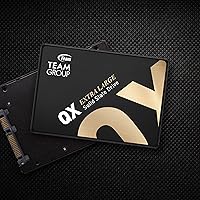
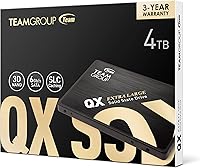
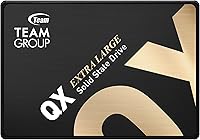
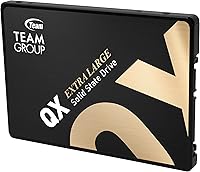
The TEAMGROUP QX 4TB Internal SSD sits in a sweet spot that most storage buyers rarely find: a massive 4TB capacity in a standard 2.5-inch SATA III form factor, at a price that doesn't require serious justification. TEAMGROUP is a Taiwanese brand that has steadily built credibility in the budget-to-mid storage space, and this drive reflects that trajectory. It fits any laptop or desktop with a spare SATA bay, making it a practical upgrade path for older machines. One honest caveat worth stating upfront: it uses QLC NAND, which trades some write endurance and peak sustained speed for a lower cost per gigabyte compared to TLC or MLC alternatives.
Features & Benefits

At its core, this high-capacity SSD reaches 500 MB/s sequential read and 460 MB/s write — respectable numbers for a SATA connection, even if NVMe drives leave it well behind. What helps day-to-day is the built-in SLC caching, which buffers short bursts of writes so common tasks like moving files or launching apps feel snappy. The 1000TBW endurance rating is unusually generous for a QLC drive of this size, suggesting real attention to long-term reliability. At just 0.28 inches thick and under an ounce, it slides into tight laptop bays without issue. A three-year limited warranty aligned to JEDEC standards rounds out the package with a practical safety net.

Best For

This 4TB SATA drive makes the most sense for people replacing a spinning hard drive in a laptop or older desktop — if your machine still boots from an HDD, the jump will feel dramatic. It is also a strong pick for anyone who needs bulk internal storage: large game libraries, video editing project archives, or a personal media collection where capacity matters more than raw throughput. Content collectors and prosumers who accumulate files quickly will appreciate fitting 4TB into a single internal slot. That said, if you are building a new system with M.2 slots available, an NVMe drive would serve you better for write-heavy workloads.

User Feedback

With over 11,000 ratings averaging 4.5 stars, the TEAMGROUP QX has clearly landed well with buyers — and that sample size is large enough to take seriously. Most positive reviews highlight easy installation, a noticeable real-world speed improvement over old hard drives, and strong value per terabyte. The honest criticism worth noting: users moving very large files in one session occasionally report a write speed dip once the SLC cache fills, which is typical QLC behavior and not a defect. A smaller share of buyers also mention detection issues tied to motherboard or BIOS compatibility, so verifying that before purchasing is genuinely a good idea.

Pros

  • 4TB of internal storage in a standard 2.5-inch form factor is genuinely hard to find at this price point.
  • Upgrading from a mechanical hard drive produces a dramatic, immediately noticeable speed improvement.
  • The slim 0.28-inch profile fits snugly into space-constrained laptops without requiring any modifications.
  • SLC caching keeps everyday tasks — file transfers, app launches, OS boot — feeling fast and responsive.
  • A 1000TBW endurance rating offers more long-term reassurance than most QLC drives at this capacity.
  • Installation is straightforward; most users report being up and running within minutes.
  • The three-year limited warranty provides a practical safety net aligned to industry standards.
  • Over 11,000 ratings averaging 4.5 stars reflects consistent satisfaction across a wide, diverse buyer base.
  • The cost per terabyte undercuts many competing SATA drives at the same capacity tier.

Cons

  • QLC NAND write speeds drop after the SLC cache fills, which affects large sequential transfers noticeably.
  • SATA III tops out well below what modern NVMe drives offer — not ideal if your system supports M.2.
  • A handful of buyers report BIOS or motherboard detection failures, requiring manual troubleshooting before use.
  • QLC NAND generally has lower write endurance per cell than TLC alternatives, a concern for write-intensive workflows.
  • No included mounting bracket or adapter, so desktop users with 3.5-inch bays will need a separate caddy.
  • Random read and write performance, while adequate, lags behind NVMe options in multitasking-heavy scenarios.
  • The warranty terms follow JEDEC TBW conditions, meaning heavy writers could void coverage sooner than expected.
  • TEAMGROUP's brand recognition is still growing, so finding third-party benchmark comparisons requires more searching than with established names.

Ratings

Our AI rating system analyzed thousands of verified global purchases of the TEAMGROUP QX 4TB Internal SSD, actively filtering out incentivized, duplicate, and bot-generated feedback to surface what real buyers actually experienced. The scores below reflect both the genuine strengths that earned this drive its loyal following and the honest pain points that a subset of users encountered. Nothing has been smoothed over — the numbers tell the full story.

Value for Money
93%
Buyers consistently point to the cost-per-terabyte as the single most compelling reason they chose this drive over competitors. At 4TB in a SATA form factor, it undercuts many rival options while still delivering respectable everyday performance, making it an easy recommendation for HDD upgraders on a budget.
A small segment of buyers who later discovered similarly priced NVMe options felt the value proposition weakened slightly in hindsight. For users with M.2 slots available, the gap in performance relative to price narrows enough to make the decision less obvious.
Read Speed Performance
81%
19%
Hitting close to 500 MB/s sequential reads in real-world use, this high-capacity SSD makes OS boots, application launches, and large file access feel noticeably snappier than any mechanical drive. Users upgrading from HDDs frequently describe the experience as transformative for day-to-day computing.
Buyers who benchmarked the drive against NVMe alternatives were reminded quickly that SATA has a hard ceiling. While read speeds are solid for the interface, users expecting close to NVMe figures — even budget NVMe — will find the gap significant in sustained workloads.
Write Speed & Caching
67%
33%
For typical workloads — saving project files, downloading software, copying moderate batches of photos — the SLC cache keeps write performance feeling brisk and consistent. Most users never push past the cache boundary in a single session, so the drive performs well for the majority of real-world scenarios.
Users moving very large files in one go — full game library transfers, video editing exports, multi-gigabyte backups — report a noticeable speed drop once the SLC cache saturates. This is a fundamental QLC behavior, not a defect, but it is the most frequently cited technical frustration among more demanding buyers.
Storage Capacity
96%
Four terabytes of internal SATA storage is genuinely difficult to source at this price tier, and buyers respond to that scarcity with enthusiasm. Whether it is a game library, a photo archive spanning years, or a media collection that long ago outgrew smaller drives, users report finally feeling like they have breathing room.
A handful of buyers noted that formatted capacity comes in slightly under the advertised 4TB due to standard base-10 versus base-2 conversion, which is industry-normal but still catches some first-time buyers off guard.
Installation Ease
91%
The overwhelming majority of buyers — including those with minimal technical experience — report completing the installation in under fifteen minutes with just a screwdriver. The standard 2.5-inch form factor means no adapters or special tools are needed for compatible systems, and TEAMGROUP provides straightforward guidance on their support site.
Desktop users with only 3.5-inch bays need a mounting bracket that is not included in the box, which surprised a portion of first-time desktop builders. The omission is minor but adds a small extra step and cost that buyers should factor in before ordering.
Compatibility
74%
26%
The TEAMGROUP QX works reliably across the vast majority of laptops and desktops with a standard SATA III bay, and most users plug it in and get going without any configuration required. Compatibility with both Windows and Linux environments is consistently reported as trouble-free.
A recurring subset of reviews flags BIOS or motherboard detection failures on certain older chipsets, requiring firmware updates or manual detection workarounds before the drive registers. While not widespread, the issue is consistent enough across different hardware configurations to warrant a pre-purchase compatibility check.
Build Quality & Durability
83%
The drive's slim metal casing feels solid without being heavy, and users report no flex, rattle, or cosmetic issues even after long-term use inside laptops that travel regularly. The 1,000,000-hour MTBF rating backs up the physical impression of a well-constructed unit.
Being a no-frills internal drive, there is no heat spreader or thermal padding included, which some enthusiasts noted when monitoring temperatures during extended transfer sessions — though actual throttling from heat was rarely reported in everyday conditions.
Long-term Endurance
79%
21%
A 1000TBW rating is genuinely reassuring for a QLC drive, and buyers who understand NAND endurance note that it outperforms many rivals at this capacity. For typical home or office users, hitting that ceiling within the warranty period would require extremely heavy daily writing that most will never approach.
QLC NAND does have a lower write endurance per cell compared to TLC at a fundamental level, and users running write-intensive server or NAS workloads expressed concern about long-term reliability beyond the warranty window. Those use cases are outside this drive's intended target, but the concern is legitimate.
Warranty & Support
77%
23%
A three-year warranty aligned to JEDEC TBW standards is a meaningful commitment at this price point, and buyers who contacted TEAMGROUP support generally reported prompt and helpful responses. The availability of free technical support through their official site adds a layer of post-purchase confidence.
Some users found the TBW-based warranty condition slightly opaque until they read the fine print — the 3-year period and the 1000TBW cap are both active limits, meaning whichever is reached first ends the coverage. This is standard practice, but clearer upfront communication would reduce confusion.
Physical Form Factor
88%
At just 0.28 inches thick and weighing under an ounce, the TEAMGROUP QX fits into tight laptop bays — including ultra-slim models with shallow drive compartments — without requiring any modification. Buyers upgrading compact desktop builds also praised the low-profile footprint.
The drive is strictly a 2.5-inch SATA device, which means it is simply not an option for any system that lacks a SATA bay entirely — a growing reality in newer ultra-thin laptops and mini-PCs built exclusively around M.2 slots.
Thermal Management
82%
18%
SATA SSDs draw significantly less power than NVMe drives, and this drive reflects that — users report it running cool to the touch during normal operations, including sustained media playback and large file reads. The passive metal casing handles heat dissipation adequately for its operating range.
During extended sequential write sessions that exhaust the SLC cache, a handful of users measured slightly elevated temperatures, though none reported thermal throttling severe enough to cause practical issues. Enclosed laptop bays with poor airflow are the most likely scenario where heat could become a marginal concern.
Software & Ecosystem
58%
42%
The drive works out of the box with any modern operating system without requiring proprietary software or drivers, which buyers appreciate for its plug-and-play simplicity. TEAMGROUP does offer a basic SSD toolbox utility for health monitoring on their website.
TEAMGROUP's companion software ecosystem is noticeably thinner than what established brands like Samsung or Western Digital offer, and users who wanted detailed drive health dashboards or migration tools found themselves relying on third-party utilities instead. This is a real gap compared to more mature competitors.
Noise & Vibration
97%
As a solid-state drive with no moving parts, it operates in complete silence — a meaningful quality-of-life improvement for users coming from spinning hard drives that hummed, clicked, and vibrated during heavy use. Buyers working in quiet environments specifically called this out as an underappreciated benefit.
There is essentially nothing negative to report here for standard use; silence is a universal SSD trait rather than a specific differentiator of this drive.
Random I/O Performance
63%
37%
For everyday tasks like opening multiple browser tabs, loading desktop applications, or managing files across folders, random read performance is adequate and noticeably better than any HDD. Users who came from spinning drives describe multitasking as feeling considerably more responsive.
Buyers who ran random write benchmarks or compared the drive to even entry-level NVMe SSDs found the numbers underwhelming. Database-style workloads, virtual machines, and software development environments that hammer small random writes are where this SATA QLC drive struggles relative to faster alternatives.

Suitable for:

The TEAMGROUP QX 4TB Internal SSD is an excellent fit for anyone still running a mechanical hard drive in a laptop or desktop who wants a meaningful performance upgrade without navigating the complexity of NVMe compatibility. If your machine has a 2.5-inch SATA bay — common in systems built before 2018 — this drive slots right in with no adapters or firmware gymnastics required. It is equally well-suited to content collectors: photographers, videographers, and media enthusiasts who accumulate large files steadily and need a single high-capacity internal drive rather than juggling external storage. Gamers who want to park an entire library on one internal drive without paying NVMe prices will find the capacity-to-cost ratio genuinely hard to beat. For anyone using a secondary internal slot as an archive or backup target, this high-capacity SSD offers reliable bulk storage with far better longevity prospects than a spinning disk.
Not suitable for:

The TEAMGROUP QX 4TB Internal SSD is not the right tool for users building a new system around an M.2 slot, where an NVMe drive would deliver dramatically faster performance for a comparable or lower cost per gigabyte. Anyone who routinely moves very large files — think raw video editing sessions, database operations, or virtual machine workloads — may run into the QLC NAND limitation: once the SLC cache is exhausted during long sequential writes, speeds drop noticeably until the drive recovers. This is not a defect, but it is a real trade-off that write-heavy power users should weigh carefully. Buyers with older or less common motherboards should also verify SATA compatibility and BIOS detection before purchasing, as a small but consistent portion of users have reported detection issues tied to specific hardware configurations. If absolute write endurance and sustained throughput are your priorities, a TLC-based drive — even at a smaller capacity — may serve you better over the long run.
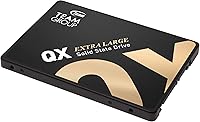
Specifications

  • Capacity: This drive offers 4TB of usable storage, making it one of the higher-capacity options available in the 2.5-inch SATA form factor.
  • Form Factor: The 2.5-inch design is the standard for laptop and desktop SATA bays, ensuring broad compatibility with older and current systems alike.
  • Interface: It connects via SATA III running at 6Gb/s, the most widely supported internal drive interface across laptops and desktops built in the last decade.
  • Read Speed: Sequential read performance reaches up to 500 MB/s, which is near the practical ceiling for SATA III connections.
  • Write Speed: Sequential write speed peaks at 460 MB/s under cached conditions, suitable for everyday file operations and general workloads.
  • NAND Type: Storage cells use 3D QLC NAND, which stacks layers vertically to achieve high density and lower cost per gigabyte compared to TLC or MLC alternatives.
  • Cache Type: An SLC caching layer accelerates burst write operations, helping the drive handle short intensive tasks without immediate speed degradation.
  • Endurance: The drive is rated for 1000 TBW (terabytes written), a notably high endurance figure for a QLC-based drive at this capacity level.
  • MTBF: Mean time between failures is rated at 1,000,000 hours, reflecting the manufacturer's confidence in the drive's long-term operational reliability.
  • Dimensions: Physical dimensions measure 3.94 x 2.75 x 0.28 inches, allowing it to fit into slim laptop bays and compact desktop enclosures without modification.
  • Weight: At 0.705 ounces, the drive adds virtually no meaningful weight to a laptop or desktop system.
  • Warranty: TEAMGROUP provides a 3-year limited warranty, with TBW conditions defined and enforced according to the JEDEC industry standard.
  • Compatibility: The drive is designed for internal installation in both laptops and desktop PCs that include a 2.5-inch SATA bay.
  • Install Type: This is an internal drive, meaning it mounts directly inside the system chassis and is not intended for external portable use.
  • Color: The drive ships in a standard black casing with no external lighting or decorative elements.
  • Brand Origin: TEAMGROUP is a Taiwanese memory and storage manufacturer with over two decades of experience producing consumer and enterprise-grade storage products.
  • Series: The QX series sits within TEAMGROUP's mainstream value lineup, targeting users who prioritize capacity and reliability over peak sequential throughput.

Related Reviews
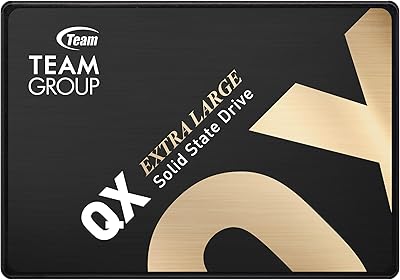
TEAMGROUP QX 2TB SATA SSD
79%
93%
Value for Money
84%
Read Speed Performance
61%
Write Speed & Sustained Performance
88%
Endurance & Longevity
94%
Installation Ease
More
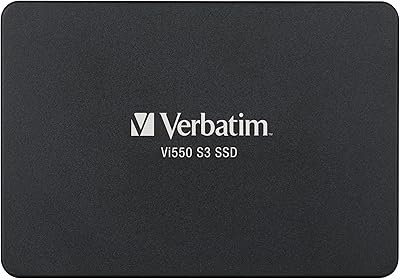
Verbatim Vi550 4TB 2.5″ Internal SSD
77%
88%
Value for Money
93%
Storage Capacity
74%
Sequential Read Speed
62%
Sustained Write Performance
91%
Installation & Setup
More
TEAMGROUP PD20 ECO 4TB Portable External SSD
74%
83%
Transfer Speed
87%
Build Quality
79%
Durability & Protection
93%
Portability
89%
Compatibility
More
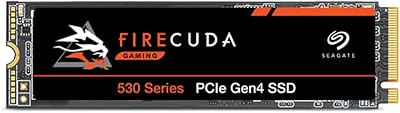
Seagate FireCuda 530 4TB M.2 NVMe SSD
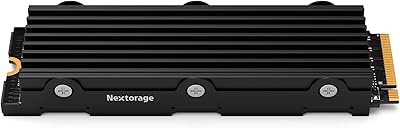
82%
93%
Sequential Read Performance
91%
Sequential Write Performance
62%
Thermal Management
84%
PS5 Compatibility
96%
Endurance & Longevity
More
Nextorage NEM-PAB 4TB M.2 NVMe SSD
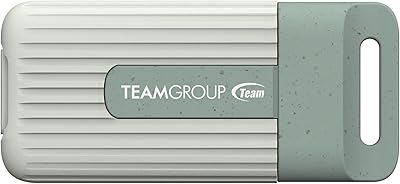
84%
91%
Installation Experience
84%
Real-World Load Times
88%
Thermal Management
67%
Value for Money
89%
Build Quality
More
TEAMGROUP MP44Q 4TB NVMe SSD
80%
92%
Sequential Read Speed
78%
Sequential Write Speed
91%
Value for Money
74%
Thermal Management
81%
Compatibility
More
Transcend MTE250S 4TB NVMe M.2 SSD
81%
92%
Read Performance
81%
Write Performance
88%
Thermal Management
74%
Capacity Value
89%
PS5 Compatibility
More
TEAMGROUP T-Force Vulcan Z 4TB SSD
85%
85%
Performance
92%
Value for Money
88%
Build Quality & Durability
90%
Ease of Installation
94%
Capacity
More
SanDisk Ultra 3D NAND 4TB Internal SSD
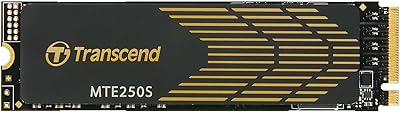
91%
94%
Sequential Read Speed
91%
Sequential Write Speed
96%
Endurance & Reliability
88%
Ease of Installation
90%
Compatibility
More
TEAMGROUP T-Force GC PRO 4TB Gen5 NVMe SSD
80%
88%
Sequential Speed Performance
83%
Thermal Management
81%
Sustained Write Consistency
67%
Compatibility & Setup Experience
74%
Value for Money
More

FAQ

In most cases, yes. If your laptop has a 2.5-inch SATA bay — which is standard on the vast majority of laptops made before around 2018 — this drive will drop right in. Just confirm your machine uses a SATA connector rather than a proprietary interface before purchasing, and check your BIOS recognizes new drives after installation.

QLC packs more data into each storage cell, which is how manufacturers hit 4TB at a lower price point. For typical use — browsing, streaming, installing apps, saving documents — you will not notice any downside. The only scenario where it matters is if you regularly copy hundreds of gigabytes in a single session; after the SLC cache fills, write speeds drop until the drive catches up. For most people, this never becomes a real issue.

A standard Phillips-head screwdriver is all you need for most installations. If you are putting it in a desktop that only has 3.5-inch drive bays, you will need a simple 2.5-to-3.5-inch mounting bracket, which costs just a few dollars and is not included in the box.

If your system has an available M.2 slot, an NVMe drive will generally outperform this 4TB SATA drive significantly in both read and write speeds. But if your machine only has a SATA bay, or you are adding secondary storage to a system that already has an NVMe boot drive, this high-capacity SSD makes a lot of sense. It is really about matching the drive to what your system actually supports.

Yes, it is on the higher end for QLC at this capacity. To put it in perspective, writing 100GB per day every single day would take nearly 28 years to hit 1000TBW. For typical home or office use, endurance is unlikely to ever be a limiting factor.

It works fine as a primary OS drive — booting Windows or Linux from this drive is far faster than any mechanical hard disk. That said, if you have an NVMe option available, using that for your OS and this drive for data storage is an efficient combination that gets the best out of both.

It is not widespread, but it does come up occasionally in user feedback. This is usually related to specific older motherboard chipsets or BIOS versions that need updating to recognize newer drives. Before installing, it is worth doing a quick check to ensure your motherboard firmware is current, which resolves most detection issues.

The 3-year limited warranty is fairly standard for this class of drive. The key detail is that it also has a TBW cap — meaning if you somehow write past 1000TB before the 3 years are up, the warranty coverage would no longer apply. TEAMGROUP does offer direct technical support through their official website, which is useful if you run into any issues.

The PS4 and PS4 Pro both support 2.5-inch SATA drives internally, so this drive is compatible as a replacement. The PS5, however, uses an M.2 NVMe slot for its expansion bay, so this drive would not work there. It could still be used as external storage via a USB enclosure with a PS5, but performance would be limited by the USB connection.

SATA SSDs in general run cooler than NVMe drives because they operate at lower speeds and draw less power. The TEAMGROUP QX sits in a slim metal casing that helps dissipate heat passively, and in normal usage scenarios — even extended file transfers — thermal throttling is not a common complaint among buyers.

Where to Buy