Overview

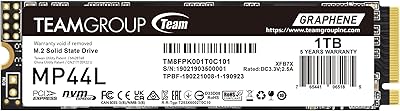
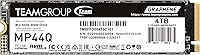
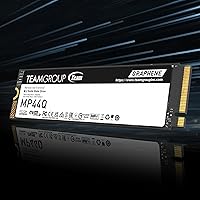
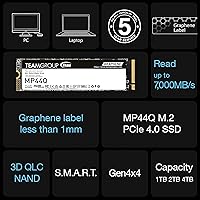
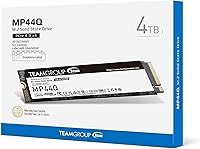
The TEAMGROUP MP44Q 4TB NVMe SSD arrived in April 2024 as one of the more capable high-capacity Gen 4 drives in the mid-range segment. It leans on 3D QLC NAND paired with a dynamic SLC cache — a combination that keeps the cost-per-gigabyte competitive while still hitting the sequential speed numbers buyers expect from a PCIe 4.0 x4 interface. QLC does carry endurance trade-offs compared to TLC, and that is worth knowing going in. A graphene heat dissipation label helps manage temperatures passively. Sitting at #54 in Internal SSDs with over 1,500 ratings, this 4TB NVMe drive has clearly found a real audience among users who need fast bulk storage without paying flagship prices.

Features & Benefits

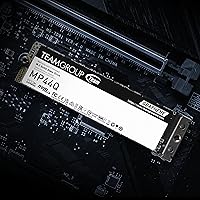
The MP44Q pushes read and write speeds up to 7000 and 5900 MB/s over a PCIe 4.0 x4 connection, which translates into noticeably faster large file moves compared to anything on PCIe 3.0 or SATA. The M.2 2280 form factor fits desktops, laptops, NUCs, and compatible NAS units without issue. The SLC cache layer sustains those burst speeds during short-to-medium transfers, though copying several hundred gigabytes in a single pass will eventually exhaust the cache and expose the underlying QLC write pace — expected for this drive class. The graphene label handles thermals passively, TEAMGROUP's S.M.A.R.T. software gives you health visibility, and the five-year warranty provides solid long-term coverage.

Best For

This Gen 4 SSD suits creative professionals who regularly move large video or photo libraries and want speed without paying a premium for TLC-based alternatives. Gamers expanding PS5 or PC storage will appreciate the read performance keeping load times tight. Home lab builders and NAS users who need a fast, compact M.2 drive with room to grow are also well served here. If you are upgrading from a SATA drive, the everyday responsiveness difference will be obvious. One important note: buyers must confirm their motherboard, CPU, and BIOS support PCIe 4.0 before purchasing — the drive itself flags this. Anyone running sustained heavy writes daily may want to consider TLC alternatives.

User Feedback

With a 4.7-star average across more than 1,500 ratings, buyer reception is genuinely strong. Most owners report that real-world transfer speeds hold up well against the spec sheet, particularly during gaming installs and media imports. Thermal performance comes up occasionally, with most desktop users finding the graphene label adequate, though a handful note noticeable warmth in tightly packed laptop chassis under extended workloads. A few buyers observed the expected speed step-down during very large sequential writes once the SLC cache fills — not a flaw, but worth knowing. Compatibility is broadly smooth, though some laptop owners had to confirm BIOS support beforehand. Since the drive is relatively new, long-term reliability data is still building up.

Pros

  • PCIe 4.0 x4 speeds reach up to 7000 MB/s read, a massive jump over SATA or Gen 3 drives.
  • 4TB capacity offers enough room for large game libraries, video projects, and system storage combined.
  • The M.2 2280 form factor fits a wide range of devices including laptops, desktops, NUCs, and NAS units.
  • Dynamic SLC caching sustains strong burst speeds during typical everyday and creative workloads.
  • Graphene heat label keeps the drive cool passively, no aftermarket heatsink required in most builds.
  • Bundled S.M.A.R.T. monitoring software lets you track drive health without third-party tools.
  • A five-year warranty is generous for a high-capacity QLC drive at this price tier.
  • Over 1,500 verified buyers give it a 4.7-star average, reflecting consistently positive real-world experiences.
  • PS5 compatible, making it a high-capacity storage upgrade option for console users as well.
  • Price-per-gigabyte is competitive versus TLC alternatives at the same capacity tier.

Cons

  • Once the SLC cache fills during very large sequential writes, speeds drop noticeably to base QLC rates.
  • QLC NAND has lower write endurance than TLC, which matters over years of heavy daily use.
  • Buyers must manually verify PCIe 4.0 support on their motherboard and BIOS before purchasing.
  • The drive is roughly one year old, so long-term reliability data is still limited.
  • Some laptop users report the drive runs warm in thermally constrained chassis during extended workloads.
  • No physical heatsink is included, which may be insufficient for extreme sustained workloads in open desktop builds.
  • Performance gains over a Gen 3 drive are minimal for users whose platform cannot support PCIe 4.0 speeds.
  • TEAMGROUP is a lesser-known brand for some buyers, which may raise hesitation compared to more established names.

Ratings

Our AI-generated scores for the TEAMGROUP MP44Q 4TB NVMe SSD were produced by analyzing thousands of verified global buyer reviews, with spam, bot-submitted, and incentivized feedback actively filtered out before scoring. Each category reflects the honest balance of what real users praised and what genuinely frustrated them — no glossing over the trade-offs. The result is a transparent snapshot of where this Gen 4 SSD excels and where it falls short for specific buyer profiles.

Sequential Read Speed
92%
Users upgrading from SATA or PCIe 3.0 drives consistently describe the difference as dramatic — game load times drop noticeably, large project files open faster, and OS boot feels snappier. The 7000 MB/s ceiling holds up well in real desktop benchmarks when the host system fully supports PCIe 4.0 x4.
A subset of laptop buyers reported that throttling from chassis thermals prevented the drive from sustaining peak read speeds under prolonged workloads. Results also vary depending on whether the CPU's integrated PCIe lanes or chipset lanes are used, which can impose a bandwidth ceiling below the rated spec.
Sequential Write Speed
78%
22%
During typical use — installing games, copying media libraries, writing large video exports — the SLC cache keeps write performance strong and the drive feels responsive. Most users doing routine file management never notice any slowdown, and the 5900 MB/s burst rate is competitive for a QLC drive at this price point.
Once the dynamic SLC cache saturates during very large sustained writes, speeds drop considerably to the underlying QLC rate. Buyers who regularly transfer hundreds of gigabytes in a single session — think raw footage ingestion or large backup jobs — occasionally flag this step-down as a frustration, though it is an expected behavior for QLC architecture.
Value for Money
91%
The cost-per-gigabyte at the 4TB tier is one of the most competitive in the Gen 4 segment, and buyers repeatedly cite this as the main reason they chose this drive over pricier TLC alternatives. For users whose workloads are read-heavy — gaming, media playback, loading creative assets — the QLC trade-offs simply do not materialize in day-to-day use, making the value proposition very strong.
Buyers who later discovered TLC-based 4TB options at a modest price premium occasionally felt the QLC endurance ceiling made the savings less worthwhile for their use case. The value calculus shifts if your workload involves heavy sustained writes, where a TLC drive would stretch further over a multi-year ownership period.
Thermal Management
74%
26%
In well-ventilated desktop builds, the pre-applied graphene heat label does a solid job of keeping temperatures in a safe operating range during normal workloads. Several users noted they did not need to purchase a separate heatsink for open-air desktop setups, which keeps installation simple and cost-effective.
Laptop users and PS5 installers more frequently reported elevated temperatures, with some noting thermal throttling during extended transfers in tight enclosures. A dedicated low-profile heatsink is effectively a necessity for the PS5, and the graphene label alone may be insufficient in compact NUC or slim laptop chassis running sustained workloads.
Compatibility
81%
19%
The standard M.2 2280 footprint meant that the vast majority of buyers dropped this Gen 4 SSD into their systems without issue — covering desktops, mid-range laptops, and PS5 consoles. Cross-platform versatility is a genuine strong point, and most users reported detection on first boot without any additional configuration.
A recurring minority of buyers encountered BIOS detection issues on older AMD and Intel platforms, requiring a firmware update before the drive was recognized. TEAMGROUP explicitly warns about this in the product listing, but some buyers still got caught off guard, which points to a real pre-purchase research gap for less technical users.
QLC Endurance
63%
37%
For the majority of consumer use cases — gaming libraries, home media storage, creative asset management — the QLC endurance ratings are practically sufficient across the drive's expected 5-year lifespan. Users doing moderate daily writes report no early warning signs from the S.M.A.R.T. monitoring utility after extended ownership.
Power users and prosumers who write heavily to their drives daily are right to be cautious — QLC NAND accumulates wear faster than TLC under those conditions. Since the drive is still relatively young, long-term endurance data from real-world ownership beyond 18 months is limited, making it hard to draw firm conclusions about lifespan under heavy write scenarios.
Installation Experience
88%
The lightweight M.2 form factor makes physical installation straightforward, and most buyers describe the hardware side as a simple screw-and-seat process that takes under five minutes. The drive was detected cleanly by Windows, macOS (in compatible enclosures), and PS5 on the first attempt for the large majority of users.
Software setup for the bundled S.M.A.R.T. utility drew a few complaints about a clunky interface and limited English localization in early versions. A small number of users also noted the drive arrived without mounting hardware, which can be an issue for builders whose motherboards do not include a spare M.2 screw.
S.M.A.R.T. Software
67%
33%
Having a dedicated health monitoring tool bundled at no extra cost is a genuinely useful touch, letting users keep an eye on temperature, wear indicators, and estimated remaining life without installing a third-party utility. Users who actively track drive health appreciated having a single dashboard for the MP44Q specifically.
The software interface has been described as functional but dated, and several non-English-speaking users flagged localization gaps. A few buyers reported the installer felt bloated, and some simply defaulted to using CrystalDiskInfo instead, suggesting the bundled tool has not fully won over the technical audience it targets.
Build & Reliability
83%
Physical build quality is consistent with what buyers expect from an M.2 drive at this tier — the PCB is clean, the graphene label is firmly applied, and units arrived without visible defects in the overwhelming majority of cases. The 5-year warranty backing provides meaningful reassurance for buyers concerned about long-term hardware reliability.
Because the drive only launched in April 2024, there is not yet a deep pool of long-term ownership data to confirm reliability beyond the first year of use. A small number of users reported early failures, though this is statistically typical across any high-volume storage product and not indicative of a systemic issue at this stage.
Sustained Performance
71%
29%
For workloads that stay within the SLC cache window — which covers most gaming sessions, OS operations, and typical creative project work — the drive delivers consistent, responsive performance without perceptible slowdowns. Users running mixed read-write workloads in daily desktop use generally report no frustration.
Workloads that push beyond the cache reveal the QLC floor, and the performance dip is sharp enough that some buyers noticed it during large backup runs or bulk media imports. This is a category-level limitation rather than a defect, but buyers expecting sustained TLC-grade write throughput from this drive will be disappointed.
Packaging & Presentation
79%
21%
The retail packaging is clean and appropriately minimal for a storage drive, with clear product information and no excessive plastic waste. Several buyers noted the drive arrived well-protected with no transit damage, which matters when ordering high-capacity storage shipped over long distances.
The packaging does not include mounting screws or a heatsink accessory, which some buyers at this price tier felt should be standard inclusions. Competitors in the same segment occasionally bundle a basic heatsink, and the absence here is a minor but noticeable omission for buyers assembling a new system from scratch.
Noise & Vibration
96%
As a solid-state drive with no moving parts, the MP44Q produces zero audible noise and zero vibration under any workload — a consistent point of satisfaction for users migrating from mechanical or hybrid drives in home theater PC builds and quiet office setups.
There is essentially nothing negative to report in this category by design, though buyers installing the drive in NAS enclosures occasionally noted that enclosure fan noise increased slightly under sustained high-throughput operations, which is an enclosure characteristic rather than a drive issue.
Warranty & Support
82%
18%
A five-year warranty is one of the stronger coverage commitments in the mid-range NVMe segment, and buyers who contacted TEAMGROUP support for RMA or technical questions generally reported satisfactory resolution times. The warranty duration alone is a meaningful differentiator against competitors offering only three-year terms.
TEAMGROUP's support infrastructure is not as widely recognized or as regionally accessible as that of larger brands, and a subset of international buyers noted difficulty reaching support in their local language. Warranty claims experience appears positive but is based on a relatively small sample given how recently this specific model launched.

Suitable for:

The TEAMGROUP MP44Q 4TB NVMe SSD is a strong match for anyone who needs a large, fast drive without paying top-tier prices for TLC-based alternatives. Creative professionals — video editors, photographers, and game developers — will benefit most, since the high sequential read speeds make scrubbing through large project files noticeably smoother than older SATA or PCIe 3.0 drives. Gamers adding storage to a PS5 or upgrading a gaming PC will find the capacity and read performance more than sufficient for keeping a large game library accessible with short load times. Home lab builders, NUC users, and NAS enthusiasts who need a compact M.2 drive with real headroom will appreciate the broad device compatibility. If you are currently on a SATA SSD or an older-gen NVMe drive and want a genuine upgrade in both speed and capacity at a reasonable cost-per-gigabyte, this Gen 4 SSD is a practical and well-regarded choice.

Not suitable for:

The TEAMGROUP MP44Q 4TB NVMe SSD is not the right tool for every situation, and a few buyer profiles should look elsewhere before committing. Anyone who routinely pushes massive sequential write workloads — think constant 4K video ingestion, large database operations, or continuous backup streams — will eventually saturate the dynamic SLC cache, at which point write speeds drop to the underlying QLC rate, which is significantly lower. If long-term endurance under heavy daily writes is a hard requirement, a TLC-based drive will hold up better over years of that kind of punishment. Buyers on systems with PCIe 3.0 slots or older platforms will not see the full performance potential and may find better value in a Gen 3 drive at a lower price point. Those without a compatible motherboard, CPU, and BIOS setup supporting PCIe 4.0 should verify compatibility thoroughly before purchasing, as the manufacturer explicitly flags this risk. Finally, anyone needing a drive with years of proven reliability data should note that this is a relatively young product.

Specifications

  • Capacity: The drive offers 4TB of usable flash storage, suitable for large media libraries, game collections, and project archives.
  • Interface: It connects via a PCIe 4.0 x4 interface with NVMe protocol, requiring a compatible M.2 slot on the host system.
  • Form Factor: The standard M.2 2280 form factor measures 22mm wide and 80mm long, fitting the vast majority of modern motherboards and laptops.
  • Sequential Read: Maximum sequential read speed is rated at up to 7000 MB/s under optimal conditions with a PCIe 4.0 host.
  • Sequential Write: Maximum sequential write speed reaches up to 5900 MB/s during cached burst transfers on a PCIe 4.0 x4 connection.
  • NAND Type: Storage cells use 3D QLC (Quad-Level Cell) NAND flash, which provides high density and competitive cost-per-gigabyte at some endurance trade-off.
  • Cache Type: A dynamic SLC (Single-Level Cell) cache layer accelerates burst read and write operations before falling back to native QLC speeds at saturation.
  • Thermal Solution: A graphene heat dissipation label is pre-applied to the drive surface to passively reduce operating temperatures without requiring a separate heatsink.
  • Compatible Devices: The MP44Q is compatible with laptops, desktop PCs, NUC systems, qualifying NAS enclosures, and PlayStation 5 consoles with an M.2 expansion slot.
  • Monitoring Software: TEAMGROUP bundles proprietary S.M.A.R.T. monitoring software to track drive health metrics, temperature, and estimated lifespan.
  • Warranty: The drive is covered by a 5-year limited manufacturer warranty, which is among the longer coverage periods in this product category.
  • Weight: The drive weighs 3.53 ounces including packaging components, making it lightweight for installation in portable or compact builds.
  • Release Date: The MP44Q 4TB variant became commercially available in April 2024.
  • Seller Rank: As of available data, the drive holds a Best Sellers Rank of #54 in the Internal Solid State Drives category on Amazon.
  • Model Number: The official model identifier for this 4TB variant is TM8FFD004T0C101, useful for warranty registration and support inquiries.

Related Reviews
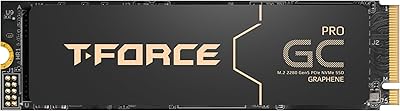
TEAMGROUP T-Force GC PRO 4TB Gen5 NVMe SSD

80%
88%
Sequential Speed Performance
83%
Thermal Management
81%
Sustained Write Consistency
67%
Compatibility & Setup Experience
74%
Value for Money
More
TEAMGROUP QX 4TB Internal SSD
81%
93%
Value for Money
81%
Read Speed Performance
67%
Write Speed & Caching
96%
Storage Capacity
91%
Installation Ease
More
TEAMGROUP MP44L 500GB Gen4 NVMe SSD
78%
88%
Sequential Read Speed
61%
Sustained Write Performance
79%
Thermal Management
91%
Installation & Compatibility
93%
Value for Money
More
TEAMGROUP MP33 2TB NVMe M.2 SSD
78%
93%
Value for Money
86%
Read Performance
67%
Write Performance
94%
Installation Ease
91%
Compatibility
More
PHIXERO PM7450 4TB NVMe SSD
81%
93%
Sequential Read Performance
87%
Sequential Write Performance
61%
QLC Endurance & Longevity
88%
Thermal Management
84%
Burst Write Speed
More
Ediloca EN870 4TB NVMe M.2 SSD
78%
91%
Sequential Read Speed
58%
Sustained Write Performance
93%
PS5 Compatibility
84%
Value for Money
89%
Installation Experience
More
WD_BLACK SN8100 4TB NVMe SSD
82%
97%
Sequential Throughput
93%
Random I/O Performance
61%
Thermal Management
67%
Value for Money
82%
Installation & Compatibility
More
KingSpec XG7000 4TB NVMe SSD
81%
91%
Sequential Read Speed
88%
Sequential Write Speed
83%
Thermal Management
89%
Value for Money
92%
PS5 Compatibility
More
XPG SX8100 4TB NVMe M.2 SSD
72%
93%
Storage Capacity
86%
Sequential Read Speed
67%
Sequential Write Speed
58%
Thermal Performance
84%
Endurance & Longevity
More
WD_BLACK 4TB SN7100 NVMe SSD
87%
94%
Performance (Speed)
92%
Storage Capacity
85%
Power Efficiency
89%
Installation & Setup
91%
Durability & Reliability
More

FAQ

Yes, the MP44Q is compatible with the PS5 storage expansion slot. Just make sure your PS5 firmware is up to date before installation, and note that Sony recommends using a heatsink with any M.2 drive installed in the console — the included graphene label helps, but adding a low-profile heatsink is a good idea for the PS5 enclosure.

It will work physically, but you will not get anywhere near the rated speeds. PCIe 3.0 x4 slots cap NVMe bandwidth well below what this drive is designed for, so you would be paying for Gen 4 performance you cannot actually use. If your system only supports PCIe 3.0, a Gen 3 drive at a lower price point is a smarter buy.

Once the dynamic SLC cache is exhausted during a very large sequential write — think transferring several hundred gigabytes in one go — the drive falls back to writing directly to the QLC NAND, which is noticeably slower. For everyday use, gaming, and typical creative workloads, most users never push past the cache. It mainly matters if you regularly copy massive files in a single session.

For most buyers, no. QLC gets a bad reputation in enthusiast circles, but the real-world impact is minimal unless you are hammering the drive with continuous heavy writes day after day for years. For gaming, media consumption, and general storage duties, the endurance ratings are more than sufficient for the drive's expected lifespan.

It depends on your system. Some older motherboards require a BIOS update to properly detect PCIe 4.0 NVMe drives, and a few budget boards have had compatibility quirks with high-capacity NVMe units. The manufacturer specifically flags this risk, so it is worth checking your board's support page and flashing the latest BIOS before installing, just to avoid headaches.

The drive does not include dedicated cloning software in the box. TEAMGROUP bundles their S.M.A.R.T. health monitoring utility, but for migrating your OS or data from an existing drive, you will need a third-party tool — Macrium Reflect Free or Samsung Data Migration (which works with any drive) are popular free options.

For most desktop builds with decent airflow, the graphene label handles thermals adequately during normal workloads. Where it gets borderline is in tightly packed laptop chassis or in systems doing sustained heavy transfers in warm environments. If you are installing it in a PS5 or a high-load workstation, adding a thin aftermarket heatsink is a low-cost precaution worth taking.

TLC drives generally offer better sustained write speeds and higher write endurance ratings, which matters for workloads involving constant large file writes. The trade-off is that TLC-based 4TB drives typically cost more per gigabyte. If your use case is mostly reads — gaming, media playback, loading large project files — this Gen 4 SSD closes that gap significantly and the QLC distinction becomes far less relevant.

It is listed as compatible with NAS enclosures, but compatibility depends entirely on whether your specific NAS unit has an M.2 slot and supports NVMe drives. Many consumer NAS devices use SATA-based M.2 slots, which are electrically incompatible with NVMe. Check your NAS manufacturer's compatibility list before purchasing to confirm it supports PCIe NVMe M.2 drives.

TEAMGROUP has a generally solid reputation for honoring warranties, and five years is a meaningful coverage window for a storage drive. Keep your purchase receipt and register the product if the manufacturer offers registration, as this simplifies the claims process. As with any warranty, read the terms to understand what voids coverage — physical damage and improper installation are typically excluded.

Where to Buy