Overview

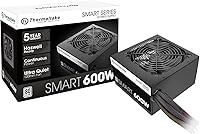
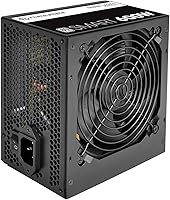
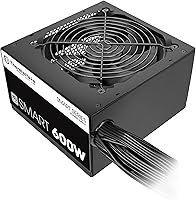
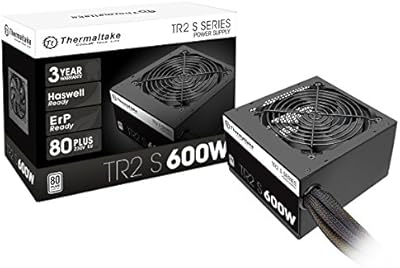
The Thermaltake SMART 600W ATX Power Supply has been a fixture in the budget PC building space since its debut in 2015, and its staying power says something real about what it delivers. Thermaltake is best known for cooling hardware, but this unit carved out its own reputation as a dependable, no-frills option for builders who need certified power without breaking the bank. It holds an 80 Plus certification, which matters — it means the supply runs at 80% or better efficiency under normal load. That said, this is not a high-end enthusiast PSU; it sits squarely in the entry-to-mid-range tier, and expectations should match that.

Features & Benefits

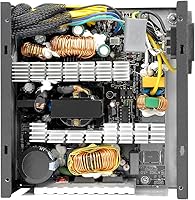
What makes this 600W PSU worth a second look at its price point is the combination of meaningful protections and real-world usability. The Active PFC circuitry cleans up incoming power draw — particularly useful if you run the system on a UPS. Two PCI-E 6+2 pin connectors mean you can run a mid-range GPU like an RX 6600 or RTX 3060 without hunting for adapters. It also checks the boxes for ATX 12V v2.3 and EPS 12V compatibility, so modern motherboards and CPUs won't have issues. Built-in protections against overvoltage, overpower, and short circuits add a layer of confidence. The rated 100,000-hour MTBF is a solid number for this price bracket.

Best For

This Thermaltake unit fits best in builds where efficiency and reliability matter more than cable aesthetics. First-time builders assembling a budget gaming rig or a capable home office PC will find it hits the right balance — enough headroom for a mid-range GPU and CPU without overpaying for wattage you won't use. It also makes sense as a straightforward replacement in an existing ATX mid-tower when the old supply starts acting up. What it is not ideal for: high-end GPU setups pulling north of 400–500W, or builders who want a clean, cable-managed interior. If tidy wire routing is a priority, a modular alternative is the smarter call.

User Feedback

With over 23,000 ratings averaging 4.6 stars, the SMART 600W has earned genuine goodwill from real builders. Buyers frequently highlight how quiet and stable it runs under normal workloads, and installation is almost universally described as painless. Longevity comes up often — plenty of users report two to four years of trouble-free operation. The criticism that appears most consistently is the non-modular cable bundle: there are a lot of unused cables in smaller cases, and managing them takes effort. A smaller but notable group of reviewers mentions early failures, which is worth keeping in mind even if it represents a minority experience. Overall, the satisfaction rate reflects a unit that consistently delivers on its core promise.

Pros

  • 80 Plus certified efficiency means less wasted heat and lower idle power draw under real workloads.
  • Dual PCI-E 6+2 pin connectors handle mid-range GPUs cleanly, no adapters needed.
  • Active PFC improves compatibility with UPS devices — a practical edge many budget PSUs skip.
  • Built-in OVP, OPP, and SCP protections add a meaningful safety net for connected components.
  • A 100,000-hour MTBF rating is genuinely above average for the price bracket.
  • Broad ATX and EPS compliance means it fits a wide range of current motherboards and CPU sockets.
  • Thousands of long-term owners report two to four years of stable, quiet operation.
  • Installation is consistently described as straightforward, even for first-time builders.
  • Fan noise stays low under moderate loads, which matters in quieter home or office environments.
  • Wide retail availability makes it easy to find, buy, and return if needed.

Cons

  • Non-modular cabling means a bundle of unused wires that must be stuffed somewhere in every build.
  • Cable clutter can meaningfully restrict airflow in smaller mid-tower cases.
  • No 80 Plus Gold or higher rating, so efficiency-focused builders are leaving performance on the table.
  • 600W of headroom is tight for modern high-end GPU builds and leaves little room for future upgrades.
  • No PCIe 5.0 power connector support, which newer flagship graphics cards increasingly require.
  • A minority of buyers report early failures, suggesting some unit-level quality consistency issues.
  • Warranty and customer support experiences appear mixed in long-term user reports.
  • The non-modular design adds cable management time that a semi-modular unit would eliminate entirely.

Ratings

The scores below reflect an AI-driven analysis of verified global buyer reviews for the Thermaltake SMART 600W ATX Power Supply, with spam, bot-generated, and incentivized feedback actively filtered out before scoring. Ratings are derived from real purchase experiences across thousands of builds — from first-time budget rigs to home office workstations — capturing both what this unit consistently gets right and where it falls short. Strengths and friction points are weighted equally so the scores give an honest picture of what to expect before you buy.

Value for Money
91%
For builders trying to keep costs down without skipping certification entirely, this 600W PSU delivers a strong return. Buyers repeatedly note that getting 80 Plus efficiency, Active PFC, and industry-standard protections at this price point is difficult to match from a comparably reputable brand.
The value equation only holds if your build stays within mid-range territory. Buyers who later upgraded to high-draw GPUs found themselves replacing this unit sooner than expected, which erodes the long-term cost argument considerably.
Reliability & Longevity
83%
A meaningful share of long-term owners report two to four years of stable, uninterrupted operation across daily-use desktops and light gaming rigs. The 100,000-hour MTBF rating appears to reflect real-world durability for typical mid-range workloads.
A visible minority of reviews describe early failures — sometimes within the first year — which introduces uncertainty for buyers planning a long-term build. Quality consistency across production batches appears to be the weak link rather than the design itself.
Power Stability
86%
Users running productivity workloads and mid-range gaming sessions consistently report clean, stable voltage delivery with no crashes or instability attributed to the PSU. The Active PFC circuitry contributes to steady power delivery especially for systems connected to a UPS.
Under sustained peak loads close to the unit's ceiling — particularly with power-hungry GPUs — some users have noted minor voltage fluctuation concerns. This is less of an issue for typical builds but worth flagging for anyone running near maximum rated output.
Noise Level
84%
At moderate system loads the fan stays quiet enough that most users in home and office environments never notice it. This is a meaningful positive for builders who work or game in quiet rooms and do not want PSU fan noise adding to overall system acoustics.
Under heavy sustained load the fan audibly spins up, which is expected but noticeable compared to premium PSUs with semi-passive fan modes. It is not objectionably loud, but buyers coming from higher-end units may find the difference apparent.
Cable Management
48%
52%
The included cable set covers all the connectors a standard ATX build requires, and cable lengths are generally adequate for mid-tower and full-tower cases. First-time builders appreciate having everything pre-attached with no separate cable sorting required.
The fully non-modular design is the most consistently criticized aspect of this unit. Every unused cable stays permanently attached, creating real cable clutter inside smaller cases and requiring deliberate effort to manage airflow — a frustration that experienced builders call out repeatedly.
Installation Ease
93%
Across thousands of reviews, ease of installation is one of the most uniformly praised qualities of the SMART 600W. The standard ATX form factor, clear labeling, and pre-attached cables mean most first-time builders get it seated and connected without any confusion.
The non-modular cable bundle does add some complexity during the cable management phase of installation, particularly in compact cases where there is limited room to tuck away extras. It is not a barrier, but it does slow down the finishing process.
Efficiency
79%
21%
The 80 Plus certification ensures the unit runs at 80% or better efficiency under normal load, which meaningfully reduces heat output and keeps electricity consumption reasonable for an entry-level supply. This is a genuine differentiator over uncertified budget alternatives.
The base 80 Plus tier sits at the lower end of the efficiency spectrum — Gold and Platinum certified units offer noticeably better efficiency, particularly at lighter loads. For systems running 24/7 or in regions with high electricity costs, the difference in operating cost adds up over time.
Component Protection
88%
OVP, OPP, and SCP protections are all present and documented, which gives builders reasonable confidence that a power event will not cascade into damaged motherboard or GPU components. Users who have experienced power anomalies report the protections responding correctly.
The protection suite covers the essentials but does not include Under Voltage Protection (UVP) or Over Temperature Protection (OTP) found on some competing units at a slightly higher price. For most home builds this gap is inconsequential, but it is worth noting for demanding environments.
GPU Compatibility
77%
23%
Two 6+2 pin PCI-E connectors cover mid-range GPUs cleanly, and buyers running cards like the RTX 3060 or RX 6700 XT report no power delivery issues whatsoever. No adapters are needed, and the connector fit is described as solid and secure.
Modern high-end GPUs increasingly require more than two PCI-E connectors or PCIe 5.0 connectors not present here, making this unit incompatible with the latest flagship cards without adapter workarounds — which are themselves a risk factor for power delivery stability.
Build Quality
74%
26%
The unit feels appropriately solid for its price tier, with a standard steel housing and connector quality that holds up through normal installation and occasional system moves. The connectors seat firmly and do not feel flimsy in day-to-day use.
Compared to higher-end PSUs, the casing finish and internal component quality are clearly a step down. A subset of long-term users report that external build quality does not fully match the durability implied by the MTBF rating, particularly around cable sleeve quality over time.
UPS Compatibility
87%
Active PFC makes this 600W PSU compatible with most UPS units on the market, including simulated sine wave models that trip up PSUs lacking PFC. This is a practical advantage for home office setups or anyone who takes power continuity seriously.
Active PFC compatibility is a feature many buyers never actively test until a power event occurs, so user feedback on this specific point is thinner than for other categories. It is nonetheless a documented and verifiable advantage over non-PFC budget alternatives.
Wattage Headroom
61%
39%
For builds drawing 350 to 450W at peak — covering the majority of mid-range gaming and productivity configurations — 600W provides comfortable headroom without wasteful oversizing. The unit handles sustained loads in this range without audible stress.
Six hundred watts sounds generous until you spec a high-end GPU into the mix. Builders with upgrade ambitions who want to move to a more powerful card in a year or two may find themselves PSU shopping again sooner than expected, which undermines the initial savings.
Brand Reputation
82%
18%
Thermaltake has been a recognized name in PC components for decades, and buyers draw real confidence from that familiarity when shopping in a crowded budget PSU market. Wide retail availability and established support channels reduce purchase anxiety for less experienced builders.
Brand recognition does not fully insulate buyers from the unit-level inconsistency noted in some reviews. Thermaltake's reputation is built more strongly on cooling products, and this PSU, while solid, does not rank among the brand's most celebrated releases among hardware enthusiasts.
Warranty & Support
63%
37%
The unit is backed by Thermaltake's standard warranty, and the brand's support infrastructure is accessible through major retail channels. Buyers who contacted support for straightforward issues report reasonably responsive service in most cases.
Warranty and support experiences are mixed in the long-form review pool, with some buyers describing difficulty getting timely resolution on failed units. The inconsistency in support quality is a recurring secondary complaint that slightly undermines confidence in post-purchase coverage.

Suitable for:

The Thermaltake SMART 600W ATX Power Supply is a practical, well-matched choice for budget-conscious builders who need a certified, reliable power source without overcomplicating their purchase. It fits naturally into first-time builds centered around mid-range components — think a Ryzen 5 or Core i5 paired with a GPU like an RTX 3060 or RX 6700, where actual system draw sits comfortably under 450W. Home office setups and general-purpose desktops will get everything they need from this unit, with capacity to spare. It also makes a smart, low-risk replacement for a dying PSU in an existing ATX tower, since the standard form factor and broad connector compatibility mean it drops in without surprises. If you run your system on a UPS, the Active PFC circuitry is a genuine bonus, ensuring cleaner power interaction with battery-backed units. Buyers who value brand familiarity and wide retail availability over premium features will find this 600W PSU easy to source, install, and trust.

Not suitable for:

The Thermaltake SMART 600W ATX Power Supply has a clear ceiling, and pushing past it is where buyers run into trouble. If you are building or upgrading to a system with a high-draw GPU — an RTX 4080, RTX 4090, or any card requiring more than 300W on its own — this unit does not provide the headroom or the connector density to do the job properly. Enthusiast and workstation builders who prioritize tight cable management will find the fully non-modular harness a real frustration, particularly in compact mid-towers where unused cables become a genuine airflow problem. This 600W PSU also lacks the higher efficiency tiers (Gold, Platinum) that serious power users look for when optimizing long-term electricity costs. It has no modular or semi-modular design, no 80 Plus Gold or above rating, and no support for newer PCIe 5.0 power connectors required by the latest flagship GPUs. If any of those factors matter to your build, spending more on a purpose-matched supply is the right call.

Specifications

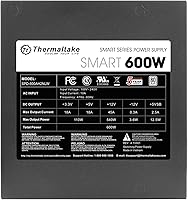
  • Output Power: Delivers 600W of continuous power at 40°C ambient temperature, ensuring stable output under real-world thermal conditions.
  • Efficiency: Carries 80 Plus certification, guaranteeing at least 80% energy efficiency under typical load to reduce heat output and operating costs.
  • Form Factor: Follows the ATX12V and EPS12V form factor standards, fitting standard ATX mid-tower and full-tower PC cases.
  • ATX Standard: Compliant with ATX 12V v2.3 and EPS 12V v2.92, ensuring compatibility with modern motherboards and CPU power requirements.
  • PCI-E Connectors: Includes two 6+2 pin PCI-E connectors, supporting a broad range of mid-range discrete graphics cards without requiring third-party adapters.
  • Power Factor: Active Power Factor Correction (Active PFC) improves power quality and ensures stable compatibility with most uninterruptible power supply (UPS) units.
  • Protections: Equipped with Over Voltage Protection (OVP), Over Power Protection (OPP), and Short Circuit Protection (SCP) to safeguard system components from electrical faults.
  • MTBF: Rated at a mean time between failures of 100,000 hours, indicating above-average reliability expectations for a unit in this price tier.
  • Hold-Up Time: Maintains a minimum hold-up time of 16 milliseconds at 60% load, providing brief power continuity during minor input disruptions.
  • Input Voltage: Designed for 120V input, intended for standard North American residential and office electrical outlets.
  • Input Frequency: Accepts input frequencies of 50 to 60 Hz, covering standard electrical grid frequencies used across North America.
  • Cable Management: Uses a fully non-modular cable harness, meaning all cables are permanently attached and cannot be removed when not in use.
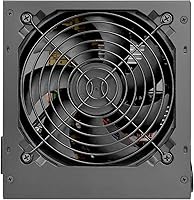
  • Cooling: Relies on air cooling via an internal fan to manage heat generated during operation.
  • Dimensions: Measures 8.9 x 4 x 7 inches (L x W x H), matching standard ATX power supply dimensions for broad case compatibility.
  • Weight: Weighs 2.2 pounds, which is typical for a non-modular ATX unit in this wattage class.
  • Power Good Signal: Outputs a power good signal within a 100 to 500 millisecond window, meeting standard ATX timing requirements for system startup stability.
  • First Available: Originally released in September 2015, giving this unit over a decade of market presence and a well-established user reliability record.

Related Reviews
Thermaltake Smart BM3 650W Power Supply
83%
88%
Value for Money
79%
Cable Management
91%
Noise Level
84%
Build Quality
93%
ATX 3.0 and PCIe 5.0 Compatibility
More
Apevia ATX-ES600W Essence 600W ATX Semi-Modular Power Supply
85%
88%
Value for Money
84%
Performance under Load
87%
Cooling Efficiency
90%
Cable Management Ease
82%
Build Quality
More
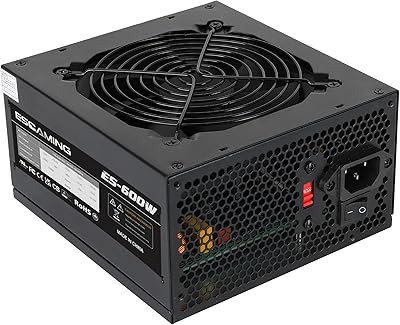
ESGAMING 600W ATX Power Supply PSU
85%
88%
Performance & Reliability
84%
Setup & Installation
92%
Noise Levels
70%
Cable Management
85%
Build Quality
More
KYLINTEC 600W Power Supply ATX PSU
81%
90%
Ease of Installation
85%
Cooling Performance
88%
Power Stability
75%
Cable Management
80%
Build Quality
More
Thermaltake TR2 S 600W ATX Power Supply
76%
88%
Overall Reliability
84%
Value for Money
86%
Noise Level
61%
Cable Management
79%
Energy Efficiency
More
Thermaltake Smart BM3 750W Semi-Modular PSU
82%
88%
Value for Money
83%
Build Quality
86%
Noise Level
79%
Cable Management
92%
ATX 3.0 & PCIe 5.0 Compatibility
More
Thermaltake Smart BM3 850W Power Supply
88%
88%
Value for Money
90%
Build Quality & Durability
85%
Energy Efficiency (80Plus Certification)
91%
Noise Levels & Fan Performance
87%
Ease of Installation
More
Thermaltake Smart 500W ATX Power Supply
79%
91%
Value for Money
84%
Reliability & Longevity
93%
Installation Ease
88%
Noise Level
58%
Cable Length & Management
More
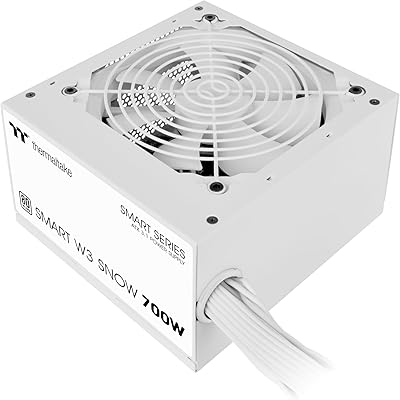
Thermaltake Smart W3 700W ATX Power Supply
82%
91%
Value for Money
84%
Build Quality
88%
Noise Level
76%
Cable Management
93%
ATX v3.1 Compatibility
More
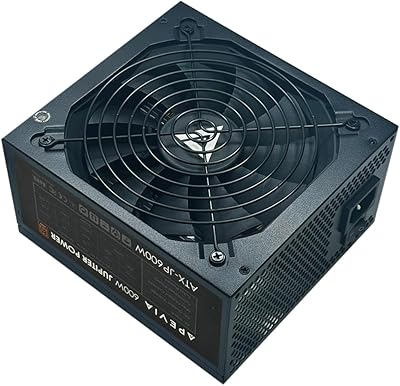
Apevia ATX-JP600W Jupiter 600W Power Supply
87%
89%
Performance
93%
Power Efficiency
85%
Cooling Efficiency
88%
Build Quality
87%
Cable Management
More

FAQ

Yes, for a mid-range build with one of those GPUs paired with a Ryzen 5 or Core i5, you will be well within safe operating range. Typical system draw for that kind of setup sits between 300 and 400W under full load, leaving comfortable headroom. The two PCI-E 6+2 pin connectors also mean your GPU will plug in directly without needing any adapters.

Yes, and this is actually one of the more underappreciated features of this unit. The Active PFC circuitry makes it compatible with most UPS devices, including simulated sine wave models. Many cheaper PSUs lack Active PFC and can behave unpredictably or even fail when paired with a UPS, so this is a meaningful plus.

It depends on your GPU. For mid-range cards, 600W is perfectly adequate. However, if you are planning to run a high-end GPU like an RTX 4080 or 4090, you will need significantly more wattage. This unit is a strong fit for builds where the GPU draws 200 to 300W or less under peak load.

Most users find it quietly unobtrusive under everyday workloads. At moderate system loads — browsing, office work, light gaming — the fan runs at low speed and is rarely noticeable. Under sustained heavy load it will spin up, but it is generally not considered loud for its class.

Yes, it includes a full set of non-modular cables covering the 24-pin ATX motherboard connector, CPU EPS power, PCI-E connectors for your GPU, SATA connectors for drives, and Molex connectors for older peripherals. The downside is that any cables you do not use will still be attached and will need to be managed inside the case.

It means every cable is permanently attached to the PSU — you cannot remove the ones you do not need. In a large full-tower case with plenty of space for cable management this is a minor inconvenience. In a smaller mid-tower, it can get messy, and unused cables need to be bundled and tucked away to avoid blocking airflow. If a clean interior is important to you, a semi-modular or fully modular PSU is worth the extra investment.

Yes, it works with both. Compliance with ATX 12V v2.3 and EPS 12V v2.92 standards means it covers the power connector requirements for current Intel and AMD motherboards and CPUs, including mainstream LGA and AM5 platforms. Just confirm your motherboard uses a standard 24-pin ATX and 8-pin EPS connector, which virtually all modern boards do.

The track record across tens of thousands of user reviews is generally positive. A significant portion of buyers report using this 600W PSU trouble-free for two to four years or longer. That said, like any mass-market unit, there is a small percentage of early failure reports in the review pool. The 100,000-hour MTBF rating is a reasonable indicator of intended durability for a budget-tier supply.

It includes Over Voltage Protection (OVP), Over Power Protection (OPP), and Short Circuit Protection (SCP). Together, these guard against the most common electrical fault scenarios — voltage spikes, overloading the unit, and direct short circuits. These are standard industry protections, and their presence at this price point is a genuine plus for component safety.

Yes, the cable set includes multiple SATA and Molex connectors in addition to the primary GPU and motherboard connectors, so powering two or more drives, case fans, and other peripherals is not a problem. Dual monitors are powered by the GPU itself, not the PSU directly, so as long as your GPU supports it, monitor count is not a limiting factor here.

Where to Buy