Overview

The Sodola SL902-SWTG124AS 6-Port 2.5G Managed Switch arrived in February 2025 and has already cracked the top 100 networking switches on Amazon — a fast rise that reflects genuine demand, not marketing hype. For home lab builders and prosumer users, this 2.5G managed switch offers a compelling entry point: real management capabilities like VLANs, QoS, and link aggregation, all without ever touching a command line. The fanless aluminum alloy build sets it apart from the plastic unmanaged switches that dominate this price tier. Just keep expectations calibrated — it's a prosumer-grade device, not an enterprise rack unit.
Features & Benefits

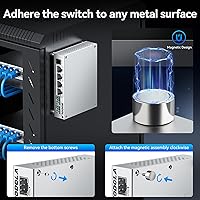
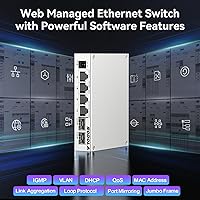
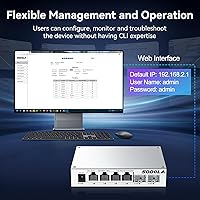
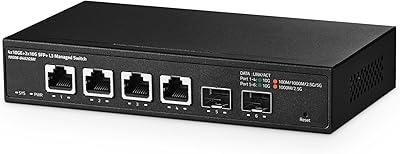
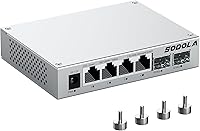
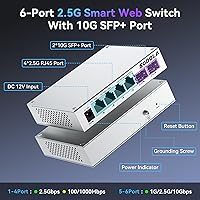
Four 2.5GbE RJ45 ports and two 10G SFP+ uplinks give this multi-gig switch a useful topology: connect NAS boxes, workstations, and a Wi-Fi 6 access point on the copper side, then push traffic upstream at 10G through the SFP+ ports. The web-based management interface handles 802.1Q VLAN tagging, LACP bonding, QoS prioritization, and IGMP snooping — no command line needed. Setting up a dedicated VLAN for IoT devices or prioritizing a gaming PC is a realistic task for someone with basic networking knowledge. Physically, the switch is compact and under 12 ounces; the magnetic mounting pads let it attach directly to metal surfaces. Auto-negotiation keeps 1G and 100M devices working without forced upgrades. One important note: no PoE on any port.

Best For

This 2.5G managed switch makes the most sense for home lab users who have outgrown their unmanaged gigabit switch and want real network segmentation without a much pricier alternative. If you already have a 2.5G NAS and a Wi-Fi 6 router with a 2.5G port, the Sodola 6-port switch is the natural link between those devices and your workstations. The dual 10G SFP+ uplinks are a real bonus for anyone connecting to a core switch or upstream router at full 10G. It is also well-suited to noise-sensitive spaces — bedrooms, media rooms, office nooks — where a fan-cooled switch would be distracting. Not the right call for anyone needing PoE-powered devices or deep SNMP-level monitoring.

User Feedback

Across more than 330 ratings, this multi-gig switch holds a 4.3-star average — a solid result for a brand that only entered Western markets earlier this year. Buyers consistently praise the easy web interface setup and the tangible speed boost when moving files to a 2.5G NAS or from a fast workstation. The aluminum build quality earns positive mentions too, with many noting it feels more premium than expected. On the flip side, documentation is considered sparse, and users familiar with Netgear or TP-Link managed lines will notice a shallower advanced feature set. SFP+ transceiver compatibility with third-party modules is reported as mostly working but not guaranteed — confirm your specific optic before buying. Long-term heat management appears unproblematic for typical home lab workloads.

Pros

  • Web GUI covers VLAN tagging, QoS, LACP, and IGMP snooping without requiring any command-line experience.
  • Dual 10G SFP+ uplinks prevent upstream bandwidth from becoming a bottleneck in multi-gig home lab setups.
  • Fanless aluminum chassis runs completely silent — ideal for bedrooms, living rooms, and media cabinet installations.
  • Magnetic mounting pads and rubber feet give genuinely flexible placement on metal surfaces or standard desks.
  • Auto-negotiation keeps existing 1G and 100M devices working, so there is no forced equipment overhaul on day one.
  • Buyers consistently report tangible speed improvements when moving large files between 2.5G NAS units and workstations.
  • Rated 4.3 stars across more than 330 reviews, reflecting strong real-world satisfaction for an entry-level managed switch.
  • Energy Efficient Ethernet (802.3az) trims idle power consumption, a meaningful saving for devices running around the clock.
  • Compact footprint and sub-12-ounce weight make it easy to tuck into tight spaces or cable-managed enclosures.

Cons

  • No PoE on any port — anyone needing to power access points or IP cameras directly must look elsewhere.
  • Documentation is thin and setup guides lack the depth needed for troubleshooting less common configurations.
  • Advanced management features are shallower than established managed lines from Netgear, TP-Link, or Ubiquiti.
  • Third-party SFP+ transceiver compatibility is not guaranteed; confirm your specific optic works before committing.
  • Support resources and community forums are limited since the brand is still building its presence in Western markets.
  • Only four copper RJ45 ports — a busier home lab or small office could outgrow that count fairly quickly.
  • No SNMP support rules out integration with professional network monitoring platforms like PRTG or LibreNMS.
  • The web interface is functional but basic, and lacks the polish or feature depth of more mature vendor platforms.
  • No rack-mount ears or mounting hardware included, making standard 19-inch rack installation inconvenient without adapters.

Ratings

The Sodola SL902-SWTG124AS 6-Port 2.5G Managed Switch has been scored across 15 categories by our AI review engine, which analyzed verified buyer feedback from multiple global markets while actively filtering out incentivized, bot-generated, and duplicate submissions. Scores reflect the honest consensus of real users — including both the aspects buyers consistently praise and the recurring frustrations that surface across independent reviews. Each category rating transparently balances genuine strengths against documented shortcomings, so you can make a buying decision grounded in real-world experience rather than marketing claims.
Value for Money
91%
For anyone upgrading from an unmanaged gigabit switch, the feature set here — VLANs, QoS, LACP, and 10G SFP+ uplinks — at this price point is genuinely hard to match. Buyers consistently note that comparable managed multi-gig switches from established brands cost significantly more for similar core functionality.
The value calculation assumes you have no need for PoE, since adding a separate PoE injector or switch to fill that gap will quickly erode the savings. Buyers who factor in the cost of sourcing compatible SFP+ modules separately may find the effective price slightly higher than the sticker suggests.
Build Quality
88%
The aluminum alloy chassis genuinely impresses buyers at this price tier — it feels more substantial than the thin plastic shells common on budget switches, and multiple users note the finish holds up well after months of continuous operation. The fanless design also removes the most common long-term mechanical failure point.
A handful of users have noted that port connectors feel slightly less snug than those on premium-brand switches, suggesting component tolerances may vary between manufacturing batches. Long-term durability data is also limited given the product only became widely available in early 2025.
Web Management Interface
83%
The web GUI handles VLAN tagging, QoS rules, and LACP bonding through a reasonably intuitive interface that prosumer users — even those without CLI experience — can navigate without consulting a manual. Users setting up a dedicated IoT VLAN or prioritizing a gaming PC find the process logically laid out.
The interface lacks the polish and feature depth of established platforms like TP-Link's managed web UI or Netgear's Smart interface, and some advanced settings feel buried or underdocumented. Users wanting detailed traffic monitoring dashboards or per-port statistics graphs will find the interface notably spartan.
Port Performance
87%
Buyers with 2.5G-capable NAS units report real, tangible improvements — large file transfers that previously crawled at gigabit speeds now sustain rates approaching 250 to 290 MB/s in practice. The speed boost is immediately perceptible when backing up large media libraries or moving project files between workstations.
Performance gains are only realized when both endpoints support 2.5GbE — buyers without upgraded adapters in their computers or NAS units will see no speed benefit at all. A small number of users have also reported occasional link stability quirks when mixing 2.5G and legacy 1G devices under heavy load.
Advanced Feature Depth
58%
42%
For the prosumer and home lab scenarios this switch targets, the available feature set — VLANs, QoS, LACP, IGMP snooping — covers the majority of real-world configurations a non-enterprise user would actually need. Buyers who require exactly these features and nothing more consistently report satisfaction.
Users familiar with Netgear's Plus or Smart managed lines, or with Ubiquiti's EdgeSwitch platform, will quickly notice the absence of SNMP support, detailed traffic analytics, advanced ACL configurations, and CLI access for scripted management. This is a genuine ceiling for anyone whose network requirements grow beyond basic prosumer management.
SFP+ Uplink Capability
79%
21%
Having two 10G SFP+ uplinks at this price gives home lab users a genuine path to a 10G core router or switch, preventing the upstream bottleneck that would otherwise emerge when all four 2.5G copper ports are active simultaneously. Users connecting to mainstream 10G routers report these ports working cleanly.
Third-party SFP+ transceiver compatibility is not guaranteed, and a meaningful subset of users report that specific modules — particularly certain brand-name fiber optics — are not recognized without workarounds. Buyers planning to use non-standard or niche transceivers should verify compatibility before committing.
VLAN & Segmentation
81%
19%
The 802.1Q VLAN implementation works reliably for the core scenarios buyers bring to this switch: separating IoT devices from the main LAN, isolating a guest network, or segmenting a home lab into distinct broadcast domains. Users report that creating and assigning tagged and untagged VLANs is intuitive compared to CLI-based alternatives.
The VLAN feature set is prosumer-grade rather than enterprise-grade — advanced scenarios like asymmetric VLAN routing, complex trunk configurations, or RADIUS-based port access control will quickly expose the switch's limitations. Users migrating from higher-end Cisco or Ubiquiti environments will notice meaningful gaps in flexibility.
QoS Prioritization
76%
24%
QoS configuration through the web GUI lets users prioritize a gaming PC, a video conferencing workstation, or a VoIP adapter without any command-line involvement — exactly what this switch's target audience needs. The feature works reliably for straightforward traffic prioritization in small office and home lab environments.
The QoS implementation is basic compared to what dedicated QoS platforms or enterprise switches offer — granular per-application traffic shaping, deep packet inspection, and DSCP remarking are not available here. For users with simple prioritization goals it is sufficient, but power users will find it limiting quickly.
Thermal Management
92%
The fanless passive cooling design earns consistent praise from users who place this multi-gig switch in noise-sensitive spaces — bedrooms, home theater rooms, and quiet home offices. Even under sustained multi-port load, buyers report the aluminum chassis stays warm but never uncomfortably hot or throttled.
In unusually warm environments or densely enclosed cabinet installations without adequate airflow, the aluminum chassis can run noticeably warm to the touch, with no active cooling to compensate. Users running all ports at sustained high throughput inside a hot server closet should ensure some passive airflow is available.
Physical Design
84%
The magnetic mounting system earns genuine appreciation from users who attach the switch to the side of a metal rack, under a desk frame, or on a steel equipment shelf — it holds securely without drilling or cable ties. The compact footprint also slots into spaces where a full rack-mounted switch simply would not fit.
No rack-mount ears are included, so fitting this into a standard 19-inch rack requires sourcing a third-party adapter, which adds cost and effort. The small footprint means only four copper ports are available, which some growing home labs find limiting sooner than expected.
Backward Compatibility
94%
Auto-negotiation on every RJ45 port ensures that older gigabit and fast Ethernet devices connect and operate normally without any manual configuration changes, which buyers appreciate when running a mixed-speed network during a gradual hardware upgrade cycle. No existing devices need to be replaced just to introduce this switch.
A small number of users have reported that certain very old or non-standard network cards occasionally negotiate to an unexpected speed, requiring a manual port-speed override in the web interface — a minor inconvenience that most users will never encounter. No widespread issues with standard 1G or 100M hardware have been reported.
Documentation & Support
52%
48%
The basic setup process is intuitive enough that most buyers get the switch online and into the web GUI without ever consulting the manual, which reduces the practical impact of the documentation gap for simple deployments. Some buyers have also found helpful configuration guides shared by community members in networking forums.
The included manual is widely described as sparse, and Sodola's online support resources for Western markets are thin compared to what Netgear, TP-Link, or Ubiquiti provide. Users who encounter less common scenarios — troubleshooting SFP+ recognition or configuring complex LACP topologies — often report having to work things out through trial and error.
Transceiver Compatibility
67%
33%
The majority of commonly available generic 10G SFP+ DAC cables and standard LC fiber modules function correctly in the uplink ports, covering the most typical home lab uplink scenarios without any special effort. Users connecting to mainstream routers and core switches with standard SFP+ interfaces report no issues.
Compatibility with brand-specific or less common SFP+ optics is inconsistent — some users report modules simply not being recognized without clear error messaging, making troubleshooting frustrating. The absence of a published compatibility list from the manufacturer compounds this uncertainty for buyers with non-standard optical infrastructure.
Energy Efficiency
86%
The 802.3az Energy Efficient Ethernet implementation works transparently — ports automatically reduce power consumption during idle periods without any manual configuration or performance trade-off, which users running the switch around the clock appreciate over time. It is a small but meaningful feature for a device that rarely gets powered off.
Total power draw figures under full load are not prominently published, making it difficult for users building power-budgeted home lab setups to accurately estimate running costs. Energy savings are most noticeable in low-traffic environments; high-throughput deployments with all ports consistently active will see limited idle-state benefits.
Setup Experience
82%
18%
First-time setup consistently draws positive feedback — buyers plug in the switch, locate the default IP address, and reach the web GUI within minutes, without needing serial console access or any pre-configuration steps. For users upgrading from unmanaged switches, the initial onboarding experience is a welcome improvement.
Users attempting more advanced initial configurations — such as setting up a management VLAN that isolates the switch's own IP — report the sequence of operations is not always intuitive and can accidentally lock out web access if done in the wrong order. Better guided setup wizards or clearer step-by-step documentation would meaningfully reduce this risk.

Suitable for:

The Sodola SL902-SWTG124AS 6-Port 2.5G Managed Switch is a strong fit for home lab enthusiasts and prosumer network builders who are ready to move beyond basic gigabit switching but have no interest in wrestling with a command-line interface. If you already own 2.5G-capable gear — a NAS, a Wi-Fi 6 access point, or a PCIe network adapter — this switch is the logical hub that lets those devices actually communicate at full speed rather than being bottlenecked by a legacy gigabit link. The web-based GUI makes practical tasks like tagging VLANs to isolate IoT traffic, applying QoS rules to prioritize a gaming PC, or configuring LACP bonding genuinely accessible to someone who understands basic networking concepts but has never touched a CLI. The dual 10G SFP+ uplinks add real value for anyone with a router or core switch that has 10G ports, since upstream traffic won't become the chokepoint. Its completely silent, fanless operation and magnetic mounting options make it equally well-suited for media rooms, bedroom desks, and home office cabinets where fan noise simply isn't acceptable.
Not suitable for:

The Sodola SL902-SWTG124AS 6-Port 2.5G Managed Switch is not the right choice if Power over Ethernet is anywhere on your requirements list — there is no PoE on any port, which immediately rules it out for anyone planning to directly power IP cameras, wireless access points, or VoIP phones through the switch. Buyers who need robust network monitoring will also hit a wall: without SNMP support, integrating this device into tools like PRTG or LibreNMS is not a realistic option. The feature set is real but deliberately simplified for prosumer use, so the granular CLI control, advanced security policies, and deep protocol support found on enterprise-grade Cisco or Juniper hardware simply do not exist here. Third-party SFP+ transceiver compatibility is not guaranteed across the board, making it a riskier choice for anyone who needs to use specific optical modules in a mixed-vendor environment. Finally, if you're coming from a well-documented Netgear or TP-Link managed switch and rely on thorough setup guides or an active community forum, the comparatively sparse documentation and limited Western-market support resources for this brand may prove frustrating.
Specifications

  • RJ45 Ports: Four 2.5GbE RJ45 ports with auto-negotiation supporting 100M, 1G, and 2.5G connection speeds on each port.
  • SFP+ Ports: Two 10G SFP+ uplink ports compatible with standard SFP+ modules for fiber or DAC cable connections.
  • Management: Fully web-based GUI management accessible from any browser on the local network, with no command-line interface required.
  • Protocols: Supports 802.1Q VLAN tagging, LACP link aggregation, QoS traffic prioritization, and IGMP snooping.
  • VLAN Support: 802.1Q port-based and tagged VLAN segmentation is configurable directly through the web management interface.
  • Link Aggregation: LACP (802.3ad) allows combining multiple ports for increased aggregate throughput or active-passive failover redundancy.
  • QoS: Quality of Service prioritization can be applied per port or per traffic class to favor latency-sensitive devices and applications.
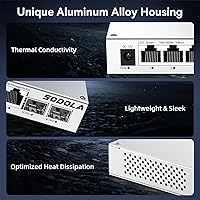
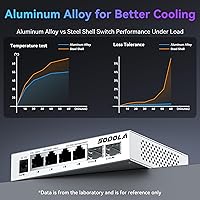
  • Chassis Material: Full aluminum alloy construction dissipates heat passively and provides a more rigid, durable enclosure than typical plastic housings at this price tier.
  • Cooling: Fanless passive thermal design produces zero operational noise and contains no moving parts that could wear out over time.
  • Mounting Options: Includes four magnetic mounting pads for secure attachment to steel or metal surfaces and rubber feet for standard desktop use.
  • Dimensions: The unit measures 7.2 x 4.88 x 3.27 inches, keeping it compact enough for tight spaces and unconventional installations.
  • Weight: At 11.7 oz, the switch is light enough to be held securely by the included magnetic pads on vertical metal surfaces.
  • Power Standard: 802.3az Energy Efficient Ethernet automatically reduces power draw during low-traffic and idle periods.
  • PoE Support: No Power over Ethernet is available on any port; all connected devices must be independently powered.
  • Model Number: The official model identifier is SL902-SWTG124AS, manufactured by Shenzhen hongyavision Technology Co., Ltd.

Related Reviews

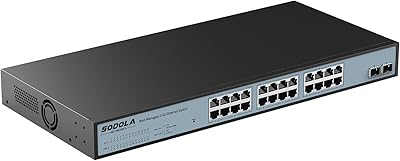
Sodola 24-Port 2.5G Managed Network Switch
80%
91%
Network Performance
88%
Build Quality
63%
Setup Experience
76%
Web Management Interface
89%
Value for Money
More
ienRon 6-Port 2.5Gb PoE Switch with 2-Port 10Gb SFP+
85%
86%
Performance
91%
Ease of Setup
88%
PoE Power Delivery
84%
Build Quality
93%
Fanless Operation
More
Sodola 48-Port 2.5GbE L3 Managed Switch
71%
94%
Port Density & Speed
91%
Value for Money
88%
Uplink Flexibility
86%
Layer 3 Feature Set
52%
Ease of Setup
More
VIMIN 6-Port 2.5G Unmanaged Network Switch
83%
88%
Throughput Performance
84%
Build Quality
93%
Setup & Ease of Use
67%
SFP+ Port Usability
96%
Fanless Noise Level
More
Vimin 6-Port 2.5G/10G Unmanaged Network Switch
79%
94%
Ease of Setup
86%
Network Performance
83%
Value for Money
88%
Port Configuration
67%
Thermal Management
More
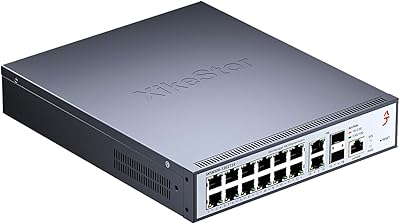
XikeStor SKS8300 16-Port 2.5G L3 Managed Switch
73%
88%
Value for Money
91%
Port Configuration
83%
Layer 3 Routing Capability
89%
Switching Performance
62%
Web Interface Usability
More
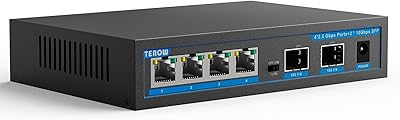
TEROW 4-Port 2.5G 2-Port SFP+ Network Switch
81%
93%
Value for Money
96%
Ease of Setup
88%
Port Performance & Link Stability
71%
SFP+ Port Compatibility
84%
Build Quality & Materials
More
Binardat 6-Port 10G L3 Managed Switch
77%
91%
10G Port Performance
88%
Multi-Speed Compatibility
84%
L3 Feature Depth
89%
Value for Money
77%
Web Management Interface
More
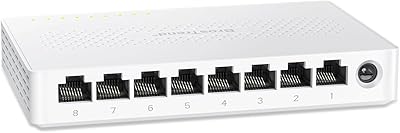
BrosTrend 8-Port 2.5G Unmanaged Switch
83%
93%
Port Speed Consistency
96%
Ease of Setup
61%
Build Quality
74%
Thermal Performance
91%
Value for Money
More
VIMIN 10-Port 2.5G Unmanaged Switch
79%
96%
Ease of Setup
89%
Port Performance
84%
Build Quality
67%
Thermal Management
71%
SFP Uplink Usability
More

FAQ

No software installation needed. The Sodola SL902-SWTG124AS 6-Port 2.5G Managed Switch has a built-in web interface you reach by entering the switch's IP address into any browser on the same network. Most buyers report having it up and accessible within a few minutes of the first power-on.
Yes, every RJ45 port auto-negotiates down to 1G or 100M, so existing devices connect without any configuration changes. You only see 2.5G speeds on devices that actually support 2.5GbE — but nothing breaks or requires manual adjustment for the slower gear.

No — this switch has no PoE support on any port, so it cannot deliver power over an Ethernet cable. If powering a wireless AP, IP camera, or VoIP phone through the cable is a requirement, you will need to specifically look for a switch with PoE or PoE+ listed as a feature.

With both your NAS and your computer equipped with 2.5GbE adapters, you can realistically expect sustained file transfer speeds in the range of 250 to 300 MB/s, compared to the roughly 115 MB/s ceiling on a gigabit connection. That translates to a large media library or full backup moving in noticeably less time, not just a benchmark number.

It is more approachable than most managed switches at this level. The web interface uses port assignment tables and dropdown menus for 802.1Q VLAN configuration — no command syntax to memorize. If you understand the basic idea of keeping your IoT devices on a separate network from your main computers, you have enough foundation to get it working.

Many standard SFP+ modules work fine, but compatibility is not universally guaranteed across all brands and types. Buyers have reported success with generic and common-brand optics, while more obscure modules may not be recognized. If you have a specific transceiver in mind, it is worth checking networking community forums or contacting the seller before purchasing.

It is completely silent. The chassis is fanless, which means no fan hum, no airflow noise, and no vibration. The aluminum body handles heat passively. Multiple buyers have mentioned placing it in bedrooms and living rooms without any noise concerns.

Yes, LACP link aggregation is supported and configurable through the web interface. You can bond two ports to a NAS or server to increase effective bandwidth or set them up for active-passive failover so the connection stays live if one link goes down. It is one of the more practical managed features available at this price.

The switch weighs under 12 oz, and the four magnetic pads provide enough holding force to keep it secure on standard steel surfaces — including rack side panels, metal desk frames, and equipment shelves. Under normal conditions and without physical impact, it holds reliably in both horizontal and vertical orientations.

Sodola is relatively new to Western markets, but the real-world feedback is encouraging: more than 330 buyers have rated this multi-gig switch and it holds a 4.3-star average, which is a meaningful signal for a network device. The fanless, all-aluminum design also removes the most common long-term failure points — fans and plastic degradation. That said, if brand longevity, domestic warranty service, or an established support community are priorities for you, well-entrenched names like Netgear or TP-Link offer a more mature ecosystem.