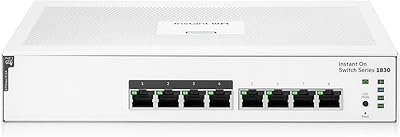
Sodola 48-Port 2.5GbE L3 Managed Switch

Overview
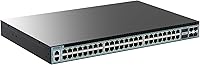
The Sodola 48-Port 2.5GbE L3 Managed Switch represents a compelling option for network builders who've outgrown 1GbE but aren't ready to pay Cisco prices for 10GbE density. Sodola is an ODM brand from Shenzhen — not a household name in networking — but this 48-port multi-gig switch punches well above what the price tag might suggest. The Layer 3 routing capability alone separates it from the vast majority of affordable switches, which top out at Layer 2. Fitting all of this into a compact 1U chassis makes it practical for space-constrained rack builds, home labs, and small server rooms that need real routing without a separate router appliance.
Features & Benefits
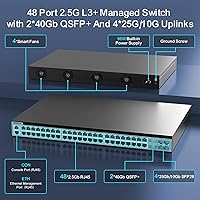
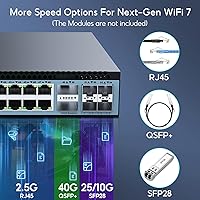
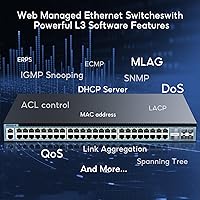
The 48 x 2.5GbE copper ports are the headline — connecting Wi-Fi 6 APs, NAS devices, or workstations at 2.5 Gbps removes the bottleneck a standard gigabit port creates when bandwidth demands spike. For uplinks, the Sodola L3 switch offers four 25G SFP28 and two 40G QSFP+ slots, enough to feed a spine or aggregation layer without saturation. The Layer 3 engine supports real inter-VLAN routing with up to 56K route entries, and MLAG support — letting two switches act as one for redundancy — is a feature you'd normally pay considerably more for. Power draw tops out at a modest 96W, which matters when budgeting rack PDU capacity.
Best For
This managed multi-gig switch hits a specific sweet spot that's hard to find at this price point. Wi-Fi 6 and 6E deployments are the most obvious fit — modern APs routinely saturate a 1GbE uplink, and having 2.5GbE per port means the switch stops being the weak link. Hyper-converged infrastructure builders will appreciate the overlay protocol support (VXLAN, NVGRE, GENEVE) for east-west virtualization traffic. Network engineers who want enterprise-grade features — PFC, ECN, SDN APIs — without signing a Cisco enterprise agreement will find real value here. That said, this is not the right call for buyers who prioritize long-term vendor support, predictable firmware cadence, or tightly integrated ecosystem tooling.
User Feedback
Across a healthy number of buyer reviews, the price-to-port ratio draws the most consistent praise — it's hard to find 48 managed multi-gig ports with real Layer 3 features at this price tier. Production NAS and virtualization users report stable throughput with no significant dropouts. On the downside, newcomers face a real learning curve, and the management manual isn't included out of the box — you have to contact the seller directly to get the full documentation, which is a genuine inconvenience. Fan noise and heat also surface in a notable subset of reviews. The lingering concern for many is firmware longevity: whether Sodola will sustain updates over a multi-year ownership window remains a fair and as-yet unanswered question.
Pros
- 48 x 2.5GbE copper ports deliver genuine multi-gig density that is extremely rare at this price point.
- Layer 3 routing with inter-VLAN support removes the need for a separate router in many SMB deployments.
- MLAG support provides active-active link redundancy typically found only in much more expensive hardware.
- The 25G SFP28 and 40G QSFP+ uplink options give the switch real headroom for tiered or spine-leaf architectures.
- VXLAN, NVGRE, and GENEVE overlay support makes this viable for virtualized and software-defined network environments.
- A 96W power ceiling is impressively low for a 48-port managed switch, easing rack PDU planning.
- Out-of-band management port allows console access independent of production network state — a genuine operational convenience.
- Production users in NAS and virtualization environments report stable throughput with no notable packet loss.
- SNMP v3, SSH2, and SSL support means security-conscious admins are not forced into insecure management protocols.
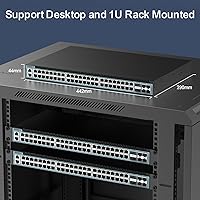
- The 1U form factor keeps rack space consumption to a minimum for dense or space-limited environments.
Cons
- Full management documentation is not included in the box and must be requested directly from the seller after purchase.
- Newcomers to managed switching report a steep learning curve with both the CLI and the web interface.
- Long-term firmware update cadence and ongoing software support from Sodola remain uncertain compared to established brands.
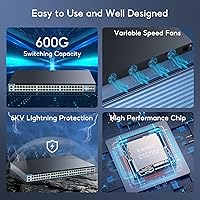
- Fan noise is noticeable enough that multiple buyers have flagged it — a real concern in quiet office or home environments.
- Brand trust and vendor accountability are harder to verify than with Cisco, Juniper, or similar established networking vendors.
- The 40°C upper operating temperature rating offers less thermal headroom than some competing enterprise-class switches.
- No native integration with major network management platforms (such as Cisco DNA or Juniper Mist) is available.
- Replacement hardware and spare parts availability may be limited given the brand's smaller market presence.
Ratings
Our AI rating system analyzed verified global buyer reviews for the Sodola 48-Port 2.5GbE L3 Managed Switch, actively filtering out incentivized, duplicate, and bot-generated submissions to surface what real network engineers and IT professionals actually experienced. Scores reflect both where this managed multi-gig switch genuinely punches above its price tier and where it falls short compared to more established alternatives — nothing is glossed over.
Port Density & Speed
Value for Money
Uplink Flexibility
Layer 3 Feature Set
Ease of Setup
Documentation Quality
Management Interface
Thermal Management
Build Quality
Firmware & Software Support
Throughput Stability
Protocol & Standard Support
Compatibility
Brand Reliability
Suitable for:
The Sodola 48-Port 2.5GbE L3 Managed Switch is built for network builders who've hit the ceiling of gigabit infrastructure and need a practical, cost-conscious path to multi-gig density. Home lab enthusiasts running a mix of NAS boxes, virtualization hosts, and Wi-Fi 6 access points will find the 48-port copper count hard to match at this price tier — each device gets a real 2.5Gbps lane instead of sharing a congested 1GbE uplink. Small and mid-sized businesses deploying modern wireless infrastructure will particularly benefit, since Wi-Fi 6 and 6E access points routinely saturate a standard gigabit port under load. Engineers building hyper-converged clusters or experimenting with overlay networking (VXLAN, MLAG) who want to do it without a six-figure equipment budget will find this switch covers the core requirements. Edge deployments needing a single 1U device to handle both access-layer and lightweight aggregation duties are also a strong fit.
Not suitable for:
Buyers who expect the brand familiarity, ecosystem depth, and long-term support guarantees of Cisco, Juniper, or Aruba should look elsewhere — the Sodola 48-Port 2.5GbE L3 Managed Switch comes from a lesser-known ODM, and firmware longevity beyond the first couple of years is not guaranteed. IT teams in regulated industries where switch vendors must appear on approved vendor lists will almost certainly find this disqualified before it reaches a purchase order. Complete networking novices should also reconsider: the management manual is not shipped with the unit and must be requested separately from the seller, which is a real friction point during initial setup. Anyone expecting plug-and-play simplicity or a polished consumer-grade interface will be disappointed — this is a managed enterprise-class device that rewards patience and prior networking knowledge. Finally, environments with strict thermal or acoustic requirements should account for reported fan noise and a rated upper operating limit of 40°C before committing.
Specifications
- Copper Ports: The switch provides 48 x 2.5GbE BASE-T RJ45 ports, each capable of auto-negotiating down to 1GbE and 100Mbps for backward compatibility with older devices.
- SFP28 Uplinks: Four 25G SFP28 uplink slots are available for high-speed connections to aggregation switches, storage arrays, or spine-layer hardware.
- QSFP+ Uplinks: Two 40G QSFP+ uplink ports provide high-density aggregation capacity suitable for connecting to core switches or high-bandwidth backbone links.
- Switching Layer: The switch operates at Layer 3, supporting full IP routing with up to 56,000 IP routing table entries and up to 112,000 MAC address table entries.
- Overlay Protocols: Supports VXLAN, NVGRE, and GENEVE overlay encapsulation protocols for use in virtualized, multi-tenant, or software-defined network environments.
- Redundancy: MLAG (Multi-Chassis Link Aggregation) is supported, allowing two switches to be paired as a logical unit for active-active link redundancy and higher availability.
- DCB Support: Data Center Bridging features include Priority Flow Control (PFC) and Explicit Congestion Notification (ECN), enabling lossless transport for latency-sensitive workloads.
- SDN Support: An RPC-API interface allows integration with Software Defined Networking controllers, enabling programmatic management of network forwarding behavior.
- OAM Support: Supports IEEE 802.1ag and ITU-T Y.1731 Ethernet OAM standards for end-to-end service monitoring, fault detection, and performance measurement including latency and jitter.
- Management Interfaces: Administrators can manage the switch via web GUI, CLI, Telnet, FTP, SNMP v1/v2/v3, SSH2, and SSL, plus a dedicated out-of-band management port for isolated access.
- Power Consumption: Maximum power draw is rated at 96W, which is notably efficient for a 48-port managed switch in a production rack environment.
- Form Factor: The switch ships in a 1U rack-mount chassis, compatible with standard 19-inch equipment racks.
- Dimensions: Package dimensions measure approximately 21.2 x 16.6 x 5.8 inches, with a unit weight of approximately 4.99 kg (11 lbs).
- Operating Temperature: The rated upper operating temperature limit is 40°C (104°F), which should be factored into rack thermal planning.
- Case Material: The chassis is constructed from metal, providing structural rigidity appropriate for rackmount deployment.
- Flexible Table Mgmt: Flexible Table Management (FTM) technology allows administrators to choose between multiple table size configuration profiles optimized for different network scenarios.
- Manufacturer: The switch is manufactured by Shenzhen Hongyavision Technology Co., Ltd., a Chinese ODM operating under the Sodola brand name.
- In the Box: Each unit ships with the switch itself, one power cord, and a basic user manual; the full management manual must be requested separately from the seller.
Related Reviews
Sodola SL902-SWTG124AS 6-Port 2.5G Managed Switch
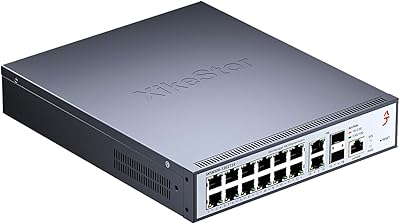
XikeStor SKS8300 16-Port 2.5G L3 Managed Switch
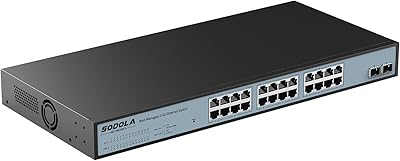
Sodola 24-Port 2.5G Managed Network Switch
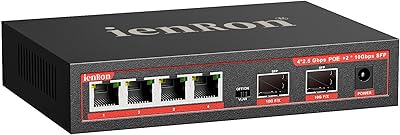
ienRon 6-Port 2.5Gb PoE Switch with 2-Port 10Gb SFP+
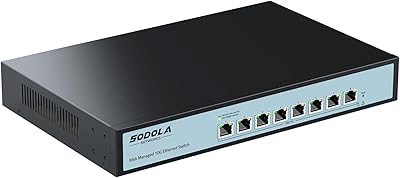
SODOLA 8 Port 10Gb Easy Web Managed Switch
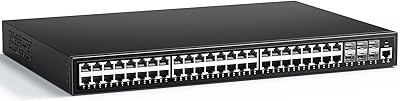
YuanLey YS48060GSM 48-Port Managed Network Switch
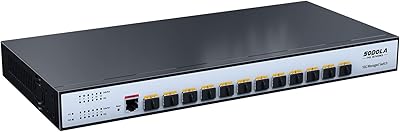
Sodola SL-SWTG3C12F 12-Port 10G SFP+ Managed Switch
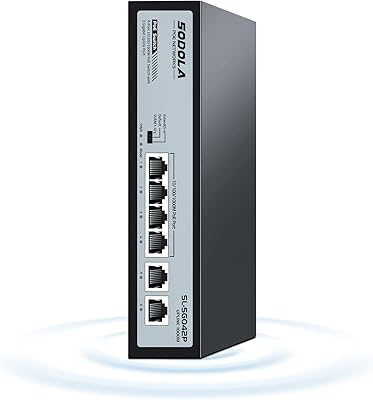
Sodola 4-Port Gigabit PoE Unmanaged Switch
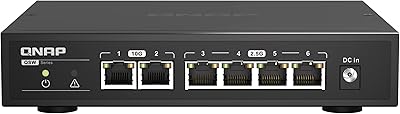
QNAP QSW-2104-2T Unmanaged Network Switch