Overview

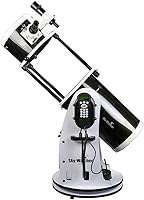
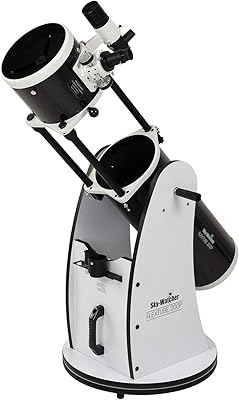
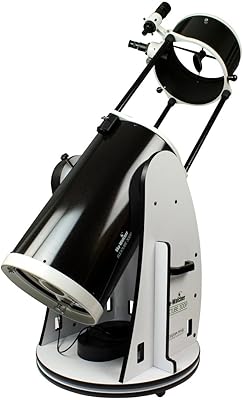
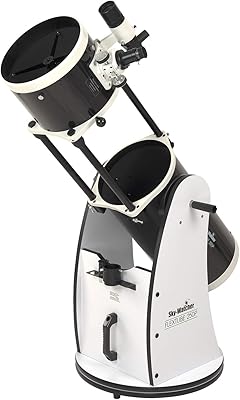
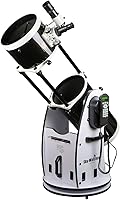
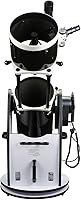
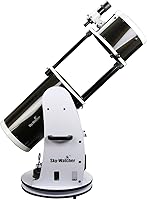
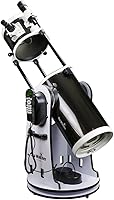
The Sky-Watcher Flextube 250 10-inch Dobsonian Telescope occupies an interesting space in the amateur astronomy market — it takes the traditionally simple Dobsonian design and layers on computerized GoTo technology and built-in WiFi control. That combination sounds almost contradictory at first. Dobsonians earned their reputation by being straightforward: big mirror, simple rocker box, no fuss. This collapsible Dobsonian keeps that aperture advantage but adds automation for observers who want help hunting down targets. The collapsible strut tube shrinks the assembly for transport without disturbing collimation. Be realistic going in: this is a large, heavy instrument best suited for dedicated backyard sessions or planned dark-sky outings.
Features & Benefits

The 10-inch (254mm) aperture is where the Flextube 250 makes its case most convincingly. That much light-gathering capability means visibly brighter images of galaxies, nebulae, and star clusters compared to scopes under 8 inches — details that simply vanish in smaller apertures start to resolve here. The SynScan GoTo system draws from a database of over 42,000 objects, making target-finding practical even for observers unfamiliar with star-hopping. All-metal servo gearing keeps tracking smooth during longer sessions. The 94% reflective borosilicate mirrors are excellent for their class, and the included eyepiece pair covers a solid magnification range. Built-in WiFi lets you drive the whole session from a phone.

Best For

This GoTo Dobsonian makes the most sense for astronomers who have spent time with a manual scope and are ready to step up in both aperture and capability. If you regularly haul a large solid-tube reflector and struggle with transport logistics, the Flextube design offers a real improvement without giving up light-gathering power. It also works well in social observing settings — astronomy club events, family nights, or any situation where finding objects quickly and reliably matters. Deep-sky enthusiasts chasing faint galaxies or globular clusters will get the most from that 10-inch mirror. Prospective buyers should be comfortable with periodic collimation checks, as that is simply part of owning a Newtonian reflector.

User Feedback

With a 3.8 out of 5 rating across 59 owners, the reception for this collapsible Dobsonian is genuinely mixed — and worth unpacking honestly. The most consistent praise centers on the quality of views at dark sites, where owners describe memorable looks at faint nebulae and distant galaxies. The portability improvement over solid-tube designs gets mentioned often too. Criticism, though, lands squarely on the experience of getting there: the SynScan alignment process has a real learning curve, and moving 76 pounds of gear solo is a physical commitment most listings understate. Owners who work through the initial setup frustrations tend to revise their opinions upward, suggesting the lower scores reflect early friction rather than deeper problems.

Pros

  • The 10-inch aperture resolves faint galaxy structure and globular cluster detail that smaller scopes cannot touch.
  • Collapsible strut design fits into a standard SUV, making dark-sky trips genuinely feasible.
  • SynScan GoTo system accurately locates targets when alignment is done carefully, saving real time during sessions.
  • The 94% reflective mirror coating delivers noticeably brighter views compared to standard-coated competitors.
  • Built-in WiFi lets you control the Flextube 250 from a tablet, keeping bright screens away from your dark-adapted eyes.
  • All-metal drive gearing tracks objects smoothly at moderate magnification without the backlash common in cheaper mounts.
  • The 42,000-object database keeps even experienced astronomers discovering new targets for years.
  • Long-term owners consistently report that the GoTo accuracy improves significantly once the alignment routine becomes second nature.
  • The included 25mm and 10mm eyepieces are usable quality, not throwaway plastic, giving you a working start.

Cons

  • The SynScan two-star alignment process is genuinely difficult for first-timers and regularly ruins early observing nights.
  • Weighing 76 pounds across two separate heavy loads, solo transport without a dolly is risky and exhausting.
  • The WiFi connection drops intermittently in cold temperatures, often at the worst possible moment mid-session.
  • Particleboard components in the rocker box feel inconsistent in quality for a scope at this investment level.
  • Official documentation barely addresses alignment troubleshooting, leaving beginners dependent on forums and YouTube.
  • Field rotation from the altazimuth mount makes long-exposure astrophotography completely impractical.
  • The companion smartphone app lags behind modern astronomy app standards and needs meaningful updates.
  • Collimation can shift if even one strut is not fully and evenly seated, and diagnosing the culprit takes experience.
  • A useful nebula filter, a Barlow lens, and a transport dolly are near-essential extras the package does not include.

Ratings

The Sky-Watcher Flextube 250 10-inch Dobsonian Telescope earns a nuanced scorecard here — our AI has processed verified owner reviews from across global markets, filtering out incentivized submissions and outlier bot activity to surface what genuine buyers actually experience. The scores below reflect both the real strengths that keep serious astronomers loyal to this collapsible Dobsonian and the friction points that trip up first-time owners. Nothing has been smoothed over.
Optical Performance
91%
Owners consistently describe views through the Flextube 250 as the clearest they have achieved at this aperture class. On steady nights, the 10-inch mirror resolves structure in galaxies like M51 and pulls globular clusters into tight, sparkling fields that smaller scopes simply cannot match. The 94% reflective mirror coating delivers noticeably brighter images than competitors using standard coatings.
Like all Newtonian reflectors, performance degrades when collimation drifts — and collimation can shift during transport even with the strut design. A handful of owners also note that seeing conditions matter enormously at this aperture, meaning poor atmospheric nights can make the large mirror feel like overkill.
GoTo Accuracy
74%
26%
When the two-star alignment is executed carefully, the SynScan system lands targets reliably within the eyepiece field of view, saving meaningful time during sessions. Owners running public star parties particularly appreciate the ability to call up a specific object quickly without manual star-hopping in front of a crowd.
The altazimuth GoTo mount requires a precise two-star alignment every session, and the process is unforgiving of rushed execution. Several reviewers report that objects land near but not centered in the field of view, requiring a short manual nudge — not a dealbreaker, but worth knowing before expecting push-button perfection.
Portability & Transport
77%
23%
Compared to a traditional solid-tube 10-inch Dobsonian, the collapsible strut design is a meaningful improvement. Owners report fitting the collapsed assembly into a mid-size SUV trunk where a solid tube would have required a roof rack or van. The struts maintain collimation well enough that most observers do not need to re-collimate after a routine car trip.
At 76 pounds, this is still a substantial instrument that most adults cannot safely move solo without a wheeled trolley or a second pair of hands. The base and the collapsed optical tube are two separate heavy lifts, and the assembly process at the observing site takes more time than a simple grab-and-go refractor.
Build Quality
83%
The all-metal gearing on both drive axes feels solid and inspires confidence during automated tracking sessions. The Crayford-style focuser operates smoothly under load and holds position without slipping, which matters when swapping between the included eyepieces at varying angles.
The rocker box and some secondary structural components use painted particleboard rather than machined aluminum, which feels inconsistent given the overall price point. A few owners in humid climates have reported minor swelling at the joints over time, suggesting long-term outdoor storage could become an issue.
SynScan Software & Interface
66%
34%
The 42,000-object database is genuinely extensive and keeps experienced observers busy for years of dedicated sessions. The built-in WiFi integration with Sky-Watcher's app adds a modern convenience layer, letting users plan and execute observing lists from a tablet without fumbling with the hand controller in the dark.
The hand controller menu system feels dated and requires multiple button presses to reach common functions, which becomes frustrating in cold weather with gloves on. The companion app, while functional, has received complaints about connectivity dropouts and a user interface that has not kept pace with modern astronomy app standards.
Initial Setup Experience
51%
49%
Owners who invest time reading the manual and watching setup tutorials report that the alignment process eventually becomes second nature after three or four sessions. Once the routine is learned, experienced users can have the scope aligned and tracking within 20 minutes of arriving at a dark-sky site.
The out-of-box setup experience is where this GoTo Dobsonian loses the most goodwill. Several reviewers describe spending entire first nights troubleshooting alignment errors rather than actually observing. The documentation covers the steps but does not adequately explain why alignment fails, leaving beginners with little recourse beyond online forums.
Included Accessories
72%
28%
The two included wide-angle eyepieces — 25mm for wide-field sweeping and 10mm for higher magnification planetary work — are genuinely usable starting points rather than throwaway pieces. The 9x50 finder scope is large enough to be practical and makes the initial two-star alignment process less tedious.
Observers serious about deep-sky viewing will want to add a higher-quality eyepiece set fairly quickly, as the included pieces do not fully exploit the mirror quality at higher magnifications. A good Barlow lens and a UHC or OIII nebula filter are near-essential additions that the base kit does not include.
Tracking Performance
78%
22%
The dual DC servo motors drive both axes smoothly enough for extended visual observation of planets and deep-sky objects at moderate magnifications. Long-term owners praise the mechanical consistency of the all-metal gearing, noting minimal backlash during direction reversals compared to belt-and-nylon alternatives in this category.
At very high magnifications — above 200x — tracking accuracy becomes noticeably less precise, requiring occasional manual corrections. The altazimuth tracking geometry also produces field rotation over time, which is manageable for visual use but entirely incompatible with serious astrophotography.
Value for Money
69%
31%
For observers who fully utilize the GoTo capability and the 10-inch aperture, the Flextube 250 offers a level of capability that would cost substantially more from competing brands or from piecing together separate components. The mirror quality alone justifies a significant portion of the investment for dedicated visual astronomers.
Buyers who underestimate the learning curve often feel the price is hard to justify when early sessions are dominated by alignment struggles rather than actual observing. The cost also puts it squarely in range of certain equatorial setups that offer astrophotography potential — something this scope cannot realistically provide.
Collimation Stability
76%
24%
The collapsible strut design holds collimation better than many skeptics predict. Owners who transport the scope carefully — keeping it level during loading and unloading — typically report only minor touch-up adjustments needed between sessions rather than a full recollimation.
Any Newtonian reflector will need periodic collimation, and this one is no exception. The strut attachment points can introduce slight misalignment if even one strut is not fully seated, and identifying which strut is the culprit after a night of poor views takes experience that new owners do not yet have.
App & WiFi Connectivity
58%
42%
The concept of controlling a large Dobsonian from a smartphone is genuinely well-executed in favorable conditions. When the WiFi connection is stable, planning and executing an observing list from the app feels modern and practical, particularly for observers who prefer dimming the hand controller to preserve night vision.
Connectivity reliability is a consistent complaint across user reviews. The WiFi signal drops intermittently in cold temperatures, and re-establishing the connection mid-session requires navigating menus by red flashlight — exactly the kind of friction this feature was meant to eliminate. Sky-Watcher's firmware updates have improved but not fully resolved the issue.
Weight & Ergonomics
53%
47%
The split-load design — rocker box and tube assembly as two separate pieces — does make the physical handling more manageable than moving a single 76-pound unit. Owners with dedicated observing spots, such as a backyard pad, report setting up the scope in a fixed location and rarely needing to move it at all.
For anyone without a permanent observing location, the weight is a persistent obstacle. Carrying the rocker box alone requires a firm grip and clear footing, and doing so in darkness on uneven ground is genuinely risky. Several reviewers recommend purchasing an aftermarket dolly as a near-mandatory companion purchase.
Database & Object Coverage
88%
A catalog of over 42,000 objects means that even dedicated observers with years of experience will continue discovering new targets. The database covers Messier objects, NGC entries, double stars, and planetary targets comprehensively, and the ability to sort by object type through the hand controller makes session planning practical rather than tedious.
The database is only as useful as the alignment that precedes it. On nights when the alignment is slightly off, the scope may point consistently away from targets across the board, rendering the large catalog frustrating rather than useful. There is also no built-in suggestion engine for beginners unsure where to start.
Documentation & Learning Resources
48%
52%
The manual covers the mechanical assembly steps clearly, and Sky-Watcher's online support pages offer supplementary diagrams that help during the initial build. Community forums and YouTube tutorials have partially filled the gap, with experienced owners producing genuinely helpful alignment walkthroughs.
The official documentation significantly underestimates how much guidance a new GoTo Dobsonian owner actually needs. Troubleshooting sections are sparse, and the alignment failure scenarios — the situations most likely to ruin a first observing night — are barely addressed. For a product at this investment level, the support materials feel like an afterthought.

Suitable for:

The Sky-Watcher Flextube 250 10-inch Dobsonian Telescope is built for astronomers who have already spent time under the stars with a smaller manual scope and are ready to take a serious step forward in both aperture and capability. If you regularly target faint galaxies, globular clusters, or planetary detail and feel limited by what a 6-inch or 8-inch instrument can resolve, the jump to a 10-inch mirror will feel transformative on a steady night. The collapsible strut design makes this GoTo Dobsonian genuinely practical for observers without a pickup truck or van — a mid-size SUV can handle it where a solid-tube equivalent simply would not fit. Astronomy club members and anyone who hosts public star parties will also find the SynScan GoTo system useful for rapidly slewing to crowd-pleasing targets without fumbling through star charts. Provided you have the patience to master the two-star alignment routine and a helper for transport on field nights, this collapsible Dobsonian rewards dedicated observers richly.
Not suitable for:

The Sky-Watcher Flextube 250 10-inch Dobsonian Telescope is a poor fit for anyone expecting to unbox it, point it at the sky, and start observing within the hour — that experience simply does not exist with this instrument. Complete beginners who have never aligned a computerized mount before should be warned that the SynScan alignment process has a real learning curve, and early frustration is the norm rather than the exception. At 76 pounds split across two heavy loads, it is also impractical for solo observers without strong lifting ability or a wheeled transport solution. Astrophotographers should look elsewhere entirely: the altazimuth mount produces field rotation that makes long-exposure imaging essentially impossible, regardless of the mirror quality. Anyone living in an apartment without a car, or who wants a quick grab-and-go scope for spontaneous observing, will find the Flextube 250 more burden than benefit. Budget-conscious buyers should also factor in the near-essential additions — a quality eyepiece set, a nebula filter, and a transport dolly — that the base kit does not include.

Specifications

  • Aperture: The primary mirror measures 10 inches (254mm) in diameter, providing substantial light-gathering capability for deep-sky visual observation.
  • Optical Design: The telescope uses a Newtonian reflector design, which delivers wide, bright fields of view at a lower cost per aperture inch than refractors or catadioptric designs.
  • Focal Length: The optical tube has a focal length of 1200mm, yielding an f/4.7 focal ratio suited to wide-field deep-sky viewing.
  • Mirror Coating: Both primary and secondary mirrors are fully multi-coated borosilicate glass with 94% reflectivity, optimizing light throughput to the eyepiece.
  • Mount Type: The scope sits on an altazimuth Dobsonian rocker-box mount with motorized GoTo capability driven by dual DC servo motors.
  • GoTo System: The SynScan hand controller provides access to a database of over 42,000 objects including Messier, NGC, IC, double stars, and solar system targets.
  • Drive System: Both altitude and azimuth axes are driven by DC servo motors with all-metal gearing, enabling automated tracking and GoTo slewing.
  • Connectivity: A proprietary built-in WiFi module allows wireless control of the mount and GoTo system via Sky-Watcher's smartphone and tablet application.
  • Tube Design: The optical tube uses a collapsible Flextube strut system that reduces the assembly length for transport while nominally preserving collimation between sessions.
  • Focuser: A 2-inch Crayford-style focuser is fitted as standard, and includes a 1.25-inch adapter for use with smaller-barrel eyepieces and accessories.
  • Eyepieces Included: Two super wide-angle eyepieces are included — a 25mm for low-power wide-field views and a 10mm for higher-magnification planetary and lunar detail.
  • Finder Scope: A 9x50 straight-through optical finder scope is included to assist with initial target acquisition and two-star GoTo alignment.
  • Power Source: The motorized GoTo system is powered by batteries, with no mains power required, making the scope suitable for use at remote dark-sky sites.
  • Assembled Dimensions: When fully assembled, the telescope measures 37 inches deep by 19 inches wide by 19 inches tall in observing configuration.
  • Weight: The complete system weighs 76.2 pounds, typically handled as two separate loads — the rocker base and the collapsed optical tube assembly.
  • Availability: The product was first listed for sale in May 2015 and remains in active production with no discontinuation announced by the manufacturer.

Related Reviews

Sky-Watcher Flextube 200 Dobsonian 8-inch Collapsible Telescope
82%
88%
Ease of Setup
90%
Portability
82%
Optical Performance
85%
Build Quality
83%
Stability during Use
More
Sky-Watcher Flextube 300 SynScan 12-inch Collapsible Dobsonian Telescope
85%
88%
Ease of Setup
91%
Tracking Accuracy
75%
Portability
90%
Build Quality
86%
Wi-Fi Control
More
Sky-Watcher Flextube 250 Dobsonian
86%
94%
Image Quality
88%
Ease of Assembly
81%
Portability
86%
Stability
92%
Optical Aperture Performance
More
Sky-Watcher Heritage 130mm Tabletop Dobsonian Telescope
82%
88%
Optical Performance
91%
Value for Money
89%
Ease of Use
86%
Portability & Storage
79%
Build Quality
More
Sky-Watcher S11550 190mm Maksutov-Newtonian Telescope
83%
94%
Optical Quality
86%
Ease of Use
91%
Build Quality
90%
Focusing Precision
60%
Portability
More
Celestron StarSense Explorer 8″ Dobsonian Telescope
79%
91%
Optical Performance
88%
App Navigation Accuracy
86%
Ease of Use
84%
Build Quality
79%
Value for Money
More
Sky-Watcher Skymax 180mm Maksutov-Cassegrain Telescope
84%
94%
Optical Performance
88%
Ease of Use
76%
Portability
91%
Build Quality
85%
Setup and Installation
More
Sky-Watcher Skymax 127mm Maksutov-Cassegrain Telescope
76%
93%
Optical Clarity
91%
Planetary Performance
84%
Build & Tube Quality
52%
Thermal Equilibration
82%
Portability
More
Sky-Watcher HEQ5 Computerized Equatorial Telescope Mount
85%
94%
Tracking Precision
91%
Build Quality
87%
Ease of Setup
65%
Portability
89%
Payload Capacity
More
Sky-Watcher Skymax 102mm Maksutov-Cassegrain Telescope
76%
93%
Optical Sharpness
88%
Build Quality
91%
Portability
82%
Value for Money
94%
Planetary Performance
More

FAQ

Honestly, it is a stretch for a true beginner. The SynScan GoTo alignment process requires a working understanding of a few bright reference stars and some patience to get right. Most first-time owners report a frustrating initial session or two before the routine clicks. If you are new to astronomy, spending a season on a simpler manual scope first will make the experience of owning this collapsible Dobsonian much more rewarding.

Not in any serious sense, no. The altazimuth Dobsonian mount produces field rotation during long exposures, which creates curved star trails and ruins tracked images. The Flextube 250 is designed purely for visual observation. If astrophotography is your goal, you need an equatorial mount, and that is a fundamentally different category of equipment.

It is manageable once you have done it a few times, but the learning curve is real. You need to identify two moderately bright stars by name, center them precisely in the eyepiece in sequence, and confirm the alignment. Rushing any step compounds the error. Most owners report that by their third or fourth session, the whole process takes around 10 to 15 minutes and works reliably.

Mostly yes, provided you handle the scope carefully during transport. The struts maintain the mirror geometry well enough that many owners only need minor touch-up collimation between outings rather than a full reset. That said, if the scope is jostled heavily in the back of a vehicle, you should always do a collimation check before observing.

The mount runs on eight AA batteries housed in a compartment on the rocker box. Battery life varies depending on temperature and how much the motors are active, but most owners report getting through two to three full observing sessions on a fresh set. Cold nights drain batteries noticeably faster, so keeping a spare set in a warm pocket is a practical habit.

Yes, the built-in WiFi lets you connect to Sky-Watcher's app and control GoTo functions from a smartphone or tablet. In practice, this is convenient for preserving night vision since a phone screen can be dimmed further than the hand controller backlight. However, some owners report intermittent connectivity issues in cold conditions, so keep the hand controller accessible as a backup.

Most owners break the load into two trips: the rocker base first, then the collapsed optical tube. A purpose-built wheeled trolley or furniture dolly makes the process dramatically easier and safer, especially on uneven ground in the dark. A few owners fabricate or purchase custom carry handles for the tube section. Planning your setup area in advance and parking close to your observing spot helps considerably.

Quite a lot. On a good night at a reasonably dark site, the Sky-Watcher Flextube 250 10-inch Dobsonian Telescope will show you structure in nearby galaxies like M31 and M51, resolved stars in globular clusters such as M13, detailed cloud bands on Jupiter, Saturn's rings with the Cassini division visible, and a wide variety of emission and planetary nebulae. Light pollution limits what you can see more than the scope does at this aperture.
With careful handling, most owners recollimate every few sessions rather than every time they set up. A laser collimator or a simple Cheshire eyepiece makes the process quick once you are familiar with it. Reflector collimation sounds intimidating to new owners but becomes routine within a few practice runs — most experienced users can touch up collimation in under five minutes.

A few additions make a meaningful difference in practice. A wheeled transport dolly is close to essential if you move the scope regularly. A UHC or OIII narrowband nebula filter dramatically improves views of emission nebulae, especially under suburban skies. A quality mid-range eyepiece in the 8mm to 12mm range will extract more detail than the stock pieces. A red-dot or Rigel-style reflex finder can also supplement the included straight-through finder for quicker initial pointing.

Where to Buy