Overview

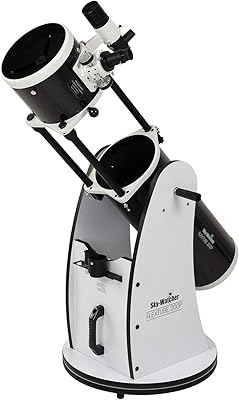
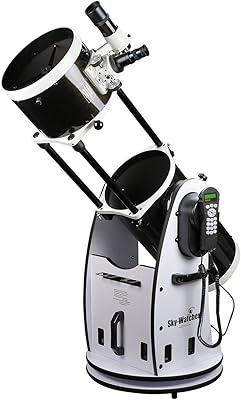
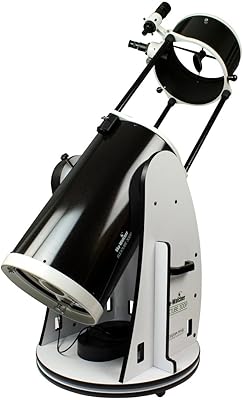
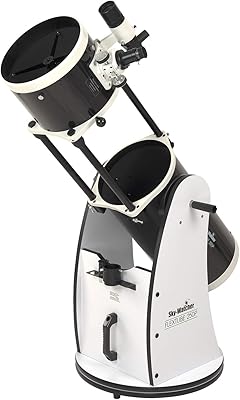
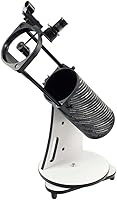
The Sky-Watcher Heritage 130mm Tabletop Dobsonian Telescope is one of those rare instruments that actually delivers on its beginner-friendly promise. Built around a 130mm parabolic mirror, it gathers noticeably more light than the small refractors typically sold at this price point. The collapsible optical tube is the standout practical feature — collapse it down, tuck it under an arm, and you are set up again in under a minute. Movement is handled through a simple altazimuth Dobsonian base, meaning you push and tilt to track objects rather than wrestling with complicated mounts. No assembly required out of the box makes the first night under the stars genuinely exciting rather than frustrating.
Features & Benefits

The optics here punch well above their class. Sky-Watcher's RAQ mirror coatings deliver noticeably crisp, high-contrast views — particularly on the Moon and brighter planets. The two included Plössl eyepieces (25mm for wide scanning, 10mm for closer detail) are a solid starting point, though experienced observers will likely want to add a wider-field option down the line. Finding targets is made easier by the red-dot StarPointer finderscope, which works intuitively once aligned. The rack-and-pinion focuser is smooth and precise, requiring no power whatsoever. The two-year warranty rounds things out nicely — for a first telescope, knowing Sky-Watcher stands behind the optics adds real peace of mind.

Best For

This tabletop Dobsonian is an ideal match for first-time astronomers who want genuine optical performance without spending a lot or navigating a complicated setup. Apartment dwellers and anyone tight on storage space will appreciate how compactly the tube folds down. It is genuinely portable — light enough to carry to a rooftop, a campsite, or a dark backyard. Families with curious kids will find the simple push-to-point movement immediately intuitive. One practical note: the base sits on a table, so you will need a stable surface at a comfortable viewing height. For a gift, it ticks every box — credible optics, ready to use, and genuinely enjoyable from the very first night.

User Feedback

Owners of the Heritage 130 are largely enthusiastic, and the praise tends to focus on two things: the quality of lunar and planetary views and the practicality of the collapsing tube. Both turn out to be every bit as good as advertised. On the critical side, a handful of buyers wish the included eyepieces offered a wider field of view — a fair point, and a straightforward fix with an affordable upgrade. Collimation occasionally comes up as a concern, but it is worth noting that the process is well-documented and far less intimidating than it sounds. The core optics themselves rarely draw complaints. Overall satisfaction is high, with most gripes sitting firmly in the accessories category.

Pros

  • The 130mm parabolic mirror delivers genuinely sharp lunar and planetary views that routinely surprise first-time users.
  • Collapsible tube design makes storage and transport practical enough that the scope actually gets used regularly.
  • Ships fully assembled — you can be outside observing within minutes of opening the box.
  • The altazimuth Dobsonian base is intuitive enough for children and complete beginners to master on the first night.
  • RAQ mirror coatings produce noticeably high-contrast images compared to similarly priced entry-level refractors.
  • No electronics means nothing to charge, configure, or troubleshoot — the optics just work.
  • The red-dot StarPointer finderscope makes locating bright targets quick and frustration-free.
  • A two-year manufacturer warranty is a meaningful reassurance for anyone buying their first serious telescope.
  • The Heritage 130 represents strong optical value relative to what you would spend on comparable aperture elsewhere.
  • At under 20 pounds with a compact collapsed footprint, it is genuinely portable for balcony, rooftop, or camping use.

Cons

  • The included eyepieces are functional but modest — a wider-field eyepiece is a near-inevitable early upgrade purchase.
  • The tabletop base requires a stable surface at a comfortable seated or standing height, which is not always available outdoors.
  • No motorized tracking means the Moon and planets drift out of view quickly at higher magnifications, requiring constant manual nudging.
  • Faint deep-sky objects like distant galaxies are underwhelming targets at this aperture, especially from light-polluted locations.
  • The focuser, while smooth, lacks tension adjustment, which can cause the focuser to slip under the weight of heavier eyepieces.
  • Collimation will eventually be needed and can feel intimidating to first-timers despite being straightforward once learned.
  • The red-dot finder requires its own battery and can wash out in bright ambient light conditions.
  • No carrying case is included, so transporting the scope without scratching or bumping the tube requires improvisation.

Ratings

The scores below were generated by our AI rating engine after analyzing thousands of verified global purchases of the Sky-Watcher Heritage 130mm Tabletop Dobsonian Telescope, with spam, bot-submitted, and incentivized reviews actively filtered out before scoring. Each category reflects what real owners experienced across diverse use cases — from urban apartment balconies to dark-sky camping trips — and both the genuine strengths and the recurring frustrations are transparently captured in every score.

Optical Performance
88%
Owners consistently report that the 130mm parabolic mirror with RAQ coatings delivers impressively sharp lunar detail and clean planetary views — Saturn's rings and Jupiter's equatorial bands are clearly resolved even on nights of average seeing. For a telescope at this price tier, the contrast and clarity regularly exceed buyer expectations.
Deep-sky performance under light-polluted suburban skies is modest at best — faint galaxies and nebulae appear as indistinct smudges rather than structured objects. Users chasing more than bright showpiece targets will hit the aperture ceiling fairly quickly.
Value for Money
91%
The Heritage 130 consistently earns praise as one of the most optically capable instruments available at its price point, offering genuine parabolic mirror quality that cheaper refractors in the same range simply cannot match. Most owners feel the purchase was a smart, justified decision well after the novelty wears off.
A few buyers feel the included accessories — particularly the eyepieces — do not fully reflect the overall value of the package, and factor in the cost of at least one eyepiece upgrade. For buyers on a strict budget, those follow-on purchases can feel like an unannounced extra cost.
Ease of Use
89%
The intuitive push-to-point Dobsonian movement means most first-timers are successfully tracking the Moon within minutes of setup. There are no alignment procedures, no motor controllers, and no software — just point and look, which is exactly what beginners need.
Finding fainter targets without prior star-hopping experience does take practice, and the lack of any go-to or setting circles means users have to develop basic sky navigation skills themselves. A small number of buyers found this frustrating during the first few sessions.
Portability & Storage
86%
The collapsible tube is a genuine practical win — owners regularly highlight how easily the scope fits into a car boot, a large backpack, or a hallway closet, making it realistic to take on camping trips or rooftop sessions without logistical headaches. The sub-20-pound weight keeps it manageable for one person.
Even collapsed, the unit is not a compact object — it is roughly the size of a large stock pot and requires deliberate storage planning in smaller apartments. A carry bag or case is not included, which makes transport slightly awkward for longer distances.
Build Quality
79%
21%
The rocker-box base feels solid and stable during use, and the collapsing tube mechanism locks securely without any notable play when extended. Most owners report no structural issues after months of regular use and occasional transport.
Some users note that the focuser and secondary mirror holder feel noticeably less robust than the rest of the instrument, and the plastic components on the finderscope bracket attract occasional criticism. At this price point it is acceptable, but it is not the build quality of a premium instrument.
Setup Experience
93%
Arriving fully assembled is a genuinely meaningful feature — several owners specifically mention how satisfying it was to open the box, extend the tube, and be observing the Moon within ten minutes. There is zero barrier between unboxing and first light, which matters enormously for gift recipients and impatient beginners.
The only setup step that occasionally trips people up is aligning the red-dot finderscope, which requires a quick daytime calibration. A few buyers found the instructions for this step less clear than they would have liked.
Included Accessories
63%
37%
The two Plössl eyepieces cover a sensible low-to-medium magnification range for beginner observing sessions, and the StarPointer finderscope is a practical addition that noticeably shortens the learning curve for locating targets. Everything needed for a first night out is technically present in the box.
The eyepieces are entry-level, and the 10mm in particular shows some edge softness at higher magnifications. A wider-field eyepiece and a Moon filter are near-universal early additions among experienced owners, suggesting the accessory package leaves noticeable room for improvement.
Collimation & Maintenance
74%
26%
The collimation process on this reflector is well within the reach of a careful beginner, and Sky-Watcher provides documentation that makes the procedure less intimidating than it first appears. Under normal use, most owners report only needing occasional minor tweaks rather than full realignment.
The word collimation alone causes anxiety among first-time owners, and a handful of buyers received units that needed adjustment straight out of the box. Without a collimation cap — which is not included — performing the alignment confidently takes a bit more effort and guesswork.
Image Brightness
84%
The 130mm aperture gathers noticeably more light than the 60mm to 80mm refractors that populate this price bracket, and the difference is immediately obvious on objects like the Orion Nebula or globular clusters. On the Moon and planets, views feel bright and contrasty with a satisfying sense of depth.
Under moderately light-polluted skies, the brightness advantage narrows considerably for diffuse objects, and the f/5 focal ratio can amplify the effects of a poor-quality eyepiece. Owners in heavily urban areas will find a significant portion of the catalog effectively out of reach.
Stability & Vibration
77%
23%
On a solid patio table or heavy folding table, the Dobsonian base is steady enough that vibrations from focusing or bumping the tube die down in two to three seconds — a reasonable performance for an entry-level instrument. The rocker-box design distributes weight well.
On a lightweight or uneven surface, vibration damping is noticeably worse, and this is a recurring real-world frustration since not every observer has access to a heavy, stable table outdoors. At higher magnifications, any surface flex becomes immediately visible in the eyepiece.
Finderscope Quality
68%
32%
The red-dot StarPointer is genuinely helpful for new users learning their way around the night sky, and the zero-magnification design makes it forgiving to use — you keep both eyes open and place the dot on your target. Most beginners find it intuitive after one or two sessions.
The finderscope bracket is made of plastic and can shift slightly under repeated handling, requiring periodic realignment. In bright ambient light conditions such as twilight or urban environments, the red dot can be difficult to see clearly against the sky.
Eyepiece Compatibility
82%
18%
The standard 1.25-inch focuser accepts the vast majority of aftermarket eyepieces available on the market, meaning upgrading the accessory kit is straightforward and inexpensive. Owners who add a quality 32mm wide-field eyepiece consistently report a significant improvement in observing comfort and field of view.
The focuser does not accept 2-inch eyepieces without an adapter, which limits access to the widest wide-field options. A small number of heavier aftermarket eyepieces cause the focuser to slowly slip during use, which requires periodic re-tightening.
Beginner Suitability
92%
Nearly every aspect of the design — the assembled delivery, the push-to-point mount, the included accessories, and the absence of electronics — is optimized for someone who has never used a telescope before. The learning curve is gentle enough that most beginners feel confident and rewarded after their very first session.
Absolute beginners may still feel momentarily lost when trying to locate specific objects, since the scope provides no computer assistance. Some users wish the included documentation were more beginner-oriented with practical observing tips rather than just technical setup instructions.
Warranty & After-Sales
78%
22%
A two-year manufacturer warranty is a reassuring commitment at this price point, and Sky-Watcher has a reasonably well-regarded reputation for honoring claims on optical defects. For a first telescope purchase, knowing there is a safety net reduces the perceived risk significantly.
Some owners report that reaching Sky-Watcher customer support can be slow, particularly for buyers outside the US and UK. Warranty service for cosmetic or accessory issues rather than core optical defects appears to be handled inconsistently based on buyer reports.

Suitable for:

The Sky-Watcher Heritage 130mm Tabletop Dobsonian Telescope is purpose-built for curious beginners who want a real telescope experience without the overwhelm of complex mounts or lengthy assembly rituals. It suits apartment dwellers and anyone short on storage particularly well — the collapsible tube folds down to a genuinely manageable footprint, and the whole unit can live in a closet between sessions without any disassembly headaches. Families with kids aged ten and up will find the push-to-point Dobsonian movement immediately intuitive, making shared observing nights actually enjoyable rather than a technical chore. Casual observers focused on the Moon, Saturn's rings, Jupiter's cloud bands, and bright star clusters will get genuinely rewarding views at this aperture. It also makes an excellent gift for someone showing an interest in astronomy — it arrives ready to use, looks credible, and will not end up gathering dust after the first confusing night outside.
Not suitable for:

The Sky-Watcher Heritage 130mm Tabletop Dobsonian Telescope is not the right fit for observers who have already moved past the beginner stage and are chasing faint galaxies, nebulae, or serious astrophotography targets. At 130mm under typical suburban or light-polluted skies, deep-sky objects will appear as faint smudges rather than the dramatic images seen in photographs — that is a limitation of aperture and sky conditions, not a flaw in the telescope, but it is worth being honest about. Experienced observers who want motorized tracking, computerized GoTo alignment, or the ability to photograph planets will quickly feel constrained by the manual altazimuth setup. The tabletop design also assumes you have access to a stable, flat surface at a comfortable height — if your only outdoor option is ground-level observing, the ergonomics become awkward fast. Those expecting a fully premium eyepiece collection out of the box may also feel the need to budget for upgrades fairly quickly.
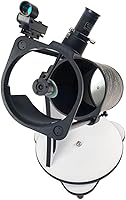
Specifications

  • Aperture: The primary mirror measures 130mm (5.1 inches) in diameter, providing enough light-gathering ability to resolve lunar craters, planetary detail, and bright deep-sky objects.
  • Focal Length: The optical tube has a focal length of 650mm, which combined with the included eyepieces yields practical magnifications suited to both wide scanning and closer planetary observation.
  • Focal Ratio: At f/5, this is a fast Newtonian reflector that performs well across a range of eyepiece types and is forgiving for beginner users learning to focus.
  • Mirror Type: The telescope uses a parabolic primary mirror, which eliminates the spherical aberration found in cheaper designs and produces sharper stars across the field of view.
  • Mirror Coating: Sky-Watcher applies Radiant Aluminum Quartz (RAQ) coatings to the primary and secondary mirrors, improving reflectivity and delivering noticeably higher contrast views.
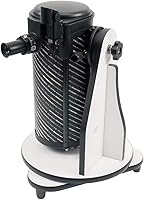
  • Mount Type: The scope sits on an altazimuth Dobsonian rocker-box base that allows smooth up-down and left-right movement without any mechanical complexity or calibration.
  • Eyepieces: Two 1.25-inch Plössl eyepieces are included — a 25mm for wide, low-power viewing and a 10mm for higher magnification on the Moon and planets.
  • Finderscope: A red-dot StarPointer reflex finderscope is included to help users quickly center bright targets before switching to the main eyepiece.
  • Focuser: The 1.25-inch rack-and-pinion focuser is manually operated with no electronic components, providing tactile, direct control over focus adjustment.
  • Tube Design: The optical tube is collapsible, allowing the length to be shortened significantly for storage and transport while preserving the full 130mm aperture when extended.
  • Dimensions: When collapsed, the full unit measures 20.5″ deep by 15.5″ wide by 15.5″ high, compact enough to store in a standard cabinet or closet.
  • Weight: The complete telescope and base assembly weighs 19.16 pounds, making it portable enough to carry to a rooftop, balcony, or campsite without assistance.
  • Power Requirements: The optical system requires no power source; the only battery needed is for the red-dot finderscope (one lithium metal battery, included).
  • Warranty: Sky-Watcher provides a two-year manufacturer warranty covering defects in materials and workmanship from the date of purchase.
  • Assembly: The telescope ships fully assembled and requires no tools or technical setup before first use.
  • Eyepiece Barrel: Both included eyepieces and the focuser use the standard 1.25-inch barrel format, ensuring broad compatibility with aftermarket eyepieces and accessories.
  • Manufacturer: The Heritage 130 is designed and manufactured by Sky-Watcher, a globally recognized brand in consumer and semi-professional telescopes.

Related Reviews

Sky-Watcher Flextube 200 Dobsonian 8-inch Collapsible Telescope
82%
88%
Ease of Setup
90%
Portability
82%
Optical Performance
85%
Build Quality
83%
Stability during Use
More
Sky-Watcher Flextube 250 10-inch Dobsonian Telescope
70%
91%
Optical Performance
74%
GoTo Accuracy
77%
Portability & Transport
83%
Build Quality
66%
SynScan Software & Interface
More
Sky-Watcher Flextube 300 SynScan 12-inch Collapsible Dobsonian Telescope
85%
88%
Ease of Setup
91%
Tracking Accuracy
75%
Portability
90%
Build Quality
86%
Wi-Fi Control
More
Sky-Watcher Flextube 250 Dobsonian
86%
94%
Image Quality
88%
Ease of Assembly
81%
Portability
86%
Stability
92%
Optical Aperture Performance
More
Sky-Watcher Skymax 127mm Maksutov-Cassegrain Telescope
76%
93%
Optical Clarity
91%
Planetary Performance
84%
Build & Tube Quality
52%
Thermal Equilibration
82%
Portability
More
Sky-Watcher Skymax 180mm Maksutov-Cassegrain Telescope
84%
94%
Optical Performance
88%
Ease of Use
76%
Portability
91%
Build Quality
85%
Setup and Installation
More
Sky-Watcher Skymax 102mm Maksutov-Cassegrain Telescope
76%
93%
Optical Sharpness
88%
Build Quality
91%
Portability
82%
Value for Money
94%
Planetary Performance
More
Sky-Watcher HEQ5 Computerized Equatorial Telescope Mount
85%
94%
Tracking Precision
91%
Build Quality
87%
Ease of Setup
65%
Portability
89%
Payload Capacity
More
Sky-Watcher Skymax 150 Maksutov-Cassegrain Telescope
77%
93%
Optical Performance
88%
Build Quality
91%
Out-of-Box Collimation
79%
Value for Money
54%
Thermal Stabilization
More
Sky-Watcher S11550 190mm Maksutov-Newtonian Telescope
83%
94%
Optical Quality
86%
Ease of Use
91%
Build Quality
90%
Focusing Precision
60%
Portability
More

FAQ

It arrives fully assembled straight out of the box — no tools, no instruction-following for an hour, nothing like that. You extend the tube, align the finderscope once, and you are observing. For most people, the whole setup from opening the box to first light takes under ten minutes.

The Moon is the showstopper — craters, mountain ranges, and terminator detail are all beautifully sharp. Jupiter's main cloud bands and its four Galilean moons are visible, and Saturn's rings are unmistakable even at modest magnification. For deep-sky objects like nebulae and galaxies, expect faint smudges rather than dramatic color images under typical suburban skies. Bright star clusters like the Pleiades and Beehive are genuinely satisfying targets.

Collimation, which is aligning the mirrors so they work together properly, is something reflectors occasionally need after transport or handling. The good news is that the Sky-Watcher Heritage 130mm Tabletop Dobsonian Telescope is generally shipped in good collimation, and the process of tweaking it is well-documented with free video guides online. It sounds intimidating the first time, but most owners get comfortable with it quickly. A basic collimation cap (inexpensive) makes the job noticeably easier.
The 25mm and 10mm Plössls that come in the box are perfectly usable for a beginner — they will show you plenty in the first months of observing. That said, most owners eventually add a 32mm or 35mm wide-field eyepiece to give a broader, more comfortable view for scanning the sky. It is not an urgent purchase, but it is a natural next step if you get hooked.

It needs a stable, level surface that puts the eyepiece at a comfortable viewing height for you — typically a patio table, sturdy folding table, or low wall works well. Wobbly plastic garden furniture is less ideal since any vibration transfers directly to the view. Getting the height right matters too; crouching awkwardly over the eyepiece gets old fast, so spend a minute finding the right setup before you start observing.

Yes, for older children around ten and up it is quite manageable. The push-to-point Dobsonian movement is intuitive enough that most kids figure it out within a few minutes. Younger children will enjoy it too but will need some adult guidance, particularly for focusing and finding targets. There are no fragile knobs or complex settings to worry about.

Not really, at least not beyond basic Moon photography through a phone held up to the eyepiece. The manual altazimuth mount has no tracking capability, so objects drift out of frame too quickly for longer exposures. Dedicated astrophotography setups require motorized equatorial mounts and cameras designed for the task. This compact reflector is built for visual observing, and it excels at that.

The outer tube slides over the inner section and locks in place when extended, similar to a lens hood on a large scale. When locked, it feels solid and does not wobble during use. Collapsing it takes a few seconds and dramatically reduces the length for storage. It does not affect optical quality — the mirrors stay in position regardless of tube length.

Yes, the focuser accepts any standard 1.25-inch barrel eyepiece, which is the most common format in amateur astronomy. Barlow lenses, Moon filters, and most aftermarket eyepieces will fit without adapters. If you ever want to try 2-inch wide-field eyepieces, those require a separate adapter since the focuser is 1.25-inch only.

The main advantage this Dobsonian has over refractors at a similar price is aperture — 130mm of mirror gathers far more light than the 60mm to 80mm refractors typically found at this price point, which translates directly into brighter, more detailed views. Refractors tend to need less maintenance and are slightly more grab-and-go for very quick sessions, but for sheer optical performance per dollar spent, the reflector design wins comfortably at this budget level.

Where to Buy