Overview

The SIYEGK BXRadio-1020 Emergency Weather Radio arrived quietly in late 2024, bringing a surprisingly capable feature set for its price tier. SIYEGK is one of several value-focused Chinese electronics brands making a serious push into the emergency preparedness market, and this all-in-one crank radio is their entry into a crowded but growing category. It is not built for hardcore survivalists with demanding performance standards — think of it as a solid starting point for households that want real emergency capability without a large investment. For beginners assembling their first kit, or casual campers wanting peace of mind, it covers the essentials with room to spare.
Features & Benefits

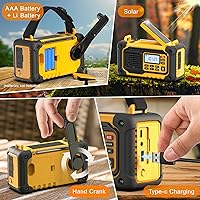
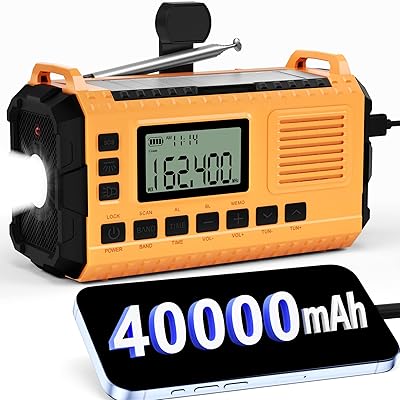
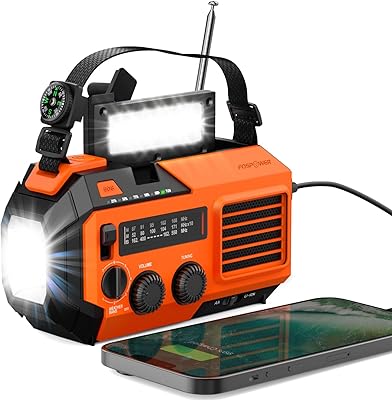
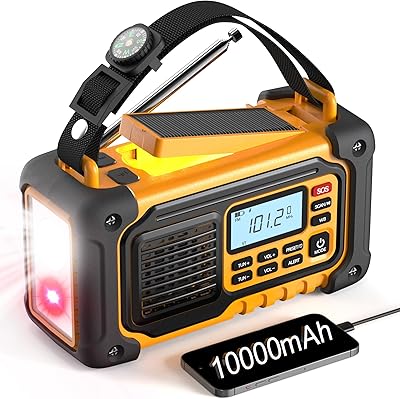
What sets this all-in-one crank radio apart is how many ways it can stay powered. Six charging options — AC adapter, USB input, built-in rechargeable battery, AAA slots, solar panel, and hand crank — means you are rarely without options. The 10,000mAh battery is genuinely large for this class of device. The NOAA standby alert mode is especially practical: the radio monitors emergency broadcasts quietly and wakes itself when a real alert fires, so it does not need to run all night. Bluetooth, a 3.5mm headphone jack, and 7-band reception add daily utility, while the tri-mode flashlight and loud SOS alarm siren extend its usefulness well beyond just radio reception.

Best For

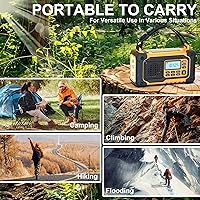
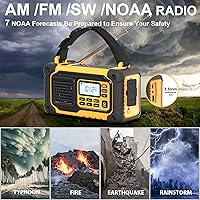
This emergency radio suits households in hurricane, tornado, or flood-prone regions who want an automatic alert system that is simple to operate. It is a strong pick for campers and hikers who need off-grid communication — having both crank and solar as backup charging methods adds real confidence on longer trips. Families wanting an easy-to-grab, bright yellow device with a readable display will find it practical under stress. Budget-conscious buyers who have been delaying building an emergency kit will find the value proposition hard to argue with. That said, those needing professional shortwave performance or military-grade ruggedness should look at higher-end options.

User Feedback

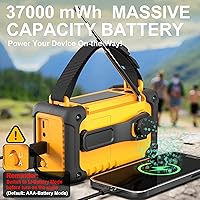
The hand crank weather radio carries a 4.2-star rating, though the review pool was still modest as of early 2025 — so treat that figure as encouraging rather than definitive. Buyers commonly praise the sound quality for the price point, the intuitive controls, and the reassurance of having multiple charging fallbacks. On the negative side, reviewers reliably flag that crank charging is slow — which is true of every device in this category — and that the solar panel functions best as a trickle top-up, not a fast recharge source. One recurring point of confusion worth noting: the product title references 37,000mWh while the specs list 10,000mAh. The two figures are not directly equivalent, and the inconsistency has left some buyers uncertain about actual capacity.

Pros

  • NOAA standby alert mode wakes the radio automatically during emergency broadcasts, so you do not need to leave it running all night.
  • Six charging methods give real flexibility — especially useful when power outages drag on for days.
  • The 10,000mAh built-in battery is genuinely large for a device at this price point.
  • At 1.52 pounds, this all-in-one crank radio feels solid in hand without being burdensome to carry.
  • Tri-mode flashlight adds practical everyday utility, not just emergency signaling.
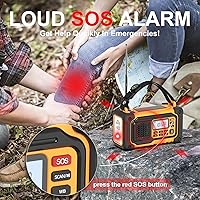
  • The loud SOS siren is a meaningful safety feature that goes beyond what most basic weather radios offer.
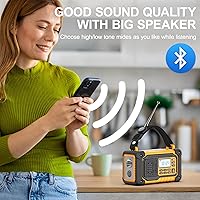
  • Bluetooth connectivity lets it double as a casual speaker during non-emergency use.
  • The bright yellow color and clear LCD display make it easy to locate and operate quickly under stress.
  • 7-band reception including AM, FM, shortwave, and NOAA covers more ground than single-band budget alternatives.
  • The 3.5mm headphone jack allows discreet nighttime listening without waking others.

Cons

  • Hand crank charging is very slow — expect it as a last-resort top-up, not a reliable power source.
  • The solar panel is a trickle charger at best; direct sunlight for extended periods yields modest results.
  • The mAh labeling inconsistency between the product title and specs page has left buyers genuinely confused about real capacity.
  • The brand has a short track record, with limited long-term reliability data available as of early 2025.
  • The review volume is still relatively low, making it harder to assess durability or performance over time.
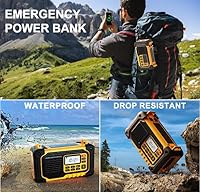
  • IPX3 water resistance handles light rain but offers no protection against submersion or heavy downpours.
  • Shortwave reception quality is adequate for casual use but will not satisfy dedicated SW listeners.
  • No carrying case or belt clip is included, which limits true on-the-go portability for outdoor activities.

Ratings

The scores below reflect AI-assisted analysis of verified global user reviews for the SIYEGK BXRadio-1020 Emergency Weather Radio, with spam, bot-generated, and incentivized feedback actively filtered out before scoring. Each category is evaluated on real-world usage patterns — from storm-season households to weekend campers — so both the strengths and the genuine frustrations are represented honestly. No score has been inflated to flatter the product.

Value for Money
88%
For buyers assembling a first emergency kit on a budget, the sheer number of features packed into this price tier is hard to argue with. Six charging methods, NOAA auto-alerts, a flashlight, Bluetooth, and a 10,000mAh battery in one compact unit would cost considerably more from an established brand. Most reviewers feel they got more than they paid for.
Some buyers feel the mAh labeling discrepancy — 37,000mWh in the title versus 10,000mAh in the specs — chips away at the trust that makes a value purchase feel good. A product at this price point cannot afford to confuse buyers about its core specs without raising broader doubts.
NOAA Alert Performance
83%
The automatic standby alert mode is the standout feature for most buyers. Knowing the radio can sit quietly on a nightstand and wake itself during a genuine weather emergency — without running audio all night — is exactly what storm-season households need. Users in hurricane and tornado zones specifically praise this functionality.
Some users note that NOAA reception quality can vary depending on geographic location and proximity to broadcast towers, which is a limitation of the technology rather than the device alone. A small number of buyers in fringe coverage areas found the auto-scan unreliable.
Charging Versatility
91%
Having six ways to power one device is genuinely reassuring during extended outages, and this all-in-one crank radio earns consistent praise for that redundancy. The ability to fall back on AAA batteries — which are universally available — gives it a meaningful edge over radios that only offer USB or crank options.
The hand crank and solar panel are slow by design and should not be mistaken for fast-charging alternatives. Several buyers expressed frustration after expecting these methods to meaningfully recharge a depleted battery quickly, only to find they are better suited for trickle top-ups during prolonged emergencies.
Battery Life
79%
21%
A 10,000mAh built-in battery is substantial for a device of this size and supports extended listening sessions without needing a recharge. Users running the radio during multi-day storm events report it holding up well across several days of intermittent use at moderate volume.
The advertised 120-hour playtime applies only at low volume levels, and real-world usage at higher volumes or with Bluetooth active cuts that figure significantly. The conflicting mAh figures in the title and product listing also make it harder for buyers to accurately benchmark this radio against competitors.
Build Quality & Durability
72%
28%
At 1.52 pounds, the unit feels reassuringly solid for its price class — not hollow or flimsy. The bright yellow casing is practical rather than cosmetic, and buyers consistently mention that it feels like something that would survive being knocked off a shelf during a stressful emergency situation.
The IPX3 water resistance is adequate for light rain but leaves some buyers wanting more, particularly outdoor users who camp in unpredictable conditions. As a newer product from a less-established brand, there is limited long-term durability data, and a handful of buyers have flagged concerns about button feel and casing seams.
Radio Reception Quality
74%
26%
AM and FM reception perform solidly for a compact emergency radio, and most users in suburban and rural areas report clean tuning without excessive interference. The digital tuning and scan function make finding a station straightforward, which matters when you are operating the device under stress.
Shortwave reception is adequate for casual listening but noticeably below what a dedicated SW receiver delivers, disappointing buyers who expected strong long-distance SW performance. In densely urban environments, some interference was noted on certain FM frequencies.
Flashlight Utility
81%
19%
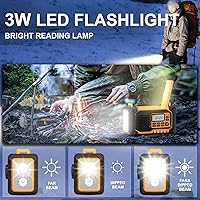
The tri-mode flashlight — standard beam, reading lamp, and SOS strobe — covers the practical bases well. The reading lamp mode in particular has received genuine appreciation from campers and users navigating their homes during blackouts, offering a softer light that is easier on the eyes in the dark.
The flashlight brightness, while useful, does not rival a dedicated torch, and buyers who want high-lumen output for navigation or search tasks may find it underwhelming. The SOS strobe is effective for signaling but serves a niche scenario most users hope never to need.
SOS Alarm
84%
The audible SOS siren is louder than most buyers expect from a device this compact, and hikers and campers treat it as a meaningful safety addition rather than a gimmick. Having both a visual strobe and an audio alarm in one device simplifies what you need to carry into the field.
Accidental activation is an occasional complaint, particularly from users who keep the device in a bag alongside other gear. There is no protective cover or locking mechanism for the SOS button, which is a practical oversight for something with such a startling output.
Ease of Use
86%
The control layout is intuitive enough that most users — including older adults and those unfamiliar with multi-band radios — get comfortable with basic operations quickly. The LCD display clearly shows battery level and frequency, reducing the guesswork that makes some emergency radios frustrating to operate under pressure.
The mode-switching button system can be confusing when toggling between radio, Bluetooth, and alert settings, particularly for first-time users. A few buyers noted the owner's manual could be clearer about how to configure the NOAA standby mode correctly.
Portability
77%
23%
At just over a pound and a half with a footprint small enough to slip into a daypack side pocket, this emergency radio travels well. Its size makes it equally at home in a bedside drawer, a camping bag, or a car glovebox emergency kit without taking up meaningful space.
The absence of a carrying case, wrist strap, or belt clip is a practical gap for outdoor users who want the device accessible without dropping it into a bag. Some buyers noted the smooth plastic casing is slightly slippery and would benefit from rubberized grip panels.
Bluetooth Audio Quality
66%
34%
The Bluetooth speaker function works reliably for casual use — music at a campsite or background audio at home — and pairs without issues to standard smartphones. It extends the device's everyday utility well beyond emergency scenarios, which buyers appreciate given the price paid.
Audio quality is clearly secondary to the radio's core purpose; the speaker sounds thin at higher volumes and lacks bass depth. Buyers comparing it to any dedicated portable Bluetooth speaker will be disappointed, but those treating it as a bonus feature generally find it acceptable.
Display Clarity
78%
22%
The HD LCD display is easy to read in most lighting conditions and shows the information that actually matters — frequency and battery level — without cluttering the screen. In low-light situations, the backlight proves genuinely useful during nighttime operation.
Backlight duration is limited, and a small number of users found the display harder to read in direct bright sunlight during outdoor daytime use. The display does not show signal strength, which would be a useful addition for fine-tuning NOAA reception in fringe areas.
Brand Reliability
61%
39%
For buyers entering the emergency radio category on a budget, SIYEGK offers a credible starting point with a feature set that competes honestly against more recognized names. The initial user feedback is broadly positive, suggesting the product performs as described for most buyers.
SIYEGK lacks the track record of established emergency radio brands, and long-term reliability data is simply not yet available for a product launched in late 2024. Buyers who prioritize brand accountability, warranty support, or service history would be taking a meaningful leap of faith here.
Spec Transparency
53%
47%
The product description covers the key specifications clearly in most areas, giving buyers a reasonable sense of what they are purchasing before committing. The feature list is comprehensive and broadly accurate for the price tier.
The inconsistency between the 37,000mWh figure used in the product title and the 10,000mAh stated in the spec sheet has been a recurring source of buyer frustration and confusion. For a product category where buyers are making preparedness decisions, that kind of labeling ambiguity is a meaningful trust issue that the brand has not adequately addressed.

Suitable for:

The SIYEGK BXRadio-1020 Emergency Weather Radio is an excellent fit for households in storm-prone regions who want a reliable alert system without overcomplicating their emergency preparedness setup. Families assembling their first emergency kit will appreciate that it covers nearly every base — weather alerts, flashlight, SOS signaling, and multiple charging methods — in one affordable, easy-to-use device. Campers, hikers, and anglers will find the combination of hand crank and solar backup genuinely useful when outlets are nowhere near, even if those methods are slower than plugging in. Older adults benefit from the bright yellow casing and large LCD display, which make the device easy to locate and operate under stress. It also works well as a gift for someone you know who keeps putting off building an emergency kit — the low barrier to entry makes it easy to just hand over and feel good about.
Not suitable for:

The SIYEGK BXRadio-1020 Emergency Weather Radio is not the right tool for buyers with serious or professional-grade demands. If you are a dedicated shortwave listener expecting crisp, long-distance SW reception, the performance here will likely disappoint compared to purpose-built shortwave receivers. Survivalists or preppers who depend on their radio as mission-critical gear in extreme conditions will want something with higher build quality, stronger weather sealing beyond IPX3, and a more established brand track record. The mAh discrepancy between the title and the product specs — 37,000mWh versus 10,000mAh — has created legitimate confusion among buyers, and anyone who needs precise capacity transparency for load planning should be aware of that inconsistency. Users expecting the solar panel or hand crank to serve as primary fast-charging sources will be frustrated; both are emergency trickle options, not practical daily drivers.
Specifications

  • Brand: Manufactured by SIYEGK, a value-focused consumer electronics brand.
  • Model: The model number is BXRadio-1020, also listed with the variant code BXRadio-1020-GRN.
  • Dimensions: The unit measures 3.1″ long by 2.3″ wide by 6.4″ tall.
  • Weight: The radio weighs 1.52 pounds, making it practical for both home kits and outdoor carry.
  • Battery Capacity: A built-in rechargeable battery rated at 10,000mAh provides the primary power reserve.
  • Charging Methods: Six charging inputs are supported: AC adapter, DC 5V USB, built-in rechargeable cell, hand crank, solar panel, and three AAA batteries.
  • AAA Batteries: Three AAA batteries are required for the backup battery slot and are included in the box.
  • Radio Bands: Receives seven bands covering AM, FM, shortwave (SW), and NOAA weather broadcast (WB) frequencies.
  • Display: Features an HD LCD screen that shows current tuning frequency and remaining battery level.
  • Bluetooth: Integrated Bluetooth speaker allows wireless audio streaming from a paired mobile device.
  • Headphone Jack: A 3.5mm headphone jack supports private listening without disrupting others nearby.
  • Flashlight Modes: The built-in flashlight operates in three modes: standard light, reading lamp, and SOS strobe.
  • SOS Alarm: A loud audible SOS siren is included to signal distress and attract attention at distance.
  • NOAA Alert: The radio supports automatic NOAA weather scanning with a standby alert mode that activates upon receiving emergency broadcasts.
  • Water Resistance: Rated IPX3, meaning the device can withstand light rain and minor water splashes but is not submersible.
  • Color: Available in Yellow, which aids visibility during emergencies or low-light situations.
  • Connectivity: Connectivity options include Bluetooth and USB, as confirmed in the product specifications.
  • Included Items: Package contents include the radio unit, AAA batteries, and an owner's manual.
  • Availability: First listed for sale on December 30, 2024, making it a recent market entrant as of early 2025.
  • Power Source: Primary power source is solar-assisted and rechargeable, with hand crank and AAA battery fallback options.

Related Reviews
RAOUOEN H27 30000mAh Emergency Weather Radio
68%
83%
Battery Capacity
81%
Value for Money
76%
Radio Reception
44%
Solar Charging
58%
Hand Crank Usability
More
FosPower A6 5200mAh Emergency Weather Radio
77%
91%
NOAA Reception
84%
Build Quality
67%
Power Bank Utility
53%
Hand Crank Efficiency
49%
Solar Charging
More
TFTDOUP Emergency Weather Alert Radio
86%
88%
Overall Performance
85%
Battery Life
90%
Charging Options
80%
Ease of Use
87%
Build Quality
More
Roxicosly CR1009Ultra 12000mAh Emergency Weather Radio
74%
88%
Battery Life
91%
Charging Versatility
86%
NOAA Alert Performance
58%
Hand Crank Durability
44%
Solar Charging Speed
More
QAUYYW Emergency Weather Radio XSY330
86%
89%
Battery Life
85%
Ease of Use
92%
Portability
75%
Radio Reception
88%
Build Quality
More
Sttfaishen F20 Emergency Hand Crank Weather Radio
72%
82%
NOAA Alert Reception
54%
Battery Capacity & Honesty
61%
Hand Crank Usability
57%
Solar Charging Performance
83%
USB-C Charging Speed
More
OnLyee CR1030 Emergency Weather Radio
76%
88%
Power Source Redundancy
83%
Hand Crank Durability
61%
Solar Charging Performance
79%
NOAA Reception Quality
67%
Battery Capacity & Phone Charging
More
AXYEBI AB-US-107Y Emergency Weather Radio
75%
91%
Value for Money
82%
NOAA Signal Reception
88%
Flashlight Performance
63%
Build Quality & Durability
67%
Hand Crank Usability
More
PRUNUS J-369 Emergency Weather Radio
71%
88%
Value for Money
83%
NOAA Reception
91%
Power Versatility
54%
Phone Charging Speed
47%
Hand Crank Efficiency
More
DexScout Crank Emergency Weather Radio 10000mAh
86%
91%
Value for Money
88%
Battery Life and Charging
94%
Portability & Size
85%
Weather Alert Accuracy
90%
Build Quality and Durability
More

FAQ

Yes, that is one of its most practical features. When set to NOAA standby mode, the hand crank weather radio monitors the weather broadcast channel quietly and triggers an alert automatically if an emergency signal is detected — you do not need to leave the volume on all night. It is a genuinely useful setup for sleeping hours during storm season.

Realistically, the hand crank is best thought of as a last resort, not an everyday charging method. A few minutes of cranking will give you enough power for a short burst of listening, but it is slow and physically tiring. Most users rely on USB or AC charging to keep the battery topped up and save the crank for genuine emergencies.

This has understandably confused a number of buyers. The two figures are not directly equivalent — milliwatt-hours and milliamp-hours are different units — but the relationship between them depends on voltage, and the way the title presents that number can feel inflated compared to the spec sheet. The honest answer is that the built-in battery is rated at 10,000mAh, which is still a solid capacity for a device this size, so focus on that figure when comparing against alternatives.

Not quickly. The solar panel on this all-in-one crank radio is designed as a supplemental trickle charger — useful for maintaining battery level during extended outdoor trips with good sun exposure, but not for rapidly recharging a depleted unit. Think of it as a slow top-up option rather than a primary power source.

Its IPX3 rating means it can handle light rain and splashing without damage, which is fine for most outdoor scenarios. However, it is not waterproof in any meaningful submersion sense, so you would not want to drop it in a stream or leave it out in a heavy downpour unprotected. A zip-lock bag is a smart backup layer if you are camping in unpredictable weather.

The Bluetooth speaker function pairs with standard smartphones and tablets and works reasonably well for casual listening. It is a nice convenience feature for everyday use — playing music at a campsite, for example — though the speaker quality is what you would expect from a compact emergency radio, not a dedicated portable speaker.

Generally, yes. The controls are straightforward, and the large LCD display makes it easy to read current settings. The bright yellow color also helps with locating it quickly. There is a small learning curve around the mode-switching buttons, but most users get comfortable within a short time. Keeping the manual handy for the first few uses is a good idea.

For most households, this emergency radio covers the essentials well enough to serve as a primary unit. That said, if you live in a region with frequent severe weather or extended power outages, having a second simpler backup radio — even a basic battery-operated model — is never a bad idea. Redundancy in emergency gear generally pays off.

The SOS alarm is described as audible from a considerable distance, and user feedback generally supports that it is genuinely loud for a device this size. It is a meaningful feature for hiking or camping scenarios where you might need to signal for help. Just be mindful not to trigger it accidentally in populated areas.

Plugging standard wired headphones into the 3.5mm jack reroutes audio away from the built-in speaker, which is useful for listening to late-night weather updates without waking a partner or fellow camper. It supports any standard 3.5mm headphone or earphone. Wireless headphones would need to use the Bluetooth function instead.