Overview

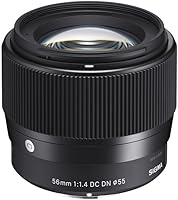
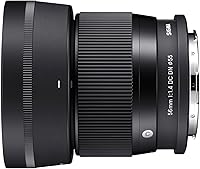
The Sigma 56mm Contemporary Prime Camera Lens is a compact, purpose-built prime for Sony APS-C mirrorless shooters who want serious optical quality without the bulk or cost of a full-frame system. On an APS-C sensor, the 56mm focal length translates to roughly 84mm equivalent — a classic portrait range that flatters subjects and compresses backgrounds naturally. It sits below Sony's own G-series pricing while delivering premium optical performance that punches well above its weight class. It integrates cleanly with Sony's Fast Hybrid AF, including face and eye tracking. Just know going in: this is a specialized portrait prime, not a walk-around lens. If zoom flexibility is your priority, look elsewhere.
Features & Benefits

The f/1.4 maximum aperture is the headline here. It pulls in enough light for dim restaurants or evening shoots without leaning on flash, and the background blur is genuinely pleasing — smooth, without the nervous quality you sometimes get from cheaper fast primes. The STM autofocus motor is near-silent, which matters a lot for video; focus transitions don't bleed into your audio track. Sony's Fast Hybrid AF integration means eye-tracking works reliably across A6400, A6600, and similar bodies. Center sharpness wide open is strong; edges sharpen noticeably by f/2.8. One honest note: there's no weather sealing, so shooting in light rain isn't something you'd want to risk.

Best For

This Sigma prime is an obvious match for portrait and headshot photographers on Sony APS-C bodies — the A6000 series, ZV-E10, A6400, A6600 — who want shallow depth-of-field results without investing in a full-frame kit. Content creators shooting talking-head videos or lifestyle content will appreciate the quiet focus motor. Street photographers get a compact lens that doesn't draw attention. That said, this Sony E-Mount lens has real limits: no optical stabilization means handheld video depends on in-body stabilization, and there's no weather protection for outdoor shooting. It's not the right choice if you need one lens to cover everything — it works best paired with a wider zoom.

User Feedback

Across photography communities, the 56mm f/1.4 earns consistently strong marks for sharpness wide open and reliable eye-tracking on compatible Sony bodies — two things that meaningfully affect daily usability. Most buyers upgrading from Sony's 50mm f/1.8 OSS note they sacrifice optical stabilization but gain noticeably better rendering and a faster aperture. Video shooters specifically praise the STM motor for smooth, audibly quiet focus pulls. On the downside, some users flag occasional focus hunting in very flat, low-contrast scenes — not a dealbreaker, but worth knowing. Build quality is generally well-regarded; mount fit complaints are rare. The broad consensus is that the optical performance justifies the price against Sony's own comparable offerings.

Pros

  • Wide f/1.4 aperture delivers strong background blur and handles low-light situations without needing flash.
  • The STM autofocus motor is near-silent — a genuine advantage for video shooters recording with on-camera audio.
  • Sony Fast Hybrid AF integration means eye-tracking and face detection work reliably on compatible bodies.
  • Center sharpness wide open is impressive for a lens at this price point; stopped down to f/2.8 it is excellent edge to edge.
  • At under 10 ounces, this Sigma prime balances well on compact APS-C bodies without feeling front-heavy.
  • The 56mm focal length (~84mm equivalent) is a natural, flattering range for portrait and headshot work.
  • Build quality feels solid and consistent; mount fit issues are rarely reported across user communities.
  • Priced meaningfully below Sony G-series alternatives while delivering competitive optical performance.
  • Bokeh rendering is smooth and pleasing — not harsh or nervous, even at the widest aperture.
  • Compact enough to carry daily without adding significant weight to a minimalist camera setup.

Cons

  • No weather sealing at all — rain, dust, or high-humidity environments put the lens at genuine risk.
  • No lens-based optical stabilization; handheld video quality depends entirely on whether your body has IBIS.
  • Autofocus can hunt noticeably in flat, low-contrast scenes — not a dealbreaker, but worth planning around.
  • Edge sharpness wide open is softer than the center; portrait shooters who crop heavily may notice this.
  • The 56mm focal length is too tight for indoor group shots, events, or any situation requiring a wider view.
  • Not a practical choice as a single-lens solution — it needs a wider companion lens to cover everyday shooting.
  • Some users report that the plastic construction, while light, does not feel as premium as the image quality suggests.
  • No built-in aperture ring, which limits manual control options for video shooters accustomed to that workflow.

Ratings

Our AI rating system analyzed thousands of verified global user reviews for the Sigma 56mm Contemporary Prime Camera Lens, actively filtering out incentivized, bot-generated, and duplicate submissions to surface what real photographers and videographers actually experience day-to-day. Scores reflect an honest synthesis of both enthusiastic praise and recurring frustrations — nothing is glossed over. Where this lens genuinely excels, the scores show it; where it falls short of buyer expectations, that is reflected just as transparently.

Optical Sharpness
93%
Portrait shooters consistently report that center sharpness at f/1.4 is exceptional — faces and eyes render with fine detail without needing to stop down at all. By f/2.8, sharpness is strong across most of the frame, which exceeds what many users expected from a Contemporary-line lens at this price.
Edge and corner sharpness wide open is noticeably softer, which can be a problem for shooters who regularly place subjects near the frame border. Users who crop heavily or shoot flat subjects like documents or menus at wide apertures will notice the falloff more acutely than portrait photographers.
Bokeh Quality
91%
The nine-blade rounded aperture produces background blur that users consistently describe as smooth and organic — not the harsh, nervous quality seen in some competing fast primes. For headshots against cluttered backgrounds like city streets or indoor environments, the subject isolation at f/1.4 is genuinely striking.
Some users note that specular highlights (small background light sources) can show slight onion-ring structures at certain apertures, which is visible when examined closely in post. This is a minor optical artifact that most viewers would never notice in final prints or social media posts, but pixel-peepers do flag it.
Autofocus Performance
84%
On bodies like the A6400 and A6600 with Sony Fast Hybrid AF, eye and face tracking locks on quickly in normal shooting conditions and holds well even when subjects move laterally across the frame. Portrait and headshot photographers in particular report that the tracking reliability meaningfully reduces the number of missed shots.
In flat or low-contrast scenes — overcast skies, plain white walls, low-light interiors — the autofocus can hunt visibly before locking, which is frustrating during time-sensitive shooting. Older A6000-series bodies without advanced phase-detect coverage also show slower, less confident AF behavior that is more noticeable than on current-generation bodies.
Video AF & Audio
88%
The STM motor is genuinely quiet — users recording talking-head content, vlogs, or documentary footage with on-camera microphones report that focus shifts do not bleed audibly into recordings. Focus transitions during video pulls are smooth rather than jerky, which gives footage a more polished, professional feel without post-production correction.
While smooth and quiet, the autofocus is not the fastest available for video — in scenes with rapidly changing depth or multiple subjects at different distances, it can hesitate before committing to the correct subject. Videographers shooting fast-moving or unpredictable subjects would likely want a more aggressive continuous AF system.
Low-Light Performance
89%
At f/1.4, this Sigma prime pulls in enough light to shoot handheld in dim restaurants, evening events, or indoor ambient-light situations where slower lenses would demand flash or unacceptable ISO increases. Users upgrading from a kit lens frequently describe the low-light capability as one of the most impactful changes they notice immediately.
Without optical image stabilization, handheld shots in very low light still require a shutter speed fast enough to freeze motion, which limits the effective ISO advantage somewhat. Users shooting on bodies without in-body stabilization — like the A6000 or A6100 — feel this limitation most acutely compared to those on IBIS-equipped bodies.
Build Quality
76%
24%
The lens feels solid in hand and mount fit is consistently reported as tight and wobble-free across units. Sigma's build tolerances in the Contemporary line are generally well-regarded, and buyers do not commonly report issues with loose rings, rattling elements, or focus ring stiffness out of the box.
The external construction is primarily plastic, which gives some users pause at this price point — it does not feel as premium as the Sony 50mm f/1.8 OSS in direct comparison. More critically, the complete absence of weather sealing means any moisture exposure is an immediate concern, which undermines confidence for shooters working at outdoor events or in variable conditions.
Portability & Size
92%
At under 10 ounces, this Sony E-Mount lens balances naturally on compact APS-C bodies without creating the nose-heavy feel that plagues larger third-party lenses. Users who carry their camera all day — street photographers, travel shooters using it as a secondary lens — appreciate that it adds almost no perceptible fatigue.
The compact size does mean the focus ring is relatively narrow, which some manual focus users find fiddly when making precise adjustments. Those coming from larger lenses may also find the physical size deceptively small and take some time adjusting to the handling ergonomics.
Value for Money
86%
Buyers consistently conclude that the optical performance — particularly sharpness and bokeh at f/1.4 — justifies the asking price when measured against Sony's own comparable E-Mount primes. Compared to the Sony 50mm f/1.8 OSS, most users feel the 56mm f/1.4 offers a meaningfully stronger optical result for a price difference that feels reasonable.
For buyers who need weather sealing or optical stabilization, the effective value drops considerably — you are paying a premium price for a lens that lacks features some competitors include. Shooters on tight budgets who discover they also need to invest in a wider companion lens may find the total system cost adds up faster than expected.
Eye & Face Tracking
87%
On supported Sony bodies, real-time eye AF works reliably and meaningfully reduces the cognitive load of portrait shooting — users report being able to focus on expression and composition rather than monitoring focus confirmation. The accuracy on sharp eyes is excellent in decent light, making it a genuine productivity tool for portrait workflows.
Performance drops noticeably with glasses, partial face occlusion, or subjects looking away from the camera, which can result in the system jumping to an unintended focus point. Eye AF behavior also varies significantly depending on which Sony body is paired with the lens — older bodies offer a degraded version of the experience.
Chromatic Aberration
78%
22%
Lateral chromatic aberration is well-controlled for a fast prime and is largely invisible in typical portrait use cases. Most modern Sony bodies and popular editing software handle any residual fringing automatically, meaning the majority of users never encounter it as a visible problem in their finished images.
Longitudinal chromatic aberration (color fringing in out-of-focus areas) is present wide open, particularly noticeable in high-contrast edges near the focus plane — a green or purple fringe on hair against bright backgrounds is a common example. Stopping down to f/2 or beyond reduces it substantially, but it requires awareness when shooting wide open.
Vignetting
72%
28%
Vignetting at f/1.4 is moderate and falls within the expected range for a fast prime of this design — most portrait photographers consider it a natural, aesthetically pleasing effect that draws attention to the center subject. In-camera lens correction on Sony bodies addresses it automatically when enabled, eliminating it for users who prefer a clean, even exposure.
Users who shoot architecture, product photography, or any content requiring even illumination across the full frame will find the corner fall-off at wide apertures problematic without correction. Shooting in RAW with correction disabled reveals more vignetting than some buyers expect at this price tier.
Distortion
83%
Barrel distortion is minimal at this focal length, which is expected from a portrait-range prime and generally confirmed by users. Straight lines at the edges of the frame remain acceptably straight for environmental portrait work, and in-camera correction handles any residual distortion cleanly.
Without lens correction applied, some slight barrel distortion is measurable, which matters more to architectural or product photographers than to portrait shooters. Users relying on JPEG output with correction disabled may notice this more than RAW shooters who apply profiles in post.
Compatibility Range
69%
31%
The lens covers the full current Sony APS-C E-Mount lineup cleanly, from older A6000-series bodies to newer ZV-E10 and A6700 models, without any reported electronic incompatibilities. Sigma has maintained firmware update support, and users report no issues with menu control or EXIF data transmission.
The lens is strictly limited to Sony E-Mount APS-C use as a practical proposition — it offers no meaningful benefit on full-frame bodies and has no adapter path to other systems. Photographers considering a future system switch or full-frame upgrade would need to replace it entirely, which limits its long-term versatility as an investment.

Suitable for:

The Sigma 56mm Contemporary Prime Camera Lens is purpose-built for Sony APS-C mirrorless shooters who have a clear, defined photographic focus — particularly portrait, headshot, and people photography. On an APS-C body, the 56mm focal length lands at roughly 84mm equivalent, which is a flattering, natural compression range for faces and upper-body shots. Portrait photographers who want genuine background separation at f/1.4 without jumping to a full-frame system will find this lens delivers results that genuinely justify the investment. Content creators and vloggers shooting talking-head or lifestyle video will appreciate the STM motor, which keeps focus transitions quiet enough that on-camera audio stays clean. Sony APS-C users on bodies like the A6400, A6600, or ZV-E10 who are ready to move past kit lens quality — and want full eye-tracking and face-detection support — will find this Sigma prime integrates tightly with their existing system.

Not suitable for:

The Sigma 56mm Contemporary Prime Camera Lens is a poor fit for photographers who need one versatile lens to cover a wide range of focal lengths — this is a specialist tool, not a do-everything solution. Travel photographers or documentary shooters who regularly work in unpredictable weather should look elsewhere, since there is no weather sealing of any kind; even light rain is a risk. Shooters who rely on optical image stabilization for handheld video or low-shutter-speed stills will need to depend entirely on in-body stabilization, which varies considerably across Sony's APS-C lineup. If you are primarily a landscape, architecture, or wide-angle photographer, the 56mm field of view is simply too tight to be practical as a primary lens. Anyone considering this lens for sports or fast-action subjects should also temper expectations — while autofocus is solid in good light, it can hunt in low-contrast or low-light edge cases where a faster, more specialized telephoto would serve better.
Specifications

  • Focal Length: Fixed 56mm focal length, equivalent to approximately 84mm on an APS-C sensor.
  • Max Aperture: Maximum aperture of f/1.4 enables strong background separation and low-light shooting without flash.
  • Lens Mount: Designed exclusively for Sony E-Mount mirrorless cameras; not compatible with A-Mount or other systems.
  • Format Coverage: Optimized for APS-C sensor format; will mount on full-frame E-Mount bodies but is not designed for that format.
  • Autofocus Type: Stepping motor (STM) system delivers near-silent, smooth focus transitions suited for both stills and video.
  • AF System Support: Fully compatible with Sony Fast Hybrid AF, including real-time eye tracking and face detection on supported bodies.
  • Angle of View: 28.5 degrees angle of view on APS-C sensor format.
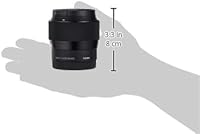
  • Weight: 9.8 ounces (approximately 280g), keeping the balance neutral on compact Sony mirrorless bodies.
  • Dimensions: Measures 2.34 inches in length and 2.62 inches in diameter, making it one of the more compact fast primes in its class.
  • Weather Sealing: No weather or dust sealing of any kind; use in rain, dusty, or high-humidity environments is not recommended.
  • Stabilization: No lens-based optical image stabilization; stabilization relies entirely on in-body systems if the camera body supports it.
  • Lens Family: Part of Sigma's Contemporary line, which prioritizes a balance of optical performance, portability, and value over the Art line's maximum optical correction.
  • Aperture Blades: Nine rounded aperture blades contribute to smooth, circular bokeh at wider aperture settings.
  • Filter Thread: 55mm front filter thread for attaching polarizing, ND, or UV filters.
  • Closest Focus: Minimum focusing distance of approximately 19.7 inches (50cm), suitable for environmental portraits but not macro work.
  • Manufacturer: Produced by Sigma Corporation of America, a well-established Japanese optical manufacturer with decades of third-party lens experience.
  • Model Number: Official model number is 351965, as designated by Sigma for retail and service identification.
  • Availability: First made available in November 2018 and remains an active, non-discontinued product in Sigma's current lineup.

Related Reviews
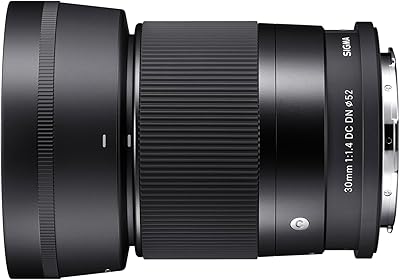
Sigma 30mm F1.4 DC DN Mirrorless Lens
84%
93%
Optical Sharpness
91%
Bokeh Quality
74%
Autofocus Performance
89%
Low-Light Capability
71%
Build Quality
More
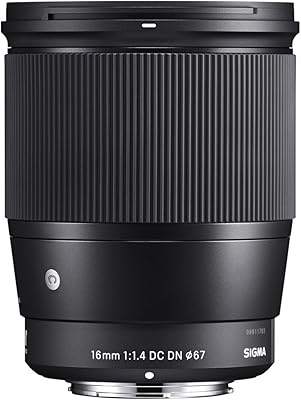
Sigma 16mm f/1.4 DC DN Wide-Angle Lens
80%
93%
Optical Sharpness
91%
Low-Light Performance
88%
Autofocus Reliability
84%
Build Quality
92%
Value for Money
More
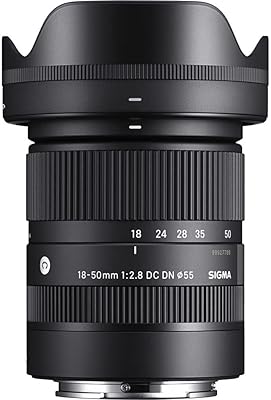
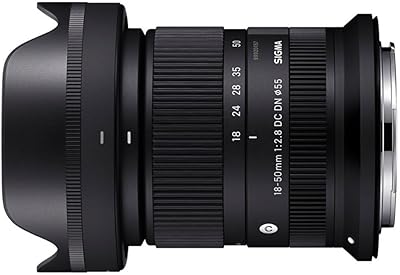
Sigma 18-50mm F2.8 DC DN Zoom Lens
84%
88%
Optical Sharpness
91%
Autofocus Performance
74%
Build Quality & Handling
86%
Value for Money
93%
Portability & Size
More
Sigma 18-50mm F2.8 DC DN Zoom Lens
81%
88%
Autofocus Performance
83%
Optical Sharpness
81%
Build Quality
94%
Size & Portability
86%
Low-Light Performance
More
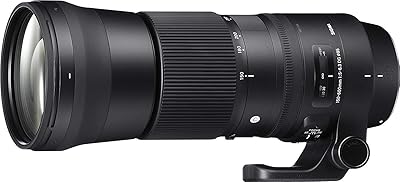
Sigma 150-600mm Contemporary Telephoto Zoom Lens
76%
83%
Autofocus Speed
76%
Image Sharpness
81%
Build Quality
74%
Weather Sealing
82%
Optical Stabilization
More
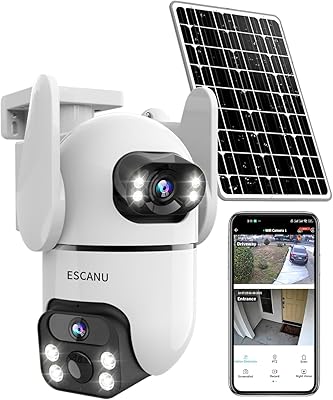
ESCANU QG8 Dual Lens Security Camera
86%
88%
Video Quality
93%
Ease of Setup
85%
Night Vision
72%
Motion Detection Accuracy
89%
Build Quality
More
Camcamp BC1018 8-Channel POE Security Camera System
78%
88%
Image Clarity
83%
Night Vision Performance
74%
PTZ Auto-Tracking
61%
Installation Experience
59%
Mobile App & Remote Access
More
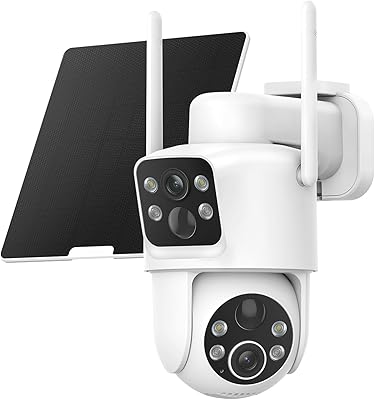
TKENPRO Dual Lens Solar Security Camera
76%
91%
Ease of Installation
88%
Dual-Lens Coverage
83%
Video Clarity (2K Resolution)
74%
Night Vision Performance
79%
Solar Charging Reliability
More
Nikon D3100 18-55mm VR Kit
74%
88%
Image Quality
91%
Ease of Use for Beginners
74%
Autofocus Performance
67%
Video Quality
78%
Build Quality & Ergonomics
More
Nikon D5200
Nikon D5200
76%
91%
Image Quality
78%
Autofocus Performance
84%
Build Quality & Ergonomics
88%
Articulating LCD Screen
69%
Video Capability
More

FAQ

Yes, the lens mounts and shoots on both bodies. However, real-time eye tracking is limited to Sony bodies that support it natively — the A6100 has basic eye AF, but the A6000 does not. Autofocus will still work well on older bodies; you just won't get the more advanced tracking features.

Physically, yes — it will mount and fire. But the 56mm f/1.4 is designed for APS-C sensors, so on a full-frame body you will need to shoot in APS-C crop mode to avoid heavy vignetting. Most full-frame Sony shooters are better served by a native full-frame lens for their system.

Quite well in most real-world conditions. The STM motor is quiet enough that it rarely bleeds into on-camera audio, and focus transitions are smooth rather than abrupt. Where it can struggle is in very flat, low-contrast scenes — don't expect it to lock instantly in near-darkness. For standard indoor or outdoor video work, though, it performs reliably.

It depends on your priorities. The Sony 50mm f/1.8 OSS has optical stabilization, which is useful for handheld video on bodies without IBIS. The Sigma, however, is a full stop faster at f/1.4, produces noticeably better bokeh rendering, and is generally considered sharper wide open. If you shoot mostly stills or have a body with IBIS, the Sigma is the stronger optical choice.

Yes. On compatible Sony APS-C bodies — particularly the A6400, A6600, and ZV-E10 — the lens communicates fully with Sony's Fast Hybrid AF system, including real-time eye and face detection. It is one of the reasons this lens is so practical for portrait work without a heavy manual focus workflow.

Center sharpness at f/1.4 is genuinely impressive — faces and eyes in a portrait frame come out crisp without needing to stop down. Edge sharpness is softer wide open, which is completely normal for fast primes at this price point. If you routinely shoot subjects positioned at the far edges of the frame, stopping down to f/2 or f/2.8 brings a noticeable improvement.

No — there is no weather or dust sealing on this lens at all. Even light rain carries a real risk of moisture ingress. If you regularly shoot in unpredictable outdoor conditions, you will want to look at weather-sealed alternatives or take precautions like a rain sleeve.

The minimum focusing distance is around 19.7 inches, or about 50cm. That is fine for tight headshots and half-body portraits, but it is not suitable for close-up or macro photography. If you need to fill the frame with small objects, this is not the right tool.

Surprisingly well-balanced. At under 10 ounces, it does not create the front-heavy feel you sometimes get with larger third-party lenses on compact bodies. The size and weight are well-matched to the smaller Sony APS-C form factor, making it comfortable to carry and shoot with for extended periods.

As of the time of writing, Sigma has not discontinued this lens — it remains an active part of their Contemporary lineup for Sony E-Mount. Given its consistent popularity and strong sales ranking, there is no indication it is being phased out in the near term.