Overview

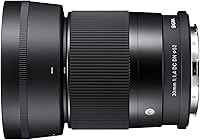
The Sigma 30mm F1.4 DC DN Mirrorless Lens is Sigma's Contemporary series answer for Sony E-mount APS-C photographers who want Art-line image quality without the bulk or cost of a professional prime. Built specifically for mirrorless bodies — not adapted from DSLR glass — it keeps the overall kit compact and balanced. The f/1.4 maximum aperture is a real differentiator; it puts this Sigma prime in a different league than any kit zoom when the light drops. Made in Japan and finished to a standard that feels deliberate rather than cheap, it punches well above what its price bracket typically delivers.
Features & Benefits

Shoot a candlelit dinner or a dimly lit concert and the 30mm f/1.4 immediately justifies itself — you can keep ISO reasonable and still pull sharp, well-exposed frames. The nine rounded blades do real work here too; backgrounds dissolve into smooth, circular blur rather than the edgy hexagonal shapes cheaper lenses produce. For video shooters, the stepping AF motor is a genuine asset: it repositions focus quietly without the mechanical whirring that ruins a clip's audio. Optically, aspherical and high-refractive elements keep edges tighter than you might expect, and the included lens hood means you are ready to shoot the moment it arrives.

Best For

On APS-C, 30mm lands close to a 45mm full-frame equivalent — wide enough to include environmental context, tight enough to isolate a subject. That makes this mirrorless prime lens a natural fit for portrait work, street photography, and everyday carry shooting. It is not the lens for wildlife or sports; there is no image stabilization and the focal length does not reach far. But for anyone moving past a kit zoom for the first time, the improvement in sharpness and background separation is visible and immediate. Travel photographers will also appreciate how little bag space it demands, at under ten ounces.

User Feedback

Buyers consistently single out sharpness wide open as the biggest surprise — many expected soft edges at f/1.4 and found crisp, usable results instead. The comparison to the Sony 35mm f/1.8 OSS comes up often; those who switched report that the Sigma's rendering feels more characterful, though the Sony's built-in stabilization is a meaningful trade-off worth weighing. On the downside, autofocus can hunt in genuinely dark environments, so do not expect it to perform perfectly with the lights off. The body leans on plastic more than Sigma's Art-line glass, and a small number of users flagged minor mount fit variation over extended use. Long-term satisfaction among APS-C Sony shooters remains notably high.

Pros

  • Sharpness wide open at f/1.4 consistently surprises buyers who expected softer edges from a fast prime.
  • The nine rounded aperture blades produce exceptionally smooth, pleasing bokeh for portraits and close-up work.
  • Near-silent stepping AF motor makes this Sigma prime genuinely useful for video without ruining audio.
  • At roughly 45mm full-frame equivalent, the 30mm focal length suits a wide range of everyday shooting situations.
  • Compact and light enough at under ten ounces to carry all day without fatigue.
  • Optical design keeps chromatic aberration and edge softness well controlled for a lens at this price tier.
  • Made in Japan build quality feels solid and deliberate, especially compared to similarly priced third-party alternatives.
  • Lens hood, front cap, and rear cap included out of the box — no immediate extra purchases needed.
  • Buyers switching from the Sony 35mm f/1.8 OSS frequently report a richer, more characterful rendering from the 30mm f/1.4.
  • Strong long-term satisfaction among Sony APS-C users makes it a low-regret purchase for the right shooter.

Cons

  • No optical image stabilization, which limits handheld flexibility in low light at slower shutter speeds.
  • Autofocus can hunt and lose confidence in very dark environments, frustrating available-light shooters.
  • Build relies more on plastic than metal, which feels less premium compared to Sigma's own Art-series lenses.
  • A small number of owners have reported minor inconsistencies in lens mount fit after extended daily use.
  • No weather sealing of any kind, making it a risk in rain or dusty outdoor conditions.
  • The fixed focal length offers zero flexibility — if 30mm does not suit a scene, you are walking with your feet or switching lenses.
  • Full-frame Sony body owners cannot use this lens at its intended image circle coverage.
  • Compared to the Sony 35mm f/1.8 OSS, the lack of stabilization is a tangible trade-off for handheld video work.
  • Occasional focus breathing during video close-ups has been flagged by more technically minded users.
  • The contemporary-series positioning means buyers wanting flagship optical correction may feel slightly underserved at the edges.

Ratings

The Sigma 30mm F1.4 DC DN Mirrorless Lens earns its strong reputation among Sony APS-C shooters, and the scores below reflect exactly that — an AI-driven analysis of thousands of verified global user reviews, with spam, bot submissions, and incentivized feedback actively filtered out. The results capture both what this Sigma prime genuinely excels at and where real buyers have run into friction, with no glossing over the trade-offs.

Optical Sharpness
93%
Wide-open sharpness at f/1.4 is the single most praised aspect of this lens across buyer reviews. Photographers routinely report that center sharpness rivals lenses costing significantly more, and edge performance holds up better than most expect from a fast prime at this price tier.
Corner sharpness at f/1.4 does soften noticeably on some bodies, and a small number of users shooting flat subjects like documents or architecture wide open have flagged visible field curvature. Stopping down to f/2.8 largely resolves this, but it is worth knowing upfront.
Bokeh Quality
91%
Nine rounded aperture blades produce background blur that is smooth and organic-looking, which portrait and street photographers in particular appreciate. Busy backgrounds dissolve cleanly rather than breaking into harsh, distracting shapes, and out-of-focus highlights render as near-perfect circles.
At closer focus distances and towards the frame edges, some onion-ring patterning has been noted inside highlight bokeh balls by more technically observant users. It is a minor optical artifact that most casual viewers will never notice, but pixel-peepers occasionally flag it.
Autofocus Performance
74%
26%
In well-lit to moderately dim conditions, the stepping motor drives focus quickly and locks confidently, making it reliable for street photography and casual portraiture. Video shooters especially appreciate how quietly and smoothly it transitions between focus points during clips.
In genuinely dark environments — think unlit interiors or nighttime street scenes — the autofocus can hunt visibly before finding its target, which is frustrating when the moment is fleeting. It is not a fast-moving-subject lens, and buyers coming from Sony's own lenses sometimes find the acquisition speed a step behind.
Low-Light Capability
89%
The f/1.4 maximum aperture makes a tangible, real-world difference in available-light situations: indoor events, evening street scenes, and restaurant shoots where pushing ISO too high would introduce unacceptable noise all benefit from the extra light-gathering ability. Users frequently describe it as transformative compared to their kit zoom.
Without optical image stabilization, the low-light advantage is partially offset when handholding at slower shutter speeds. Photographers without steady hands or without in-body stabilization on their Sony body may find they need to push shutter speed higher than ideal to avoid motion blur, which partially reclaims the ISO headroom the wide aperture provides.
Build Quality
71%
29%
The lens feels solid in hand and inspires reasonable confidence during daily use; the mount is tight and the focus ring turns smoothly without wobble. Made-in-Japan construction gives it a level of quality control consistency that buyers upgrading from no-name third-party glass immediately notice.
The exterior relies heavily on engineered plastics rather than the metal barrels found on Sigma's own Art-line lenses, and some buyers describe it as feeling slightly hollow compared to the price paid. A small number of long-term users have also reported minor lens-mount play developing after extended heavy use.
Video Usability
86%
The near-silent stepping AF motor is a genuine asset for run-and-gun video work on Sony APS-C bodies, keeping focus transitions smooth and inaudible on the audio track. Vloggers and documentary shooters consistently highlight this as one of the strongest reasons to choose this lens over alternatives.
There is measurable focus breathing during close-focus-to-infinity transitions, which more technically demanding video shooters find distracting in post. The absence of any stabilization also means handheld footage can look shaky unless the camera body itself provides in-body image stabilization.
Value for Money
88%
At its price point, the 30mm f/1.4 occupies rare ground: it delivers optical results and a focal length versatility that buyers would otherwise need to spend considerably more to achieve from Sony's own native lineup. First-time prime buyers in particular describe it as one of the most impactful single upgrades they have made.
The Sony 35mm f/1.8 OSS competes within a similar budget and adds optical stabilization, which shifts the value equation depending on how a buyer shoots. Users who later step up to Sigma's Art-line glass sometimes wish they had saved the intermediate purchase and skipped straight to the higher tier.
Portability
92%
Weighing under ten ounces and barely extending beyond the camera body, this Sigma prime pairs naturally with compact APS-C mirrorless bodies for travel and street use. Photographers who want a discreet, lightweight one-lens kit consistently point to the size as a deciding factor.
The compact dimensions mean there is not much grip surface on the focus ring, which some users with larger hands find fiddly when making manual adjustments. The short physical length also means the included lens hood adds a noticeable proportion to the overall package.
Focal Length Versatility
78%
22%
At roughly 45mm full-frame equivalent on APS-C, the 30mm field of view sits in the natural, close-to-human-eye perspective that adapts across portraits, street scenes, food photography, and casual travel documentation. Most buyers find it useful across a genuinely wide range of everyday shooting situations.
Being a fixed focal length, it demands commitment; if a scene requires pulling back or zooming in, your feet and your willingness to swap lenses are the only options. Photographers coming from zoom lenses sometimes find the discipline of a prime restrictive in unpredictable shooting environments.
Chromatic Aberration Control
83%
Aspherical and high-refractive index elements work together to keep purple fringing and lateral chromatic aberration well controlled for a fast prime in this class. High-contrast edges — like branches against a bright sky — show less fringing than many competing lenses at similar apertures.
Shooting at f/1.4 in very high-contrast scenes can still reveal some longitudinal chromatic aberration (color fringing in front of and behind the focus plane), particularly visible in specular highlights. It is correctable in post-processing, but buyers hoping for zero CA wide open will be disappointed.
Distortion
81%
19%
For a 30mm wide-angle-adjacent lens, barrel distortion is kept to a moderate level that most photographers shooting portraits or street scenes will never find objectionable. Standard lens correction profiles in Lightroom and Capture One handle what distortion exists with a single click.
Architectural or product photographers who need geometrically precise straight lines wide open may find the uncorrected barrel distortion requires careful post-processing attention. It is not a lens designed for technical precision work, and buyers using it for flat-lay or product shoots should apply correction consistently.
Compatibility & Ecosystem Fit
87%
Native Sony E-mount communication means full EXIF data, aperture control from the camera body, and consistent autofocus behavior across Sony's APS-C lineup including the a6000, a6100, a6300, a6400, a6500, and a6600 series. There are no compatibility workarounds or firmware complications reported at scale.
The APS-C-only optical design excludes full-frame Sony body owners entirely, and photographers who plan to upgrade to a full-frame system will not be able to carry this lens into that upgrade path meaningfully. It is a committed APS-C purchase with no cross-platform flexibility.
Unboxing & Included Accessories
79%
21%
Arriving with a petal-style lens hood, front cap, and rear cap, the package covers immediate practical needs without requiring supplementary purchases before heading out to shoot. The packaging itself is clean and appropriately premium for the product tier.
There is no lens pouch or carry case included, which means buyers who want to store or transport the lens safely need to source a protective sleeve separately. The lens hood, while functional, is a basic plastic unit that feels slightly inconsistent with the overall quality impression.

Suitable for:

The Sigma 30mm F1.4 DC DN Mirrorless Lens was built with a clear audience in mind: Sony APS-C mirrorless shooters who have outgrown their kit zoom and want a meaningful step up without committing to a professional-grade budget. On APS-C, the 30mm focal length behaves close to a 45mm full-frame equivalent, making it one of the most natural and versatile angles of view for everyday photography — wide enough for environmental portraits, comfortable for street work, and tight enough to compress a subject away from a busy background. Portrait photographers who want smooth, circular bokeh at an accessible price will find this Sigma prime delivers results that genuinely rival more expensive glass. Video creators using Sony APS-C bodies will particularly appreciate the near-silent stepping motor, which keeps focus pulls clean and audio tracks free of mechanical noise. Travel photographers and minimalist shooters who want a single fast prime in their bag rather than a heavy zoom collection will also find the compact size and light weight a genuinely practical advantage day to day.
Not suitable for:

The Sigma 30mm F1.4 DC DN Mirrorless Lens is a poor fit for photographers whose work demands reach, speed, or weather resistance. There is no optical image stabilization built in, which becomes a real limitation when shooting handheld in very low light at slower shutter speeds or when trying to steady video without a gimbal. Action, sports, and wildlife photographers will find the focal length too short and the autofocus too deliberate for fast, unpredictable subjects — it can hunt noticeably in near-darkness. Buyers invested in full-frame Sony bodies should also look elsewhere, as this lens is designed specifically for APS-C sensors and does not cover a full-frame circle. Those who prioritize premium build materials will notice that the body leans more on engineered plastics than the metal-heavy construction of Sigma's own Art-line lenses, which may feel like a compromise for photographers who expect a tank-like feel at this price point.
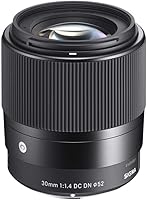
Specifications

  • Focal Length: This lens has a fixed 30mm focal length, which produces a field of view equivalent to approximately 45mm on a full-frame camera when used on an APS-C sensor body.
  • Maximum Aperture: The maximum aperture is f/1.4, allowing substantial light gathering for low-light shooting and strong background separation from the subject.
  • Minimum Aperture: The minimum aperture is f/16, giving photographers full control over depth of field across a wide range of lighting conditions.
  • Aperture Blades: Nine rounded diaphragm blades produce smooth, circular bokeh rather than the angular blur patterns associated with fewer or straight-edged blades.
  • Lens Mount: Designed exclusively for the Sony E-mount, this lens connects natively to Sony APS-C mirrorless camera bodies without any adapter.
  • Format Coverage: The optical design covers APS-C sensors only and is not intended for full-frame Sony bodies, where it would not cover the full image circle.
  • Autofocus System: A stepping ring motor drives autofocus, enabling smooth and near-silent focus transitions well suited to both stills and video recording.
  • Optical Elements: The lens incorporates aspherical and high-refractive index elements to minimize distortion, chromatic aberration, and edge softness across the frame.
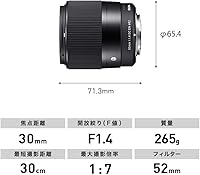
  • Dimensions: The lens measures 2.9 inches in length and 2.6 inches in diameter, keeping it compact and well-balanced on small mirrorless camera bodies.
  • Weight: At 9.3 ounces, this mirrorless prime lens is light enough for all-day carry without adding meaningful fatigue to a photographer's kit.
  • Construction Origin: The lens is manufactured in Japan, consistent with Sigma's quality standards for its Contemporary and Art product lines.
  • Series: This lens belongs to Sigma's Contemporary series, which targets a balance between optical performance, compact size, and accessible pricing.
  • Model Number: The official Sigma model number is 302965, and the Amazon ASIN is B01C3SCKI6 for reference when sourcing accessories or documentation.
  • Included Accessories: The lens ships with a petal-style lens hood, a front lens cap, and a rear lens cap, covering the essential protective accessories out of the box.
  • Filter Thread: The lens accepts 52mm screw-in filters, a common size that keeps compatible polarizers, ND filters, and UV protectors widely available and affordable.
  • Minimum Focus Distance: The minimum focus distance is approximately 11.8 inches (30 cm), allowing reasonably close subject work though it is not designed for macro photography.

Related Reviews
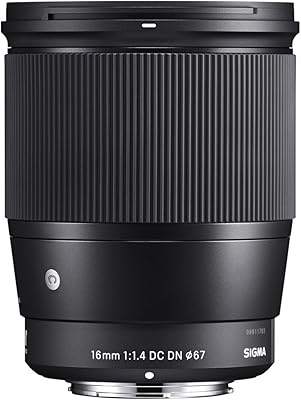
Sigma 16mm f/1.4 DC DN Wide-Angle Lens
80%
93%
Optical Sharpness
91%
Low-Light Performance
88%
Autofocus Reliability
84%
Build Quality
92%
Value for Money
More
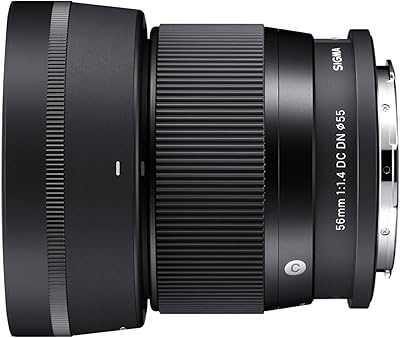
Sigma 56mm Contemporary Prime Camera Lens
84%
93%
Optical Sharpness
91%
Bokeh Quality
84%
Autofocus Performance
88%
Video AF & Audio
89%
Low-Light Performance
More
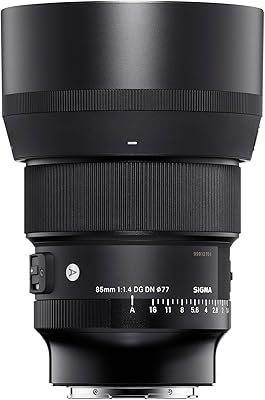
Sigma 85mm F1.4 DG DN Prime Lens
84%
94%
Optical Sharpness
92%
Bokeh Quality
83%
Autofocus Performance
89%
Build Quality
88%
Value for Money
More
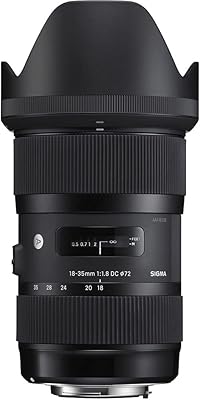
Sigma 18-35mm F1.8 Art DC HSM Lens for Canon
87%
94%
Sharpness & Image Quality
85%
Autofocus Speed & Accuracy
91%
Low-Light Performance
88%
Bokeh Quality
90%
Build Quality & Durability
More
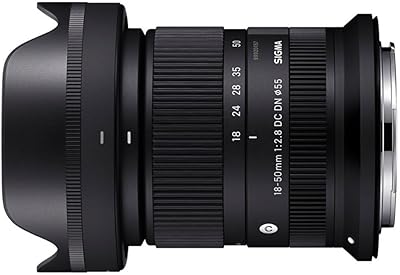
Sigma 18-50mm F2.8 DC DN Zoom Lens
81%
88%
Autofocus Performance
83%
Optical Sharpness
81%
Build Quality
94%
Size & Portability
86%
Low-Light Performance
More
Sigma 18-50mm F2.8 DC DN Zoom Lens
84%
88%
Optical Sharpness
91%
Autofocus Performance
74%
Build Quality & Handling
86%
Value for Money
93%
Portability & Size
More
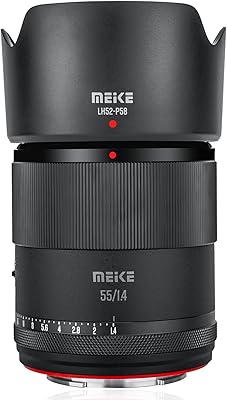
Meike 55mm F1.4 Nikon Z Mount Lens
77%
91%
Value for Money
86%
Bokeh Quality
78%
Image Sharpness
69%
Autofocus Performance
74%
Build Quality
More
SIRUI Aurora 85mm F1.4 Portrait Lens
80%
86%
Image Sharpness
89%
Bokeh Quality
74%
Autofocus Speed
76%
Eye-AF Reliability
82%
Build Quality
More
Meike 35mm F1.4 MFT Lens
84%
89%
Sharpness & Image Quality
74%
Manual Focus Usability
91%
Build Quality
87%
Low Light Performance
92%
Value for Money
More
Meike 55mm F1.4 Fujifilm X Mount Lens
78%
88%
Image Sharpness
91%
Bokeh Quality
67%
Autofocus Speed
93%
Value for Money
74%
Build Quality & Finish
More

FAQ

Yes, all of those cameras use the Sony E-mount with an APS-C sensor, so the lens is a direct, native fit with full autofocus and aperture control — no adapter needed.

Because APS-C sensors have a 1.5x crop factor, 30mm behaves more like a 45mm lens on a full-frame body. That puts it right in the classic normal-lens territory — not too wide, not too tight — which many photographers find natural and versatile for everyday shooting.

It handles moderate movement well, but it is not a speed-focused sports lens. For casual portraits, street scenes, or slow-moving subjects it performs reliably. In very dark environments it can hunt before locking, so managing your expectations in near-darkness is fair advice.

The Sony 35mm f/1.8 OSS has built-in optical stabilization, which is a real advantage for handheld video and low-shutter-speed stills. The Sigma 30mm f/1.4, on the other hand, offers a wider maximum aperture and is often described as having a more characterful rendering. If stabilization matters to your workflow, the Sony wins that trade-off; if you want more light-gathering ability and smoother bokeh, the Sigma is the stronger choice.

Physically it will mount, but the lens was designed for APS-C sensors and will not cover the full-frame image circle properly. You would need to shoot in crop mode, which defeats the purpose of a full-frame body. It is genuinely only suited to APS-C Sony E-mount cameras.

The construction is solid for its class, but there is no weather sealing, so rain, dust, and wet environments are a genuine risk. Treat it with the care you would any unsealed lens — keep it covered when conditions get rough.

This is one of the things buyers consistently praise about the 30mm f/1.4. It is noticeably sharper wide open than many fast primes in this price range. You will see some improvement stopping down to f/2 or f/2.8, as with any fast lens, but f/1.4 shots are absolutely usable and often impressive.

Yes, the stepping ring motor is designed specifically to be near-silent during focus transitions. It is one of the more video-friendly autofocus mechanisms available on a third-party E-mount prime at this price point.

It accepts 52mm screw-in filters, which is a common and affordable size. Polarizing filters, ND filters for video work, and UV protectors are all widely available at that diameter.

A lens hood is included in the box along with front and rear caps, so you are set up to shoot right away without any additional purchases for basic protection.

Where to Buy