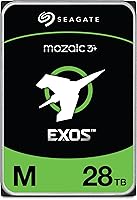
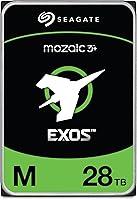
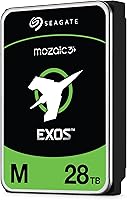
Seagate Exos M 28TB Internal Hard Drive





Overview
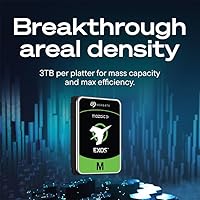
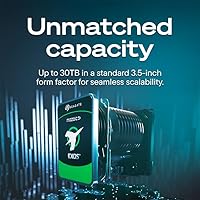
The Seagate Exos M 28TB Internal Hard Drive represents something genuinely rare: enterprise-class storage technology now accessible outside the data center. At its core is Mozaic 3+, Seagate's heat-assisted magnetic recording platform that achieves 3TB per platter — a density milestone that makes 28TB possible in a standard 3.5-inch chassis. To put that in perspective, you're looking at enough space for roughly 5,600 hours of 1080p video, or a complete archive for a small creative studio. Released in June 2025, it ranks among the highest-density SATA drives shipping today. That said, it's engineered for always-on workloads, not casual desktop use.
Features & Benefits
The Mozaic 3+ platform is doing a lot of heavy lifting here. By using heat-assisted magnetic recording, Seagate writes data to much smaller magnetic grains, achieving platter density that would have seemed implausible just a few years ago. The 6Gb/s SATA interface paired with a 7200RPM spindle delivers consistent sequential throughput that NAS and server workloads actually need. The 2.5 million hour MTBF rating sounds abstract, but it translates to years of uninterrupted operation under real enterprise conditions. Power draw is also surprisingly lean — up to 60% lower than comparable 10TB-era drives — which matters when running multiple units inside a populated enclosure.
Best For
This 28TB enterprise drive is built squarely for people who take storage seriously. Home lab builders running TrueNAS, Unraid, or similar platforms will appreciate the enterprise firmware, which includes rotational vibration compensation — a feature consumer drives routinely skip. Content creators managing massive raw footage archives and media server operators with large Plex or Jellyfin libraries will find the capacity genuinely useful rather than aspirational. Small businesses needing a single high-density backup target without a wall of drives will also be well-served. Where this high-capacity HDD falls short: gaming rigs, casual desktops, or any scenario where price-per-TB is the deciding factor.
User Feedback
With over 1,200 ratings and a 4.3-star average, the Exos M 28TB lands in solid territory — strong enough for a confident purchase, with enough caveats to warrant careful reading. Buyers consistently praise how cleanly the drive is recognized in NAS enclosures and how quietly it runs during sustained workloads. Heat in dense arrays is the most frequently raised concern; multi-drive setups in compact enclosures can push temperatures higher than some owners expected. A handful of reviewers noted more spin-up noise than anticipated during the initial break-in period. The price premium over consumer alternatives comes up often, though enterprise-focused users generally consider the reliability tradeoff worthwhile.
Pros
- 28TB in a single 3.5-inch drive eliminates the need to populate multiple bays for high-density storage builds.
- Mozaic 3+ HAMR technology delivers a genuine areal density leap, not just incremental capacity padding.
- A 2.5 million hour MTBF rating puts this drive in a different reliability class than most consumer alternatives.
- Rotational vibration sensors in the firmware help sustain performance in multi-drive NAS enclosures.
- Power draw is significantly lower than older high-capacity drives, which matters in always-on deployments.
- Drive recognition in TrueNAS, Unraid, and major NAS platforms has been consistently smooth for most buyers.
- Quiet operation during sustained sequential workloads makes it livable in home or small office environments.
- Standard SATA interface means no new controllers or cabling — drops into existing infrastructure without friction.
- 4.3 stars across over 1,200 ratings reflects broad real-world satisfaction from a demanding user base.
Cons
- The price premium over consumer NAS drives is steep and hard to justify for light or intermittent workloads.
- Heat output in densely populated enclosures has surprised some buyers — airflow planning is not optional.
- Audible spin-up noise during the initial break-in period has caught some users off guard.
- Workload rate limits mean sustained heavy writes beyond the rated threshold can impact long-term drive health.
- Overkill for anyone whose storage needs top out well below the 28TB ceiling — capacity goes underutilized.
- Not designed for random-read-heavy workloads, so desktop and gaming performance expectations will be unmet.
- Enterprise positioning means fewer consumer-friendly warranty touchpoints compared to IronWolf or WD Red lines.
- A small subset of buyers reported inconsistent firmware behavior in older RAID controllers or aging NAS units.
Ratings
Our editorial team fed thousands of verified global reviews for the Seagate Exos M 28TB Internal Hard Drive through our AI scoring engine, which actively filters out incentivized, bot-generated, and outlier feedback before calculating each category score. The result is a balanced, data-grounded set of scorecards that reflect both what real buyers genuinely praised and where they ran into friction — no spin, no cherry-picking.
Storage Capacity
Reliability & Longevity
Sequential Throughput
NAS Compatibility
Value for Money
Noise & Vibration
Thermal Management
Power Efficiency
Firmware & SMART Reporting
Packaging & Delivery Condition
Setup & Installation
Write Endurance
Brand Reputation & Support
Suitable for:
The Seagate Exos M 28TB Internal Hard Drive is purpose-built for anyone who runs serious storage infrastructure at home or in a small business setting and refuses to compromise on reliability. Home lab operators using TrueNAS, Unraid, or similar platforms will feel right at home with its enterprise firmware, particularly the rotational vibration compensation that keeps performance stable in multi-drive enclosures. Content creators — videographers, photographers, or audio engineers — who are drowning in raw project files will appreciate consolidating what used to require a shelf of drives into a single bay. Media server enthusiasts building out large Plex or Jellyfin libraries, as well as small businesses needing a dense, dependable local backup target, are also natural fits. If you prioritize uptime and longevity over squeezing every cent out of the cost-per-terabyte equation, this drive rewards that mindset.
Not suitable for:
Buyers who just need extra storage for a gaming PC or general desktop should look elsewhere — the Seagate Exos M 28TB Internal Hard Drive carries an enterprise price tag that makes little sense outside always-on, workload-heavy environments. It is not optimized for the kind of bursty, random-read-heavy patterns that desktop and gaming use typically demand, and the cost premium is hard to justify when consumer NAS drives can handle lighter workloads for less. Anyone on a tight budget who is comparison-shopping purely on price-per-terabyte will find more economical options in Seagate's own IronWolf or WD's Red lineup. Users in compact or poorly ventilated enclosures should also think carefully, as this high-capacity HDD runs warmer than consumer alternatives and requires adequate airflow to operate reliably over the long term. If your storage needs are modest or intermittent, the investment simply does not make practical sense.
Specifications
- Capacity: This drive offers 28TB of formatted storage in a single unit, one of the highest capacities available in the 3.5-inch SATA form factor as of mid-2025.
- Form Factor: Built to the industry-standard 3.5-inch form factor, making it physically compatible with the vast majority of desktop server chassis, NAS enclosures, and RAID arrays.
- Interface: Uses a SATA 6Gb/s interface, the same connector standard found in nearly all modern motherboards and NAS enclosures, requiring no special controllers or adapters.
- Spindle Speed: The platters spin at 7200RPM, which supports the kind of sustained sequential read and write throughput that enterprise and prosumer NAS workloads demand.
- Recording Tech: Seagate's Mozaic 3+ platform uses heat-assisted magnetic recording (HAMR) to achieve up to 3TB of data per platter, enabling the 28TB total capacity.
- Areal Density: Achieves up to 3TB per platter, a density milestone that allows more storage in the same physical chassis footprint compared to conventional magnetic recording drives.
- Reliability (MTBF): Rated at 2.5 million hours mean time between failures, reflecting the drive's design for continuous, always-on operation in enterprise-class environments.
- Power Efficiency: Consumes up to 60% less power compared to 10TB-class drives from previous generations, reducing energy costs in multi-drive always-on deployments.
- Vibration Control: Includes rotational vibration (RV) sensors and compensation firmware, which help maintain stable performance when multiple drives are running simultaneously in close proximity.
- Dimensions: Packaged at 8.82 x 6.06 x 3.03 inches and weighing 1.72 pounds, consistent with standard 3.5-inch drive sizing used across enterprise and prosumer hardware.
- Model Number: The official Seagate part number is ST28000NM003K, which should be referenced when checking NAS compatibility lists or purchasing replacement units.
- Manufacturer: Designed and manufactured by Seagate Technology, a long-established storage hardware company with deep roots in enterprise HDD development.
- Release Date: The drive became commercially available in June 2025, making it one of the most recently released high-capacity SATA HDDs on the market at the time of this review.
- Workload Rating: Engineered for enterprise-class workload rates, meaning it is rated to handle far higher annual data throughput than typical consumer or prosumer NAS drives.
- User Rating: Holds a 4.3 out of 5 star average across more than 1,200 verified ratings on Amazon, reflecting broadly positive reception from a technically demanding buyer base.
Related Reviews
Seagate Exos 1TB Internal Hard Drive
Seagate Exos X10 10TB Internal Hard Drive
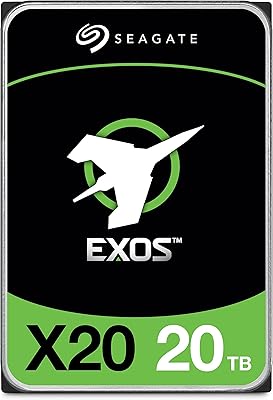
Seagate Exos X20 20TB Recertified Hard Drive
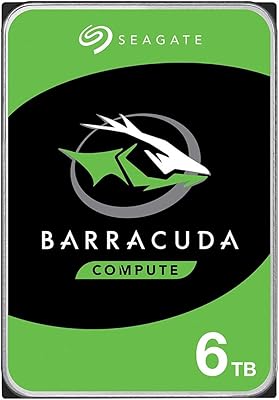
Seagate Barracuda 6TB Internal Hard Drive
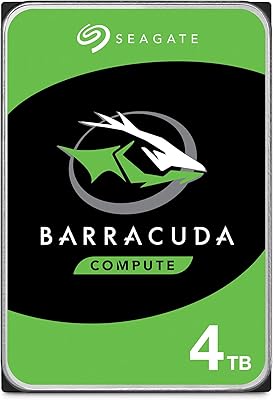
Seagate BarraCuda 4TB Internal Hard Drive
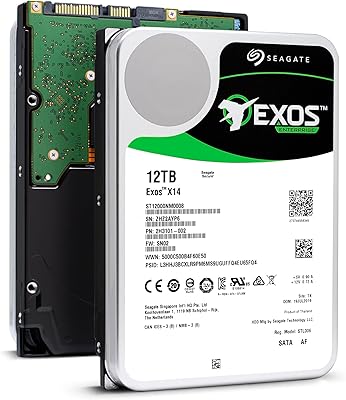
Seagate Exos X14 12TB Hard Drive
Seagate BarraCuda ST8000DM004 8TB Internal Hard Drive
Seagate Exos 7E10 4TB Internal Hard Drive
Seagate BarraCuda 2TB Internal Hard Drive